Google Maps switches to Hanyu Pinyin for Taiwan (sloppily)

Until very recently, Google Maps gave street names in Taiwan in Tongyong Pinyin — most of the time, at least. This was the case even for Taipei, which most definitely has long used Hanyu Pinyin, not Tongyong Pinyin. The romanization on Google Maps was really a hodgepodge in the maps of Taiwan. And it’s still kind of a mess; but now it’s at least more consistent — and more consistent in Hanyu Pinyin.

First the good. In Google Maps:

  • Hanyu Pinyin, not Tongyong Pinyin, is now used for street names throughout Taiwan
  • Tone marks are indicated. (Previous maps with Tongyong did not indicate tones.)

Now the bad, and unfortunately there’s a lot of it and it’s very bad indeed:

  • The Hanyu Pinyin is given as Bro Ken Syl La Bles. (Terrible! Also, this is a new style for Google Maps. Street names in Tongyong were styled properly: e.g., Minsheng, not Min Sheng.)
  • The names of MRT stations remain incorrectly presented. For example, what is referred to in all MRT stations and on all MRT maps as “NTU Hospital” is instead referred to in broken Pinyin as “Tái Dà Yī Yuàn” (in proper Pinyin this would be Tái-Dà Yīyuàn); and “Xindian City Hall” (or “Office” — bleah) is marked as Xīn Diàn Shì Gōng Suǒ (in proper Pinyin: “Xīndiàn Shìgōngsuǒ” or perhaps “Xīndiàn Shì Gōngsuǒ“). Most but not all MRT stations were already this incorrect way (in Hanyu Pinyin rather than Tongyong) in Google Maps.
  • Errors in romanization point to sloppy conversions. For example, an MRT station in Banqiao is labeled Xīn Bù rather than as Xīnpǔ. (埔 is one of those many Chinese characters with multiple Mandarin pronunciations.)
  • Tongyong Pinyin is still used in the names of most cities and townships (e.g., Banciao, not Banqiao).

Screenshot from earlier this evening, showing that Tongyong Pinyin is still being used in Google Maps for some city and district names (e.g., Gueishan, Sinjhuang, Banciao, Jhonghe, Sindian, and Jhongjheng rather than Hanyu Pinyin’s Guishan, Xinzhuang, Banqiao, Zhonghe, Xindian, and Zhongzheng, respectively).
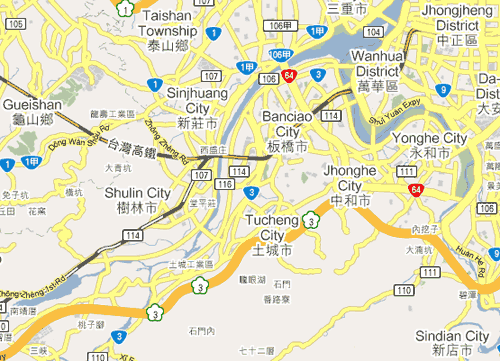
map of Taipei area, with names as shown above

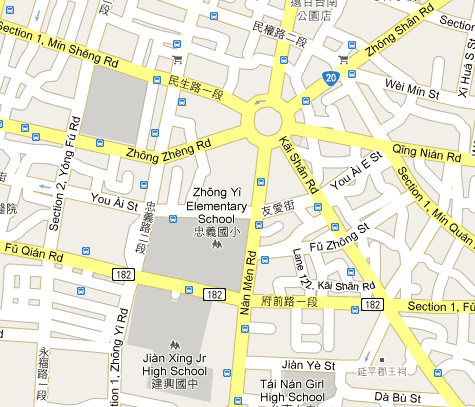
I don’t have any old screenshots of my own available at the moment, so for now I’ll refer you to an image that Fili used in an old post of his. Compare that with this screenshot I took a few minutes ago from Google Maps of the same section of Tainan:
tainan_google_maps2

Note especially how the name of the junior high school is presented.

  • Previously “Jian Xing Junior High School”.
  • Now “Jiàn Xìng Jr High School”.

This is typical of how in old maps some things were labeled (poorly) in Hanyu Pinyin. (Words, not bro ken syl la bles, are the basis for Pinyin orthography. This is a big deal, not a minor error.) And now such places are still labeled poorly in Hanyu Pinyin, but with the addition of tone marks.

I’d like to return to the point earlier on sloppy conversions. Surprisingly, 成都路 is given as “Chéng Doū Road” rather than as “Chéngdū Road“.
screenshot from Google Maps of 'Cheng Dou [sic] Rd', near Taipei's Ximending
Although “Xinpu” might not be the sort of name to be contained in some romanization databases, there is nothing in the least obscure about Chengdu, the name of a city of some 11 million people. Google Translate certainly knows the right thing to do with 成都路:
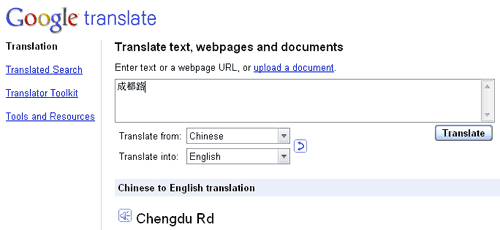
screenshot from Google Translate, showing how Google will translate '成都路' as 'Chengdu Rd'

But Google Maps doesn’t get this simple point right, which likely points to outsourcing. Why would Google do this? And why wouldn’t it ensure that a better job was done? Because, really, so far the long-overdue conversion to Hanyu Pinyin in Google Maps for Taiwan is something of a botch.
Script differences complicate matters for Uzbeks in Kyrgyzstan

Ethnic Uzbeks in southern Kyrgyzstan are reportedly suffering from problems with the education system, including that Uzbekistan has switched to the Latin alphabet but Kyrgyzstan has not.

Kyrgyzstan is home to more than 766,000 ethnic Uzbeks out of an overall population of roughly 5 million, according to figures compiled by the State Statistics Committee. Although their numbers are slowly declining, Uzbeks remain the largest minority group in the country. Today, there are just 14 Uzbek language schools in Osh, compared with 21 in 1991….

A shortage of Uzbek-language textbooks and teaching materials constitutes another large obstacle. Many children in Uzbek-language schools must use textbooks that were published in Uzbekistan during the Soviet era. “The situation [became] complicated after Uzbekistan changed from using Cyrillic and started using the Latin [alphabet] in 1993,” explained Erkin Bainzarov, the editor of the Uzbek section of the Osh Shamy (“Evening Osh”) newspaper. “As a result, Kyrgyzstan’s Uzbek schools were forced to stop using textbooks published by Tashkent,” and must rely on antiquated materials. Teachers in Kyrgyzstan have not adapted to the Latin alphabet.

To help, the Kyrgyz-Uzbek University, the only university in the country to provide instruction in Uzbek, established a Textbook Development Center in 1997 with the help of Batyrov’s Friendship of Peoples University in Jalalabad.

“Since Uzbekistan switched to Latin, we started developing our own [Uzbek] textbooks [written in Cyrillic],” said Tursunbai Kamilov, the director of the center. “Since 1997, we have developed a set of seven textbooks for the primary school and 20 textbooks for secondary and high schools.” Yet more is needed. Kamilov says that due to inadequate financing, Uzbek schools only have 34 percent of the textbooks they need.

Some representatives of the Uzbek community say that if current trends persist, southern Kyrgyzstan’s Uzbek-language educational structure could experience a complete collapse. “We have to maintain our schools, and have our children go to Uzbek language schools to preserve our language, culture and identity,” said Khalturaev, the school principal.

source: Kyrgyzstan: Uzbeks in Southern Regions Wrestle with Cultural Dilemma, Eurasianet, October 27, 2009

further reading:

Taipei County switches to Hanyu Pinyin

Street signs in Taipei County are beginning to be changed to Hanyu Pinyin. For Pinyin supporters here, this is a long-awaited development.

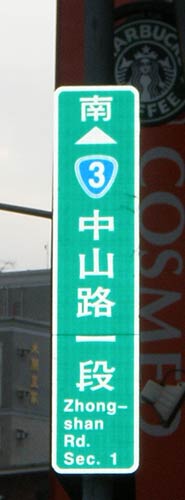
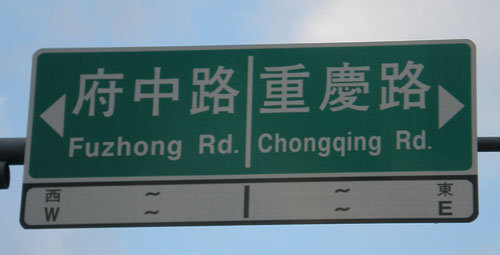
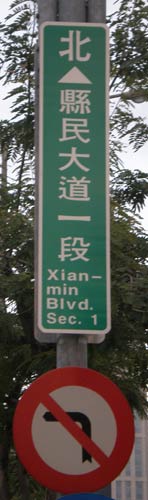
Here are some examples of new signs in Banqiao, the seat of the Taipei County Government. They were taken near the Fuzhong MRT station.

street sign in Banqiao, Taiwan, in Hanyu Pinyin: 'Fuzhong Rd.' 'Chongqing Rd.'

Xianmin Blvd. Sec. 1 (This is a vertical sign, too narrow for 'Xianmin' on one line, so it's hyphenated, with 'min' on the second line)

Zhongshan Rd. Sec. 1

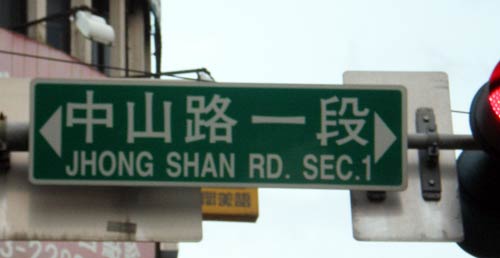
This is one of the Tongyong signs about to be taken down. It’s at the same intersection as the “Zhongshan” sign at above right. [November 17 update: The sign is now gone.]
JHONG SHAN RD. SEC.1

The first roads to receive these signs are large ones, especially those connecting one city to another. This is probably going to be a long, slow process, which is certainly to be expected given (a) how damn long it took them to get this started and (b) that most signs never got changed to Tongyong Pinyin during the previous administration. My impression is that most street signs in Taipei County, especially in smaller towns and on smaller roads, remain in MPS2 (the Tongyong Pinyin of the 1980s).

Has anyone noticed any changes yet in Xindian, etc.?

I wish I could provide links to official announcements, etc. But so far I haven’t been able to find any. I have, however, spoken with officials from the county government who confirm the new policy, so I’m going ahead and announcing this here.

Nice to see no InTerCaps. Unfortunately, the apostrophe situation is SNAFU, with those responsible for the signage using outdated guidelines (calling for a hyphen instead of an apostrophe). But I’ve forwarded the central government’s current rules on this to those concerned, which I hope will help get the problem fixed before any such signs go up.

-r endings, their pronunciation, and Pinyin spelling

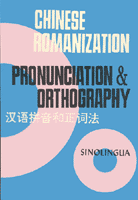
cover of Chinese Romanization: Pronunciation and OrthographyArrr! In recognition of International Talk Like a Beijinger Pirate Day, here are the rules for how to spell those -r endings in Hanyu Pinyin and how those endings affect the pronunciation of syllables. In many cases, it’s more complicated than just adding an -r sound at the end of the standard syllable.

This information is from Yin Binyong’s Chinese Romanization: Pronunciation and Orthography. The full section from this book is available in PDF form: r- Suffixed Syllables.

Written form Actual pronunciation
-ar (mǎr, horse) -ar (mǎr)
-air (gàir, lid) -ar (gàr)
-anr (pánr, plate) -ar (pár)
-aor (bāor, bundle) -aor (bāor)
-angr (gāngr, jar) -ãr (gãr)
-or (mòr, dust) -or (mòr)
-our (hóur, monkey) -our (hóur)
-ongr (chóngr, insect) -õr (chõr)
-er (gēr, song) -er (gēr)
-eir (bèir, back) -er (bèr)
-enr (ménr, door) -er (mér)
-engr (dēngr, lamp) -ẽr (dẽr)
-ir* (zìr, Chinese character) -er (zèr)
-ir (mǐr, rice) -ier (mǐer)
-iar (xiár, box) -iar (xiár)
-ier (diér, saucer) -ier (diér)
-iaor (niǎor, bird) -iaor (niǎor)
-iur (qiúr, ball) -iour (qióur)
-ianr (diǎnr, bit) -iar (diǎr)
-iangr (qiāngr, tune) -iãr (qiãr)
-inr (xīnr, core) -ier (xīer)
-ingr (língr, bell) -iẽr (liẽr)
-iongr (xióngr, bear) -iõr (xiõr)
-ur (tùr, rabbit) -ur (tùr)
-uar (huār, flower) -uar (huār)
-uor (huór, work) -uor (huór)
-uair (kuàir, piece) -uar (kuàr)
-uir (shuǐr, water) -uer (shuěr)
-uanr (wánr, to play) -uar (wár)
-uangr (kuāngr, basket) -uãr (kuãr)
-unr (lúnr, wheel) -uer (luér)
-ür (qǔr, song) -üer (qǔer)
-üer (juér, peg) -üer (juér)
-üanr (quānr, loop) -üar (quār)
-ünr (qúnr, skirt) -üer (quér)

Notes:

  • ã, õ, ẽ indicate nasalized a, o, e.
  • The -i marked with an asterisk indicates either of the apical vowels that follow zh, ch, sh, r and z, c, s.

Pinyin with audio and Chinese characters: Fortress Besieged

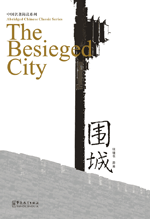
cover of the book 'The Besieged City' (围城)Sinolingua‘s terrific series of abridged editions of classic Chinese books includes one of my favorites, which may well be the finest novel written in Mandarin during the twentieth century: Qian Zhongshu’s Wéichéng (圍城/围城), best known in English as Fortress Besieged but published by Sinolingua with the English title of The Besieged City.

I’m very pleased to announce that Pinyin.info now offers the first chapter of Sinolingua’s edition this book, along with an audio file of it being read aloud. This edition is in Mandarin, in word-parsed Hanyu Pinyin (with Chinese characters underneath) and has a few notes in English as well as mp3 files of the text being read aloud.

Here’s the download page: Wéichéng (圍城/围城/).

I’ve often told people who plan to go to China and want me to recommend a book that will help them “understand” the country (as if!) they’re about to visit: “By all means, read the Analects of Confucius, the Dàodéjīng, and the Zhuāngzǐ; but know in advance that they’ll be about as relevent to your trip as reading the Gospels would be to someone from China who’s about to travel to the West for the first time. And don’t waste your time with crap like The Tao of the Chinese Boardroom’s Inner Art of Feng-shui or whatever. Read Fortress Besieged. It’s as good a start as just about anything — and a lot more fun to read.”

The novel is also available in a fine English translation.

Related reading:

screenshot of part of a paragraph of the PDF of this book

Taiwan train stations and the switch to Hanyu Pinyin

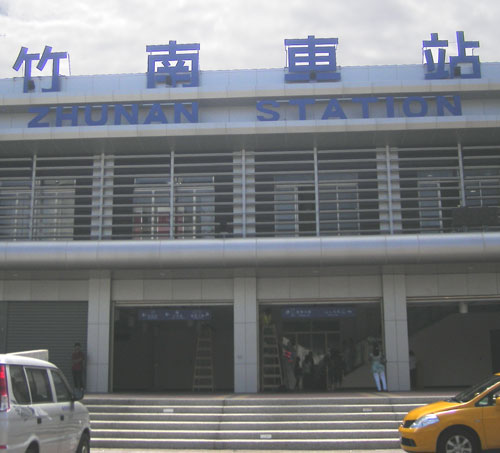
Although Hanyu Pinyin has been Taiwan’s official romanization system since the beginning of this year, progress in implementation on signage has so far been little to none (at least in what I’ve witnessed). So I was pleased to see this sign earlier this week at the remodeled train station in Zhunan, Miaoli County.

sign atop train station reading 'ZHUNAN STATION' in large letters

Those big letters unmistakably spell out the name of the city in Hanyu Pinyin. Good.

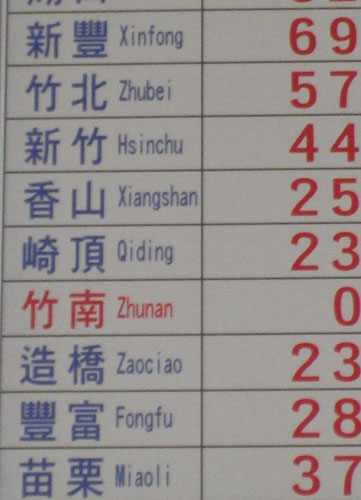
But what about the use of romanization inside the station? Here’s a shot of part of a board listing the stations near Zhunan.

train_station_names

Let’s look at the systems used in the names above:

  • Xinfong — Hanyu Pinyin and Tongyong Pinyin mix
  • Zhubei — Hanyu Pinyin
  • Hsinchu — Wade-Giles
  • Xiangshan — Hanyu Pinyin
  • Qiding — Hanyu Pinyin (BTW, that’s a terrible Q, as it’s too little distinct from an O, especially at a distance.)
  • Zhunan — Hanyu Pinyin
  • Zaociao — Tongyong Pinyin
  • Fongfu — Tongyong Pinyin
  • Miaoli — same in most systems

Once again we see the government’s incompetence when it comes to such simple things as spelling names correctly on signage.

But since at least “Zhunan” was right, what about signage for the same name beyond the train station?

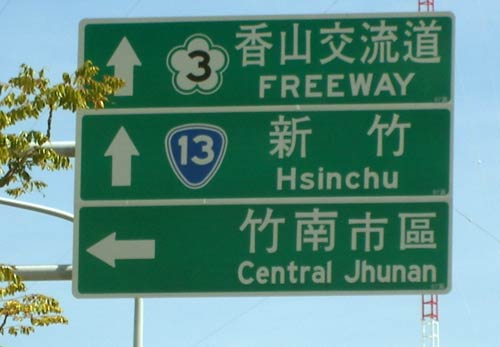
Well, there’s still Tongyong Pinyin (“Jhunan”):

directional sign reading 'Central Jhunan'

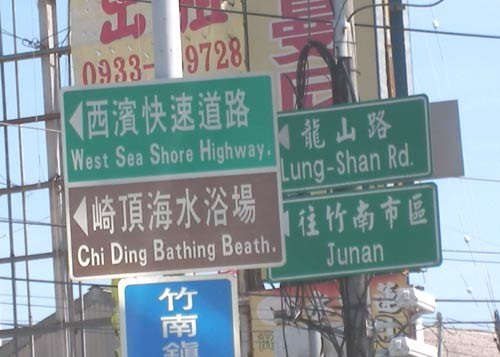
And there’s still Tongyong’s predecessor, MPS2 (“Junan”), along with other systems, typos, and sloppy English:

signs reading 'Junan', 'West Sea Shore Highway.', 'Lung-Shan Rd.', and 'Chi Ding Bathing Beath.'

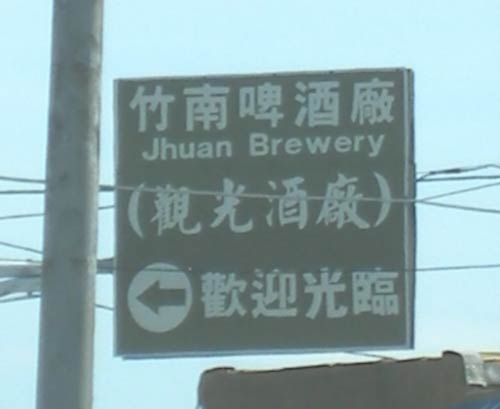
And there are still spellings that are simply wrong (“Jhuan”), regardless of the system:
directional sign above the highway, reading 'Jhuan Brewery'

I’ve said it before, I’ll say it again: “Taiwan’s romanization situation: plus ça change, plus c’est la même chose.”

books bought in Beijing

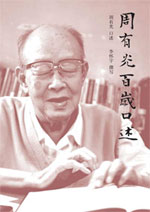
cover of a book by Zhou YouguangI didn’t have any luck finding anything in Sin Wenz (Lādīnghuà Xīn Wénzì / 拉丁化新文字), despite trips to several large used book stores. (Fortunately, the Internet is now providing some leads. Thanks, Brendan and Joel!) But I did find some other books to bring home.
I acquired lots of books by Zhou Youguang, not all of which focus primarily on linguistics:

Other than the Zhou Youguang books, here are my favorite finds of the trip, as they are for the most part in correctly word-parsed Hanyu Pinyin (with Hanzi underneath), along with a few notes in English:

I’ll soon be posting more about the above books with Pinyin, so watch this site for updates. Really, this is gonna be good.

Although this collection of Y.R. Chao says it’s volume 15, it’s actually two books:

  • Zhào Yuánrèn quánjí, dì 15 juàn (趙元任全集第15卷)

Some more titles:

  • Measured Words: The Development of Objective Language Testing, by Bernard Spolsky
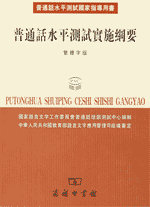
  • Pǔtōnghuà shuǐpíng cèshì shíshī gāngyào (普通話水平測試實施綱要). Now with the great smell of beer! Sorry, Brendan, I owe you one — more than one, actually.

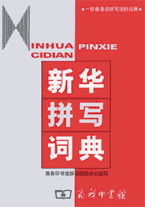
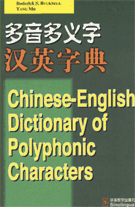
The following I bought because Yin Binyong, the scholar primarily responsible for Hanyu Pinyin’s orthography, is the author of these titles from Sinolingua’s series of Bógǔtōngjīn xué Hànyǔ cóngshū (“Gems of the Chinese Language through the Ages” (their translation)), all of which are in Mandarin (Hanzi) and English, with Pinyin only for the sayings being illustrated:

cover of 'Chinese-English Dictionary of Polyphonic Characters' (多音多义字汉英词典)cover of 'Putonghua shuiping ceshi shishi gangyao' (普通話水平測試實施綱要)cover of 'Xinhua pinxie cidian'

Other:

And finally:

Of course I already have that one — more than one copy, in fact. But it’s always good to have more than one spare when it comes to one of the two most important books on Pinyin orthography. I really need to follow up on my requests to use excerpts from this book, as it is the only major title missing from my list of romanization-related books (though it’s in Mandarin only).

sign in a Beijing bookstore reading 'Education Theury' [sic]

InTerCaPiTaLiZaTion: the Beijing trip

To my relief, I saw very little in the way of the orthography-killing cancer that is InTerCaPiTaLiZaTion while I was in Beijing.

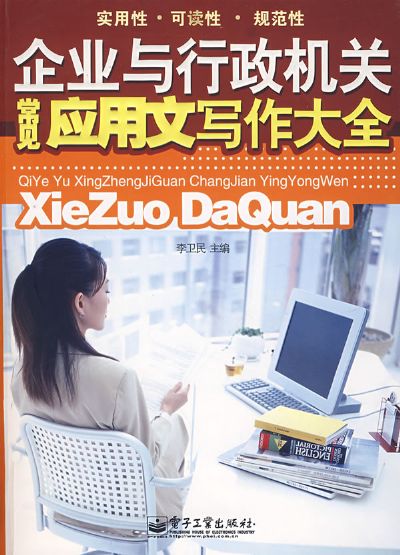
The worst offender I spotted was the cover to Qǐyè yǔ xíngzhèng jīguān chángjiàn yìngyòngwén xiězuò dàquán (企业与行政机关常见应用文写作大全 / 企業與行政機關常見應用文寫作大全), which to me just screams out “UGly NightMare”. But at least the word parsing is right, which is more than can be said for many uses of Pinyin in China.

intercapped_book_title

Note that the image is flipped:
detail from the above photo, showing how the title on a book spine is mirrored

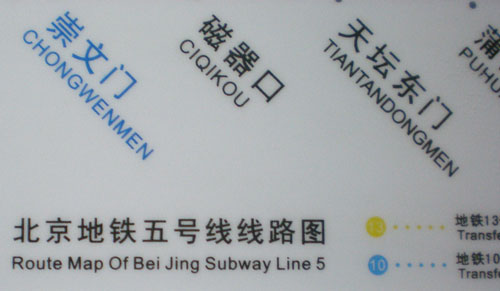
More troubling, because it is on official signage, is the use of intercaps on some station guides above the doors of subway cars.

Route Map Of Bei Jing Subway Line 5
The capitalization of “Of” demonstrates that the bro-ken and InTerCaPiTaLized “Bei Jing” is probably due more to standard sloppiness than design. At least I certainly hope no one did that on purpose.

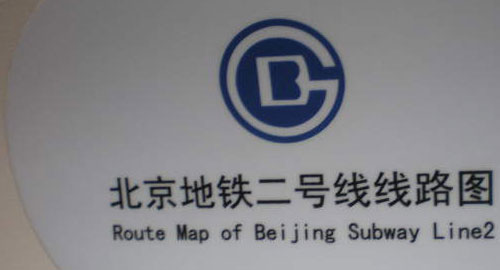
Fortunately, that usage isn’t found throughout the subway system, as this photo from a map of another line shows.
Route Map of Beijing Subway Line2

Reports of what style is to be found on other Beijing subway lines — especially the newest ones — would be welcome.

And Randy spotted this one:
'BeiJing Vikings Football' in black letters on a red van door, with Hanzi

But that appears to be a one-off, since the Beijing Vikings don’t use that style on their Web site or elsewhere that I noticed.