Banqiao — the Xinbei ways

Xinbei, formerly known as Taipei County and now officially bearing the atrocious English name of “New Taipei City,” has made available an online map of its territory.

Interestingly, the map is available not just in Mandarin with traditional Chinese characters and English with Hanyu Pinyin (most of the time — but more on that soon) but also in Mandarin with simplified Chinese characters. A Japanese interface is also available.

The interface for all versions opens to a map centered on Xinbei City Hall. What struck me upon seeing this for the first time was that, in just one small section, Banqiao is spelled four different ways:

  • Banqiao (Hanyu Pinyin)
  • Panchiao (bastardized Wade-Giles)
  • Ban-Chiau (MPS2, with an added hyphen)
  • Banciao (Tongyong Pinyin)

Click the map to see an enlargement.
click for larger version

I want to stress that these are not typos. These are the result of an inattention to detail that is all too common here.

The spelling for the city, er, district is also wrong in the interface, with Tongyong used. Since Banqiao is the seat of the Xinbei City Government and has more than half a million inhabitants,*, it’s not exactly so obscure that spelling its name correctly should be much of a challenge. Tongyong and other systems also crop up in some other names outside the interface.

It should be admitted, however, that the Xinbei map’s romanization is still better overall than the error-filled mess issued by GooGle.

*: including me

China and U.S. study abroad programs

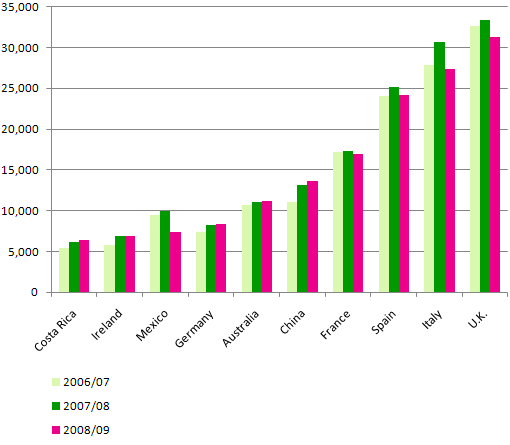
China remained the fifth most popular destination for U.S. students studying abroad during the 2008/09 school year, and it continued to account for 5 percent of U.S. study abroad.

In the previous academic year, growth for the PRC as a destination increased 19.0 percent, while study abroad as a whole increased 8.5 percent. But for 2008/09 growth for China was a much smaller 3.9 percent, while the total worldwide figure declined -0.8 percent. Figures for the top four destinations also dropped.

The order of the top 10 remained the same as in the previous year, except Mexico and Germany switched places.

Top 10 destinations for study abroad by U.S. students in the 2006-07, 2007-08, and 2008-09 school years
China shown as the fifth most popular destination for study abroad. The top destination is the U.K., followed by Italy, Spain, and France. See the link to my source material for the actual numbers.

Some other figures of possible interest:

  • Japan was in 11th place with 5,784 students, a 1.3 percent increase over the previous year.
  • Taiwan’s total grew 3.3 percent to 597.
  • Hong Kong grew 5.7 percent to 1,155.
  • South Korea grew a dramatic 29.1 percent to 2,062.
  • Singapore grew 7.7 percent to 612.

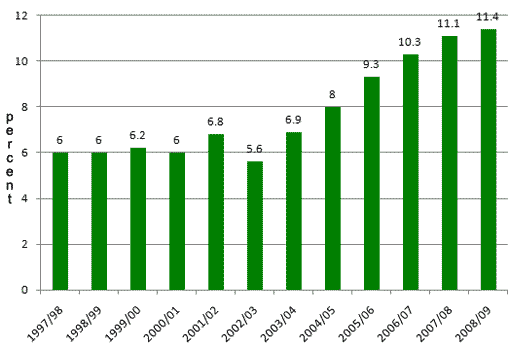
Study in Asia increased slightly.

Percent of study abroad performed in Asia
chart showing percentage of study abroad in Asia flat at about 6% from 1996-2000, with growth increasing since 2003 to the present 11.1% for the 2008-09 school year

source: Open Doors data portal

Previous posts on this subject:

Going south with official Taiwan map

In the past, when I found romanization errors in official government documents I often contacted the agencies in charge so they could make improvements. But as those who live in Taiwan may have noted, this practice has had limited success. And in the process I’ve built up a great deal of bile from encountering bureaucratic roadblocks to fixing mistakes. So is it any wonder that when I see things like this map, I often think, “Wǒ hǎo xiǎng tù.” Maybe now it’s time to start going with that feeling — metaphorically speaking. And what could be more appropriate, given that we are about to have a tùnián? (I know, I know: That pun’s probably not going to make any of the New Year cards.)

So today I’ll post in public about one such mess. I recently looked over a map of southern Taiwan issued by Taiwan’s official Tourism Bureau and was not surprised to find errors — a lot of errors. (This particular map was published in June 2010 and is, as far as I know, the most recent edition.)

Most of the errors are cases of remnants of Tongyong Pinyin (e.g., Cingshuei for what is written Qingshui in Hanyu Pinyin). Oddly, on this map Tongyong Pinyin is often seen in only part of a name (e.g., what is written 豐丘 in Chinese characters is given as Fengciou, which has Hanyu Pinyin’s Feng rather than Tongyong’s Fong but Tongyong’s ciou rather than Hanyu’s qiu).

What at first glance would appear to be another example of this mixing is Xizih, a bay next to Gaoxiong. There being no xi in Tongyong Pinyin and no zih in Hanyu Pinyin, one might guess this should be Xizi. But in fact this should be Sizi (written Sihzih in Tongyong). Or is also a typo in the Chinese characters (四子灣) and thus should be something else?

Other errors are even more mysterious, such as Tainan’s “Eternal For Cves” for 億載金城 (yì zǎi jīnchéng). I suspect they were going for “Eternal Fortress” but got lost somewhere along the way.

I estimate the map has about 100 errors. Of course, here I’m referring to just the map side itself and not the text on the reverse, which is filled with similar mistakes. Also, it’s just for southern Taiwan. The other two or three maps needed to cover most of the country likely each have just as many mistakes or more.

Turning back to the map at hand, here are some errors in just the area covering the southern tip of Taiwan (map sections C8 and C9).

On the map Should be
Haikau Desert Haikou Desert
Kenting National Forest Recreation Area Kending National Forest Recreation Area
Kenting National Park Kending National Park
Kenting National Park Administration Kending National Park Administration
Natural Center Nature Center
Ping-e Ping’e
(Shizih) (Shizi)
Shuangliou Shuangliu
Sihchongxi Sichongxi
Sihchong River Sichong River
Sihchongxi Hot Springs Sichongxi Hot Springs
Syuhai Xuhai
Syuhai Hot Springs Xuhai Hot Springs
Syuhai Prairie Xuhai Prairie

Keep in mind that more than half of the area in sections above is water and thus lacking in any place names that could be misspelled.

I should note that Kenting for what should be Kending appears to be what might be labeled an official error — another case of the government mistakenly believing that using old, misleading spellings from the days of bastardized Wade-Giles is necessary lest foreigners be confused. (The worst examples of this are the names of counties and many cities, such as Taichung rather than Taizhong, Pingtung rather than Pingdong, Hualien rather than Hualian, and Chiayi rather than Jiayi.) But if Kenting somehow ended up being official, then the map is still wrong, because the correct Hanyu Pinyin spelling “Kending” (which is also the correct spelling in Tongyong Pinyin) is also seen.

In short, this map is, regrettably, another example of the Taiwan government’s failure to maintain quality control in its use of romanization. It’s been said before but perhaps it needs to be said again: It’s a sad state of affairs when a country can’t manage even the simple task of correctly spelling the names of its own towns and special attractions on its own maps — not that anyone else has managed to get their maps of Taiwan correct either; and some that should be good remain awful. (Yeah, I’m talking about you, GooGle.)

Wenlin releases major upgrade (4.0)

Wenlin logoOne of my favorite programs, Wenlin (which bills itself as “software for learning Chinese”), has just released a major upgrade for both Mac and Windows versions. This doesn’t happen often; it has been three-and-a-half years since the most recent big change was issued (Wenlin 3.4) and heaven only knows how long since 3.0 came out. So, yes, this release has many substantial improvements.

One of the features nearest and dearest to my heart is that Wenlin 4.0 features greatly improved handling of Pinyin. I was among the field testers for the new version, so I’ve already spent a lot of time examining this feature. Here are a few important aspects of this:

  • Conversions from Chinese characters follow Hanyu Pinyin orthography much more closely than before. This is a major change for the better. (There’s still some room for improvement. But I don’t think we’ll have to wait years for this.)
  • In the past, using Wenlin to convert long texts in Chinese characters into Pinyin could be a real chore, with users having to examine example after example of Chinese characters with multiple pronunciations in order to select the proper pronunciation for that particular context. But now users may, if they so desire, tell Wenlin not to ask users for disambiguation input. Of course, that doesn’t mean that Wenlin will always guess right; but many users will be happy that this trade-off allows them to skip the frustration of, for example, having to tell the program over and over and over that, yes, in this case 說 is pronounced shuō rather than shuì.
  • Relative newcomers to Mandarin may appreciate that for common words tone sandhi is indicated in Wenlin with additional marks (a dot or line below the vowel). This feature can also be turned off, for those who want standard Pinyin.

There are, of course, many improvements beyond the area of Pinyin. Here are a few:

  • One limitation of Wenlin 3.x was that its English dictionary wasn’t very large. But Wenlin 4.0 includes not only the ABC Chinese-English Comprehensive Dictionary but also the excellent new ABC English-Chinese, Chinese-English Dictionary (now finally in stock in the printed version).
  • The flashcards are now set up to handle not just individual characters but polysyllabic words.
  • There’s full Unicode Unihan 6.0 support for more than 75,000 Chinese characters.
  • And for those who think 75,000 just isn’t enough, users can now access Wenlin’s CDL technology. Through this, users can create new, variant, and rare characters; moreover, these can be published and shared with other Wenlin users or CDL-friendly devices.
  • Seal script versions of more than 11,000 characters are provided.
  • Wenlin contains an e-edition of the Shuowen Jiezi (Shuōwén Jiězì / 說文解字 / 说文解字).
  • Coders will be interested to know that Wenlin appears to be headed toward becoming open-source.
  • Both Mandarin and English entries are marked with grade levels, which aids learners by indicating relative frequency of use. The levels for Mandarin words are based on the Hanyu Shuiping Kaoshi (Hànyǔ Shǔipíng Kǎoshì / 汉语水平考试 / 漢語水平考試 / HSK).

The full version (i.e., the CD with the program comes in a box and is likely packaged with a hard copy of the manual) is US$199, or US$179 if you download it from the Wenlin Web store. Upgrades from 3.x cost US$49.

For more information, see the summary of features and outline of what’s new in Wenlin 4.0.

screenshot from Wenlin 4.0 -- click for larger version

Xin Tang no. 1: articles in Gwoyeu Romatzyh

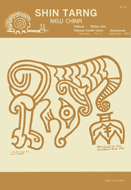
click to view the PDFI’ve just put up another issue of Xin Tang.

As you may have noticed already, the name on the cover is given not as Xin Tang but as Shin Tarng. That’s because the journal started out being published in the Gwoyeu Romatzyh romanization system. But using the Hanyu Pinyin spelling here helps me keep track of these better.

Almost all of this issue is in Mandarin written in Gwoyeu Romatzyh. One article also has an en face translation into English. And as is the case with the other issues of Xin Tang, a variety of topics are covered.

Shin Tarng no. 1 (September/Jiǔyuè 1982)

Hanyu Pinyin Cihui

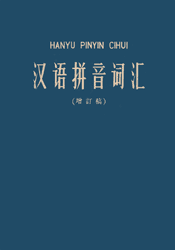
image of the cover of this book, which gives 'HANYU PINYIN CIHUI', followed on the next line in larger characters by '汉语拼音词汇', followed on the next line, in smaller letters, by '增訂稿' -- the text is white against a blue backgroundToday, for all you orthography junkies (Hello? Hello? Anybody there?), I have added a selection from the 1963 edition of Hanyu Pinyin Cihui (汉语拼音词汇 / Hànyǔ Pīnyīn Cíhuì).

The book, which is fully alphabetized by Hanyu Pinyin (i.e., like the ABC dictionary series, not like the Hanzi-by-Hanzi Pinyin ordering seen in most dictionaries published in the PRC), is a long list of Mandarin words as written in Hanyu Pinyin and Chinese characters. It’s meant as a reference for word division and other such orthographic concerns. It’s the sort of thing that just cried out to have been made into a full dictionary (especially since that’s what it looks like, minus definitions); but, unfortunately, it never was. But it was an important influence on the ABC series.

One can see some interesting instances of differences between Pinyin orthography then and now. For example, in this old edition of Hanyu Pinyin Cihui de tends to be appended to words and written as d, e.g. ái’áid, rather than the current ái’ái de (皚皚的). Similarly, zi is written z at the end of a word, e.g. ǎigèz, rather than the current ǎigèzi (矮个子).

Also interesting is the mixed use of simplified and traditional Chinese characters. (It will be easier to see what I’m referring to if you open the PDF file of the introduction and A’s of Hanyu Pinyin Cihui.) The title on the cover is given as 汉语拼音词汇 in Chinese characters — perfectly standard. But below this is 增訂稿 (zēngdìng gǎo / revised edition); note how dìng is written as 訂 rather than as 订.

More striking, though, for the modern reader is the script in the foreword. Here, what was written 汉语拼音词汇 on the cover is written 汉語拼音詞汇, mixing traditional and simplified forms. The full traditional version of this would be written 漢語拼音詞彙. The text of the introduction is similarly mixed. This is because this was published before many simplified forms that are now standard were fully accepted officially.

The selection from this book here on Pinyin.info comprises the introduction and all of the entries beginning with the letter a.

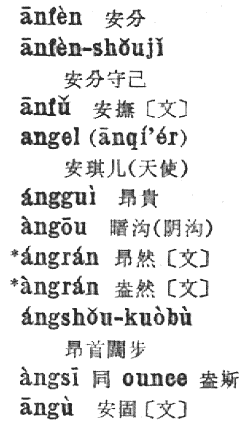
image of a few entries

Pingdong signage

I was recently in southern Taiwan’s Pingdong County to spend a few quiet days — I wish it had been more — by the sea. (Taiwan’s official spelling for this county remains the bastardized Wade-Giles form, Pingtung, rather than Pingdong, which is how it is spelled in MPS2, Tongyong Pinyin, and Hanyu Pinyin.)

The official signs I saw were predominantly in Tongyong Pinyin. The exceptions to this were generally errors (though perhaps official errors — see below) rather than instances of Hanyu Pinyin or other systems. I was surprised to see that this was the case not only with street signs but also with highway signage. Street signs are local. But highway signs fall under the jurisdiction of a ministry of the central government and thus usually follow national guidelines — and follow them more quickly than other signage. But while highway signs in many other parts of Taiwan have been changed to Hanyu Pinyin, Pingdong lags, for whatever reason.

Click on the photos for larger versions.

Here’s a street sign unmistakably in Tongyong Pinyin. “Wunzih” is written “Wenzi” in Hanyu Pinyin.
street sign reading 'Wunzih Rd.'

Here’s a fancy street sign for the tourists in Hengchun — thus the stylized “春” (below “Hengnan Rd.”) for “恆春” (Héngchūn). “Hengnan” could be any of lots of romanization systems. The interesting parts are the use of a counter-productive English translation (“South Bay”) rather than the Mandarin place name “Nanwan” and the use of the bastardized Wade-Giles form Kenting for Kending. The Kenting spelling, though wrong, was by far the most common one on official signage, which leads me to suspect that this is another case of the Taiwan government embracing the delusion that an obscure-to-the-world place is actually world famous in its bastardized Wade-Giles spelling and thus foreigners would be confused if signs actually represented the right way to pronounce this. Ugh. So even though every one of Taiwan’s official romanization systems for the past quarter century would spell this the same, Kending, the government says it should be spelled Kenting … at least from one source; but the Ministry of the Interior, which should have the greater jurisdiction, says to use Kending.

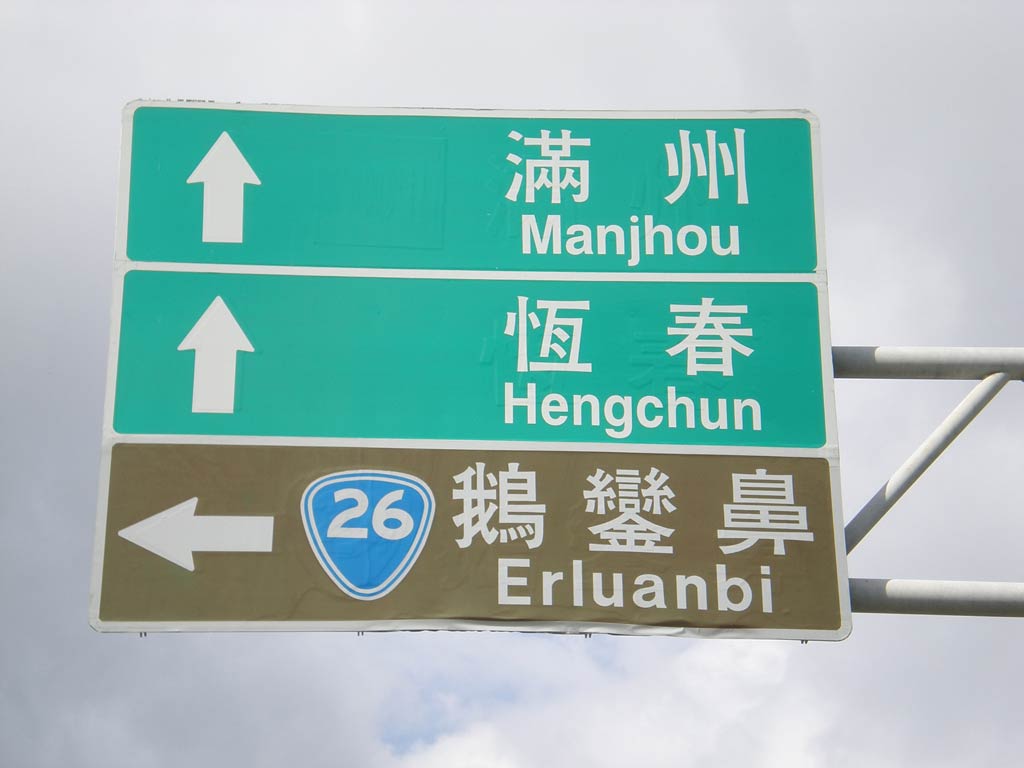
If you look carefully (click on the image to zoom in), you can see that the previous version of the sign (underneath the new one) did not have any romanization. The ‘r’ in Erluanbi is especially odd, given that it doesn’t belong there. (Éluánbí / 鵝鸞鼻 / n.: bulbous nose) The error appears to come from Taiwan government itself, whose Research, Development, and Evaluation Commission’s site on “bilingual” forms gives the r spelling — though it also gives the correct “Eluanbi” spelling for other instances of this.
3 highway signs, reading 'Manjhou', 'Hengchun', and 'Erluanbi'

Or maybe the sign makers just borrowed the r from this sign.

Another distinctly Tongyong sign:

I was pleased to see this trilingual sign, with Mandarin, English, and Vietnamese.

ABC English-Chinese, Chinese-English Dictionary out soon

front cover of the ABC English-Chinese, Chinese-English DictionaryThe ABC Chinese-English Dictionary was published ten years ago. It was revolutionary in that, for the first time, a Mandarin-English dictionary was ordered entirely by the headwords’ pronunciation as written in pinyin. (Stroke and radical indexes are also there to aid finding a character when its shape is known but not its pronunciation.) Other dictionaries in the DeFrancis ABC series have followed. But up to now there been no ABC dictionary with an English to Mandarin section as well as a Mandarin to English one.

At the end of this month the University of Hawai`i Press is releasing the ABC English-Chinese, Chinese-English Dictionary. The new dictionary, which is 1,252 pages long, has 29,670 entries in its English-Mandarin section and 37,963 entries for Mandarin-English (total 67,633 entries). (The much larger ABC Chinese-English Comprehensive Dictionary has some 196,000 entries — all Mandarin-English).

This is a big year for Mandarin-English dictionaries, with the forthcoming release of the ABC ECCE and the release three months ago of the massive Oxford Chinese Dictionary. From the standpoint of Pinyin, however, the Oxford dictionary is a disappointment. For example, the Oxford dictionary has no Pinyin in the English-Mandarin section, just Chinese characters; in some other places tone marks are missing from some of the Pinyin, where it appears at all. Perhaps this will be rectified in the online edition, which has yet to appear. At the moment, though, the Oxford looks like a fairly traditional dictionary — albeit a huge one — aimed mainly at English learners in China, which isn’t necessarily a bad thing if you happen to be among that very large group of people. For more on the Oxford, see the video at Danwei and the entries at Chinese Forums (with some images) and Language Log.

Unlike the Oxford dictionary, the ABC ECCE offers both Pinyin and Chinese characters for all entries and sample sentences. (See samples below. Click on those for more extensive examples in PDF files.)

From what I’ve seen so far of the ABC English-Chinese, Chinese-English Dictionary, I expect it to become the dictionary for English-speaking students of Mandarin. I’ll write more about this once I’m able to see a hard copy.

The ABC English-Chinese, Chinese-English Dictionary retails for only US$20, compared to US$75 for the Oxford.

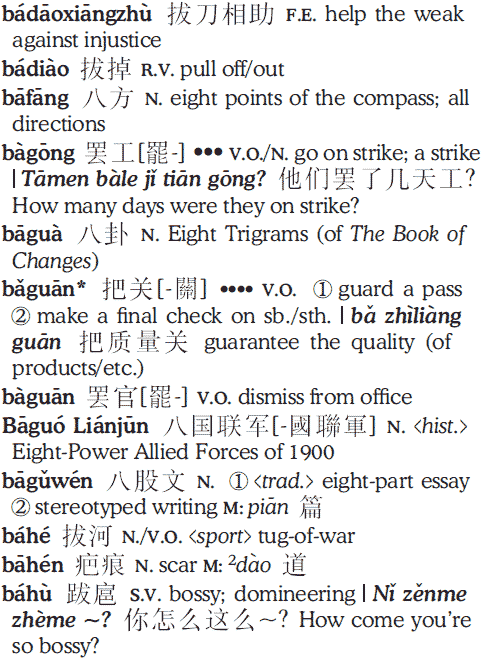
From the Mandarin-English section. But don’t expect the text in the printed edition to be this large. I’ve enlarged the image to make it easier to read on the Web.
examples of entries in the Mandarin-English section of the ABC English-Chinese, Chinese-English Dictionary

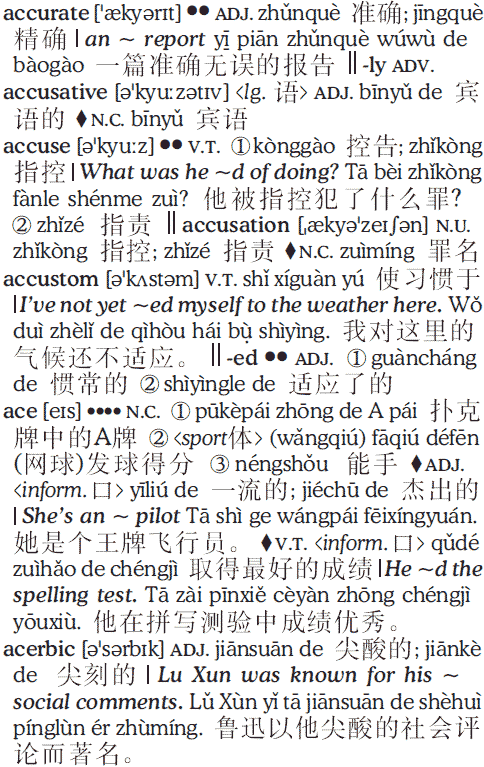
From the English-Mandarin section:
examples of entries in the English-Mandarin section of the ABC English-Chinese, Chinese-English Dictionary

(ISBN-10: 0824834852; ISBN-13: 978-0824834852)

See also: