A clang on the Taipei MRT announcements

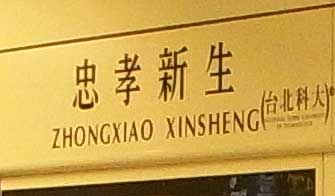
photo of a sign at the Zhongxiao Xinsheng MRT stationPeople generally don’t listen carefully to the announcements on the Taipei MRT, a subway/elevated train mass-transit system. With four languages to get through — Mandarin, Taiwanese, Hakka, and English — that’s a lot of talking. And anyway, the cars can be so full that it’s hard to hear such things clearly over all the background noise anyway. Still, you’d think that at least the people who make the recordings would be paying attention.

Below is a link to a recording of a relatively new announcement, advising people on the Danshui line that Minquan West Road is the place to change trains for the Luzhou line, which opened late last year: “Mínquán West Road Station. Attention: passengers transferring to Sānchóng, Lúzhōu, or Zhōngxiào-Xīnshēng please change trains at this station.“

Or at least what I typed above is what the announcement is supposed to give. As you may have noticed, however, “Zhōngxiào-Xīnshēng” is rendered “Zhongxiao-Xinshang,” with a very un-Mandarin shang that rhymes with the English words clang, pang, hang, and sang. And that’s without getting into the matter of tones.

I pointed out this error to Taipei City Hall and the authorities in charge of the MRT. As usual, I had to spend some time repeatedly explaining: “No, Xinshang is not the English pronunciation of Xīnshēng. Xīnshēng isn’t English. It’s Mandarin. What the announcement gives is simply an error….” I was pleasantly surprised, however, that the main person I spoke to at TRTS did not require the usual explanations. He understood the problem and said it would be fixed.

This, however, was a couple of months ago. The recordings have not yet been changed. I haven’t been holding my breath over this, though, because the official with the MRT system warned that it would take time to run a public bid notice for a new recording, make the new recording, and then install the recording in the front and back cars of some 100 trains. Still, the system has been known to move fairly quickly; unfortunately, this usually happens only when the change is for the worse, such as renaming Xindian City Hall as Xindian City Office (now Xindian District Office), or renaming the whole Muzha line because some superstitious nitwits thought that a joking, non-official nickname was bringing the system bad luck.

For longtime residents of Taipei, the shang mispronunciation will likely bring back memories of the bad old days when the MRT system first opened. Back then the signage was predominantly in bastardized Wade-Giles, with the pronunciations in the English announcements matching what a clueless Westerner might say when shown names like Kuting and Nanking (properly: Gǔtíng and Nánjīng, respectively). Perhaps the most offensive pronunciation on the system then was given to Dànshuǐ, which at the time was [mis]spelled Tamshui on the MRT system. This was pronounced as three syllables: Tam (rhymes with the English word “dam”) + shu (“shoe”) + i (as in “machine”).

By the way, the Xinbei City Government has been changing signs around Danshui from Danshui to the old Taiwanese spelling of Tamsui (note: not Tamshui). But more about that in a different post.

Feichang nankan!

The sign in the photo below has been up for years; but only recently did I finally get a chance to take a halfway decent photo of it. It’s just outside the second terminal of Taiwan’s main international airport and thus is the first example of road signage that many visitors to Taiwan see.

The atrocious typography displayed in how “Nankan” (南崁/Nánkàn) is written is certainly a good introduction to the chabuduo world of Taiwan’s signage.

Truly nánkàn (ugly)!

a directional sign pointing the way to Nankan -- but 'Nankan' is written with all letters the same height (i.e., the capital 'N' is reduced to the height of the letter 'a' and the 'k' is similarly shrunken)

Conferences in Hawaii

Tomorrow morning I’m off to Honolulu for the Zhang Liqing Memorial International Conference on Hanyu Pinyin. This promises to be a tremendously exciting event, with select scholars from throughout the United States, Asia, and Oceania participating. I’ll have more to say about this after the gathering.

While I’m in Hawaii I may drop in on the joint conference of the Association for Asian Studies and the International Convention of Asia Scholars (March 31–April 3). You might think, though, that with nearly 800 sessions on just about everything under the sun, at least a few of them would discuss romanization. (But nooo.) Still, session 282, “Beyond Cultural Essentialism: Neo-Orientalism in Chinese Studies” (Friday morning, 10:15-12:15), sounds interesting, especially Edward McDonald’s talk on character fetishization in Chinese studies. McDonald’s new book, Learning Chinese, Turning Chinese: Challenges to Becoming Sinophone in a Globalised World, also covers this topic.

If you know of anything else particularly interesting going on at the AAS-ICAS conference or in Honolulu at large, please let me know. (For example, what’s the best bookstore there?)

Spreading the good news

Behold, I bring you good tidings.

As I keep having to note, most of the things that are supposedly in Pinyin are terrible. This is not because Pinyin itself is inherently poor or difficult. It’s because most people who produce such things have a fundamental lack of understanding of Pinyin as a system. (And, yes, that includes most users in China.) So it is with amazement that I report today on a journal that not only offers dozens of pages in Hanyu Pinyin — good Hanyu Pinyin — but does so twice every month. It’s also well worth noting that the journal is aimed primarily at adult native speakers of Mandarin, not foreigners trying to pick up the language, though certainly it could also be read by people in the latter group.

From what I’ve seen so far, this journal gets right the things most commonly written incorrectly elsewhere, including:

And it doesn’t use the atrocious ɑ that some people mistakenly believe is required either.

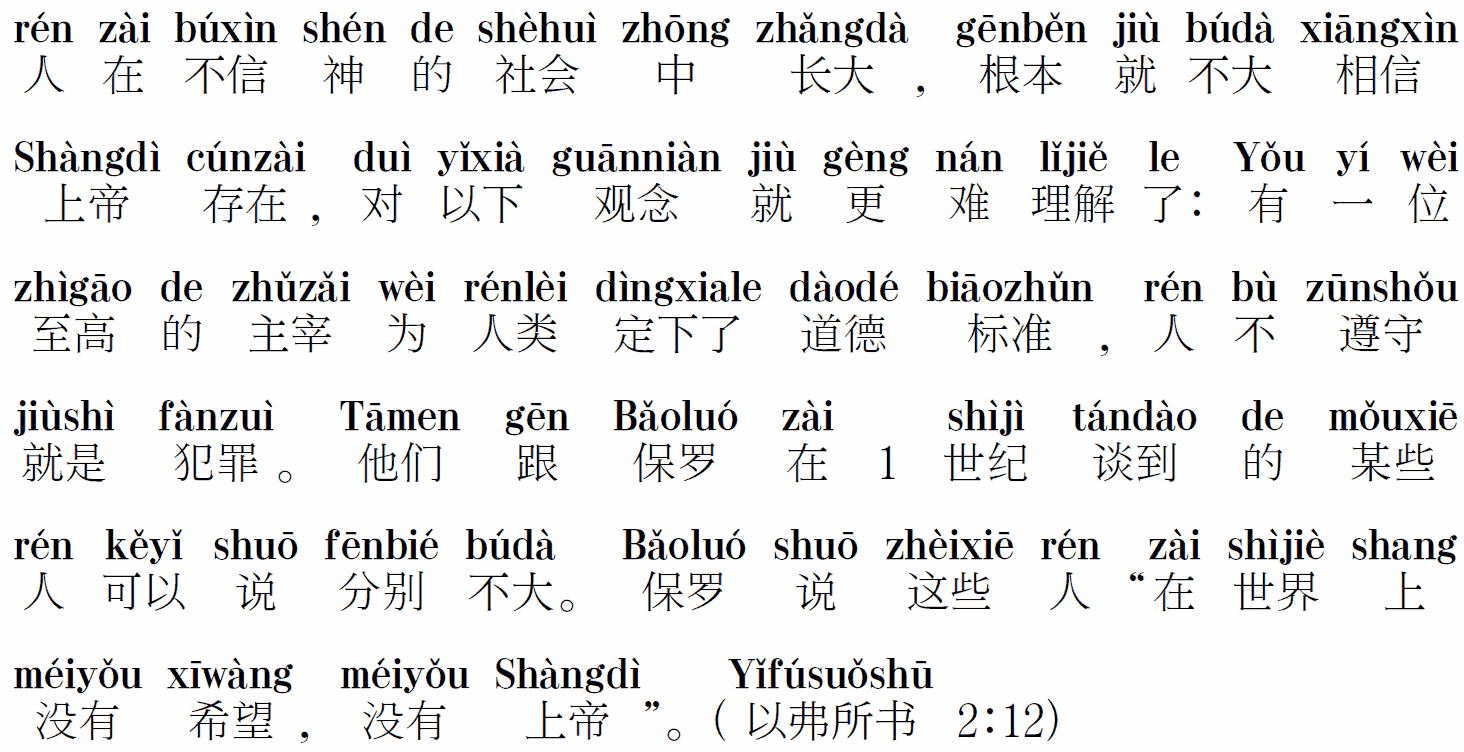
Unfortunately, punctuation and alphanumerics are not included in the Pinyin. But other than that there’s very little that doesn’t follow standard Pinyin orthography, the main exception being the indication of the tone sandhi related to the special cases of yī and bù, (e.g., the journal gives “bú shì” and “búdà” instead of the standard “bù shì” and “bùdà,” and “yìhuíshì” and “yí wèi” instead of the standard “yīhuíshì” and “yī wèi“). That said, though, tone changes related to yi and bu can be something of a pain. So although this isn’t standard, I can see why it was done and am not entirely unsympathetic to this approach.

Here are a few sample lines (click to enlarge):
screenshot of some text in the journal, showing text in simplified Chinese characters with word-parsed Hanyu Pinyin above the Hanzi. Note: Yifusuoshu/以弗所書 = Ephesians

It would be nice if this were in Unicode, to help aid searches and cutting and pasting. The text, however, appears to have been made in a system devised years ago by the people at the journal. Regardless, I’m happy to see the Pinyin.

Overall, despite the lamentable absence of punctuation and Arabic numerals in the Pinyin, this is quality work, which is perhaps all the more remarkable in that the Pinyin and simplified Hanzi edition of this journal is not truly free to circulate in the land of its target audience. That’s because its publishers are Jehovah’s Witnesses, a group suppressed by the PRC (though it appears that at least at the moment their sites are not blocked by the great firewall). The journal, Shǒuwàngtái, may be more familiar to you by its English name: Watchtower. Whatever you might think of Jehovah’s Witnesses, I hope you’ll recognize the considerable accomplishment of those who put together this publication.

Getting to the Jehovah’s Witnesses Web pages that link to Shǒuwàngtái can be tricky. (Go to the magazines page, select “Chinese (Simplified)” for the language; then choose the month and file with Pinyin.) So I’m providing direct links to some documents below:

I haven’t found any Pinyin editions other than those. Perhaps old ones are taken offline.

Rénrén Dōu Xūyào Zhīdao De Hǎo Xiāoxi (I'd prefer 'de' instead of 'De' -- but that's no big deal) 人人都需要知道的好消息

With thanks to Victor Mair.

Weishenme Zhongwen zheme TM nan?

David Moser’s essay Why Chinese Is So Damn Hard — which is one of the most popular readings here on Pinyin Info, with perhaps half a million page views to date (nothing to dǎ pēntì at!) — has been translated into Mandarin: Wèishénme Zhōngwén zhème TM nán? (为什么中文这么TM难?). (Gotta love the use of Roman letters there.)

Although the translation has been online for only 24 hours or so, it has already received more than 150 comments.

A suggestion for readers and translators looking for something similar: Moser’s Some Things Chinese Characters Can’t Do-Be-Do-Be-Do.

Ni neibian ji dian?

Here are some photos of a large, elaborate, and no-doubt expensive sundial outside the Nangang high-speed rail station (next door to the Nangang train station and Nangang MRT station).

These were taken at 11 a.m. (The one of the sundial itself was taken on a different day.) But as you can see below, the sundial certainly isn’t indicating the time is 11:00. Rather, it’s pointing toward 9:20 or so.

The disc labeled IX is actually XI (11). I took the photo from a reverse vantage point, so the number is upside down in the photo.

This vantage point puts the number upside down. So you should read this as XI, not IX.

Perhaps whoever erected the main part of the sundial doesn’t know Roman numerals. (Sorry: that’s about as close as this post gets to talking about scripts.) But that wouldn’t account for the dial indicating 9:20 instead of 9:00.

I contacted the Taipei City Government about this. They said to contact the Taiwan High Speed Rail Corporation, which I did. They, in turn, responded that I’d reached the wrong office and should write a different office; but they didn’t forward the message or provide me with the correct e-mail address. Once I’d tracked down another office I e-mailed the folk there. That was more than a week ago. There has been no response.
I spoke with someone at the site who appeared to be in a position of authority. He told me that the sundial hadn’t been adjusted yet and that they would get to it next year. He was too busy to answer any more questions though, such as “Next year?” Also, I suspect that it won’t be easy to rotate that huge thingamajig, so why didn’t they get it right the first time?

Still, at least someone in authority seems to understand there’s a problem.

*For anyone who doesn’t recognize the title of this post, it’s an allusion to the 2001 movie Nǐ nèibiān jǐ diǎn (《你那边几点》 / What Time Is It There?).

Bing Maps for Taiwan

The maps of Taiwan put out by GooGle are plagued with errors in their use of Pinyin. But what about that other big company with deep pockets? You know: Microsoft. How good a job does Microsoft’s Bing do with its maps of Taiwan?
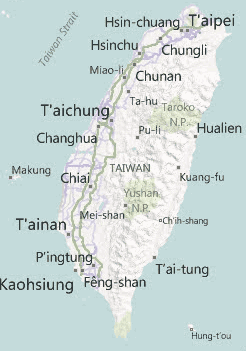
map of Taiwan from Bing, showing Wade-Giles place names

I won’t keep y’all waiting: After examining Bing’s maps of Taiwan the two words that came first to mind were incompetent and atrocious.

The country-level map is odd, offering Wade-Giles. And although the use of the hyphen is irregular, I will give Bing points for getting at least Wade-Giles’ apostrophes right. So, although some place names on the map are decades out of date (e.g., Hsin-chuang, Chungli, Chunan, Kuang-fu), at least they’re not horribly misspelled within that system.

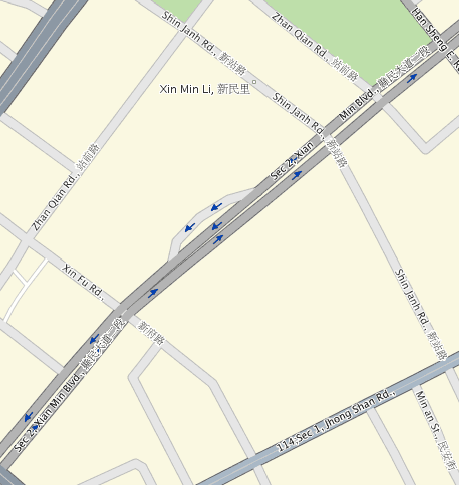
It’s at the street level that Bing’s weirdness becomes most apparent. For example, below is part of Bing’s map of Banqiao.

I added the highlighting.

click for larger map

This tiny but representative fragment of the map has not one but four romanization systems:

  • MPS2: Gung Guang, Min Chiuan, Shin Fu (Even within MPS2, none of those should have spaces or extra capital letters.)
  • Hanyu Pinyin: Banqiao (This is the only properly written place name on this map fragment.)
  • Tongyong Pinyin: Jhancian, Sianmin, Sin Jhan
  • Gwoyeu Romatzyh(!): Shinjann (This is the same road as the one marked “Sin Jhan”. In Hanyu Pinyin, which is what officially should be used here, this is written “Xinzhan”.)

A few more points about this small fragment of the map:

  • Wen Hua could be either MPS2 or Hanyu Pinyin, but not Tongyong Pinyin. And it should be Wenhua.
  • Minan is missing an apostrophe. (It should be Min’an.)
  • Banchiao is just wrong, regardless of the system. They were probably going for MPS2 but erroneously used an o instead of a u: Banchiau.
  • Sec 1 Rd should be Rd Sec. 1.
  • Mrt should be MRT.

So that’s four systems, plus additional errors.

There’s much, much more that’s wrong with this than is right. That’s even more evident on a larger map — and that’s without me bothering to mark orthographic problems in the Pinyin (e.g., Wen Hua instead of the correct Wenhua).
click for larger view

Here bastardized Wade-Giles (e.g., “Mrt-Hsinpu” at top, center — and, FWIW, in the wrong location) has been added to the mix, making a total of five different romanization systems, as well as some weird spellings, e.g., U Nung, Win De, Bah De, Ying Sh — and that’s without including my favorite, JRLE, because that one is correct in MPS2 (“Zhile” in Hanyu Pinyin).

The main point is that vast majority of names are spelled wrong. And among the few that are spelled correctly, those that are written with correct orthography can be counted on one hand. So, to the words above (incompetent and atrocious) let me add FUBAR.

The copyright statement lists not only Microsoft but also Navteq. The Taiwan maps on the latter company’s site, however, are different from those on Bing. Navteq’s are generally in Hanyu Pinyin, though almost invariably improperly written (e.g., Tai bei Shi, Ban Qiao Shi). And despite the prevalence of Hanyu Pinyin, they still contain other romanization systems (e.g., Jhong Shan) and outright errors (e.g., Shin Jahn).

So an update from Navteq wouldn’t be nearly enough to fix Bing’s problems, which are fundamental.

US grad enrollments in Mandarin fall

Although the number of people studying Mandarin in the United States has continued to rise (more about that in a later post), enrollments there in graduate courses in Mandarin have declined.

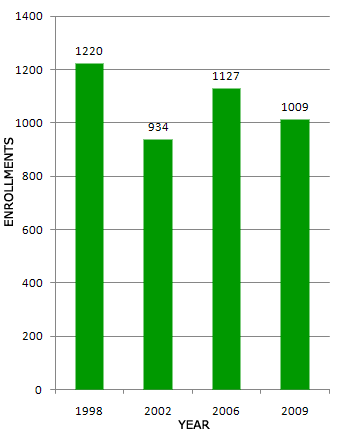
No. of U.S. Graduate School Enrollments in Mandarin from 1998 to 2009

(year: enrollments): 1998: 1220, 2002: 934, 2006: 1127, 2009: 1009

Grad School Enrollments in Mandarin as a Percentage of Total U.S. Post-Secondary Enrollments in Mandarin

1998: 5.15%, 2002: 3.35%, 2006: 2.63%, 2009: 1.96%

Here’s something I wrote the last time I addressed this topic.

The much-ballyhooed but also much-deserved increase in students studying Mandarin has all been at the undergraduate level. Given that the grad enrollment as a percentage of total enrollment for Mandarin is about the same as that for French (2.63 percent and 2.73 percent, respectively) it might appear that Mandarin has simply reached a “normal” ratio in this regard. But native speakers of English generally need much more time to master Mandarin than to master French. Simply put, four years, say, of post-secondary study of French provides students with a much greater level of fluency than four years of post-secondary study of Mandarin.

Also, there is a great deal more work that needs to be done in terms of translations from Mandarin. I do not at all mean to belittle the work being done in French — or in any other language…. I just mean that Mandarin has historically been underrepresented in U.S. universities given the number of speakers it has and its body of texts that have not yet been translated into English. U.S. universities need to be producing many more qualified grad students who can handle this specialized work. And right now, unfortunately, that’s not happening.

That still holds, except that grad enrollment as a percentage of total enrollment for Mandarin is even lower than before (1.96% vs. 2.37% for French, 1.99% for Spanish, and an impressive 4.68% for Korean).

sources: