Xin Tang 4

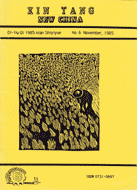
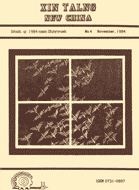
cover of issue number 4 of the journal 'Xin Tang (New China)'The fourth issue of Xin Tang is now online.

For those of you wondering why Xin Tang is spelled Xin Talng on the cover, that’s because parts of this particular issue use a tonal-spelling variation of Hanyu Pinyin, as follows.

Simple rules for tonal spelling

  1. ma (媽) / ling (拎)
  2. mal (麻) / lilng (零)
  3. maa (馬) / liing (領)
  4. mah (罵) / lihng (另)
  5. “‘” biaaoshih qingsheng, kee’shi “‘de” dou –> “d”.

Here, for example, is a message from the publisher.

Colng zheih yihqi qii SHIN TARNG gaai weil XIN TALNG, shiiyohng d welnzih yii Pin Yin (jiaan xiee PY) weil jichuu. Duobahn d welnzhang yohng yooudiaoh PY xiee. Biaodiaoh faa qiing kahn fengmiahn erh xiah’tou d jiaandan shuomilng.

The same passage in Pinyin with tone marks:

Cóng zhèi yì qī qǐ SHIN TARNG gǎi wéi XIN TANG, shǐyòng d wénzì yǐ Pīn Yīn (jiǎn xiě PY) wéi jīchǔ. Duōbàn d wénzhāng yòng yǒudiào PY xiě. Biāodiào fǎ qǐng kàn fēngmiàn èr xià’tou d jiǎndān shuōmíng.

Not all of the romanization in this issue follows that form. Some has no special spellings but instead uses tone marks. Some has no tone marks. Give ‘em all a try and see what you think.

Xin Tang 4 (PDF)

Xin Tang 6

cover of Xin Tang, no. 6My previous post linked to a new HTML version of Homographobia, an essay by John DeFrancis. The work was first published in November 1985, in the sixth issue of Xin Tang (New China).

Xin Tang (Xīn Táng) is an especially interesting journal in that it is primarily in Mandarin written in romanization. A variety of romanization systems and methods are employed over the course of the journal. Indeed, over the course of its run one can see many questions of systems and orthographies being worked out.

I want to stress, though, that the journal does not restrict itself to material of interest only to romanization specialists. It also features poetry, illustrated stories, philosophy, letters to the editor, children’s material, and much more.

English and a few Chinese characters are also found; and there are even articles in languages such as Turkish (with Mandarin and English translations).

Most of what appears in English is also translated into Mandarin — romanized Mandarin, of course. So DeFrancis’s essay also appears, appropriately, in Pinyin:

Homographobia is a disorder characterized by an irrational fear of ambiguity when individual lexical items which are now distinguished graphically lose their distinctive features and become identical if written phonemically. The seriousness of the disorder appears to be in direct proportion to the increase in number of items with identical spelling that phonemic rendering might bring about….

Tongyinci-kongjuzheng shi yi zhong xinli shang d shichang, tezheng shi huluande haipa yong pinyin zhuanxie dangqing kao zixing fende hen qingchu d cir hui shiqu tamend bianbiexing. Kan qilai, zhei ge bing d yanzhongxing gen pinyin shuxie keneng zaocheng d tongxing pinshi shuliang d zengjia cheng zhengbi….

All of the issue with the DeFrancis essay is now online: Xin Tang no. 6.

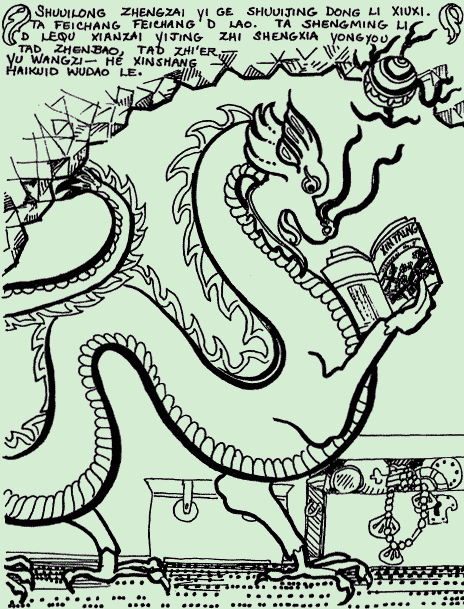
illustration of a dragon reading a copy of Xin Tang, from an illustrated story
Note the occasional employment of a tonal spelling (shuui).

Homographobia

Twenty-five years ago, John DeFrancis wrote a terrific essay on what he aptly dubbed homographobia (in Mandarin: tóngyīncí-kǒngjùzhèng). It’s a word that deserves wider currency, as the irrational fear he describes still affects a great many people.

Homographobia is a disorder characterized by an irrational fear of ambiguity when individual lexical items which are now distinguished graphically lose their distinctive features and become identical if written phonemically. The seriousness of the disorder appears to be in direct proportion to the increase in number of items with identical spelling that phonemic rendering might bring about. The aberration may not exist at all among people favored by writing systems that are already closely phonemic, such as Spanish and German. It exists to a mild degree among readers of a poorly phonemic (actually morphophonemic) writing system such as English, some of whom suffer anxiety reactions at the thought of the confusion that might arise if, for example, rain, rein, and reign were all written as rane. It exists in its most virulent form among those exposed to Chinese characters, which, among all the writing systems ever created, are unique in their ability to convey meaning under extreme conditions of isolation

That the fear is a genuine phobia, that is an irrational fear, is attested to by the fact that it is confined only to those cases in which lexical items that are now distinguished in writing would lose their distinctiveness if written phonemically, as in the case of the three English homophones mentioned above. Quite irrationally, the fear is not provoked by lexical items which are not now distinguished in writing, even though the amount of already existing homography might be considerably greater than in projected cases, such as the mere three English words pronounced rane. The English graphic form can, for example, has at least ten different meanings which to a normal mind might appear as ten different words. But no one, either in or out of his right mind in such matters, suffers any anxiety from the problems which in theory should exist in such extensive homography.

The uncritical acceptance of current written forms as an immutable given ignores the accidents in the history of writing that have resulted in current graphic differentiation for some homophones and not for others. Such methodological myopia cannot lead to any useful consideration of ambiguity….

The complete essay is now online: Homographobia.

new book in Pinyin

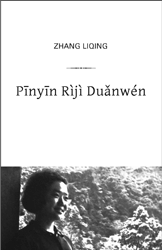
image of the cover of the printed edition of Pinyin Riji DuanwenI’m very pleased to announce the publication of a new book, Pīnyīn Rìjì Duǎnwén, by Zhāng Lìqīng. Other than one introductory letter in English, the work is entirely in Mandarin.

This is perhaps the world’s first Mandarin-language book to be published in Hanyu Pinyin without so much as one Chinese character. Thus, it is of historic importance. But it’s also a wonderful collection of stories. The author generously granted Pinyin.info the right to release all of this book online.

The work will also soon be available in an inexpensive printed edition.

Some of you will recall Zhang’s lovely story Dàshuǐ Guòhòu (“After the Flood”), which first appeared here three years ago. It leads the new collection. The remaining twelve memoirs/stories are mainly in the same vein, recalling a childhood in China and Taiwan.

Zhè shì yī gè lǎo gùshi. Shìqing fāshēng zài 1946 nián xiàtiān. Nà nián wǒ jiāngjìn shí suì, zhù zài Sìchuān Chéngdū jiāoqū d Bǎihuā Qiáo. Zhōngguó Kōngjūn Tōngxìn Xuéxiào d jīdì zài nàli. Wǒ bàba shì nà ge xuéxiào d jūnguān….

The author died earlier this year. She was able to view proofs of the work, though her illness prevented her from making any corrections herself. Fortunately, several people stepped in, contributing substantially to the checking of the Pinyin and other aspects of the work. I’d like especially to thank the following people: David W. Goodrich, Jiao Liwei, Kuo Hsin-chun, Melvin Lee, and Victor H. Mair. Any errors found in the book should be considered my own.

Please report any divergences from the Pinyin orthography established by Yin Binyong and the spellings used in the ABC Chinese-English Comprehensive Dictionary (Zhang was, after all, one of the associate editors of that massive work) to me. I’ve made very few intentional departures from those.

Please note that the use of “d” (where most authors would use “de”) is intentional. This is not a bug but a feature, something I came to understand better the more time I spent with this text. The use of “d” is explained in the second introductory letter (Liǎng Fēng Gěi Biānzhě d Xìn: 2).

a brief list of some romanization-related books

My good friend Jim, known to many through his blogs Beijing Boyce (the guide to the bars of Beijing — and lots of restaurants there as well) and Grape Wall of China (for China’s wine scene), has a new site focusing on books about or touching upon China.

He asked me to contribute my list of the top five romanization-related books in English. I cheated some, such as by leaving out Palmer’s The Principles of Romanization, with Special Reference to the Romanization of Japanese, which is difficult to find, somewhat outdated, and doesn’t focus much on Sinitic languages; and by including other works primarily in romanized Mandarin.

But it’s a start.

To see my list and lots of others, go to China Book Bites (a.k.a. Chuānchuànr).

roots of the stone lions story

The tongue-twisting tale of Mr. Shi, the poet who likes to eat lions (better known as the story that goes Shi shi shi shi shi… — see section 3 of that page), is often reproduced — though usually by people who misunderstand its meaning. (It is not an argument against romanization.)

I haven’t been able yet to track down just when and where Y.R. Chao (Zhao Yuanren / Zhào Yuánrèn / 趙元任) first published this. But what is particularly interesting, at least to me, is that this — probably the most widely known thing Chao ever wrote, outside the musical realm at least — is not entirely original to him but was inspired by another shi-story … by Chao’s roommate at Cornell.

Here’s an excerpt from “The Problem of the Chinese Language,” which Chao wrote in 1916.

I agree with Mr. Hu [Shih], therefore that living words are not intrinsically vulgar and that we should use them in writing. Secondly, whether we write with characters or with letters, we should use sounds that are at least auditorily intelligible. Differences between the spoken and the written languages do, and ought to exist in all languages, but the two must not be separated by a chasm. A poem must be recitable, an oration must be deliverable, not to oneself, but to others. I wager that if a poem is read aloud to a hundred educated persons of the same dialect as the reader, unless it is on a hackneyed them with hackneyed phrases, it will not be understood by more ears than one can count on his fingers — two ears to a person.

With one syllable shi and four variations of tones in northern mandarin, one can write a whole story. The example in 石1室1詩1士3史2氏3,嗜3豕2,失3仕3,誓3食1十1獅1。獅1似3嗜3虱1,史2氏3設1寺3,恃3師1勢3,使3施3氏3拾1獅1屍1。俟3食1時1,始2識1世3事3。史2使2侍3逝3適1市3,視3施3氏3。試3釋1是3事3…… was written by Mr. M. T. Hu. (Similar homonymic passages can be constructed in other dialects.) If we paraphrase it as in 石頭房子裏的詩翁,姓史的,愛吃豬肉,云云, we shall notice two points. First, the auditorily intelligible form has polysyllabic words for single ideas. Secondly, it uses better sounding syllables. Sin3 for surname, ai3 for like, chu1 for swine, are both more pleasant and less ambiguous than shi. Such spoken words as hao2 (good), men1 (door), yao3 (want), in their proper tones have no other common words of the same sound. This polysyllabism and the choice of sounds are the results of natural selection of speech sounds according to their survival value.

M.T. Hu stands for Minfu Ta Hu (also sometimes written Minfu Tah Hu), who went on to get his Ph.D. in mathematics at Harvard in 1917. (My initial guess was that he’s “Hu Minfu” and that his nickname is “da Hu”, given how there were several Chinese with the family name of Hu studying at Cornell at the same time. But he seems to have used the long form even in formal contexts.)

Here’s the text again without the tone numbers (which don’t correspond with current systems anyway, something that might make a good post (“Tone Wars and the Standardization of Guoyu/Putonghua”) but which I’ll probably never get around to writing). I’ve highlighted sections longer than two characters that also appear in Chao’s version (see below).

石室詩士史氏,嗜豕,失仕,誓食十獅。獅似嗜虱,史氏設寺,恃師勢,使施氏拾獅屍。俟食時,始識世事。史使侍逝適市,視施氏。試釋是事……

And here’s Chao’s version:

石室詩士施氏嗜獅,誓食十獅。氏時時適市視獅。十時,氏適市,適十碩獅適市。是時,氏視是十獅,恃十石矢勢,使是十獅逝世。氏拾是十獅尸適石室。石室濕,使侍試拭石室。石室拭。氏始試食是十獅尸。食時,始識是十碩獅尸實十碩石獅尸。是時,氏始識是事實。試釋是事。”(原文無標點)

So Chao certainly made this his own.

For more from the same essay, see Responses to objections to romanization, which is well worth reading.

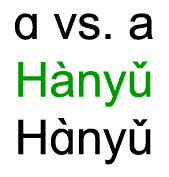
ɑ vs. a

image of the rounded 'a' and the normal 'a' with the example given of the word 'Hanyu' (with tone marks)About a year ago (which is roughly how overdue this post is), a commenter noted that some Chinese publishers “are convinced that Pinyin must be printed with ɑ (single-story „Latin alpha“, as opposed to double-story a), and with ɡ (single story; not double story g).”
But does Hanyu Pinyin in fact call for this longstanding Chinese habit of bad typography? This was one of the first questions I asked of Zhou Youguang, the father of Hanyu Pinyin, when I met with him: Are those who insist upon the ɑ-style letter correct?

“Oh, no,” Zhou replied. “That ‘ɑ’ is just for babies!” And he laughed that wonderful laugh of his that no doubt has contributed to his remarkable longevity.

Zhou was referring to the facts that the “ɑ” style of letter is usually found specifically in books for infants … and that this style generally does not belong elsewhere. In fact, ɑ and ɡ (written thusly, as opposed to g) are often referred to as infant characters. A variant of the letter y is sometimes included in this set.

Letters in that style are also found in the West — but almost always in books for toddlers, and often not even in those. Furthermore, even in those cases the use of such letters appears to have no positive effect on children’s reading.

The correct-style letters for Pinyin are the same as those for English, Zhou stated.

I hope that anyone who has been using “ɑ” will both officially and in practice switch to “a”. It’s long past time that the supposed rule calling for “ɑ” was treated as a dead letter.

Long live good typography!

persistent MPS2

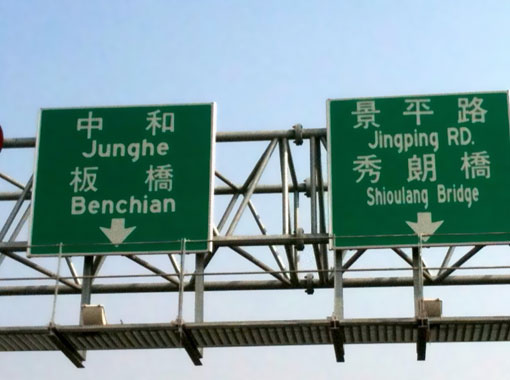
Poagao sent me this photo of signs on Zhong’an Bridge, which joins Xindian and Zhonghe (both in Taipei County). (So the zhong is probably for Zhonghe; but I’m not sure what the an is meant to be short for.) The signs are a good illustration of the sloppy approach to romanization in Taiwan. Because this is a new bridge, these are definitely new signs and thus should be in Hanyu Pinyin, which is official not just in Taipei County but nationally.

two large directional signs above a road across a bridge, as described in this post

As the table below shows, however, the only name that definitely isn’t written in MPS2 — the romanization system that predated Tongyong, which in Taiwan predated Hanyu Pinyin — is a typo. MPS2 hasn’t been official for the better part of a decade.

on the sign system Hanyu Pinyin
Junghe MPS2 Zhōnghé
Benchian wrong in all systems Bǎnqiáo
Jingping (MPS2, Tongyong, Hanyu Pinyin) Jǐngpíng
Shioulang MPS2 Xiùlǎng

And there’s no excuse for making “Shioulang Bridge” so small and squashed. This also brings to mind another aspect of Hanyu Pinyin: because of its design and the fact that it uses abbreviated forms of some vowel combinations (e.g., uei -> ui, iou -> iu), it doesn’t need as much horizontal space as MPS2 or Tongyong Pinyin, which means it can be written with larger letters — an important factor in signage. (See the second table of the comparative typing chart to see such differences between Hanyu Pinyin and Tongyong Pinyin.)

system spelling
MPS2 Shioulang
Tongyong Pinyin Sioulang
Hanyu Pinyin Xiulang