ABC English-Chinese, Chinese-English Dictionary out soon

front cover of the ABC English-Chinese, Chinese-English DictionaryThe ABC Chinese-English Dictionary was published ten years ago. It was revolutionary in that, for the first time, a Mandarin-English dictionary was ordered entirely by the headwords’ pronunciation as written in pinyin. (Stroke and radical indexes are also there to aid finding a character when its shape is known but not its pronunciation.) Other dictionaries in the DeFrancis ABC series have followed. But up to now there been no ABC dictionary with an English to Mandarin section as well as a Mandarin to English one.

At the end of this month the University of Hawai`i Press is releasing the ABC English-Chinese, Chinese-English Dictionary. The new dictionary, which is 1,252 pages long, has 29,670 entries in its English-Mandarin section and 37,963 entries for Mandarin-English (total 67,633 entries). (The much larger ABC Chinese-English Comprehensive Dictionary has some 196,000 entries — all Mandarin-English).

This is a big year for Mandarin-English dictionaries, with the forthcoming release of the ABC ECCE and the release three months ago of the massive Oxford Chinese Dictionary. From the standpoint of Pinyin, however, the Oxford dictionary is a disappointment. For example, the Oxford dictionary has no Pinyin in the English-Mandarin section, just Chinese characters; in some other places tone marks are missing from some of the Pinyin, where it appears at all. Perhaps this will be rectified in the online edition, which has yet to appear. At the moment, though, the Oxford looks like a fairly traditional dictionary — albeit a huge one — aimed mainly at English learners in China, which isn’t necessarily a bad thing if you happen to be among that very large group of people. For more on the Oxford, see the video at Danwei and the entries at Chinese Forums (with some images) and Language Log.

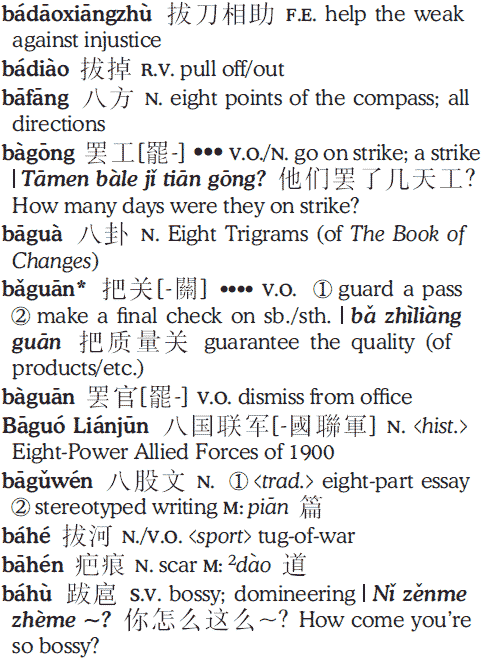
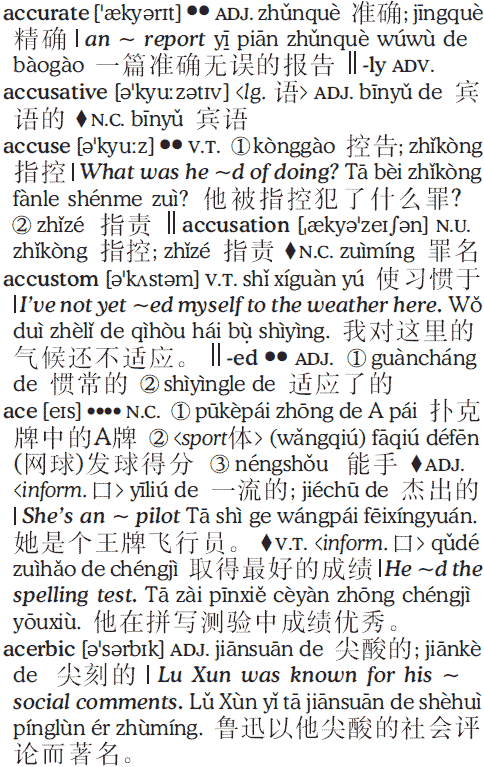
Unlike the Oxford dictionary, the ABC ECCE offers both Pinyin and Chinese characters for all entries and sample sentences. (See samples below. Click on those for more extensive examples in PDF files.)

From what I’ve seen so far of the ABC English-Chinese, Chinese-English Dictionary, I expect it to become the dictionary for English-speaking students of Mandarin. I’ll write more about this once I’m able to see a hard copy.

The ABC English-Chinese, Chinese-English Dictionary retails for only US$20, compared to US$75 for the Oxford.

From the Mandarin-English section. But don’t expect the text in the printed edition to be this large. I’ve enlarged the image to make it easier to read on the Web.
examples of entries in the Mandarin-English section of the ABC English-Chinese, Chinese-English Dictionary

From the English-Mandarin section:
examples of entries in the English-Mandarin section of the ABC English-Chinese, Chinese-English Dictionary

(ISBN-10: 0824834852; ISBN-13: 978-0824834852)

See also:

Xin Tang 6

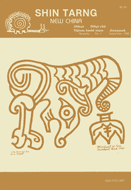
cover of Xin Tang, no. 6My previous post linked to a new HTML version of Homographobia, an essay by John DeFrancis. The work was first published in November 1985, in the sixth issue of Xin Tang (New China).

Xin Tang (Xīn Táng) is an especially interesting journal in that it is primarily in Mandarin written in romanization. A variety of romanization systems and methods are employed over the course of the journal. Indeed, over the course of its run one can see many questions of systems and orthographies being worked out.

I want to stress, though, that the journal does not restrict itself to material of interest only to romanization specialists. It also features poetry, illustrated stories, philosophy, letters to the editor, children’s material, and much more.

English and a few Chinese characters are also found; and there are even articles in languages such as Turkish (with Mandarin and English translations).

Most of what appears in English is also translated into Mandarin — romanized Mandarin, of course. So DeFrancis’s essay also appears, appropriately, in Pinyin:

Homographobia is a disorder characterized by an irrational fear of ambiguity when individual lexical items which are now distinguished graphically lose their distinctive features and become identical if written phonemically. The seriousness of the disorder appears to be in direct proportion to the increase in number of items with identical spelling that phonemic rendering might bring about….

Tongyinci-kongjuzheng shi yi zhong xinli shang d shichang, tezheng shi huluande haipa yong pinyin zhuanxie dangqing kao zixing fende hen qingchu d cir hui shiqu tamend bianbiexing. Kan qilai, zhei ge bing d yanzhongxing gen pinyin shuxie keneng zaocheng d tongxing pinshi shuliang d zengjia cheng zhengbi….

All of the issue with the DeFrancis essay is now online: Xin Tang no. 6.

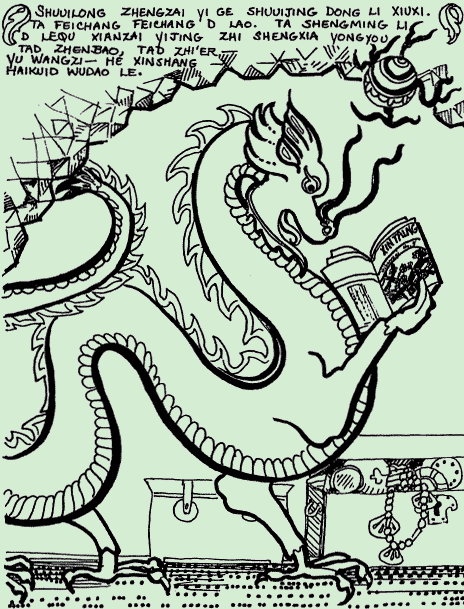
illustration of a dragon reading a copy of Xin Tang, from an illustrated story
Note the occasional employment of a tonal spelling (shuui).

Homographobia

Twenty-five years ago, John DeFrancis wrote a terrific essay on what he aptly dubbed homographobia (in Mandarin: tóngyīncí-kǒngjùzhèng). It’s a word that deserves wider currency, as the irrational fear he describes still affects a great many people.

Homographobia is a disorder characterized by an irrational fear of ambiguity when individual lexical items which are now distinguished graphically lose their distinctive features and become identical if written phonemically. The seriousness of the disorder appears to be in direct proportion to the increase in number of items with identical spelling that phonemic rendering might bring about. The aberration may not exist at all among people favored by writing systems that are already closely phonemic, such as Spanish and German. It exists to a mild degree among readers of a poorly phonemic (actually morphophonemic) writing system such as English, some of whom suffer anxiety reactions at the thought of the confusion that might arise if, for example, rain, rein, and reign were all written as rane. It exists in its most virulent form among those exposed to Chinese characters, which, among all the writing systems ever created, are unique in their ability to convey meaning under extreme conditions of isolation

That the fear is a genuine phobia, that is an irrational fear, is attested to by the fact that it is confined only to those cases in which lexical items that are now distinguished in writing would lose their distinctiveness if written phonemically, as in the case of the three English homophones mentioned above. Quite irrationally, the fear is not provoked by lexical items which are not now distinguished in writing, even though the amount of already existing homography might be considerably greater than in projected cases, such as the mere three English words pronounced rane. The English graphic form can, for example, has at least ten different meanings which to a normal mind might appear as ten different words. But no one, either in or out of his right mind in such matters, suffers any anxiety from the problems which in theory should exist in such extensive homography.

The uncritical acceptance of current written forms as an immutable given ignores the accidents in the history of writing that have resulted in current graphic differentiation for some homophones and not for others. Such methodological myopia cannot lead to any useful consideration of ambiguity….

The complete essay is now online: Homographobia.

roots of the stone lions story

The tongue-twisting tale of Mr. Shi, the poet who likes to eat lions (better known as the story that goes Shi shi shi shi shi… — see section 3 of that page), is often reproduced — though usually by people who misunderstand its meaning. (It is not an argument against romanization.)

I haven’t been able yet to track down just when and where Y.R. Chao (Zhao Yuanren / Zhào Yuánrèn / 趙元任) first published this. But what is particularly interesting, at least to me, is that this — probably the most widely known thing Chao ever wrote, outside the musical realm at least — is not entirely original to him but was inspired by another shi-story … by Chao’s roommate at Cornell.

Here’s an excerpt from “The Problem of the Chinese Language,” which Chao wrote in 1916.

I agree with Mr. Hu [Shih], therefore that living words are not intrinsically vulgar and that we should use them in writing. Secondly, whether we write with characters or with letters, we should use sounds that are at least auditorily intelligible. Differences between the spoken and the written languages do, and ought to exist in all languages, but the two must not be separated by a chasm. A poem must be recitable, an oration must be deliverable, not to oneself, but to others. I wager that if a poem is read aloud to a hundred educated persons of the same dialect as the reader, unless it is on a hackneyed them with hackneyed phrases, it will not be understood by more ears than one can count on his fingers — two ears to a person.

With one syllable shi and four variations of tones in northern mandarin, one can write a whole story. The example in 111323,嗜32,失33,誓3111。獅1331,史2313,恃313,使333111。俟311,始2133。史2使23313,視333。試3133…… was written by Mr. M. T. Hu. (Similar homonymic passages can be constructed in other dialects.) If we paraphrase it as in 石頭房子裏的詩翁,姓史的,愛吃豬肉,云云, we shall notice two points. First, the auditorily intelligible form has polysyllabic words for single ideas. Secondly, it uses better sounding syllables. Sin3 for surname, ai3 for like, chu1 for swine, are both more pleasant and less ambiguous than shi. Such spoken words as hao2 (good), men1 (door), yao3 (want), in their proper tones have no other common words of the same sound. This polysyllabism and the choice of sounds are the results of natural selection of speech sounds according to their survival value.

M.T. Hu stands for Minfu Ta Hu (also sometimes written Minfu Tah Hu), who went on to get his Ph.D. in mathematics at Harvard in 1917. (My initial guess was that he’s “Hu Minfu” and that his nickname is “da Hu”, given how there were several Chinese with the family name of Hu studying at Cornell at the same time. But he seems to have used the long form even in formal contexts.)

Here’s the text again without the tone numbers (which don’t correspond with current systems anyway, something that might make a good post (“Tone Wars and the Standardization of Guoyu/Putonghua”) but which I’ll probably never get around to writing). I’ve highlighted sections longer than two characters that also appear in Chao’s version (see below).

石室詩士史氏,嗜豕,失仕,誓食十獅。獅似嗜虱,史氏設寺,恃師勢,使施氏拾獅屍。俟食時,始識世事。史使侍逝適市,視施氏。試釋是事……

And here’s Chao’s version:

石室詩士施氏嗜獅,誓食十獅。氏時時適市視獅。十時,氏適市,適十碩獅適市。是時,氏視是十獅,恃十石矢勢,使是十獅逝世。氏拾是十獅尸適石室。石室濕,使侍試拭石室。石室拭。氏始試食是十獅尸。食時,始識是十碩獅尸實十碩石獅尸。是時,氏始識是事實。試釋是事。”(原文無標點)

So Chao certainly made this his own.

For more from the same essay, see Responses to objections to romanization, which is well worth reading.

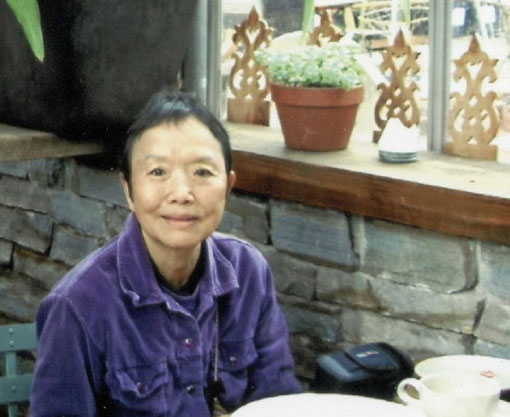
Li-ching Chang, 1936-2010

Li-ching Chang (Zhāng Lìqīng / 張立青 / 张立青 / Zhang Liqing) was born in Changyi (near Qingdao), Shandong Province, China, on October 5, 1936. When she was 5 years old, her family sought to escape the fighting (between the Communists and the Nationalists) in her native Shandong Province and fled inland to Sichuan, eventually settling in Chengdu. In 1947 Li-ching’s family followed Chiang Kai-shek’s armies and moved to Gangshan, southern Taiwan. Li-ching attended Tainan Normal School. The same school at the same location has since been expanded to become the National University of Tainan. Upon graduation from this teacher training high school, Li-ching taught in elementary schools for several years. During this period, she also joined an army drama troupe.

After an intensive period of preparation for the college entrance examinations, Li-ching was successful in entering the Chinese Department at National Taiwan University, from which she received her B.A. degree in 1964. She also went on to earn an M.A. (1966) at NTU, with a thesis focusing on the works of the early medieval poet, Tao Yuanming. Later, she enrolled in a graduate program of Chinese studies at the University of Washington in Seattle, and there she earned another M.A., writing a thesis on the modern Chinese playwright, Cao Yu.

Li-ching was a superb teacher of Mandarin and was employed by numerous outstanding institutions of higher education, including the University of Washington, the Oberlin program at Tunghai University (Taichung, Taiwan), Middlebury College, Harvard University, Bryn Mawr College (joint program with Haverford College), the University of Pennsylvania, and Swarthmore College. Li-ching was co-founder and co-editor of Xin Tang, a journal of romanized Chinese. She served on the editorial board of the ABC Chinese-English dictionaries at the University of Hawaii and made a virtuoso translation of Zhou Youguang’s The Historical Evolution of Chinese Languages and Scripts (published by The Ohio State University National East Asian Language Resource Center in 2003).

She generously provided several of her important works to this Web site, including:

Li-ching lived in Swarthmore, Pennsylvania, with her husband, the scholar Victor H. Mair.

Li-ching Chang / Zhang Liqing / ???

Pinyin subtitles for Crouching Tiger, Hidden Dragon

Er, someone has created Hanyu Pinyin subtitles for the film Crouching Tiger, Hidden Dragon (Wòhǔcánglóng / 臥虎藏龍 / 卧虎藏龙). They’re in UTF-8 (Unicode) and come in two varieties: one with tone marks (link above), the other without. The latter would be useful primarily for those who have trouble getting diacritics to appear properly, such as many of those watching the movie through a TV hooked up to a DivX DVD player.

The set of subtitles also includes English and Mandarin in Chinese characters (both traditional and simplified versions).

The subtitles might seem to go by a bit quickly. But that’s generally because people don’t have much experience reading Hanyu Pinyin. (Also, the English subtitles leave out a lot. But the Pinyin ones are comprehensive.) Practice reading and you’ll get much faster at it.

Remember to use these only for good (e.g., practice reading Pinyin, Mandarin learning, helping those with problems reading Chinese characters) and not bad (e.g., piracy).

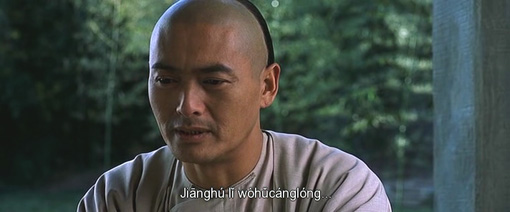
still from the movie, showing the subtitled text of Li Mubai saying 'Jianghu li wohucanglong'

recent milestones for Sino-Platonic Papers

The Web site for Sino-Platonic Papers, Professor Victor Mair’s iconoclastic journal, has expanded to the point that, as of the most recent batch of reissues, it offers more than half of the journal’s 198 (and counting) issues in full and for free. So if you haven’t visited that site recently you might want to have another look.

I’ll mention just a few of the recent additions:

Other recent milestones for SPP include

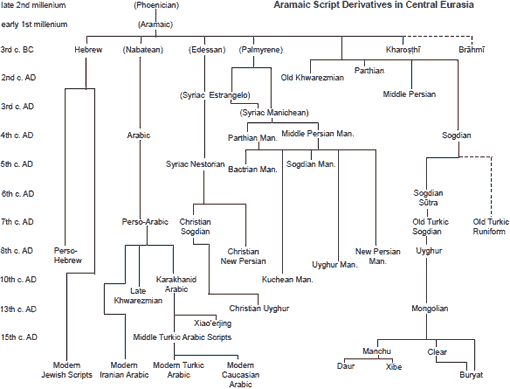
Below: A chart from SPP 198, Aramaic Script Derivatives in Central Eurasia, by Doug Hitch.
chart of scripts derived from Aramaic. See SPP 198 (the link for this image) for a version of this chart with machine-readable text.

How to learn real Mandarin: an anecdote

The following is a guest post by Professor Victor H. Mair of the University of Pennsylvania’s Department of East Asian Languages and Civilizations.

The personal names used in the original correspondence have been changed to generational designations.

Compared to the Hànzì-centric pedagogical approach which forces little children to memorize extremely difficult and complicated characters like 老鼠 and 蝴蝶 instead of teaching them lǎoshǔ and húdié, today I received some more hopeful and sane news.

A friend of mine is teaching her grandson Mandarin. The way she is doing it is to write out the Xī yóu jì (Journey to the West) in a simple báihuà paraphrase using Pinyin only (with glosses in English for new vocabulary). My friend is a first-generation immigrant to America, and her daughter married a German who was studying in the United States, so that makes the grandson third-generation Chinese-American/German.

The other day, the grandson asked his mom out of the blue: “What’s the difference between shíjiān, shídài, and shífèn?” My friend, the grandmother, explained to me that all of these terms were in the Pinyin text that she had prepared for her grandson, and that she had glossed them as “time” or “period.” She said that the boy’s mother was very pleased, and she was tickled too, because the boy had discerned the common element shí by himself. As my friend (the grandmother) put it, “He spends very little time on Chinese, so we were pleasantly surprised.”

Hearing this account from my friend, I wrote to her: “Thank you so much for the TRULY WONDERFUL story you wrote about your grandson. This is how to learn real Chinese!!!! And you are being a real Chinese teacher to teach your grandson this way. And I’m also happy that your daughter appreciates what you and her son are doing together. Tell your grandson I’m really impressed at the intelligence of his question.”