books bought in Beijing

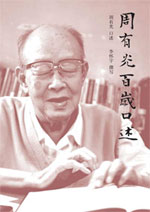
cover of a book by Zhou YouguangI didn’t have any luck finding anything in Sin Wenz (Lādīnghuà Xīn Wénzì / 拉丁化新文字), despite trips to several large used book stores. (Fortunately, the Internet is now providing some leads. Thanks, Brendan and Joel!) But I did find some other books to bring home.
I acquired lots of books by Zhou Youguang, not all of which focus primarily on linguistics:

Other than the Zhou Youguang books, here are my favorite finds of the trip, as they are for the most part in correctly word-parsed Hanyu Pinyin (with Hanzi underneath), along with a few notes in English:

I’ll soon be posting more about the above books with Pinyin, so watch this site for updates. Really, this is gonna be good.

Although this collection of Y.R. Chao says it’s volume 15, it’s actually two books:

  • Zhào Yuánrèn quánjí, dì 15 juàn (趙元任全集第15卷)

Some more titles:

  • Measured Words: The Development of Objective Language Testing, by Bernard Spolsky
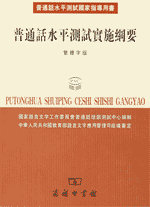
  • Pǔtōnghuà shuǐpíng cèshì shíshī gāngyào (普通話水平測試實施綱要). Now with the great smell of beer! Sorry, Brendan, I owe you one — more than one, actually.

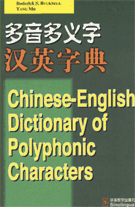
The following I bought because Yin Binyong, the scholar primarily responsible for Hanyu Pinyin’s orthography, is the author of these titles from Sinolingua’s series of Bógǔtōngjīn xué Hànyǔ cóngshū (“Gems of the Chinese Language through the Ages” (their translation)), all of which are in Mandarin (Hanzi) and English, with Pinyin only for the sayings being illustrated:

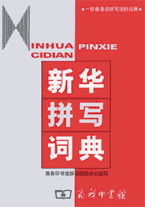
cover of 'Chinese-English Dictionary of Polyphonic Characters' (多音多义字汉英词典)cover of 'Putonghua shuiping ceshi shishi gangyao' (普通話水平測試實施綱要)cover of 'Xinhua pinxie cidian'

Other:

And finally:

Of course I already have that one — more than one copy, in fact. But it’s always good to have more than one spare when it comes to one of the two most important books on Pinyin orthography. I really need to follow up on my requests to use excerpts from this book, as it is the only major title missing from my list of romanization-related books (though it’s in Mandarin only).

sign in a Beijing bookstore reading 'Education Theury' [sic]

Y.R. Chao’s responses to arguments against romanization

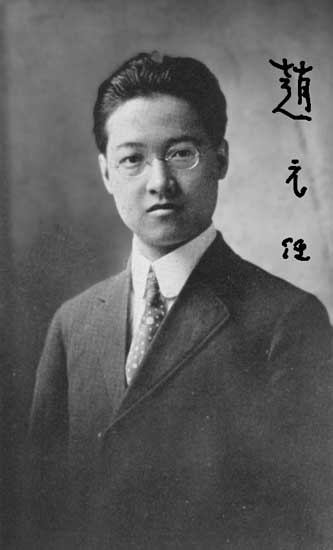
Y.R. Chao. Also, FWIW, Wikipedia took this image from Pinyin.Info, not the other way around.Pinyin.Info has a new reading: Responses to objections to romanization, written by the brilliant linguist Y.R. Chao in 1916, when he was a young man of 24.

It’s an unfortunate irony that another writing associated with Chao, the famous “stone lions” (a.k.a. shi, shi, shi) piece, is often mistakenly cited as evidence that the author opposed romanization. In fact, Chao favored using romanization for Mandarin, as his essay reveals.

It’s written in the form of 16 “objections,” each followed by Chao’s reply. For example:

Obj. 8 Alphabetized Chinese loses its etymology.

Rep. 8 This argument is like that often urged against simplified English spelling and is to be met similarly. In actual usage, how much attention do we give to etymology in words like 學, 暴, 發, 旋, 之, through, draught, etiquette, row, disaster? Of how many of these very common words do you know the original meaning? It is not to be denied, of course, that it is useful to know the etymology of words by looking them up, and our future dictionaries of alphabetized polysyllabic words should no doubt give their derivations.

The etymology of disaster (which is pretty cool) is certainly easy enough for an educated person to guess, if you stop to think about it. But I must admit I never had.

I have added notes following the text.

The Art of War: a companion volume

Sonshi, the largest website dedicated to Sun Zi’s (Sun Tzu’s) Art of War, recently selected Victor H. Mair’s new translation as “the #1 Art of War edition.”

In announcing its judgment, the site stated, “how rare a book that courageously stands up to centuries of established thought, proceeds to knock it down with sound logic and proof, and succeeds in convincing even the Old Guard to change their views.”

Professor Mair has just published a free, book-length companion to his translation: Soldierly Methods: Vade Mecum for an Iconoclastic Translation of Sun Zi bingfa, with a complete transcription and word-for-word glosses of the Manchu translation by H. T. Toh (1 MB PDF).

Yes, all that and Manchu too. The appendixes might well supply the longest text in romanized Manchu available online — not to mention the longest one with English translation. (Perhaps someone from Echoes of Manchu can comment.)

And I’d like to note the introduction to the transcription offers a cool word I hadn’t come across before: Mandjurist, which is German for “Manchu philologist.”

Here’s the table of contents:

  • Preface
  • Principles of Translation
  • Guide to Pronunciation
  • Key Terms
  • Abbreviations
  • Discussion
    • The Book and Its Title
    • Authorship
    • Historical Background
    • Dating
    • Stylistics and Statistics
    • Techniques and Technology
    • Taoistic Aspects
    • Eurasian Parallels
    • On the World Stage
    • Notes
  • Appendix I: The Pseudo-Biography of Sun Wu
  • Appendix II: Further Notes on Selected Key Terms
  • Appendix III: Transcription of the Manchu Translation of the Sun Zi with Word-for-Word English Glosses by Hoong Teik Toh
  • Appendix IV: Transcription of the Manchu Translation of the Sun Zi by Hoong Teik Toh
  • Bibliography

This is issue no. 178 of Sino-Platonic Papers.

John DeFrancis video

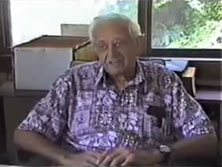
John DeFrancisTen years ago John DeFrancis was awarded the Chinese Language Teachers Association’s first lifetime achievement award. Since he could not be present at the association’s annual conference to receive the award, he sent a videotape of a 12-minute acceptance speech. The video was recently edited down to 6:27 and uploaded to YouTube: John DeFrancis remarks.

Here’s my summary of the main points:

0:00 — While working on what he intended to be a largely political study of Chinese nationalism, DeFrancis encountered references to people who wanted China to adopt an alphabetic writing system, an idea which he initially dismissed. But discovering Lu Xun’s interest in romanization led him to investigate the matter further. [I’m frustrated by the cut away from this discussion. Perhaps a fuller version of the video will be posted later.]
1:30 — Emphasizes he’s not in favor of completely abandoning Chinese characters. Rather, he favors digraphia.
2:30 — “I’d like to mention three aspects of the Chinese field which have interested me.”

  1. pedagogy (2:50) — lots of advancements
  2. linguistic aspect (3:20) — that’s also progressing well
  3. socio-linguistics (3:52) — the field isn’t doing as well as it should be

5:00 — computers and Chinese characters. DeFrancis tears into the Chinese government for its emphasis on shape-based character-input methods rather than Pinyin.

Book reviews, vol. 6

Sino-Platonic Papers has rereleased for free its sixth volume of reviews, mainly of books about China and its history and languages (5.6 MB PDF).

The reviews are by David Utz, Xinru Liu, Taylor Carman, Bryan Van Nordan, and Victor H. Mair.

Contents

  • Review Article by David A. Utz of Ádám Molnár, Weather-Magic in Inner Asia. With an Appendix, “Alttürkische fragmente über den Regenstein,” by P. Zieme. Indiana University Uralic and Altaic Series, 158. Bloomington, Indiana: Indiana University, 1994.
  • Graham Parkes, ed., Heidegger and Asian Thought. Honolulu: University of Hawaii Press, 1987. Reviewed by Taylor Carman and Bryan Van Norden.
  • Beijing Daxue Nanya Yanjiusuo [Peking University Institute for South Asian Studies], ed. Zhongguo zaiji zhong Nanya shiliao huibian (Collection of South Asian Historical Materials from Chinese Sources). 2 vols. Shanghai: Shanghai Guji Chubanshe, 1995. Reviewed by Xinru Liu.

The following 23 reviews are by the editor of Sino-Platonic Papers.

  • Ronald E. Emmerick and Edwin G. Pulleyblank. A Chinese Text in Central Asian Brahmi Script: New Evidence for the Pronunciation of Late Middle Chinese and Khotanese. Serie Orientale Roma, LXIX. Rome: lstituto ltaliano per ii Medio ed Estremo Oriente, 1993.
  • YIN Binyong and SU Peicheng, eds. Kexuede pingjia Hanyu hanzi [Scientifically Appraise Sinitic and Sinographs]. Zhongguo yuwen xiandaihua congshu (Chinese Language Modernization Series), 1. Peking: Huayu Jiaoxue Chubanshe (Sinolingua), 1994.
  • WU Chang’an. Wenzi de toushi — Hanzi lunheng [A Perspective on Culture — Balanced Discussions on the Sinographs]. Wenhua Yuyanxue Congshu [Cultural Linguistics Series]. N.p. (Changchun?): Jilin Jiaoyu Chubanshe, 1995.
  • ZHOU Shilie, comp. Tongxingci cidian [Dictionary of Homographs]. Peking: Zhongguo Guoji Guangbo Chubanshe, 1995. (Reviewed twice from different perspectives in the same issue.)
  • KANG Yin. Wenzi Yuanliu Qianshi (The Origin and Development of Chinese Ideographs) (sic). N.p.: Guoji Wenhua Chubanshe, 1992.
  • DUAN Kailian. Zhongguo minjian fangyan cidian [A Dictionary of Chinese Folk Topolecticisms]. Haikou: Nanhai chuban gongsi, 1994.
  • CHANG Xizhen, comp. Beiping tuhua [Peking Colloquialisms]. Taipei: Shenge Shiye Youxian Gongsi Chubanshe, 1990.
  • ZHANG Xunru. Beiping yinxi xiaoche bian [A Compilation of Words with “er” Suffix in Pekingese]. Taipei: Taiwan Kaiming, 1991; 2nd Taiwan ed.; 1956, first Taiwan ed.
  • LI Sijing. Hanyu “er” [] yin shi yanjiu [Studies on the History of the “er” [] Sound in Sinitic]. Taipei: Taiwan Shangwu, 1994.
  • Erdengtai, Wuyundalai, and Asalatu. Menggu mishi cihui xuanshi [Selected Explanations of Lexical Items in The Secret History of the Mongols]. Mengguzu lishi congshu [Series on the History of the Mongolian People]. Hohhot: Neimenggu Renrnin Chubanshe, 1980; 1991 rpt.
  • Matthews, Stephen and Virginia Yip. Cantonese: A Comprehensive Grammar. Routledge Grammars. London and New York: Routledge, 1994.
  • Killingley, Siew-Yue. Cantonese. Languages of the World / Materials 06. München-Newcastle: Lincom Europa, 1993.
  • ZHONG Jingwen, chief ed. Yuhai (An Encyclopedia of Chinese Folk Language), Vol. 1: Mimiyu (Chinese Secret Language). Vol. editors ZHENG Shuoren and CHEN Qi. Shanghai: Shanghai Wenyi Chubanshe, 1994.
  • Harrell, Stevan, ed. Cultural Encounters on China’s Ethnic Frontiers. Seattle and London: University of Washington Press, 1995.
  • Woo, Henry K. H. The Making of a New Chinese Mind: Intellectuality and the Future of China. Hong Kong: China Foundation, 1993.
  • Miller, Lucien, ed. South of the Clouds: Tales from Yunnan. Translated by GUO Xu, Lucien Miller, and XU Kun. Seattle and London: University of Washington Press, 1994.
  • Hoizey, Dominique and Marie-Joseph Hoizey. A History of Chinese Medicine. Tr. by Paul Bailey. Vancouver: UBC Press; Edinburgh: Edinburgh University Press, 1993.
  • Crystal, David. An Encyclopedic Dictionary of Language and Languages. London: Penguin, 1992, 1994.
  • Day, Gordon M. Western Abenaki Dictionary. Vol. 1: Abenaki-English. Vol. 2: English-Abenaki. Mercury Series, Canadian Ethnology Service, Papers 128 and 129. Hull, Quebec: Canadian Museum of Civilization, 1994-95.
  • Hassrick, Peter H. The Frederic Remington Studio. Cody, Wyoming: Buffalo Bill Historical Center, in association with University of Washington Press (Seattle, London), 1994.
  • Jonaitis, Aldona, ed. Chiefly Feasts: The Enduring Kwakiutl Potlatch. Seattle and London: University of Washington Press; New York: American Museum of Natural History, 1991.
  • Jerry L. Norman and W. South Coblin. “A New Approach to Chinese Historical Linguistics.” Journal of the American Oriental Society, 115.4 (1995),576-584.

Bits and Pieces

  • Letter concerning An Zhimin’s views on the origins of bronze metallurgy in China.
  • “Yet again on Tibet.” This is one in a continuing series of discussions with Edwin G. Pulleyblank, W. South Coblin, and others on the origins of the name “Tibet”.

This was first published in February 1996 as issue no. 70 of Sino-Platonic Papers.

Mandarin newspaper with Pinyin

Victor Mair’s latest post at Language Log introduces a new U.S.-based newspaper, the Huayu Xuebao (Mandarin Learning Newspaper, 華語學報), which is similar to Taiwan’s Guoyu Ribao (Mandarin Daily News), the main difference being the former uses Hanyu Pinyin while the latter uses zhuyin fuhao (bopo mofo).

Well, actually the Huayu Xuebao doesn’t use proper Pinyin (see recent remarks). But I’m so happy to see this long-needed paper that I’ll hold my tongue for now.

Unfortunately, the paper doesn’t have its Web site ready yet — not that the long-established Guoyu Ribao is much better at that, at least when it comes to texts as they appear in the newspaper. So, for more information about the Huayu Xuebao, write learningnewspaper [AT] yahoo.com or phone +1-201-288-9188 (New Jersey).

There’s also a sample issue.

source: How to learn to read Chinese, Language Log, May 25, 2008