foreign languages in NZ secondary schools

New Zealand’s Ministry of Education has released figures on secondary school enrollments in foreign languages in 2007, according to a newspaper report.

Education Ministry figures show nearly 70,000 pupils studied foreign languages at secondary schools last year, with 27,284 learning French.

Japanese was also popular (18,440), followed by Spanish (9531) and German (6623).

Chinese… attracted just 1687 pupils.

The total of those figures (63,565) seems considerably shy of “nearly 70,000.” So I suspect some languages more popular than Mandarin have been left off the list. Either way, Mandarin takes only about 2.5 percent of the total. And no indication is given of what percentage of those are “heritage” students.

That’s a lot of kids taking Japanese, though. Can anyone familiar with the situation in New Zealand comment on that?

I wasn’t able to locate the source of these figures. I did, however, find some figures from ten years ago, though they don’t include Mandarin. Also, I don’t understand the categories. But, FWIW:

Numbers of students studying second languages, July 1998

language secondary learners primary & intermediate learners
Japanese 21,701 13,625
French 20,990 8,413
German 7,377 3,877
Spanish 2,247 5,172

A few more lines from the 2008 report:

Under the new curriculum, schools must be “working toward” offering pupils in years 7 to 10 the option of learning a second language from 2011, in a push to make more Kiwis bilingual.

However, the ministry says it is up to schools and their communities to choose which languages are offered – meaning French is likely to remain popular.

A ministry spokesman said measures were underway to boost teachers’ ability to teach a variety of foreign languages in schools.

They included Maori medium scholarship and overseas exchange programmes.

sources:

further reading:

US post-secondary enrollments in foreign languages and the position of Mandarin

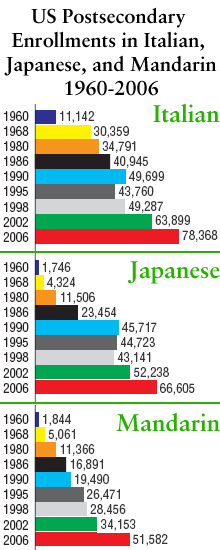
graphs showing the enrollments of Japanese and Mandarin over time, with Italian thrown in by way of comparisonFrom the way the U.S. media talk about the boom in Mandarin classes, it’s easy to get the impression that Mandarin is about to become the most studied language in the United States. So I offer the following overdue reality check.

The data come from the results of a large survey of foreign-language enrollments in U.S. post-secondary schools. The survey was conducted by the Modern Language Association. I started work on this post when the results were released in November 2007; but, well, I got distracted.

This post has lots of tables and figures, so for those who don’t want to scan through everything I offer some basic points up front.

  • Spanish has more enrollments than all other foreign languages put together.
  • By far the biggest enrollment boom since 1990 has not been for Mandarin but for American Sign Language.
  • The boom in enrollments in Arabic also surpasses that for Mandarin.
  • Mandarin is indeed growing in popularity — but in recent years only at the undergraduate level.
  • Japanese continues to be more popular than Mandarin, though by an ever-smaller margin.
  • Mandarin is the seventh most studied foreign language in U.S. post-secondary schools, behind Spanish (which leads Mandarin by a ratio of 16:1), French, German, American Sign Language, Italian, and Japanese.
  • Relatively speaking, enrollments in foreign languages are much lower than they were 30 years ago.

A few summary remarks of my own:

  • I don’t expect the high growth rates for Mandarin to continue for many more years unless the programs are dumbed down (in which case they wouldn’t count for much) or Pinyin gains a much more prominent role in Mandarin pedagogy (and not just at the introductory level). The difficulties of Chinese characters will help keep numbers down, as will the eventual realization that learning Mandarin isn’t an easy ticket to riches (or even a ticket to riches at all).
  • Japanese received a big boost in the 1980s, when the media cranked out story after story about the power of Japan’s rising economy and the need to learn the language. Yet Japanese didn’t become the next big world language. I predict a similar path for Mandarin.
  • A high percentage of those taking Mandarin classes in U.S. high schools are students who are both ethnically Chinese and already familiar with the language. The MLA didn’t provide figures on that for post-secondary students. But I would be surprised if such “heritage” students don’t represent a higher percentage of those in Mandarin language courses than heritage students in most other language classes.

OK, now on to some details.

Look below at the growth for American Sign Language since 1990. If Mandarin had had that sort of growth (4,820 percent!) the pundits would no doubt be telling us that the Chinese had already taken over the planet and were going to rule the entire galaxy within the next decade. (And don’t get me started about the supposed Mandarin in Serenity/Firefly.) But American Sign Language just doesn’t seem to get the same sort of respect, despite the fact that it still has more than 50 percent more enrollments than Mandarin. Arabic, which has also had a much faster growth rate than that of Mandarin, hasn’t received the same level of hype either.

Growth in Enrollments: in declining order of growth from 1990 to 2006

Enrollments 1990 2006 % Growth 2002-06 % Growth 1990-2006
American Sign Language 1,602 78,829 29.7 4820.7
Arabic 3,475 23,974 126.5 589.9
Korean 2,286 7,145 37.1 212.6
Mandarin 19,490 51,582 51.0 164.7
Hebrew 12,995 23,752 4.2 82.8
Portuguese 6,211 10,267 22.4 65.3
Italian 49,699 78,368 22.6 57.7
Spanish 533,944 822,985 10.3 54.1
Japanese 45,717 66,605 27.5 45.7
French 272,472 206,426 2.2 -24.2
German 133,348 94,264 3.5 -29.3
Russian 44,626 24,845 3.9 -44.3
Total 1,125,865 1,489,042 12.7 32.3

Change in enrollments over time: in declining order of total enrollment for 2006

Change between Surveys 1995-98 1998-2002 2002-06
Spanish 8.3% 13.7% 10.3%
French -3.1% 1.5% 2.2%
German -7.5% 2.3% 3.5%
American Sign Language 165.3% 432.2% 29.7%
Italian 12.6% 29.6% 22.6%
Japanese -3.5% 21.1% 27.5%
Mandarin 7.5% 20.0% 51.0%
Russian -3.8% 0.5% 3.9%
Arabic 23.9% 92.3% 126.5%
Hebrew * 20.6% 44.0% 4.2%
Portuguese 6.0% 21.1% 22.4%
Korean 34.0% 16.3% 37.1%
Total 5.0% 16.6% 12.7%

* Modern and Biblical Hebrew combined

Below: Russian may not have the top number of enrollments, but it certainly has some motivated students, given the high numbers of them in advanced courses.

Enrollments in Introductory-Level Courses vs. Enrollments in Advanced-Level Courses

Intro Enr. Advanced Enr. Total Enrollment Ratio of Intro Enr. to Advanced Enr.
Russian 17,527 6,569 24,096 2.67:1
Portuguese 7,387 2,422 9,809 3.05:1
German 72,434 18,758 91,192 3.86:1
French 160,736 40,927 201,663 3.93:1
Korean 5,511 1,397 6,908 3.94:1
Greek, Ancient 13,250 3,176 16,426 4.17:1
Mandarin 41,193 9,262 50,455 4.45:1
Spanish 669,432 142,602 812,034 4.69:1
Japanese 55,161 10,585 65,746 5.21:1
Latin 26,787 4,383 31,170 6.11:1
Hebrew, Modern 7,665 1,250 8,915 6.13:1
Arabic 20,571 2,463 23,034 8.35:1
Italian 69,757 7,593 77,350 9.19:1
Hebrew, Biblical 7,854 705 8,559 11.14:1
American Sign Language 72,694 5,249 77,943 13.85:1
Other languages 27,836 3,478 31,314 8.00:1
Total 1,275,795 260,819 1,536,614 4.89:1

One thing I find particularly troubling is that the number of graduate students studying Mandarin has fallen. (Please click on the link in the previous sentence, since the relevant table is too wide to fit on this page.) The much-ballyhooed but also much-deserved increase in students studying Mandarin has all been at the undergraduate level. Given that the grad enrollment as a percentage of total enrollment for Mandarin is about the same as that for French (2.63 percent and 2.73 percent, respectively) it might appear that Mandarin has simply reached a “normal” ratio in this regard. But native speakers of English generally need much more time to master Mandarin than to master French. Simply put, four years, say, of post-secondary study of French provides students with a much greater level of fluency than four years of post-secondary study of Mandarin.

Also, there is a great deal more work that needs to be done in terms of translations from Mandarin. I do not at all mean to belittle the work being done in French — or in any other language. In fact it pains me that the MLA’s list of languages being studied included neither Old French nor Provençal, both of which I have studied and love dearly. I just mean that Mandarin has historically been underrepresented in U.S. universities given the number of speakers it has and its body of texts that have not yet been translated into English. U.S. universities need to be producing many more qualified grad students who can handle this specialized work. And right now, unfortunately, that’s not happening.

Post-Secondary Enrollments in Select Sino-Tibetan Languages and Classical Japanese: 2002, 2006

Two-Year Colleges Undergrad Programs Grad Programs Total
Language 2002 2006 2002 2006 2002 2006 2002 2006
Cantonese 47 96 128 82 5 0 180 178
Literary Sinitic 0 0 56 101 18 12 74 113
Japanese, Classical 0 0 8 23 11 7 19 30
Taiwanese 0 0 34 21 13 0 47 21
Tibetan 0 0 43 56 35 64 78 120
Tibetan, Classical 0 0 8 11 20 33 28 44

The figures in the table above are probably too low. Literary Sinitic (“classical Chinese”) is probably especially underrepresented because often too little differentiation is given between it and modern standard Mandarin. But at least the numbers can provide minimum figures.

Enrollments in Introductory Classes: 2-Year Schools vs. 4-Year Schools

Language Ratio of Intro Enr. in 2-Year Schools to Intro Enr. in 4-Year Schools
Greek, Ancient 0.00:1
Hebrew, Biblical 0.01:1
Latin 0.04:1
Hebrew, Modern 0.07:1
Portuguese 0.11:1
Russian 0.15:1
German 0.20:1
Italian 0.23:1
French 0.24:1
Arabic 0.26:1
Mandarin 0.26:1
Korean 0.28:1
Japanese 0.39:1
Spanish 0.49:1
American Sign Language 1.47:1
Other languages 0.24:1

American Sign Language sticks out here as the only language that more people take at the introductory level at junior colleges than at universities. Roughly twice as many people take introductory Spanish in universities as at junior colleges. Introductory Japanese classes are surprisingly popular at the two-year college level, well above the level for introductory Mandarin, though Mandarin is not unpopular itself.

Course Enrollments in Some Asian and Pacific Languages

Language 1998 2002 2006 % Change 2002–06
Hindi/Urdu 1314 2009 2683 33.55
Vietnamese 899 2236 2485 11.14
Tagalog/Filipino 794 1142 1569 37.39
Sanskrit 363 487 607 24.64
Hmong 15 283 402 42.05
Thai 272 330 307 -6.97
Indonesian 223 225 301 33.78
Samoan 207 201 280 39.30
Cantonese 39 180 178 -1.11
Tibetan 80 78 120 53.85
Literary Sinitic 32 74 113 52.70
Pashto 14 103 635.71
Punjabi 32 99 103 4.04
Total 4270 7358 9251 25.73

Although more U.S. postsecondary students are studying languages other than English than ever before, that’s unfortunately not because U.S. students as a whole have finally embraced the study of languages. Rather, there are simply more students now. Relatively speaking, enrollments in foreign languages are much lower than they were 30 years ago.
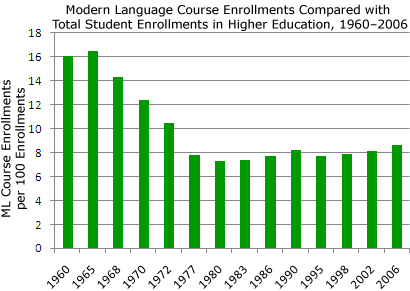
graph showing that present US postsecondary enrollment in foreign languages is relatively much lower than it was in in the 1960s

If “ancient” foreign languages such as Latin and Ancient Greek were included in the graph, the imbalance between the 1960s and the present in foreign-language enrollments would be even greater.

source: Enrollments in Languages Other Than English in United States Institutions of Higher Education, Fall 2006 (PDF), MLA, November 13, 2007

Taiwan personal names: a frequency list

Imagine taking everyone in the United States with the family name of Johnson, Williams, Jones, Brown, Davis, Miller, Wilson, Moore, Taylor, or Anderson … and giving them all the new family name of “Smith.” Then add to the Smiths everyone surnamed Thomas, Jackson, White, Harris, Martin, Thompson, Garcia, Martinez, Robinson, Clark, Rodriguez, Lewis, Lee, Walker, Hall, Allen, Young, Hernandez, King, Wright, and Lopez. Those are, in descending order beginning with Smith, the 32 most common family names in the United States. It takes all of those names together to reach the same frequency that the name “Chen” (Hoklo: Tân) has in Taiwan.

Chen covers 10.93 percent of the population here, according to figures released by Chih-Hao Tsai based on the recent release of the names of the 81,422 people who took Taiwan’s college entrance exam this year.

By way of additional contrast, Smith, the most common family name in the United States, covers just 1.00 percent of the population there.

In Taiwan, the 10 most common family names cover half (50.22 percent) of the population. Covering the same percentage in the United States requires the top 1,742 names there. And covering the same percentage as Taiwan’s top 25 names (74.17 percent) requires America’s top 13,425 surnames.

So if you’re just getting started in Mandarin, consider that you’ll get a lot of mileage out of memorizing the tones for the top ten names.

family name (Mandarin form) spelling usually seen in Taiwan percent of total cumulative percentage
Chén Chen 10.93% 10.93%
Lín Lin 8.36% 19.29%
Huáng Huang 6.06% 25.35%
Zhāng Chang 5.39% 30.74%
Li, Lee 5.20% 35.94%
Wáng Wang 4.20% 40.14%
Wu 4.03% 44.17%
Liú Liu 3.18% 47.36%
Cài Tsai 2.86% 50.22%
Yáng Yang 2.64% 52.86%
Hsu 2.32% 55.18%
Zhèng Cheng 1.86% 57.05%
Xiè Hsieh 1.77% 58.82%
Qiū Chiu 1.50% 60.32%
Guō Kuo 1.48% 61.79%
Zēng Tseng 1.45% 63.24%
Hóng Hung 1.40% 64.64%
Liào Liao 1.38% 66.02%
Hsu 1.33% 67.35%
Lài Lai 1.32% 68.66%
Zhōu Chou 1.24% 69.90%
Yeh 1.18% 71.08%
Su 1.17% 72.25%
Jiāng Chiang 0.97% 73.22%
Lu 0.94% 74.17%

For those wanting the Taiwanese (Hoklo) forms of these names, see Tailingua’s list of Common Family Names in Taiwan.

On the other hand, common given names have much greater variety in Taiwan than in America, especially in the case of males. In the United States the top 10 names for males cover 23.185 percent of the male population, and the top 10 names for females cover 10.703 percent of the population. In Taiwan, however, the top 10 given names (male and female together) cover just 1.49 percent of the population.

sources:

further reading:

Taiwan Google searches: Hanyu Pinyin vs. Tongyong Pinyin

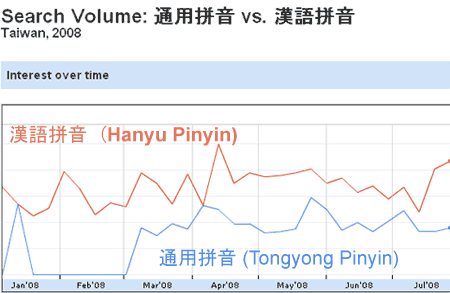
Taiwan’s still official but probably-not-long-for-this-world romanization system for Mandarin is Tongyong Pinyin. Tongyong Pinyin, however, is basically unknown outside Taiwan and, in truth, very little known even within Taiwan. (And many of those — like me — who do know it don’t like it.) But still, it’s what the Chen administration forced into use on highway signs, within train stations, and on some other signage throughout the country. So there’s certain to be some interest for it here. But in Taiwan how does interest in it compare against interest in Hanyu Pinyin, use of the latter system being regarded as something close to a sign of the apocalypse among some Tongyong supporters? The new Google Insights provides some clues.

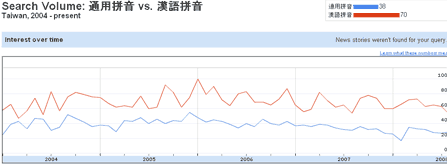
Here’s a relative look at Google searches from Taiwan in 2008 for the terms “漢語拼音” (Hanyu Pinyin) and “通用拼音” (Tongyong Pinyin).

In Taiwan, searches for Hanyu Pinyin have clearly been more popular this year.

What about in the longer term? Below is a chart from 2004 to the present. (The lines are a little different because in the long-term chart averages are by month; but the monthly averages probably give a clearer picture anyway.)

Again, interest in Hanyu Pinyin comes out on top — consistently — even in Taiwan.

Not surprisingly, in searches worldwide, Tongyong Pinyin basically doesn’t even register against Hanyu Pinyin, so great is the disparity.

If you’d like to run some searches on your own, note that Google Insights distinguishes between traditional and “simplified” Chinese characters, i.e., a search for “漢語拼音” will yield substantially different results than one for “汉语拼音”.

Mandarin newspaper with Pinyin

Victor Mair’s latest post at Language Log introduces a new U.S.-based newspaper, the Huayu Xuebao (Mandarin Learning Newspaper, 華語學報), which is similar to Taiwan’s Guoyu Ribao (Mandarin Daily News), the main difference being the former uses Hanyu Pinyin while the latter uses zhuyin fuhao (bopo mofo).

Well, actually the Huayu Xuebao doesn’t use proper Pinyin (see recent remarks). But I’m so happy to see this long-needed paper that I’ll hold my tongue for now.

Unfortunately, the paper doesn’t have its Web site ready yet — not that the long-established Guoyu Ribao is much better at that, at least when it comes to texts as they appear in the newspaper. So, for more information about the Huayu Xuebao, write learningnewspaper [AT] yahoo.com or phone +1-201-288-9188 (New Jersey).

There’s also a sample issue.

source: How to learn to read Chinese, Language Log, May 25, 2008

Book reviews, vol. 5

Sino-Platonic Papers has rereleased for free its fifth volume of reviews, mainly of books about China and its history and languages (11.6 MB PDF).

Even if you have no particular interest in the specific works reviewed, I recommend at least browsing through this and all of the other volumes of reviews from Sino-Platonic Papers, as they often feature Victor Mair at his most direct and entertaining about a wide range of subjects.

Table of Contents:

  • Review Article: The Present State and Future Prospects of Pre-Han Text Studies. A review of Michael Loewe, ed., Early Chinese Texts: A Bibliographical Guide. Reviewed by E. Bruce Brooks, University of Massachusetts at Amherst.

N.B.: The following 29 reviews are by the editor of Sino-Platonic Papers.

  • Roger T. Ames, Chan Sin-wai, and Mau-sang Ng, eds. Interpreting Culture through Translation: A Festschrift for D. C. Lau.
  • Sau Y. Chan. Improvisation in a Ritual Context: The Music of Cantonese Opera.
  • CHANG Xizhen. Beijing Tuhua [Pekingese Colloquial].
  • CHANG/AIXINJUELUO Yingsheng [AISINGIORO *Yingsheng]. Beijing Tuhua zhong de Manyu [Manchurian in Pekingese Colloquial].
  • BAI Gong and JIN Shan. Jing Wei’er: Toushi Beijingren de Yuyan [“Capital Flavor”: A Perspective on the Language of the Pekingese].
  • JIA Caizhu, comp. Beijinghua Erhua Cidian [Dictionary of Retroflex Final-r in Pekingese].
  • Julia Ching and R. W .L. Guisso, eds. Sages and Sons: Mythology and Archaeology in Ancient China.
  • FENG Zhiwei. Xiandai Hanzi he Jisuanji (Modern Chinese Characters and Electronic Computers).
  • FENG Zhiwei. Zhongwen Xinxi Chuli yu Hanyu Yanjiu [Chinese Information Processing and Research on Sinitic].
  • Andre Gunder Frank. The Centrality of Central Asia.
  • HUANG Jungui. Hanzi yu Hanzi Paijian Fangfa [Sinographs and Methods for Ordering and Looking up Sinographs].
  • W. J. F. Jenner. The Tyranny of History: The Roots of China’s Crisis.
  • Adam T. Kessler. Empires Beyond the Great Wall: The Heritage of Genghis Khan.
  • David R. McCraw. Du Fu’s Laments from the South.
  • Michael Nylan, tr. and comm. The Canon of Supreme Mystery, by Yang Hsiung.
  • R. P. Peerenboom. Law and Morality in Ancient China: The Silk Manuscripts of Huang-Lao.
  • Henry G. Schwarz. An Uyghur-English Dictionary.
  • Vitaly Shevoroshkin, ed. Dene-Sino-Caucasian Languages.
  • Vitaly Shevoroshkin, ed. Nostratic, Dene-Caucasian, Austric and Amerind.
  • Laurence G. Thompson, comp. Studies of Chinese Religion: A Comprehensive and Classified Bibliography of Publications in English, French, and German through 1970.
  • Laurence G. Thompson, comp. Chinese Religion in Western Languages: A Comprehensive and Classified Bibliography of Publications in English, French, and German through 1980.
  • Laurence G. Thompson, comp. Chinese Religion: Publications in Western Languages, 1981 through 1990.
  • Aat Vervoorn. Men of the Cliffs and Caves: The Development of the Chinese Eremitic Tradition to the End of the Han Dynasty.
  • WANG Jiting, ZHANG Shaoting, and WANG Suorong, comp. Changjian Wenyan Shumianyu [Frequently Encountered Literary Sinitic Expressions in Written Language].
  • John Timothy Wixted. Japanese Scholars of China: A Bibliographical Handbook.
  • YÜ Lung-yü, ed. Chung-Yin wen-hsüeh kuan-hsi yüan-liu [The Origin and Development of Sino-Indian Literary Relations].
  • ZHANG Guangda and RONG Xinjiang. Yutian Shi Congkao [Collected Inquiries on the History of Khotan].
  • ZHANG Yongyan, chief ed. Shishuo Xinxu Cidian [A Dictionary of A New Account of Tales of the World].
  • Peter H. Rushton. The Jin Ping Mei and the Non-Linear Dimensions of the Traditional Chinese Novel.

  • William H. Baxter, A Handbook of Old Chinese Phonology. Reviewed by Paul Rakita Goldin, Harvard University.
  • JI Xianlin (aka Hiän-lin Dschi). Dunhuang Tulufan Tuhuoluoyu Yanjiu Daolun [A Guide to Tocharian Language Materials from Dunhuang and Turfan]. Reviewed by XU Wenkan, Hanyu Da Cidian editorial offices in Shanghai.
  • GU Zhengmei. Guishuang Fojiao Zhengzhi Chuantong yu Dasheng Fojiao [The Political Tradition of Kushan Buddhism and Mahayana Buddhism]. Reviewed by XU Wenkan, Hanyu Da Cidian editorial offices in Shanghai.
  • W. South Coblin, University of Iowa. A Note on the Modern Readings of 土蕃.
  • Rejoinder by the Editor.
  • Announcement concerning the inauguration of a new series in Sino-Platonic Papers entitled “Bits and Pieces.”

This work also continues the discussion regarding the Chinese characters “土蕃” and Tibet.

This was first published in July 1994 as issue no. 46 of Sino-Platonic Papers.

Web site for stroke-order practice

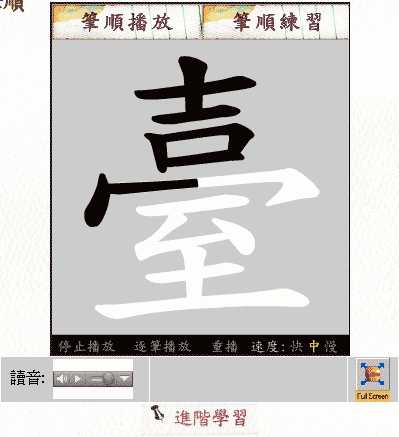
Taiwan’s Ministry of Education has put online new a Web site devoted to stroke order for Chinese characters.

Unlike the older MOE stroke-order online handbook, this new site provides animations of the stroke order for 4,808 of the most frequently used traditional Chinese characters. And they really are traditional, too. For example, a Pinyin search for tai (it doesn’t accept tone marks or numbers) doesn’t return 台, even though it is more commonly seen in Taiwan than the full form of 臺. But perhaps that’s a glitch, since 台 is within the system, as a search for that particular character reveals.

Users can also test their knowledge of official stroke order, since each character’s animation also comes with an interactive feature in which users trace the strokes with their mouse. (Click on the button to the top right of the character.) It can be a little picky, as I suppose befits the prescriptive nature of the site. (In the real world, people write many characters using orders other than what Taiwan’s Ministry of Education and your Mandarin teacher might tell you is the One True Way. But that’s another matter.)

Although there’s no English interface at present, the files are labeled in English, so positioning your mouse over the navigation elements will usually reveal enough for non-Hanzi readers to make their way around.

Unfortunately, the site doesn’t appear to work with anything other than @#$%! Internet Explorer. Also, at first the search feature allowed the entry of no more than four letters, making it impossible to use Pinyin (Hanyu Pinyin is offered along with Taiwan’s official Tongyong Pinyin) to look up characters for, say, zhong and guang, or for the Pinyin syllables with the most letters: chuang, shuang, and zhuang (not counting -r forms); but someone there is on the ball, since that was fixed after I wrote the ministry about it yesterday.

partial screenshot, showing the character ? (TAI) being written

site and further reading:

video of Pinyin’s ‘father,’ Zhou Youguang, in English

Roddy of Chinese Forums, Signese, Dreams of White Tiles, and even more sites, found a new video (4 min. 40 sec.) of Zhou Youguang speaking, in English, to a reporter from the Guardian.

I was kind of surprised to see this featured on the Guardian’s front page under the ‘Father of Pinyin’ title – I’d wager 9/10ths upwards of the Guardian’s readership doesn’t know what pinyin is. Somewhat unforgivably they’ve managed to spell the guy’s name wrong and not bothered to add tones to the pinyin used in the video, and the interview is pretty weak – basically it’s ‘here’s a nice old Chinese guy talking for a few minutes’ but there’s really very little of depth. They’ve also opted to add subtitles to what sounds to me like perfectly comprehensible English.

But enough negativity, if you want to get a look at the guy who rescued you from bopomofo, have a look.

As happy as I am about the video, I’m going to add a bit more negativity. Failure to get the word parsing correct is also a major error: not “pin yin zhi fu” but “Pīnyīn zhī fù.” Actually, even that isn’t so good, because Pinyin is meant for modern baihua, not the style of Literary Sinitic and its many short forms. Thus, “Pīnyīn de fùqin” would be better.

The accompanying article is amazingly sloppy in parts.

Although the article manages to spell Zhou Youguang’s name correctly, it consistently refers to him not by his family name but by his given name, “Youguang.” It’s almost inconceivable that any reporter in China could (repeatedly) make such an elementary mistake; so perhaps this is the fault of an overzealous copy editor.

I’m not going to sort out and list what’s correct and what’s incorrect in the rest of the article, other than mention one point at the end.

Confusingly, Taiwan uses several different romanisation methods — including a variant of pinyin, tongyong pinyin — and zuiyin.

Zuiyin? Of course what is meant is zhuyin (zhùyīn/註音/注音), which is spelled correctly earlier in the article. Zuiyin (zuìyīn/罪因) is a noun meaning “cause of a crime.”

sources: