
A quarter century of Sino-Platonic Papers

These days, with the click of a mouse one can publish something that can instantly be seen by people around the world. But despite this ease it can still feel like a major accomplishment if someone has the tenacity to keep even a blog going past its first few years.

Consider, then, the days long before user-friendly blogging software, the days before blogs even. The days before desktop publishing was in the hands of more than a few, before most people had the ability to send or receive files electronically, before most people had even heard of the Internet. The days when typewriters were still common.

So these were also the days so long before Unicode that including Chinese characters or even common diacritics in a manuscript usually meant writing them in by hand.

The days when small-scale publishing meant trips to the copy shop and long sessions spent photocopying and stapling. When the international correspondence needed to issue a small journal meant trip after trip to the post office, paying postage to send something to what might well be the other side of the globe, and having to wait weeks, months, for a reply.

The days when receiving payment for issues meant paper checks sent through the regular mail and then taken during certain hours to the bank, where you would wait in line for a teller. And heaven help you with the endless paperwork and waiting if the check was not in U.S. dollars but a foreign currency.

The days when long-distance phone calls really cost something. And international calls? Ouch!

And all that’s on top of all of the other many challenges involved in running a peer-reviewed academic journal.

Those are just some of the situations Victor Mair had to deal with when his journal, Sino-Platonic Papers, was getting off the ground. And there have certainly been many challenges since.

So I think it’s worth noting that Sino-Platonic Papers has reached the age of twenty-five and is still going strong.

There are now more than two hundred issues, the majority of which are available in full for free on Sino-Platonic Papers’ Web site. The shortest issue is just four pages, while the longest to date stretches over three volumes and comprises approximately one thousand pages.

That this journal has published all manner of authors, from internationally renowned scholars to unaffiliated researchers out in the boondocks, helps demonstrate its willingness to take risks. (But, as Cameron Crowe reminds us, that’s how you become great.)

Sino-Platonic Papers has just released its thirteenth volume of book reviews (many of which are particular favorites of mine). But what is especially notable is that it marks the twenty-fifth anniversary of the beginning of this wide-ranging journal.

I congratulate SPP‘s editor, Victor Mair, on this milestone.

Here’s what the anniversary issue covers.

  • Preface
  • Ancient China and Its Enemies: The Rise of Nomadic Power in East Asian History by Nicola Di Cosmo
  • The Prehistory of the Silk Road by E. E. Kuzmina, ed. Victor H. Mair
  • Mozi: A Complete Translation by Ian Johnston
  • Envisioning Eternal Empire: Chinese Political Thought of the Warring States Era by Yuri Pines
  • The Politics of Mourning in Early China by Miranda Brown
  • The Revelation of the Magi: The Lost Tale of the Wise Men’s Journey to Bethlehem by Brent Landau
  • A Story Waiting to Pierce You: Mongolia, Tibet and the Destiny of the Western World by Peter Kingsley
  • Rome and China: Comparative Perspectives on Ancient World Empires, ed. Walter Scheidel
  • The Camel’s Load in Life and Death: Iconography and Ideology of Chinese Pottery Figurines from Han to Tang and Their Relevance to Trade along the Silk Routes by Elfriede Regina Knauer
  • Ethnic Identity in Tang China by Marc Abramson
  • Mélange tantriques à la mémoire de Hélène Brunner/Tantric Studies in Memory of Hélène Brunner, ed. Dominic Goodall and André Padoux
  • Imperial China, 900-1800 by F. W. Mote
  • Local Religion in North China in the Twentieth Century: The Structure and Organization of Community Rituals and Beliefs by Daniel L. Overmyer
  • Tibetan Market Participation in China by Wang Shiyong
  • Chinese as It Is: A 3D Sound Atlas with First 1000 Characters by Conal Boyce
  • Language Choice and Identity Politics in Taiwan by Jennifer M. Wei
  • ABC English-Chinese, Chinese-English Dictionary, ed. John DeFrancis and Zhang Yanyin
  • Learning Chinese, Turning Chinese: Challenges to Becoming Sinophone in a Globalized World, by Edward McDonald

Disclaimer: I volunteer as SPP’s technical editor and maintain its Web site. But I certainly didn’t have any such position twenty-five years ago!
How to write adjectives in Hanyu Pinyin

cover image for the bookToday’s selection from Yin Binyong’s Xīnhuá Pīnxiě Cídiǎn (《新华拼写词典》 / 《新華拼寫詞典》) deals with how to write Mandarin’s adjectives.
This reading is available in two versions:

iOS app for writing Pinyin with tone marks

Those of you who, unlike me, own an iPhone, an iPad, or an iPod Touch may find the new Pinyin Typist Mac application of use.

Taffy of Tailingua had a look at this for me.

I’ve had a play with the Pinyin application and I’m generally quite positive about it. It’s clean, unfussy, and gets the job done. The automatic positioning looks to be flawless (i.e. typing zhuang1 gives you zhu?ng, not zh?ang)…. Overall though I like it, as it does what it set out to do without any showboating or unnecessary steps (excepting apostrophes).

Although I wish the apostrophe and hyphen were right there on the main screen instead of on a secondary one, the program allows people to do what they need to do: type Pinyin with tone marks.

It sells for US$3.99 US$2.99.

[Headline changed from “Mac app for writing Pinyin with tone marks”]

The where and why of missing second tones

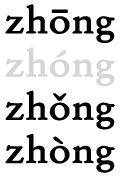
image of 'zhong' written with 1st, 2nd, 3rd, and 4th tone -- with the 2nd-tone one in light gray instead of black textMy previous post mentioned that not all tonal permutations exist in the real world. For example, modern standard Mandarin has zhōng, zhǒng, and zhòng, but doesn’t have zhóng. I did not, however, get into any of the reasons for the absence of second-tone zhong.

Fortunately, my friend James E. Dew, who is much more qualified than I to discuss such fine points of linguistics, was kind enough to send in the explanation below. Jim used to teach the Chinese language and linguistics at the University of Michigan; and for many years he directed the Inter-University Program (a.k.a. the Stanford Center) in Taipei. He is also the author of 6000 Chinese Words: A Vocabulary Frequency Handbook and coauthor of Classical Chinese: A Functional Approach.

Most simply stated, Mandarin syllable shapes with unaspirated occlusive initials and nasal finals don’t occur in second tone. This can be restated a bit less opaquely for those who have not studied Chinese historical phonology, as follows:

Syllables that begin with unaspirated stops b, d, g, or affricates j, zh, z, and end in a nasal n or ng, as a rule don’t have second-tone forms. There are a few exceptions, such as béng (甭 / “needn’t”) and zán (咱 / “we”), which were new words formed by contraction — from búyòng and zámén, respectively — after the tone class split described below took place.

This came about because when Middle Chinese (of Sui-Tang times) píngshēng 平声/平聲 split into yīnpíng 阴平/陰平 (modern Mandarin “first tone”) and yángpíng 阳平/陽平 (M “second tone”), syllables with aspirated initials went into the new yángpíng class, while those with unaspirated initials all fell into the yīnpíng (M first tone) group, thus leaving no unaspirated syllables with nasal finals in the modern Mandarin second tone class.

An interesting corollary to this rule is that among Mandarin “open” syllables (those that end in a vowel) with the above-listed initials, almost all of the second-tone syllables derive from Middle Chinese rùshēng 入声/入聲, and their cognates have stop endings in the southern dialects that preserve rùshēng, as illustrated by the Cantonese examples given below.

For those who like to pronounce what they read, Cantonese rùshēng syllables have level tones, either high, mid or low. In the Yale romanization used here, high tone is marked with a macron (e.g., dāk), mid tone is unmarked, and low tone is signified by an h following the vowel. A double “aa” sounds like the “a” in “father,” while a single “a” is a mid central vowel. Thus baht sounds like English “but” and dāk sounds like English “duck.”
  Mandarin Cantonese
拔 bá baht
白 bái baahk
薄 báo bohk
別/别 bié biht
伯 bó baak
博 bó bok
答 dá daap
德 dé dāk
敵/敌 dí dihk
毒 dú duhk
格 gé gaak
閣/阁 gé gok
國/国 guó gwok
急 jí gāp
極/极 jí gihk
集 jí jaahp
夾/夹 jiá gaap
結/结 jié git
節/节 jié jit
菊 jú gūk
覺/觉 jué gok
決/决 jué kyut
雜/杂 zá jaahp
澤/泽 zé jaahk
閘/闸 zhá jaahp
宅 zhái jaahk
哲 zhé jit
執/执 zhí jāp
直 zhí jihk
竹 zhú jūk
濁/浊 zhuó juhk

Pinyin’s never-used letter?

As most people reading this blog know, Mandarin has about 1,300 syllables (interjections and loan words complicate the count a little). If tones — a basic part of the language — are disregarded, the number of drops to 400 and something syllables.

Given 410 or so basic syllables and 4 tones — one of these days I need to write something more on the wrongful neglect of the so-called neutral tone — some people might expect there to be more like 1,640 syllables instead of about 1,300. The reason for the lower number is that not all syllables exist in all four tones. For example, quite clearly the official language of Zhōngguó does not lack zhōng … or zhǒng or zhòng. But zhóng is another matter.

So not all possible tonal variations of those 400-something syllables appear in modern standard Mandarin. But what about letters?

If you look at the official alphabet for Hanyu Pinyin, it’s exactly the same as that for English (other than in pronunciation, of course), which is a bit odd, especially considering that Pinyin doesn’t use the letter v (or at least isn’t supposed to for Mandarin words).

So in this case, I’m excluding v but otherwise being expansionist about the glyphs I’m calling letters. To be specific: I’m referring to a-z, minus v, but including ā, á, ǎ, à, ē, é, ě, è, ī, í, ǐ, ì, ō, ó, ǒ, ò, ū, ú, ǔ, ù, ü, ǖ, ǘ, ǚ, and ǜ. (Even though Ī, Í, Ǐ, Ì, Ū, Ú, Ǔ, Ù, Ü, Ǖ, Ǘ, Ǚ, and Ǜ never come at the beginning of a word, let’s not automatically eliminate them, because there is an occasional need for ALL CAPS.)

Are there any of those possible glyphs that don’t appear at all — at least as given in the large ABC Comprehensive Chinese-English Dictionary?

The answer, perhaps surprisingly, is yes.

Which letter is it?

a. ǖ b. ǘ c. ǚ d. ǜ

Have you made your choice?

It doesn’t take much thought to eliminate C as the answer. “Nǚ” (woman) is one of those first-couple-of-Mandarin-lessons vocabulary terms. And the word for green (lǜsè) is hardly obscure either. It might be harder to think of a word with the letter ǘ; but there are some. Donkey (lǘ) is probably the most common. So the answer is A: ǖ.

It’s important to note that the lack of ǖ is in appearance only. The sound ǖ occurs in plenty of Mandarin words; it’s just that Pinyin’s simplified orthography calls for writing “u” instead where ǖ follows j, q, x, or y.

But even though I didn’t find an example of ǖ, I’d encourage font designers not to scratch it from their list of must-have glyphs for Pinyin faces, especially since teachers will no doubt want to continue giving tone-pattern drills based on four tones for all vowels, regardless. Also, someone with a searchable edition of the Hanyu Da Cidian or maybe the new Oxford online edition is probably about to use the comments to point me to some obscure entry there….

How to handle ‘de’ and interjections in Hanyu Pinyin

cover image for the bookToday’s selection from Yin Binyong’s Xīnhuá Pīnxiě Cídiǎn (《新华拼写词典》 / 《新華拼寫詞典》) deals with how to write Mandarin’s various de‘s, mood particles, and interjections.

This reading is available in two versions:

I’ve already written about the principles in previous posts. For example, see

How to write numbers and measure words in Hanyu Pinyin

cover image for the bookToday’s selection from Yin Binyong’s Xīnhuá Pīnxiě Cídiǎn (《新华拼写词典》 / 《新華拼寫詞典》) is about writing numbers and measure words.

This reading is available in two versions:

For more on this, see these posts and the PDFs linked to therein.