Taiwan personal names: a frequency list

Imagine taking everyone in the United States with the family name of Johnson, Williams, Jones, Brown, Davis, Miller, Wilson, Moore, Taylor, or Anderson … and giving them all the new family name of “Smith.” Then add to the Smiths everyone surnamed Thomas, Jackson, White, Harris, Martin, Thompson, Garcia, Martinez, Robinson, Clark, Rodriguez, Lewis, Lee, Walker, Hall, Allen, Young, Hernandez, King, Wright, and Lopez. Those are, in descending order beginning with Smith, the 32 most common family names in the United States. It takes all of those names together to reach the same frequency that the name “Chen” (Hoklo: Tân) has in Taiwan.

Chen covers 10.93 percent of the population here, according to figures released by Chih-Hao Tsai based on the recent release of the names of the 81,422 people who took Taiwan’s college entrance exam this year.

By way of additional contrast, Smith, the most common family name in the United States, covers just 1.00 percent of the population there.

In Taiwan, the 10 most common family names cover half (50.22 percent) of the population. Covering the same percentage in the United States requires the top 1,742 names there. And covering the same percentage as Taiwan’s top 25 names (74.17 percent) requires America’s top 13,425 surnames.

So if you’re just getting started in Mandarin, consider that you’ll get a lot of mileage out of memorizing the tones for the top ten names.

family name (Mandarin form) spelling usually seen in Taiwan percent of total cumulative percentage
Chén Chen 10.93% 10.93%
Lín Lin 8.36% 19.29%
Huáng Huang 6.06% 25.35%
Zhāng Chang 5.39% 30.74%
Li, Lee 5.20% 35.94%
Wáng Wang 4.20% 40.14%
Wu 4.03% 44.17%
Liú Liu 3.18% 47.36%
Cài Tsai 2.86% 50.22%
Yáng Yang 2.64% 52.86%
Hsu 2.32% 55.18%
Zhèng Cheng 1.86% 57.05%
Xiè Hsieh 1.77% 58.82%
Qiū Chiu 1.50% 60.32%
Guō Kuo 1.48% 61.79%
Zēng Tseng 1.45% 63.24%
Hóng Hung 1.40% 64.64%
Liào Liao 1.38% 66.02%
Hsu 1.33% 67.35%
Lài Lai 1.32% 68.66%
Zhōu Chou 1.24% 69.90%
Yeh 1.18% 71.08%
Su 1.17% 72.25%
Jiāng Chiang 0.97% 73.22%
Lu 0.94% 74.17%

For those wanting the Taiwanese (Hoklo) forms of these names, see Tailingua’s list of Common Family Names in Taiwan.

On the other hand, common given names have much greater variety in Taiwan than in America, especially in the case of males. In the United States the top 10 names for males cover 23.185 percent of the male population, and the top 10 names for females cover 10.703 percent of the population. In Taiwan, however, the top 10 given names (male and female together) cover just 1.49 percent of the population.

sources:

further reading:

Taiwan Google searches: Hanyu Pinyin vs. Tongyong Pinyin

Taiwan’s still official but probably-not-long-for-this-world romanization system for Mandarin is Tongyong Pinyin. Tongyong Pinyin, however, is basically unknown outside Taiwan and, in truth, very little known even within Taiwan. (And many of those — like me — who do know it don’t like it.) But still, it’s what the Chen administration forced into use on highway signs, within train stations, and on some other signage throughout the country. So there’s certain to be some interest for it here. But in Taiwan how does interest in it compare against interest in Hanyu Pinyin, use of the latter system being regarded as something close to a sign of the apocalypse among some Tongyong supporters? The new Google Insights provides some clues.

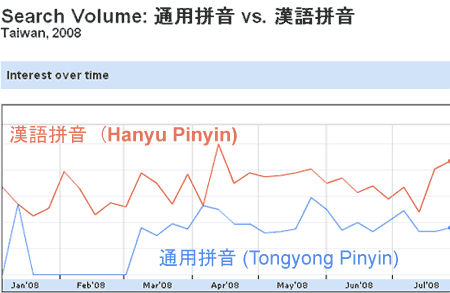
Here’s a relative look at Google searches from Taiwan in 2008 for the terms “漢語拼音” (Hanyu Pinyin) and “通用拼音” (Tongyong Pinyin).

In Taiwan, searches for Hanyu Pinyin have clearly been more popular this year.

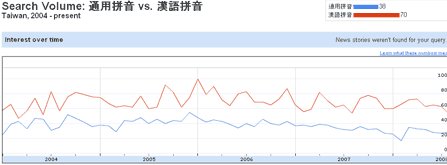
What about in the longer term? Below is a chart from 2004 to the present. (The lines are a little different because in the long-term chart averages are by month; but the monthly averages probably give a clearer picture anyway.)

Again, interest in Hanyu Pinyin comes out on top — consistently — even in Taiwan.

Not surprisingly, in searches worldwide, Tongyong Pinyin basically doesn’t even register against Hanyu Pinyin, so great is the disparity.

If you’d like to run some searches on your own, note that Google Insights distinguishes between traditional and “simplified” Chinese characters, i.e., a search for “漢語拼音” will yield substantially different results than one for “汉语拼音”.

software for Shanghainese

Professor Qián Nǎiróng (Qian Nairong / 錢乃榮) of Shanghai University has just issued free software to help with the writing of Shanghainese (上海话). People may now download the 1.3 MB zip file of the program.

Some examples:

shanghe 上海
shanghehhehho 上海闲/言话(上海话)
whangpugang 黄浦江
suzouhhu苏州河
shyti 事体(事情)
makshy 物事(东西)
bhakxiang 白相(玩)
dangbhang 打朋(开玩笑)
ghakbhangyhou 轧朋友(交朋友)
cakyhangxiang 出洋相(闹笑话,出丑)
linfhakqin 拎勿清(不能领会)
dhaojiangwhu 淘浆糊(混)
aoshaoxhin 拗造型(有意塑造姿态形象)
ghe 隑(靠)
kang 囥(藏)
yin 瀴(凉、冷)
dia 嗲
whakji 滑稽

The program offers two flavors of romanization. Here are some examples of the differences between the two styles:

New Folk Old Timers
makshy 物事(东西)
bhakxiang 白相(玩)
dangbhang 打朋(开玩笑)
ghakbhangyhou 轧朋友(交朋友)
cakyhangxiang 出洋相(闹笑话,出丑)
linfhakqin 拎勿清(不能领会)
mekshy 物事(东西)
bhekxian 白相(玩)
danbhan 打朋(开玩笑)
ghakbhanyhou 轧朋友(交朋友)
cekyhanxian 出洋相(闹笑话,出丑)
linfhekqin 拎勿清(不能领会)

Here’s a brief story on this:

Xiànzài, wǒmen zài wǎngluò zhōng liáotiān de shíhou yuèláiyuè duō de péngyou dōu kāishǐ xǐhuan yòng Shànghǎihuà. Dànshì yǒushíhou shìbushì juéde xiǎng biǎodá dehuà bùzhīdào zěnme dǎ, nòng de yǒudiǎn bùlúnbùlèi ne? Xiànzài, yī ge kěyǐ qīngsōng dǎchū Shànghǎihuà de chéngxù chūlai le.

Jīngguò liǎng nián nǔlì, Shànghǎi dàxué Zhōngwénxì Qián Nǎiróng jiàoshòu jí tā de yánjiūshēng hé dādàng zhōngyú yú běnyuè wánchéng le Shànghǎihuà shūrùfǎ de zhìzuò. Zhíde guānzhù de shì, zhè tào shūrùfǎ hái bāokuò xīn-lǎo liǎng ge bǎnběn, 45 suì yǐshàng de lǎo Shànghǎi rénhé niánqīng yī dài de Shànghǎirén dōu kěyǐ zhǎodào zìjǐ de “dǎfǎ.”

Háishi tóngyàng 26 ge zìmǔ de jiànpán, 8 yuè 1 rì qǐ xiàzài le Shànghǎihuà shūrùfǎ zhīhòu, nín jiù kěyǐ tōngguò shūrù “linfhakqin” dǎchū “līn wù qīng,” shūrù “dhaojiangwhu” dǎchū “táo jiànghu” děng yuánzhī yuán wèi de Shànghǎihuà le. Zuótiān, jìzhě tíqián xiàzài dào gāi ruǎnjiàn. Ànzhào shǐyòng shuōmíng, yòng quánpīn de fāngshì chángshì shūrù “laoselaosy” zhèxiē zìmǔ, píngmù shàng, lìjí chūxiàn le “lǎo sānlǎo sì” (Shànghǎihuà, yìsi shì “màilǎo, chōng lǎochéng de yàngzi”).

Jùxī, yóuyú Shànghǎihuà yǔ Pǔtōnghuà de dúfǎ yǒusuǒbùtóng, suǒyǐ zài pīnyīn pīnxiě fāngshì shàng háishi xūyào shǐyòng shuōmíng de bāngzhù. Bǐrú jìzhě fāxiàn, fánshì yǔ Pǔtōnghuà shēngmǔ, yùnmǔ xiāngtóng de zì, zài Shànghǎihuà shūrùfǎ zhōng zuìzhōng yòng de háishi Pǔtōnghuà pīnyīn, bùtóng de zé cǎiyòng Shànghǎihuà shūrùfǎ de pīnxiě fāngshì. Rú “chénguāng” de “chén,” “huātou” de “tóu” dōu fāchéng zhuóyīn, Shànghǎihuà pīnyīn shūrùfǎ zhōng yàozài shēngmǔ zhōng jiā yī ge zìmǔ h, pīnchéng “shen,” “dhou;” fánshì rùshēng zì, zé zài pīnyīn hòu jiā zìmǔk, rú “báixiāng” de “bái” jiù pīnchéng bhek.

Bùguò, dàjiā bùyào juéde tài nán. Jìzhě fāxiàn, Shànghǎihuà shūrùfǎ yǔ Pǔtōnghuà de shūrùfǎ zuìdà xiāngtóng zhī chǔzài yú, zhǐyào liánxù shūrù shēngmǔ hé yùnmǔ jiù kěyǐ, bùxū shūrù shēngdiào. Cǐwài, Shànghǎihuà pīnyīn shūrù xìtǒng háiyǒu lèisì “zhìnéng” yōudiǎn, kěyòng suōlüè fāngshì bǎ cíyǔ pīnxiě chūlai.

Zhǔchí Shànghǎihuà shūrùfǎ kāifā de Shànghǎi dàxué Zhōngwénxì Qián Nǎiróng jiàoshòu gàosu jìzhě, zhè tào shūrùfǎ bùjǐn néng dǎchū Shànghǎihuà dà cídiǎn zhōng 15,000 duō ge cítiáo, érqiě hái néng yòng Shànghǎihuà pīnyīn dǎchū Shànghǎihuà zhōng shǐyòng zhe de, yǔ Pǔtōnghuà cíyì xiāngtóng dàn yǔyīn bùtóng de chángyòng cíyǔ. Rú “Huángpǔ Jiāng” shūrù “whangpugang” , “lǐxiǎng” zéshì lixiang děng, gòngjì 10,000 duō ge cítiáo.

sources:

Ovid Tzeng reiterates backing for Hanyu Pinyin

Earlier this week Ovid Tzeng, a former minister of education and current minister without portfolio, reaffirmed his support for Taiwan adoping Hanyu Pinyin and said that this is an important issue the government will need to deal with sooner or later.

Zēng Zhìlǎng Jiàoyùbù zhǎng rènnèi, jiānchí cǎiyòng Hànyǔ Pīnyīn, shì tā bèi huàn xiàlái de zhǔyīn zhīyī. Tā zuótiān réng bù gǎi qí zhì, qiángdiào guówài bùguǎn Zhōngwén jiàoxué huò xuéshù qīkān, hěn duō yǐjing gǎiyòng Hànyǔ Pīnyīn, Táiwān bùnéng shìruòwúdǔ, zhè suī fēi xīn zhèngfǔ zuì yōuxiān shīzhèng xiàngmù, dànshì yě lièwéi wèilái zhòngdà jiǎntǎo shìxiàng.

Most of the source article for this discusses poet and academic Zheng Chouyu’s backing for Hanyu Pinyin. He stresses his view that this is a practical matter, not a political one.

source: Zhèng Chóuyǔ jiànyì: Zhōngwén yìyīn kěyǐ cǎi Hànyǔ Pīnyīn (鄭愁予建議:中文譯音 可採漢語拼音), United Daily News, June 9, 2009

further reading: Hanyu Pinyin backer to return to Taiwan’s Cabinet, Pinyin News, April 29, 2008

early Chinese tattoos

As my friend Tian of Hanzi Smatter continues to document, some people, Westerners especially, remain keen on having themselves tattooed with Chinese characters — even if they can’t read them. I doubt, though, that many are aware of China’s historical traditions in tattooing. As Carrie E. Reed notes in Early Chinese Tattoo (2.9 MB PDF), which is the latest reissue from Sino-Platonic Papers, “it appears that the practice of tattoo (other than the penal use) never achieved any level of general acceptance or widespread use among most parts of ancient Chinese society of any era.”

Yes, penal use: In early China tattooing was a common way of branding criminals. Often such tattoos were standard designs, such as circles. But sometimes they contained text.

Here’s something from Reed’s discussion of the Yuan dynasty’s legal code:

In the section on illicit sexual relationships we read that, in general, on the first offense the adulterous couple will be separated, but if they are “caught in the act” a second time, the man (it is not clear if the woman is tattooed as well) will be tattooed on the face with the words “committed licentious acts two times” (犯姦二度) and banished. Numerous examples are given to illustrate this type of punishment.

Reed examines and translates many texts describing tattoos.

Some of the terms encountered in these early texts are (with a literal translation given in parentheses) qing 黥 (to brand, tattoo), mo 墨 (to ink), ci qing 刺青 (to pierce [and make] blue-green), wen shen 文身 (to pattern the body), diao qing 雕青 (to carve and [make] blue-green), ju yan 沮顏 (to injure the countenence), wen mian 文面 (to pattern the face), li mian 剺面 (to cut the face) , hua mian 畫面 (to mark the face), lou shen 鏤身 (to engrave the body), lou ti 鏤體 (same), xiu mian 繡面 (to embroider [or ornament] the face), ke nie 刻涅 (to cut [and] blacken), nie zi 涅字 (to blacken characters) ci zi 刺字 (to pierce characters), and so on. These terms are sometimes used together, and there are numerous further variations. In general, if the tattooing of characters (字) appears in the term, it refers to punishment, but this is certainly not true in every case. Likewise, if a term literally meaning “to ornament” or “decorate” is used, it does not necessarily mean that the tattoo was done voluntarily or for decorative purposes.

All of the types of tattoo, except perhaps for the figurative and textual, are usually described as inherently opprobrious; people bearing them are stigmatized as impure, defiled, shameful or uncivilized. There does not ever seem to have been a widespread acceptance of tattoo of any type by the “mainstream” society; this was inevitable, partly due to the early and long-lasting association of body marking with peoples perceived as barbaric, or with punishment and the inevitable subsequent ostracism from the society of law-abiding people. Another reason, of course, is the Confucian belief that the body of a filial person is meant to be maintained as it was given to one by one’s parents.

This was first published in June 2000 as issue no. 103 of Sino-Platonic Papers. Although the work contains no illustrations, it does feature copious translations of texts describing tattoos or relating tales about them.

Gaoxiong street signs

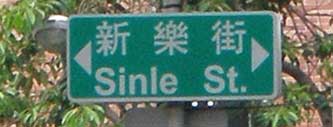
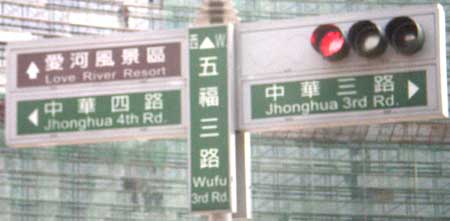
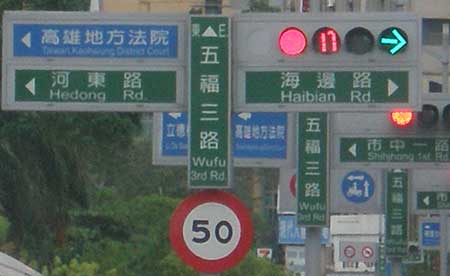
Sinle StDuring an extremely brief trip a few weeks ago to Gāoxióng, Taiwan’s second-largest city, I was able to grab a few photos of signage there. Most of these were taken from a moving taxi; thus the poor quality and lack of much diversity. But these are the best I could do under the circumstances.
First, a few basic points:

  • they’re in Tongyong Pinyin (bleah — but at least they’re consistent)
  • they don’t use InTerCaPiTaLiZaTion (This lack is, of course, a good thing. If only Taipei hadn’t screwed this up!)
  • in most cases the text in romanization is large enough to read even at a distance (Very good — unlike all too many relatively recent signs elsewhere, such as Taipei County.)

In short, other than the choice of romanization most of these signs aren’t all that bad. They’re certainly much better (and more consistent) than the ones that Taipei County put up in Tongyong Pinyin a few years ago. (Although Taipei County’s current magistrate said more than two years ago that he was in favor of switching to Hanyu Pinyin, as far as I can see he has done absolutely nothing about this. Of course, some might say that he’s done absolutely nothing about anything; but I’ll leave discussion of that to the political blogs.)

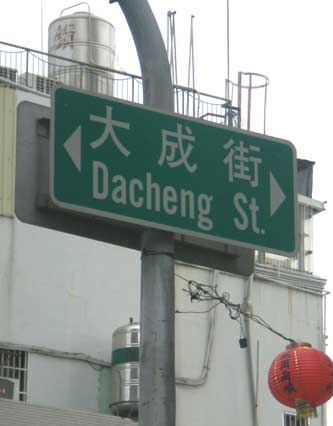
Here’s another Gāoxióng sign with romanization that isn’t too small.
Dacheng St.

I’m not a fan of the practice of force-justifying the Chinese characters and romanization/English to the same width. This style can be seen in many of these signs. Sometimes this results in the romanized/English words being spaced too far apart; more often, though, the Chinese characters are left with lots of space between them — so much space that it would be easy to have spaces indicate word divisions for the texts in Hanzi (something Y.R. Chao recommended nearly a century ago), which might be an interesting thing to try on signs. I wonder if anyone has ever performed any experiments on this.

The full Mandarin name of the school indicated by the blue sign on the left is rather long:

Gāoxióng shìlì Gāoxióng nǚzǐ gāojí zhōngxué
(高雄市立高雄女子高級中學)

Whoever made the sign wisely desided to cut that down to 高雄女中 (Gāoxióng nǚ zhōng). If only someone had realized that it would have been better to use something shorter than the full English name, too. “Kaohsiung Municipal Girls’ Senior High School” is a lot to fit on one small sign. “Kaohsiung Girls’ High School”, “Girls’ Municipal High School”, or something even shorter would have been much better.

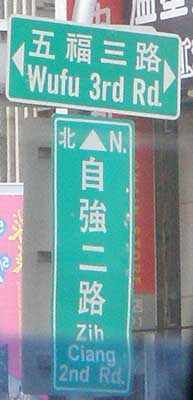
Here are some more signs.

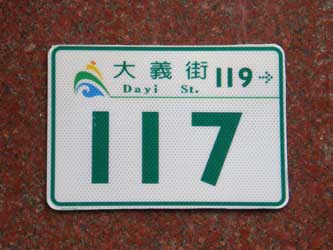
And finally an address plate on a building. This style could certainly be better.
Dayi St.

Book reviews, vol. 6

Sino-Platonic Papers has rereleased for free its sixth volume of reviews, mainly of books about China and its history and languages (5.6 MB PDF).

The reviews are by David Utz, Xinru Liu, Taylor Carman, Bryan Van Nordan, and Victor H. Mair.

Contents

  • Review Article by David A. Utz of Ádám Molnár, Weather-Magic in Inner Asia. With an Appendix, “Alttürkische fragmente über den Regenstein,” by P. Zieme. Indiana University Uralic and Altaic Series, 158. Bloomington, Indiana: Indiana University, 1994.
  • Graham Parkes, ed., Heidegger and Asian Thought. Honolulu: University of Hawaii Press, 1987. Reviewed by Taylor Carman and Bryan Van Norden.
  • Beijing Daxue Nanya Yanjiusuo [Peking University Institute for South Asian Studies], ed. Zhongguo zaiji zhong Nanya shiliao huibian (Collection of South Asian Historical Materials from Chinese Sources). 2 vols. Shanghai: Shanghai Guji Chubanshe, 1995. Reviewed by Xinru Liu.

The following 23 reviews are by the editor of Sino-Platonic Papers.

  • Ronald E. Emmerick and Edwin G. Pulleyblank. A Chinese Text in Central Asian Brahmi Script: New Evidence for the Pronunciation of Late Middle Chinese and Khotanese. Serie Orientale Roma, LXIX. Rome: lstituto ltaliano per ii Medio ed Estremo Oriente, 1993.
  • YIN Binyong and SU Peicheng, eds. Kexuede pingjia Hanyu hanzi [Scientifically Appraise Sinitic and Sinographs]. Zhongguo yuwen xiandaihua congshu (Chinese Language Modernization Series), 1. Peking: Huayu Jiaoxue Chubanshe (Sinolingua), 1994.
  • WU Chang’an. Wenzi de toushi — Hanzi lunheng [A Perspective on Culture — Balanced Discussions on the Sinographs]. Wenhua Yuyanxue Congshu [Cultural Linguistics Series]. N.p. (Changchun?): Jilin Jiaoyu Chubanshe, 1995.
  • ZHOU Shilie, comp. Tongxingci cidian [Dictionary of Homographs]. Peking: Zhongguo Guoji Guangbo Chubanshe, 1995. (Reviewed twice from different perspectives in the same issue.)
  • KANG Yin. Wenzi Yuanliu Qianshi (The Origin and Development of Chinese Ideographs) (sic). N.p.: Guoji Wenhua Chubanshe, 1992.
  • DUAN Kailian. Zhongguo minjian fangyan cidian [A Dictionary of Chinese Folk Topolecticisms]. Haikou: Nanhai chuban gongsi, 1994.
  • CHANG Xizhen, comp. Beiping tuhua [Peking Colloquialisms]. Taipei: Shenge Shiye Youxian Gongsi Chubanshe, 1990.
  • ZHANG Xunru. Beiping yinxi xiaoche bian [A Compilation of Words with “er” Suffix in Pekingese]. Taipei: Taiwan Kaiming, 1991; 2nd Taiwan ed.; 1956, first Taiwan ed.
  • LI Sijing. Hanyu “er” [] yin shi yanjiu [Studies on the History of the “er” [] Sound in Sinitic]. Taipei: Taiwan Shangwu, 1994.
  • Erdengtai, Wuyundalai, and Asalatu. Menggu mishi cihui xuanshi [Selected Explanations of Lexical Items in The Secret History of the Mongols]. Mengguzu lishi congshu [Series on the History of the Mongolian People]. Hohhot: Neimenggu Renrnin Chubanshe, 1980; 1991 rpt.
  • Matthews, Stephen and Virginia Yip. Cantonese: A Comprehensive Grammar. Routledge Grammars. London and New York: Routledge, 1994.
  • Killingley, Siew-Yue. Cantonese. Languages of the World / Materials 06. München-Newcastle: Lincom Europa, 1993.
  • ZHONG Jingwen, chief ed. Yuhai (An Encyclopedia of Chinese Folk Language), Vol. 1: Mimiyu (Chinese Secret Language). Vol. editors ZHENG Shuoren and CHEN Qi. Shanghai: Shanghai Wenyi Chubanshe, 1994.
  • Harrell, Stevan, ed. Cultural Encounters on China’s Ethnic Frontiers. Seattle and London: University of Washington Press, 1995.
  • Woo, Henry K. H. The Making of a New Chinese Mind: Intellectuality and the Future of China. Hong Kong: China Foundation, 1993.
  • Miller, Lucien, ed. South of the Clouds: Tales from Yunnan. Translated by GUO Xu, Lucien Miller, and XU Kun. Seattle and London: University of Washington Press, 1994.
  • Hoizey, Dominique and Marie-Joseph Hoizey. A History of Chinese Medicine. Tr. by Paul Bailey. Vancouver: UBC Press; Edinburgh: Edinburgh University Press, 1993.
  • Crystal, David. An Encyclopedic Dictionary of Language and Languages. London: Penguin, 1992, 1994.
  • Day, Gordon M. Western Abenaki Dictionary. Vol. 1: Abenaki-English. Vol. 2: English-Abenaki. Mercury Series, Canadian Ethnology Service, Papers 128 and 129. Hull, Quebec: Canadian Museum of Civilization, 1994-95.
  • Hassrick, Peter H. The Frederic Remington Studio. Cody, Wyoming: Buffalo Bill Historical Center, in association with University of Washington Press (Seattle, London), 1994.
  • Jonaitis, Aldona, ed. Chiefly Feasts: The Enduring Kwakiutl Potlatch. Seattle and London: University of Washington Press; New York: American Museum of Natural History, 1991.
  • Jerry L. Norman and W. South Coblin. “A New Approach to Chinese Historical Linguistics.” Journal of the American Oriental Society, 115.4 (1995),576-584.

Bits and Pieces

  • Letter concerning An Zhimin’s views on the origins of bronze metallurgy in China.
  • “Yet again on Tibet.” This is one in a continuing series of discussions with Edwin G. Pulleyblank, W. South Coblin, and others on the origins of the name “Tibet”.

This was first published in February 1996 as issue no. 70 of Sino-Platonic Papers.

Mandarin newspaper with Pinyin

Victor Mair’s latest post at Language Log introduces a new U.S.-based newspaper, the Huayu Xuebao (Mandarin Learning Newspaper, 華語學報), which is similar to Taiwan’s Guoyu Ribao (Mandarin Daily News), the main difference being the former uses Hanyu Pinyin while the latter uses zhuyin fuhao (bopo mofo).

Well, actually the Huayu Xuebao doesn’t use proper Pinyin (see recent remarks). But I’m so happy to see this long-needed paper that I’ll hold my tongue for now.

Unfortunately, the paper doesn’t have its Web site ready yet — not that the long-established Guoyu Ribao is much better at that, at least when it comes to texts as they appear in the newspaper. So, for more information about the Huayu Xuebao, write learningnewspaper [AT] yahoo.com or phone +1-201-288-9188 (New Jersey).

There’s also a sample issue.

source: How to learn to read Chinese, Language Log, May 25, 2008