Tibetan-English sample sentences

It seems like a good time for something related to Tibet.

The newest rerelease from Sino-Platonic Papers comprises 900 sample sentences in romanized Tibetan and English, the Tibetan being specifically Kham Tibetan.

From the introduction:

The reader is undoubtedly aware that written Tibetan radically differs from what is spoken and that there are also many differences in, for example, written Tibetan in Amdo regions and that of Lhasa. The value of this material is that it presents one of the most widely used Tibetan dialects as it is actually spoken.

Renchin-Jashe, a native of Yulshul (Yushu) Tibetan Autonomous Prefecture in Qinghai Province where Kham is spoken, wrote these sentences using a system that he devised. I then edited the sentences…. We have tried throughout to present sentences that reflect Tibetan culture.

This issue is Kham Tibetan Language Materials (2.7 MB PDF), by Renchin-Jashe and Kevin Stuart.

Here are the first 15 of the 900 sentences.

  1. Qa e tel.
    Hello.
  2. Chou ghale-jiele en?
    Is your life well?
  3. Nga Norbu Sangbho yin.
    I’m Norbu Sangbho.
  4. Chou Doje e rei?
    Are you Doje?
  5. Nga yin.
    Yes, I am.
  6. Chou dhemo yin nam?
    How are you?
  7. Nga dhemo yin, tujeche.
    Fine, thanks.
  8. Droma dhele ghale e ree?
    How is Droma?
  9. Mo ni dhele ghale ree tujeche.
    She is very well, thank you.
  10. Chou dhehi eyou, Avo Qalsang?
    How are you, Mr. Qalsang?
  11. Ghongmo zang, Ashe Yudron.
    Good evening, Ms. Yudron.
  12. Ghong mo chou dhemo en?
    How are you this evening?
  13. Da do nub dhe mo jie Tshering.
    Good night Tshering.
  14. Ghashou, Dondrub.
    Good-bye, Dondrub.
  15. Sang nyin tutree zei.
    See you tomorrow.

The work also contains a guide to pronunciation and sentences for learners at the intermediate level.

It was first published in November 1993 as issue no. 42 of Sino-Platonic Papers.

China’s earliest romanization system

The most recent rerelease from Sino-Platonic Papers is Dì-yī ge Lādīng zìmǔ de Hànyǔ Pīnyīn Fāng’àn shì zěnyàng chǎnshēng de? (How Was the First Romanized Spelling System for Sinitic Produced? / 第一个拉丁字母的汉语拼音方案是怎样产生的), by YIN Binyong (尹斌庸).

The author should be familiar to regular readers of this site, as he wrote the standard works on Hanyu Pinyin orthography — Chinese Romanization: Pronunciation and Orthography and the Xinhua Pinxie Cidian — as well as Pinyin-to-Chinese Character Computer Conversion Systems and the Realization of Digraphia in China.

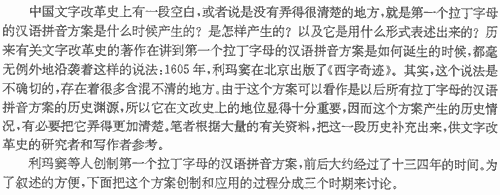
The text is in Mandarin in Chinese characters. Here is the introduction.
image of the Mandarin text (in Chinese characters) of the first two paragraphs of the article

This is issue no. 50 of Sino-Platonic Papers. It was first published in November 1994.

Web site for stroke-order practice

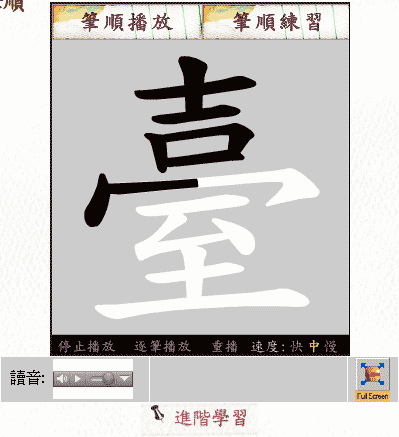
Taiwan’s Ministry of Education has put online new a Web site devoted to stroke order for Chinese characters.

Unlike the older MOE stroke-order online handbook, this new site provides animations of the stroke order for 4,808 of the most frequently used traditional Chinese characters. And they really are traditional, too. For example, a Pinyin search for tai (it doesn’t accept tone marks or numbers) doesn’t return 台, even though it is more commonly seen in Taiwan than the full form of 臺. But perhaps that’s a glitch, since 台 is within the system, as a search for that particular character reveals.

Users can also test their knowledge of official stroke order, since each character’s animation also comes with an interactive feature in which users trace the strokes with their mouse. (Click on the button to the top right of the character.) It can be a little picky, as I suppose befits the prescriptive nature of the site. (In the real world, people write many characters using orders other than what Taiwan’s Ministry of Education and your Mandarin teacher might tell you is the One True Way. But that’s another matter.)

Although there’s no English interface at present, the files are labeled in English, so positioning your mouse over the navigation elements will usually reveal enough for non-Hanzi readers to make their way around.

Unfortunately, the site doesn’t appear to work with anything other than @#$%! Internet Explorer. Also, at first the search feature allowed the entry of no more than four letters, making it impossible to use Pinyin (Hanyu Pinyin is offered along with Taiwan’s official Tongyong Pinyin) to look up characters for, say, zhong and guang, or for the Pinyin syllables with the most letters: chuang, shuang, and zhuang (not counting -r forms); but someone there is on the ball, since that was fixed after I wrote the ministry about it yesterday.

partial screenshot, showing the character ? (TAI) being written

site and further reading:

status of Cantonese: a survey-based study

The latest new release from Sino-Platonic Papers is one that I think will be of particular interest to readers of Pinyin News. It’s an extensive study of not only the attitudes of speakers of Cantonese and Mandarin toward the status of Cantonese but also their beliefs about its future, especially in Hong Kong: Language or Dialect–or Topolect? A Comparison of the Attitudes of Hong Kongers and Mainland Chinese towards the Status of Cantonese (650 KB PDF), by Julie M. Groves.

This study reports on a comparative survey of three groups of Chinese: 53 Hong Kong Cantonese speakers, 18 Mainland Chinese Cantonese speakers, and 72 Mainland Chinese Putonghua speakers. It was found that the Putonghua speakers held more ‘classic’ views, the majority seeing Cantonese as a dialect. In contrast, only just over half the Hong Kongers and two-fifths the Mainland Cantonese speakers considered it clearly a dialect, while one-third of all respondents favoured a mid-point classification. The differing perspectives held by the groups can be traced to their different political and linguistic situations, which touch issues of identity.

The author notes, “The uncertainties in classification also reflect a problem with terminology. The Chinese word usually translated dialect, fangyan (方言), does not accurately match the English word dialect.” Groves recommends the adoption of Victor Mair’s proposed English word for fangyan: topolect.

Although this focuses on the dialect vs. language debate, it covers much more than that. Those being surveyed were also asked questions such as:

  • Where do you think the best Cantonese is spoken?
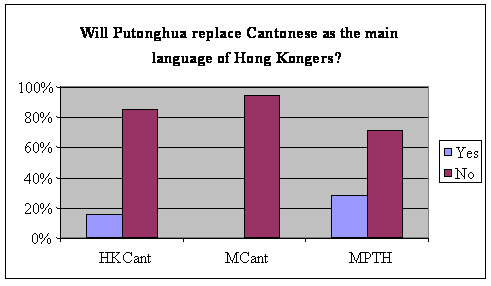
  • Do you think Putonghua will eventually replace Cantonese as the main, everyday language of Hong Kongers?
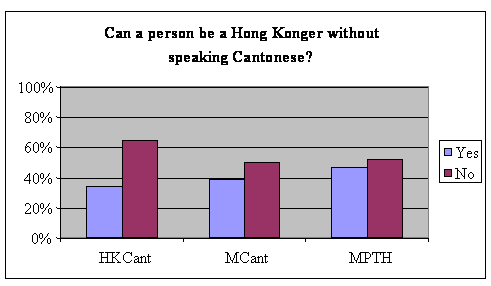
  • Do you think it is possible for someone to consider themselves to be a Hong Konger (or Hong Kong Chinese/Chinese Hong Konger) without being able to speak Cantonese?

The results of the study may also prove useful for those interested in the future of other languages of China and Taiwan, such as Taiwanese and Shanghainese.

Here are a couple of the many graphs found in the study.

HK Cant = Hong Kong Cantonese speakers
MCant = mainland Cantonese speakers
MPTH = mainland speakers of Mandarin (“Pǔtōnghuà“)

graph of responses to the question 'Will Putonghua replace Cantonese as the main language of Hong Kongers?' Most say 'no' -- and this is strongest among mainland Cantonese speakers

graph of responses to the question 'Can a person be a Hong Konger without speaking Cantonese?' Most Hong Kong Cantonese speakers say no; but the answer is closer to a tie for mainland Mandarin speakers

Intrigues of the Warring States: SPP

The latest rerelease from Sino-Platonic Papers is Miching Mallecho: The Zhanguo ce and Classical Rhetoric (1.7 MB PDF), by Paul Rakita Goldin of the University of Pennsylvania. This covers the Zhanguoce (Zhànguó cè/戰國策/战国策 / Intrigues of the Warring States), from China’s Warring States period. The phrase “miching mallecho” comes from Hamlet; those interested in knowing more can refer to the first page of Goldin’s work.

Here’s an excerpt:

The Intrigues are a collection of anecdotes about people from the Warring States period and how they acquire the things they want: position, fame, revenge, glory for the state, and so on. Naturally, since advisors often find the best resource to be the king, they focus their attention to persuade the king to action–action sometimes beneficial to the king and his state, but often advantageous to the counselors themselves and their favorites. These are the rhetorical pieces. But in many of the stories, the characters use very different methods, such as conspiracy, espionage, and framing, to achieve their goals. These anecdotes always involve some sort of scheme or machination to bring about a desired end.

The Intrigues, then, are primarily about intrigue. The lively, disjointed pieces fuse together to paint an irreverent picture of Warring States politics. The entire book seems to be a glorification of mendacity and trickery. The cunning advisors live by their wits, rising and falling by their own ingenuity and that of their rivals. By contrast, the kings are continuously hoodwinked by the unscrupulous sophistry of their own ministers. Some, like Lord Mengchang (e.g. 4.35b-36b; 10.579f.; 153) accept the duplicity of their retainers and even encourage it, on a manageable scale, rather than oppose it fruitlessly. But most do not, and are deceived throughout.

The Intrigues form a document from turbulent times, and the jungle law they advocate reflects the circumstances in which they originated. Scholars have been reluctant to concede this point because of the clear anti-Confucian message it entails. But the position of the Intrigues is unmistakable: all is due to him who attains it; the more devious the plot, the more entertaining; virtue and loyalty are eminently unprofitable. They are a paean to miching mallecho.

If we must find a Western analogy for the Intrigues, let us look to the Arabian Nights and the medieval European fabliaux. All three raise trickery to an art form with pure delight. Differences in culture can explain differences in what the schemers scheme for….

This was originally published as issue no. 41 of Sino-Platonic Papers in October 1993.

Goldin’s website has bibliographies on a number of topics of possible interest to readers of this site:

  • Ancient Chinese Civilization: Bibliography of Materials in Western Languages (ca. 7,100 entries)
  • Ancient Chinese Civilization Bibliography: 2006-07 entries only (ca. 375 entries)
  • Bibliography of Materials Pertaining to the Kuo-tien and Shanghai Museum Manuscripts (ca. 1,250 entries)
  • Gender and Sexuality in Pre-Modern China: Bibliography of Materials in Western Languages (ca. 750 entries)
  • Principal Translations of the Thirteen Classics into Western Languages

video of Pinyin’s ‘father,’ Zhou Youguang, in English

Roddy of Chinese Forums, Signese, Dreams of White Tiles, and even more sites, found a new video (4 min. 40 sec.) of Zhou Youguang speaking, in English, to a reporter from the Guardian.

I was kind of surprised to see this featured on the Guardian’s front page under the ‘Father of Pinyin’ title – I’d wager 9/10ths upwards of the Guardian’s readership doesn’t know what pinyin is. Somewhat unforgivably they’ve managed to spell the guy’s name wrong and not bothered to add tones to the pinyin used in the video, and the interview is pretty weak – basically it’s ‘here’s a nice old Chinese guy talking for a few minutes’ but there’s really very little of depth. They’ve also opted to add subtitles to what sounds to me like perfectly comprehensible English.

But enough negativity, if you want to get a look at the guy who rescued you from bopomofo, have a look.

As happy as I am about the video, I’m going to add a bit more negativity. Failure to get the word parsing correct is also a major error: not “pin yin zhi fu” but “Pīnyīn zhī fù.” Actually, even that isn’t so good, because Pinyin is meant for modern baihua, not the style of Literary Sinitic and its many short forms. Thus, “Pīnyīn de fùqin” would be better.

The accompanying article is amazingly sloppy in parts.

Although the article manages to spell Zhou Youguang’s name correctly, it consistently refers to him not by his family name but by his given name, “Youguang.” It’s almost inconceivable that any reporter in China could (repeatedly) make such an elementary mistake; so perhaps this is the fault of an overzealous copy editor.

I’m not going to sort out and list what’s correct and what’s incorrect in the rest of the article, other than mention one point at the end.

Confusingly, Taiwan uses several different romanisation methods — including a variant of pinyin, tongyong pinyin — and zuiyin.

Zuiyin? Of course what is meant is zhuyin (zhùyīn/註音/注音), which is spelled correctly earlier in the article. Zuiyin (zuìyīn/罪因) is a noun meaning “cause of a crime.”

sources:

critique of proposed guidelines for writing Taiwan place names

Several months ago I wrote about the move by Taiwan’s Ministry of the Interior (MOI) to impose Tongyong Pinyin by instituting standards for the writing of place names. (See MOI and Tongyong Pinyin: update). I was told that my remarks had been translated into Mandarin and distributed to those involved. But I have never received any response, despite more than one follow-up call. Although I never much expected to receive a useful response anyway, I had hoped for at least something.

Keep in mind that these are remarks aimed at those in the central government, who, at least for the time being, are compelled to work within the framework of Tongyong Pinyin. Also, I tried to stick as much as possible to the examples in the government’s draft, thus my use of “Jhuzih Hu,” which is both Tongyong Pinyin and a name whose word parsing is more complicated than most.

I have amended a few details, deleted some sections with personal details, and removed the conclusion, which was mainly polite blah-blah-blah.

I would welcome comments and suggestions for revisions.

Response to Taiwan’s Proposed Guidelines for Place Names in Romanization and English

As you are surely aware, Taiwan’s government has a very poor record when it comes to romanization. So the government now has an important opportunity to show Taiwan’s foreign community and others here who care about standards and are pained by the nation’s sloppiness in this regard that it is finally giving the issue the care it deserves. Unfortunately, the proposed guidelines in their present state would do little to improve the situation and in some cases could make things worse. Specifically, the proposed guidelines have seven basic problems.

  1. Failure to use Hanyu Pinyin
  2. Failure to use apostrophes correctly
  3. Failure to use hyphens correctly
  4. Partial failure to indicate individual words correctly
  5. Failure to handle non-Chinese names correctly
  6. Failure to consider instances where tone marks might be useful or even necessary
  7. Failure to fix old, misleading spellings

Before I give details about the problems listed above I would like to note that the guidelines are, however, correct in one important way: Place names should begin with a capital letter followed by lower-case letters. The Taipei City Government made an enormous mistake when it instituted the practice of adding extra capital letters where none are needed.

WRONG RIGHT
NanJing East Road Nanjing East Road
TianMu Tianmu
TaiNan Tainan

The Taipei City Government’s foolish policy of ExTra CaPiTal LettErs also helped bring about another major problem in Taipei: the omission of apostrophes before syllables beginning with a, e, and o. This will be addressed in my second point. But first comes the introductory one.

1. Failure to use Hanyu Pinyin

I know that the issue of Hanyu Pinyin vs. Tongyong Pinyin is not supposed to be on the table, so I do not expect any action to be taken on this for now. Nevertheless, I believe it necessary to remind the Ministry and those responsible for reviewing the guidelines that members of the international community — both within and outside of Taiwan — overwhelmingly support the adoption of Hanyu Pinyin for Mandarin and oppose the use of Tongyong Pinyin. There is simply no green/blue divide among foreigners on this issue; an overwhelming majority of “green” foreigners oppose Tongyong Pinyin and strongly support Hanyu Pinyin; and an overwhelming majority of “blue” foreigners feel the same way. For foreigners, this is a practical matter, not a political one.

The government’s insistence upon the use of Tongyong Pinyin has cost Taiwan respect and is having an impact on students’ choices of where to study Mandarin. Moreover, the lack of a consistent, correct, and internationalized romanization system considerably complicates Taiwan’s efforts to lure more tourists to the island. The government should abandon Tongyong Pinyin immediately, before it does any more harm. Too much time, money, and effort have been wasted already.

Nevertheless, some of the damage that has been done could be repaired if the government implements the best possible guidelines for the use of the romanization system it continues to insist upon. The proposed guidelines, however, are at best insufficient and thus are in need of significant revision.

This brings me to my main points.

2. Failure to use apostrophes correctly

The MOI guidelines correctly indicate that something is needed to distinguish syllables beginning with a, e, and o. But the MOI guidelines use the wrong method to indicate these breaks.

The MOI says that people should use a hyphen before syllables beginning with a, e, and o. This is a very bad idea. The correct way to do this is by using an apostrophe. Here is the rule Taiwan should adopt: “Put an apostrophe before any syllable that begins with a, e, or o, unless that syllable comes at the beginning of a word or immediately follows a hyphen or other dash.”

Table: Examples of how to write words that have inner syllables beginning with a, e, or o

WRONG RIGHT
Da-an Da’an
Su-ao Su’ao
Ren-ai Ren’ai

The main reason it is crucial not to use a hyphen in such places is that hyphens have other important uses, which I will discuss next.

3. Failure to use hyphens correctly

Hyphens are especially important when it comes to assigning names to places and things (especially things representing abbreviations and things that join two places).

WRONG RIGHT REASON
Suhua Expressway Su-Hua Expressway This road runs between Su‘ao and Hualian
Beiyi Expressway Bei-Yi Expressway This road runs between Taipei (Taibei) and Yilan. (And for heaven’s sake don’t make this “Pei-Yi.”)
Jianan dazun Jia-Nan dazun Jia-Nan refers to Jiayi and Tainan (嘉南大圳).
Huajiang Bridge Hua-Jiang Bridge The bridge joins Wanhua and Jiangzicui.
Sun Moon Lake Sun-Moon Lake These are joined elements.
Taida Tai-Da An abbreviation for Taiwan Daxue (台灣大學)

See https://pinyin.info/readings/texts/hyphens.html for details and additional ways that hyphens can help clarify Pinyin.

4. Partial failure to indicate individual words correctly

The guidelines are correct that there should be spaces between words (詞) but not between mere syllables (字). But the guidelines are too vague — and sometimes incorrect! — about how to determine what a word is (and thus what should be written separately).

Taiwan should use the guidelines that have already been worked out for these principles and have been accepted internationally. I am referring, of course, to the guidelines for Hanyu Pinyin, which are covered in general here — https://pinyin.info/rules/pinyinrules.html — and in detail in two books: Chinese Romanization: Pronunciation and Orthography (漢語拼音和正詞法) (ISBN 7-80052-148-6) and 新華拼寫詞典 (ISBN 7-100-03414-0). The latter book is sometimes available at the main Eslite bookstore near Taipei City Hall. The best Mandarin-English dictionary following these principles is the ABC Chinese-English Comprehensive Dictionary, edited by John DeFrancis; you should also use it as a standard reference.

Supporters of Tongyong Pinyin have often touted that system’s supposed “compatibility” with Hanyu Pinyin. Having the two systems share the same basic guidelines would be a good way to demonstrate that this is something more than empty words.

Most of the examples in the guidelines are correct. A few need revision.

WRONG RIGHT
Yangmingshan Yangming Shan
Jhuzihhu Jhuzih Hu [Zhuzi Hu]

5. Failure to handle non-Chinese names correctly

Just a few days ago President Chen Shui-bian (whose name, I note, is spelled in Hanyu Pinyin, not Tongyong Pinyin; but no one confuses him with the president of the People’s Republic of China!) was in Tainan County to mark the opening of some new roads around the Southern Taiwan Science Park. Each of the three roads has been given a name from an aboriginal language, something the president praised. Yet the government’s guidelines would force Mandarin upon the aboriginal names, changing them to something that would be incorrect.

Similarly, the administration has supported Aborigines regaining their original names and even villages reacquiring their original, non-Chinese names. (See, for example, http://news.yam.com/cna/garden/200708/20070801554267.html )

Ideally, no Chinese characters would be used with some of these names; but I don’t expect that to happen soon.

WRONG RIGHT
Kaidagelan Ketagalan
Tailuge Taroko
Sihmakusih (司馬庫斯) Smangus

Attention must also eventually be given to the issue of using Sinitic languages other than Mandarin (specifically Taiwanese and Hakka) in place names.

6. Failure to consider instances where tone marks might be useful or even necessary

Because Mandarin is a tonal language, a few names that are different may appear to be identical in romanization unless tone marks are included. In practice, only a very small percentage of names are subject to this ambiguity. Taipei, for example, has more than 600 different street names; but only the following would need attention there.

Chinese characters Pinyin and English mix
景華街 Jǐnghuá St.
景化街 Jǐnghuà St.
同安街 Tóng’ān St.
通安街 Tōng’ān St.
萬慶街 Wànqìng St.
萬青街 Wànqīng St.
五常街 Wǔcháng St.
武昌街 Wǔchāng St.
向陽路 Xiàngyáng Rd.
襄陽路 Xiāngyáng Rd.

For the benefit of foreigners and to aid clarity, tone marks should follow the practice of Hanyu Pinyin, not of Zhuyin Fuhao, i.e. first tone should be indicated (ā, ē, ī, ō, ū, and ǖ; not a, e, i, o, u, and ü). This is especially important because most names are written without tone marks; we should not get these confused with words that have only first-tone syllables, such as Tōng’ān (通安).

One possibility would be to tone marks on only the less common name(s). For example, we would write 五常街 as “Wǔcháng Street” but 武昌街 simply as “Wuchang Street” (rather than as “Wǔchāng Street“).

Some would advocate using tone marks on most if not all signage with Pinyin. This deserves study.

7. Failure to fix old, misleading spellings

Several years ago when the central government promulgated Tongyong Pinyin it kept the old spellings for some cities and all counties (other than Yilan, which changed from “Ilan”). This was a mistake. The old spellings are inherently ambiguous in pronunciation and are often quite simply misleading.

The government should end the policy of retaining most old spellings. Quite simply, there is nothing useful to foreigners or anyone else about retaining, for example, “Taitung” for what should be spelled “Taidong.” A limited, practical approach for the time being would be to immediately change all names that are spelled the same way in Tongyong Pinyin and Hanyu Pinyin, with the possible exception of retaining “Taipei” instead of switching to “Taibei.”

WRONG RIGHT
Taitung Taidong
Matsu Mazu
Kinmen Jinmen
Hualien Hualian
Chiayi Jiayi
Pingtung Pingdong
Keelung Jilong

exam completed in Pinyin

This season is the thirty-first anniversary of the reinstatement of China’s national college entrance examinations after the end of the disastrous Cultural Revolution. Here’s the story of something that happened the year of the reinstatement (1977), when Zhang Huiming, a professor in the Chinese department of Xianyang Normal College, grading exams from Xianyang, Shaanxi, and its surrounding areas.

That year, after the start of the third day of work grading the exams had begun, one of the teachers on the grading team suddenly shouted in amazement, “Come look at this exam!” There before all of us was a language exam that had been answered completely in Hanyu Pinyin. Facing this situation, everyone discussed it. Right away, some said, “This is simply horsing around, putting on a show. Give it a zero!” The head of the grading team was inclined toward this idea. But Zhang Huiming insisted on first putting the exam into Chinese characters. “Who wouldn’t allow such an exam? There’s no rule against it. And Chairman Mao long ago indicted, ‘Writing should follow the world’s common Pinyin trend [i.e., use an alphabet like everyone else].’”

Everyone fell silent. Zhang Huiming took about half an hour to annotate the Hanyu Pinyin with Chinese characters. It turned out that the exam was nearly without errors in spelling or tone marks. The score, to everyone’s surprise, was 88. The teachers who corrected the exams were all convinced by this examinee of the soundness of training in Hanyu Pinyin.

A nice story. But I can’t help but note sadly that a bunch of well-educated people didn’t simply read the essay as it was written. Such are the prejudices against it. What I’d really like is a story that doesn’t treat Pinyin as if it were merely a set of training wheels.

“Gāokǎo huīfù 30 nián” zhǔtí bàodào tuīchū hòu, hěn duō dúzhě fā lái diànzǐ yóujiàn, jiǎngshù dāngnián de gāokǎo gùshi. Xiányáng Shīfàn Xuéyuàn Zhōngwénxì jiàoshòu Zhāng Huìmín, shì 1977 nián Xiányáng dìqū yǔwén yuèjuàn lǎoshī zhīyī. Dāngnián, yī fèn wánquán yòng Hànyǔ Pīnyīn wánchéng de yǔwén dájuàn ràng tā zhìjīn nánwàng.

Dāngnián, yuèjuàn gōngzuò kāishǐ hòu de dì-sān tiān, yuèjuànzǔ yī lǎoshī tūrán jīngyà de shuō: “Kuài kàn, zhè fèn shìjuàn!” Yī piān wánquán yòng Hànyǔ Pīnyīn zuòdá de yǔwén shìjuàn chéngxiàn zài dàjiā miànqián. Suíhòu, zhè fèn tèshū de shìjuàn zài quántǐ lǎoshī zhōngjiān kāishǐ chuányuè. Miànduì zhè yī qíngkuàng, dàjiā yìlùnfēnfēn. Yǒurén dāngchǎng biǎoshì: “Jiǎnzhí jiùshì húnào, biāoxīnlìyì, gěi língfēn!” Yuèjuànzǔ zǔzhǎng yě qīngxiàng gāi yìjian. Dàn Zhāng Huìmín jiānchí yīng xiān jiāng kǎojuàn fānyì chéng Hànzì. “Shuí bù ràng tā zhèyàng dájuàn? Gāokǎo bìng méiyǒu bùyǔn xǔyòng Hànyǔ Pīnyīn zuò dá’àn de guīdìng, kuàngqiě Máo zhǔxí zǎojiù zhǐshì: ‘Wénzì yào zǒu shìjiè gòngtóng Pīnyīn de fāngxiàng.’”

Chénmò le yīhuìr zhīhòu, Zhāng Huìmín yòng jìn bàn ge xiǎoshí de shíjiān, gěi zhěng fèn dájuàn shàng de Hànyǔ Pīnyīn biāozhù le Hànzì. Ràng Zhāng Huìmín nányǐ wàngjì de shì, nà fèn kǎojuàn, yīnjié, shēngdiào jīhū méiyǒu cuòwù. Jiéguǒ, zhè fèn fèijìn zhōuzhé de yǔwén dájuàn jīng gě fùzé lǎoshī píngyuè hòu, zǒng fēn jìngrán shì 88 fēn. Quántǐ yuèjuàn lǎoshī dōu bèi zhè wèi kǎoshēng zhāshi de Hàn yǔyán gōngdǐ suǒ zhéfú.

source: Yī fèn yòng pīnyīn wánchéng de yǔwén shìjuàn (一份用拼音完成的语文试卷), Huash.com, March 27, 2007