Mandarin newspaper with Pinyin

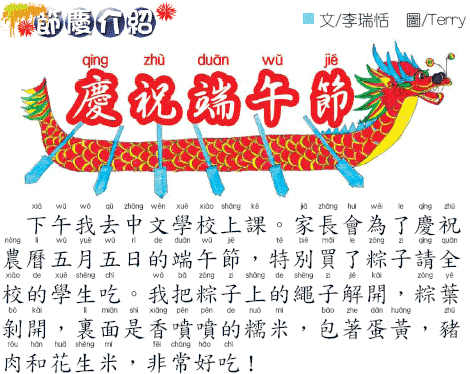
Victor Mair’s latest post at Language Log introduces a new U.S.-based newspaper, the Huayu Xuebao (Mandarin Learning Newspaper, 華語學報), which is similar to Taiwan’s Guoyu Ribao (Mandarin Daily News), the main difference being the former uses Hanyu Pinyin while the latter uses zhuyin fuhao (bopo mofo).

Well, actually the Huayu Xuebao doesn’t use proper Pinyin (see recent remarks). But I’m so happy to see this long-needed paper that I’ll hold my tongue for now.

Unfortunately, the paper doesn’t have its Web site ready yet — not that the long-established Guoyu Ribao is much better at that, at least when it comes to texts as they appear in the newspaper. So, for more information about the Huayu Xuebao, write learningnewspaper [AT] yahoo.com or phone +1-201-288-9188 (New Jersey).

There’s also a sample issue.

source: How to learn to read Chinese, Language Log, May 25, 2008

Mandarin-language papers in Indonesia

The Jakarta Post recently ran an article titled “Chinese papers attracting younger readers.” That would indeed be encouraging news, given the considerable damage in Indonesia to Sinitic languages and Chinese culture during their suppression there for most the second half of the twentieth century.

But the specifics of the article are a little less encouraging.

Since controls against newspapers in Mandarin were eased in 2000, Jakarta has had up to six so-called Chinese newspapers. The number is now down to three, at least one of which is operating in the red.

Bambang Suryono (a.k.a. Lie Zuo Hui), editor in chief of the Yìnní Guójì Rìbào (Indonesian International Daily News, 印尼國際日報) said that Chinese newspapers in general did not get many young readers or contributors who could write well.

After the reformation era in 2001, Sino-Mandarin courses started to sprout in the city. However, Bambang said new Chinese language students were not yet apt to read Chinese newspapers.

“They can write simple articles about their daily activities, but not on complex subjects.”

For that matter, not many people on his own staff can write in Hanzi.

Out of his editorial staff of 20, there are only four journalists that can write in Chinese, and the youngest is 58 years old. “It’s so hard to find young people that can write in Chinese,” Bambang said.

Sunardi Mulia, the editor-in-chief of a business daily Indonesia Shang Bao, said most of his paper’s readers were above 55 years old.

“They are those who once went to local Chinese schools,” he said. “More and more of those aging readers are passing away.”

Sunardi’s paper, has few reporters. “I have to really roll up my sleeves to report large events,” he said. And about 90 percent of the paper’s editorial team are over 50….

“It’s true more young people have begun learning the language. However, it will take time for them to improve because their cultural surrounding is completely different than previous generations.”

“A lot of their parents cannot speak Mandarin or read Chinese anymore,” said Sunardi.

“So their opportunities to practice and communicate with the language are very limited. They probably need 15 years or so before they can read fluently,” said Sunardi, 59.

Sunardi said his paper’s present marketing target was mostly foreigners, specifically businesspeople from China and Taiwan. But he was optimistic about the future for his paper — again, though, not because of people born and bred in Indonesia but because of new readers arriving as immigrants from China.

No. of copies printed per day, according to the editors:

  • Guoji Ribao: 60,000 copies per day, about one-third of those distributed in Jakarta
  • Shang Bao: 10,000 copies per day, most distribued in Jakarta
  • Harian Indonesia Yinni Sin Chew Ribao (formerly government controlled): 55,000 per day

source: Chinese papers attracting younger readers, Jakarta Post, May 15, 2008 (alternate source)

online texts in Hanyu Pinyin

Chris recently wrote and asked for a list of texts in Pinyin. This site, of course, has at least a few things in Pinyin. Unfortunately, however, they can be a bit difficult to find. So having a list is indeed a good idea.

Here are some readings in Hanyu Pinyin:

Some song lyrics

I should probably figure out a way to incorporate this into the recommended readings section. One of the problems with this site is that it has grown much, much larger than I ever expected, which has resulted in some pages not fitting well within the structure I initially established for Pinyin Info. Over the years various additional readings have been added to the site, a few of which are even in Hanyu Pinyin. But since Pinyin Info’s recommended readings section is set up for books rather than essays, songs, etc., this will involve a rethinking of that page.

I very much hope people can help expand the list by providing links to readings elsewhere in Pinyin. But before listing something in the comments, please make sure it is in real Hanyu Pinyin (e.g., with word parsing instead of bro ken syl la bles, with tone marks instead of tone numbers, and with proper capitalization and punctuation). Alas, most texts that are supposedly in Pinyin do not follow those rules.

Book reviews, vol. 5

Sino-Platonic Papers has rereleased for free its fifth volume of reviews, mainly of books about China and its history and languages (11.6 MB PDF).

Even if you have no particular interest in the specific works reviewed, I recommend at least browsing through this and all of the other volumes of reviews from Sino-Platonic Papers, as they often feature Victor Mair at his most direct and entertaining about a wide range of subjects.

Table of Contents:

  • Review Article: The Present State and Future Prospects of Pre-Han Text Studies. A review of Michael Loewe, ed., Early Chinese Texts: A Bibliographical Guide. Reviewed by E. Bruce Brooks, University of Massachusetts at Amherst.

N.B.: The following 29 reviews are by the editor of Sino-Platonic Papers.

  • Roger T. Ames, Chan Sin-wai, and Mau-sang Ng, eds. Interpreting Culture through Translation: A Festschrift for D. C. Lau.
  • Sau Y. Chan. Improvisation in a Ritual Context: The Music of Cantonese Opera.
  • CHANG Xizhen. Beijing Tuhua [Pekingese Colloquial].
  • CHANG/AIXINJUELUO Yingsheng [AISINGIORO *Yingsheng]. Beijing Tuhua zhong de Manyu [Manchurian in Pekingese Colloquial].
  • BAI Gong and JIN Shan. Jing Wei’er: Toushi Beijingren de Yuyan [“Capital Flavor”: A Perspective on the Language of the Pekingese].
  • JIA Caizhu, comp. Beijinghua Erhua Cidian [Dictionary of Retroflex Final-r in Pekingese].
  • Julia Ching and R. W .L. Guisso, eds. Sages and Sons: Mythology and Archaeology in Ancient China.
  • FENG Zhiwei. Xiandai Hanzi he Jisuanji (Modern Chinese Characters and Electronic Computers).
  • FENG Zhiwei. Zhongwen Xinxi Chuli yu Hanyu Yanjiu [Chinese Information Processing and Research on Sinitic].
  • Andre Gunder Frank. The Centrality of Central Asia.
  • HUANG Jungui. Hanzi yu Hanzi Paijian Fangfa [Sinographs and Methods for Ordering and Looking up Sinographs].
  • W. J. F. Jenner. The Tyranny of History: The Roots of China’s Crisis.
  • Adam T. Kessler. Empires Beyond the Great Wall: The Heritage of Genghis Khan.
  • David R. McCraw. Du Fu’s Laments from the South.
  • Michael Nylan, tr. and comm. The Canon of Supreme Mystery, by Yang Hsiung.
  • R. P. Peerenboom. Law and Morality in Ancient China: The Silk Manuscripts of Huang-Lao.
  • Henry G. Schwarz. An Uyghur-English Dictionary.
  • Vitaly Shevoroshkin, ed. Dene-Sino-Caucasian Languages.
  • Vitaly Shevoroshkin, ed. Nostratic, Dene-Caucasian, Austric and Amerind.
  • Laurence G. Thompson, comp. Studies of Chinese Religion: A Comprehensive and Classified Bibliography of Publications in English, French, and German through 1970.
  • Laurence G. Thompson, comp. Chinese Religion in Western Languages: A Comprehensive and Classified Bibliography of Publications in English, French, and German through 1980.
  • Laurence G. Thompson, comp. Chinese Religion: Publications in Western Languages, 1981 through 1990.
  • Aat Vervoorn. Men of the Cliffs and Caves: The Development of the Chinese Eremitic Tradition to the End of the Han Dynasty.
  • WANG Jiting, ZHANG Shaoting, and WANG Suorong, comp. Changjian Wenyan Shumianyu [Frequently Encountered Literary Sinitic Expressions in Written Language].
  • John Timothy Wixted. Japanese Scholars of China: A Bibliographical Handbook.
  • YÜ Lung-yü, ed. Chung-Yin wen-hsüeh kuan-hsi yüan-liu [The Origin and Development of Sino-Indian Literary Relations].
  • ZHANG Guangda and RONG Xinjiang. Yutian Shi Congkao [Collected Inquiries on the History of Khotan].
  • ZHANG Yongyan, chief ed. Shishuo Xinxu Cidian [A Dictionary of A New Account of Tales of the World].
  • Peter H. Rushton. The Jin Ping Mei and the Non-Linear Dimensions of the Traditional Chinese Novel.

  • William H. Baxter, A Handbook of Old Chinese Phonology. Reviewed by Paul Rakita Goldin, Harvard University.
  • JI Xianlin (aka Hiän-lin Dschi). Dunhuang Tulufan Tuhuoluoyu Yanjiu Daolun [A Guide to Tocharian Language Materials from Dunhuang and Turfan]. Reviewed by XU Wenkan, Hanyu Da Cidian editorial offices in Shanghai.
  • GU Zhengmei. Guishuang Fojiao Zhengzhi Chuantong yu Dasheng Fojiao [The Political Tradition of Kushan Buddhism and Mahayana Buddhism]. Reviewed by XU Wenkan, Hanyu Da Cidian editorial offices in Shanghai.
  • W. South Coblin, University of Iowa. A Note on the Modern Readings of 土蕃.
  • Rejoinder by the Editor.
  • Announcement concerning the inauguration of a new series in Sino-Platonic Papers entitled “Bits and Pieces.”

This work also continues the discussion regarding the Chinese characters “土蕃” and Tibet.

This was first published in July 1994 as issue no. 46 of Sino-Platonic Papers.

Unicode tops other encodings on Web pages: Google

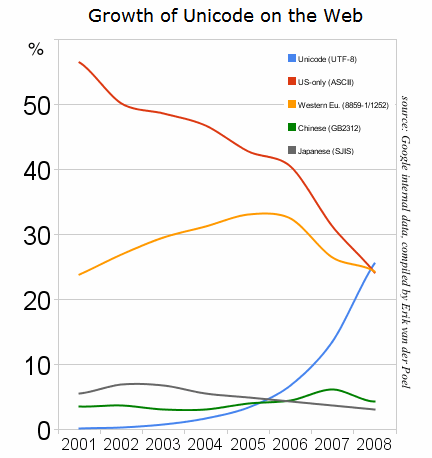
Google is reporting that in December 2007 Unicode became the most frequently used encoding on Web pages.

Just last December there was an interesting milestone on the web. For the first time, we found that Unicode was the most frequent encoding found on web pages, overtaking both ASCII and Western European encodings—and by coincidence, within 10 days of one another. What’s more impressive than simply overtaking them is the speed with which this happened.

Here’s Google’s graph:
graph showing percentage of pages in various encodings, 2001-2008, with ASCII starting about 56% in 2001 and declining to about 25% now, which is also about where iso-8859-1 and utf-8 are now

I wish Big5, the encoding most used for Web pages in traditional Chinese characters, had been included in the graph. And I suspect that it’s only within the past ten years — perhaps even within the timeframe of the graph — that more Web pages have been encoded in GB (used for so-called simplified Chinese characters) than Big5. (GB is shown on the graph in green.)

Of course, many (most?) Web pages don’t declare any character encoding. This is especially bad when they contain characters beyond the bounds of ASCII, since those characters will often end up rendered as garbage on systems different than that of the creator of the Web page.

So … should I have a post focusing on Unicode without again berating the Unicode Consortium for its continuing unscientific, egregious, and unforgivable use of ideographic? I don’t think so.

source: Moving to Unicode 5.1, Official Google Blog, May 5, 2008

Documenting and Revitalizing Austronesian Languages: free online book

Language Documentation & Conservation, a refereed, open-access journal sponsored by the National Foreign Language Resource Center and published online by the University of Hawai‘i Press, has released its first online book: Documenting and Revitalizing Austronesian Languages, edited by D. Victoria Rau and Margaret Florey.

Half of the chapters in the new book (ISBN 978-0-8248-3309-1) focus specifically on Austronesian languages of Taiwan. I have indicated those with bold text below.

Contents:

Introduction: documenting and revitalizing Austronesian languages
I. International capacity building initiatives

  • The language documentation and conservation initiative at the University of Hawai’i at Manoa
  • Training for language documentation: Experiences at the School of Oriental and African Studies
  • SIL International and endangered Austronesian languages

II. Documentation and revitalization activities

  • Local autonomy, local capacity building and support for minority languages: Field experiences from Indonesia
  • Documenting and revitalizing Kavalan
  • E-learning in endangered language documentation and revitalization
  • Indigenous language-informed participatory policy in Taiwan: A socio-political perspective
  • Teaching and learning an endangered Austronesian language in Taiwan

III. Computational methods and tools for language documentation

  • WeSay, a tool for engaging communities in dictionary building
  • On designing the Formosan multimedia word dictionaries by a participatory process
  • Annotating texts for language documentation with Discourse Profiler’s metatagging system

There have also been two issues of the journal issued to date, though neither of these has anything specific about languages spoken in Taiwan.

This is indeed a promising beginning. I look forward to more such titles from the journal.

Hanyu Pinyin backer to return to Taiwan’s Cabinet

Dr. Ovid Tzeng (Zēng Zhìlǎng / 曾志朗 ) will be returning to government as a minister without portfolio in the Cabinet of the incoming administration of Ma Ying-jeou.

Tzeng has done important work in psycholinguistics and is known to support Taiwan’s adoption of Hanyu Pinyin. Indeed, this support was one of the reasons he was pushed out of office the last time he was in government service, as minister of education at the beginning of President Chen Shui-bian’s first term.

Tasked with choosing a romanization system for Taiwan, Tzeng recommended Hanyu Pinyin. He was promptly replaced by someone who backed the adoption of the newly minted Tongyong Pinyin.

Tzeng’s name is often misspelled “”Ovid Tseng” in news reports.

major paper on Crazy English released

The new work I promised on Li Yang and his Crazy English method has finally been published and is available for free on the Web: A Survey of Li Yang Crazy English (2.6 MB PDF), by Amber R. Woodward.

For a little more on this, see Victor Mair’s recent post on Language Log: Crazy English again.

This paper, which is some 70 pages long, includes photos and even videos.

Here’s the table of contents:

  • Preface
  • Abstract
  • Li Yang: The Man
    • Li Yang’s Background
    • The Establishment of Li Yang Crazy English
  • Crazy English: The Method
    • Precursors to Crazy English
    • Crazy English Pedagogical Method
    • Crazy English Psychological Method
    • The Potential for Success of the Crazy English Method
  • Li Yang Crazy English Politics: The Madness
    • Li Yang’s Personal Ideology
    • Zhang Yuan’s 1999 Documentary, Crazy English
    • Crazy English Publicity
    • Government Response to Li Yang
    • Connection between the Method and the Madness
  • Appendix
    • Survey on Li Yang and Crazy English
    • Transcript of Time Asia Interview
    • Transcript of Li’s Responses to Criticism
    • Pictures of Li Yang Crazy English
  • Bibliography

This is issue no. 180 of Sino-Platonic Papers.

Further reading: