‘dialects’ wasting ‘important neurons’ needed for Mandarin, English: Lee Kuan Yew

In 1979 Singapore launched its campaign for people there to “Strike Hard Against Hoklo, Cantonese, and Other Languages that Your Government Says Are Puny and Insignificant Because They Have Only Tens of Millions of Speakers Apiece,” er, “Speak Mandarin” (Jiǎng Huáyǔ Yùndòng / 讲华语运动). The city-state has been marking the the 30th anniversary of this with some speeches, such as one a couple of weeks ago by former prime minister Lee Kuan Yew (Lǐ Guāngyào), now “minister mentor.”

Lee described the situation:

Thirty years ago I launched the Speak Mandarin campaign. [Singaporean] Chinese students learned Mandarin at school. Unfortunately, they used to speak dialects amongst themselves, at home, and with their friends — a variety of dialects.

Here, “dialects” is of course the standard misnomer for Sinitic languages other than Mandarin.

Lee said that he himself was setting a bad example during the 1960s and 1970s by doing such highly irresponsible things as giving speeches in the native language of the majority of Singapore’s citizens. So he stopped all that. And he had the government shut down almost all broadcasts in Hokkien (Hoklo) and other such languages.

Lee said that although he understands “the strong emotional ties to one’s mother tongue … the trend is clear. In two generations, Mandarin will become our mother tongue.”

Actually, no, that’s not clear at all. Rather, a very different trend is apparent. During his speech Lee displayed the graph below, with data taken from surveys conducted by Singapore’s Ministry of Education.

Dominant Home Language of Singaporean Chinese Primary-1 Students (1980 to 2009)
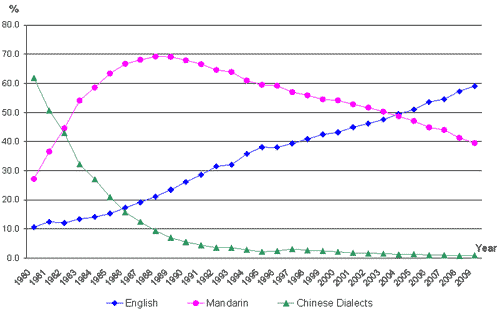
graph showing English in a steady climb from 10% -- all numbers are approximate -- (1980) to 60% (2009); 'Chinese dialects' in steep decline from 1980 (62%) to 1988 (9%) and continuing to decline to only 1% or 2% in 2009; and Mandarin, which begins in 1980 at 28% and quickly tops 60% in 1985, with slower growth until 1988 (69%), after which it enters a steady decline to 39% (2009)

As the primary language of the home for young students, Mandarin has dropped steadily since the late 1980s, while English has risen steadily since 1980, with English surpassing Mandarin in 2004. (Language data for the whole population is more complicated. See, for example, the 2005 General Household Survey.)

Of course the government and Lee recognize this. But they don’t want to fight against English, which is crucial to Singapore’s success. So what Lee is proposing is that parents — both parents — speak Mandarin, not English, to their children.

(I see from my stats that this site gets lots of visitors from Singapore. Can any of you comment on how well you think the public will respond to Lee’s proposal.)

Lee explained in his speech that people have only so many “gigabytes” in their brains to devote to languages.

Though stating that speaking “dialects” in some situations can provide “extra warmth,” he warns that by using such languages: “You are losing important neurons with data which should not be there. And like the computer, when you delete it, it doesn’t really go away. It’s there at the back, and you’ve got to go to the rubbish channel and say ‘destroy.’ And it’s still disturbing your hard disk.”

Thus, those rubbish languages must be destroyed “dialects” must be let go, he said.

On March 8 a linguist at Nanyang Technological University (NTU) in Singapore was quoted in the newspaper as saying, “Although Singaporeans are still multilingual, 40 years ago, we were even more multilingual. Young children are not speaking some of these languages at all any more…. All it takes is one generation for a language to die.” But even after all these years, with Sinitic languages other than Mandarin fading fast there, this is apparently still no time to be slacking off, as Lee’s principal private secretary, Chee Hong Tat, promptly responded, “It would be stupid for any Singapore agency or NTU to advocate the learning of dialects, which must be at the expense of English and Mandarin.”

Part of the reason behind Lee’s call, however, is a basic misunderstanding. Setting aside the matters of educating children in a language not native to them and how many languages most people are capable of speaking effectively, the main difficulty with learning Mandarin is not the language itself (especially for those who speak other Sinitic languages) but Chinese characters as its near-exclusive script.

If Singapore is smart about promoting Mandarin, sooner rather than later it will develop a two-track system, with most students studying how to read and write Mandarin exclusively in Hanyu Pinyin, while those who wish become more specialized can go on to study Chinese characters as well. For this to work, Singapore will need to produce plenty of material to read in Pinyin. (A newspaper, for example, would be a must — and one with real news, not just cute stories for kids.) The city-state certainly has the means and motive for this. But does it have the imagination? If it does, most students could save their precious neurons and gigabytes for other things — perhaps even their families’ traditional native languages.

SOURCES:
Lee Kuan Yew speech:

Some Singapore blog posts:

newspaper stories:

letter to the editor:

additional:

How to write verbs in Hanyu Pinyin

cover of Chinese Romanization: Pronunciation and OrthographyToday’s release from Yin Binyong’s Chinese Romanization: Pronunciation and Orthography is a long, important section that covers verbs in Hanyu Pinyin (2 MB PDF).

In this post I’ll go over the rules for what to do with Mandarin’s three tense-marking particles — zhe (著/着), guo ( 過/过), and le (了) — since these participles are extremely common and people are often unaware of how they should be written in Pinyin. Fortunately, this is pretty easy: -zhe and -guo are always written solid (with no interposing space or hyphen) with the verb they follow. The case of le is more complicated (but not too much trouble).

-zhe 著/着

-zhe is added onto a verb to indicate the ongoing nature of an action or state, whether in the past, present, or future. It thus bears a certain similarity to the English verb suffix -ing. A sentence in which -zhe is used tends to emphasize the description of the action or state indicated by the verb. Since no other sentence component may be interposed between a verb and -zhe, a general rule may be stated: -zhe is always written as one unit with the verb it follows.

Some examples:

Tā wēixiàozhe duì wǒ shuō: “Nǐ lái ba!”
她微笑著對我說: “你來吧!”
(Smiling, she said to me, “Come on!”)

Nǐ xiān děngzhe, ràng wǒ jìnqu kànkan.
你先等著,讓我進去看看.
(You wait out here while I go in and look.)

Note that “kànkan” in the sentence above shows something else about verbs in Hanyu Pinyin: the second part of a reduplicated verb is in the neutral tone.

-guo 過/过

-guo is added after a verb to indicate that a given person or object has experienced the action expressed by the verb. -guo may only be used in the past tense. Since no other sentence component may be interposed between a verb and -guo, a general rule may be formulated: -guo is always written as one unit with the verb it follows.

Some examples:

Wǒ xuéguo liǎng nián Yīngyǔ, dànshì méi xuéguo Rìyǔ.
我學過兩年英語,但是沒學過日語.
(I’ve studied two years of English, but I haven’t studied Japanese.)

Nà běn shū wǒ kànjianguo, hǎoxiàng zài shūjià shang.
那本書我看見過,好像在書架上.
(I have seen that book somewhere; I think it’s on the bookshelf.)

le 了

The tense-marking particle le is added after a verb to emphasize that the action expressed has been completed or that the state indicated has been achieved. -le is ordinarily written as one unit with the verb it follows.

For example:

Zuótiān wǎnshang wǒ kànle yī chǎng diànyǐng.
昨天晚上我看了一場電影.
(I saw a movie yesterday evening.)

But here’s where it starts to get a little more complicated.

If a verb complement is interposed between the verb and the tense marker -le in a sentence, there are two possible written forms. If the verb and its complement are written as a unit, then –le is written as a unit with them; if they are written separately, then -le too is written separately.

For example:

Xiǎo Chén qīngqīng de guānshangle fángmén.
小陳輕輕的關上了房門.
(Xiao Chen gently closed the house door.)

But also:

Tā cóng shūbāo lǐ ná chūlai le liǎng běn liánhuánhuà.
他從書包裡拿出來了兩本連環畫.
(He pulled two comic books out of his bookbag.)
(ná 拿 — verb; chūlai 出來 — complement)

I suspect that’s the sort of thing that may well change (for the simpler) once Pinyin makes it out into the world of popular usage as a script in its own right. But for now I’m just givin’ the rules as I find ‘em.

Speaking of which, here’s the final twist on -le.

Apart from its function as a tense-marking particle, -le can also serve as a mood-marking particle. (The former usage is usually denominated le1 and the latter le2 in grammar texts.) In its latter capacity, le always appears at the end of a sentence or clause, just before a comma, period, or other punctuation mark. The two different le’s, le1 and le2, are sometimes quite difficult to distinguish in practice. With this in mind, and with the aim of simplifying HP orthography, the, following simple rule is set out: any le, whether le1 or le2, appearing at the end of a sentence or clause is to be written by itself.

Thus, that’s actually a good thing, since it simplified matters. So, for anyone programming a Pinyin converter, put a space before le if it is immediately followed by punctuation.

Thus, for example:

Wǒmen túshūguǎn yǐjing mǎile sānwàn duō běn shū le.
我們圖書館已經買了三萬多本書了.
(Our library has already purchased over thirty thousand books.)

Hǎo le, hǎo le, dàjiā dōu bié chǎo le.
好了好了, 大家都別吵了.
(All right, all right, everybody quiet down.)

Remember: This post covered only one small aspect of the entire reading. So be sure to download and read the entire PDF, which has many, many more examples.

It’s also a very useful reading for students of Mandarin.

Writing Taiwanese: 1999 study

This seems as good an announcement as any to end my hiatus from posting. Sino-Platonic Papers has just rereleased a popular issue of likely interest to many readers of Pinyin News: Writing Taiwanese: The Development of Modern Written Taiwanese (2.2 MB PDF), by Alvin Lin.

The table of contents gives a pretty good picture of what’s inside:

Preface
Introduction
The Status Quo: Characters and Taiwanese writing

  1. The Roots of Writing in Taiwanese: Wenyan, baihua and academic Taiwanese
  2. The Missing 15 Percent: Developing a written vernacular
  3. One Attempt at Finding the Missing 15 Percent: Yang Qingchu’s Mandarin-Taiwanese Dictionary

Writing Romanized Taiwanese

  1. The Roots of Romanized Taiwanese: Church Romanization
  2. Church Romanization Today: The Taigu listserver
  3. An Indigenous System: Liim Keahioong and Modern Literal Taiwanese

Linguistic and Social Considerations

  1. Some Linguistic Classifications
  2. Dealing with Homonyms: Morphophonemic spelling
  3. Tones in Taiwanese: Surface vs. Lexical tones
  4. Representing Dialects: Picking a standard written form or representing all dialects
  5. Summary of Linguistic Concerns: Deciding the degree of coding
  6. Writing, Reading, Printing, Computing, Indexing and other Practical Concerns
  7. Social Concerns: Tradition and Political Meaning
  8. Conclusion: Future Orthography Policy on Taiwan

Bibliography
Appendices:

  • Email Survey
  • Pronunciation guide to church romanization

List of Tables and Illustrations:

  • Table 1: Suggested Characters for Taiwanese Morphemes from Three Sources
  • Figure 1: Yang Qingchu’s Taiwanese-Mandarin Dictionary
  • Figure 2: Church romanization
  • Figure 3: Modern Literal Taiwanese
  • Figure 4: Sample e-mail from Taigu listserver

This was first published in 1999 as issue number 89 of Sino-Platonic Papers.

San Francisco Chinatown signage

Here are some photos I took a couple of years ago in San Francisco’s Chinatown.

As should be clear from the Mandarin and Cantonese pronunciations I’ve provided for the Chinese characters, the Sinitic names for streets in Chinatown certainly don’t come from Mandarin, which isn’t surprising given how the Chinese diaspora was not predominantly Mandarin speaking until recently. My guess would be Taishanese Cantonese.

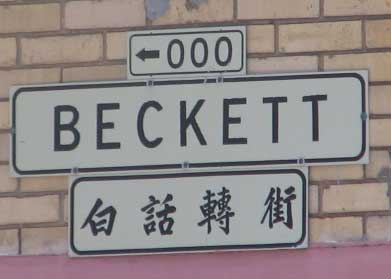
Beckett: 白話轉街 (Mandarin: Báihuàzhuǎn Jiē; Cantonese: baahk- wa/ jyun/ )

BECKETT 白話轉街

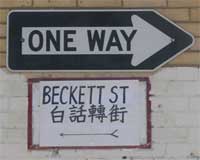
I like this unofficial sign even better.
a one-way sign, beneath which is a hand-lettered sign reading BECKETT ST 白話轉街

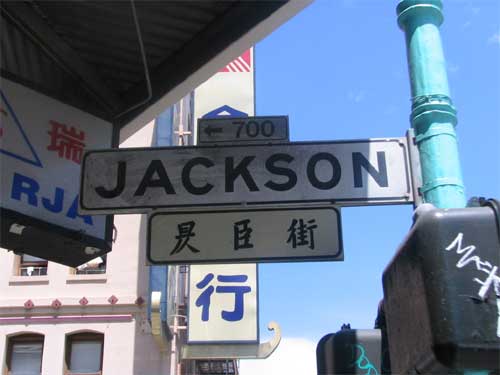
Jackson: 昃臣街 (Mandarin: Zèchén Jiē; Cantonese: jak\ sahn\)

The first Chinese character, 昃, is a surprising choice since it is quite rare and would not be known by most people. Some far more common characters that perhaps could have been used instead include 則 (Cantonese: jak\), 責 (Cantonese: jaak-), 澤 (Cantonese: jaahk-), and 擇 (Cantonese: jaahk-) — all of which are pronounced zé in Mandarin.

Jackson 昃臣街

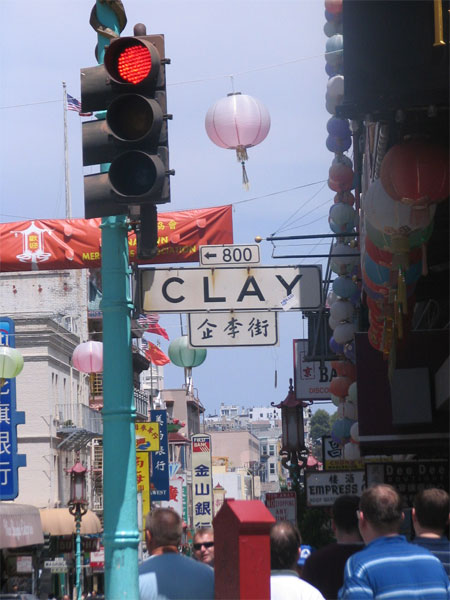
Clay: 企李街 (Mandarin: Qǐlǐ Jiē; Cantonese: keih/ leih/)

streetsign for Clay Street, with 企李街 in Chinese characters

Commercial: 襟美慎街 (Mandarin: Jīnměishèn Jiē; Cantonese: kam\ meih/ sahn-)

I would have expected a semantic translation for this street name. But Kam-meih-sahn appears to be another phonetic approximation.

'Commercial 襟美慎街' -- a bronze placque embedded in brick paving

Grant: 都板街 (Mandarin: Dōubǎn Jiē; Cantonese: dou\ baan/ gaai\)

This is another interesting one. Note that Doubaan and Grant sound nothing like each other. And this isn’t a semantic translation of Grant either. So why is this street labelled 都板街? The answer is that the Sinitic name preserves an old name of the street: Dupont.

street sign reading 'Grant 都板街'

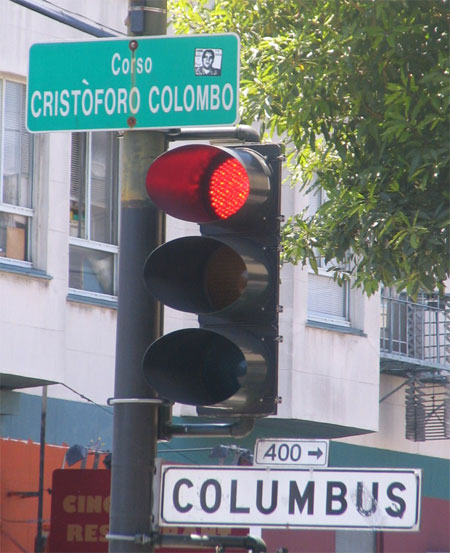
And for lagniappe, here’s a photo taken in the nearby Italian district, where Columbus Street is also identified in Italian as Corso Cristòforo Colombo.

as described above

further reading:

misc. links

click for complete imageI’m feeling guilty that I haven’t posted in over a month. But since I still don’t have anything ready I’ll make do for now with mention of just a few relatively recent items elsewhere:

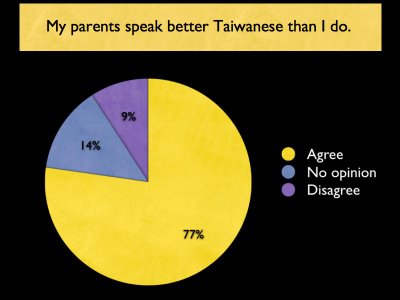
My parents speak Taiwanese better than I do. agree: 77%; disagree: 9%; no opinion: 14%

and for lagniappe:

China and U.S. study abroad programs

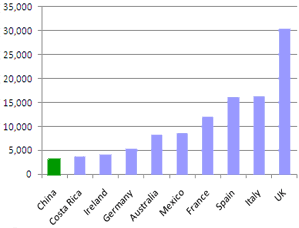
China has become the fifth most popular destination for U.S. students in study abroad programs, according to the results of a newly released study.

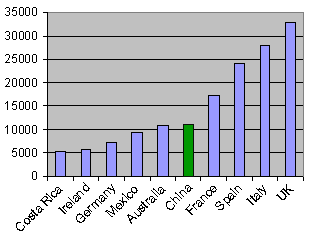
Top 10 destinations for study abroad by U.S. students in the 2006-07 school year
China shown as the fifth most popular destination for study abroad. The top destination is the UK, followed by Italy, Spain, and France.

It was only a few years ago that China made it into the top ten for the first time.

Top 10 destinations for study abroad by U.S. students in the 2000-01 school year
China shown as the tenth most popular destination for study abroad. The top destination is the UK, followed by Italy, Spain, and France.

The trend evident by comparing the two graphs is also backed up by the numbers: There has been a tremendous increase in the number of American students receiving credit for study abroad.

This latest increase marks a decade of unprecedented growth in the number of American students receiving academic credit for their overseas academic experience, with an increase of close to 150%, from under 100,000 in 1996/97 to nearly a quarter of a million in 2006/07.

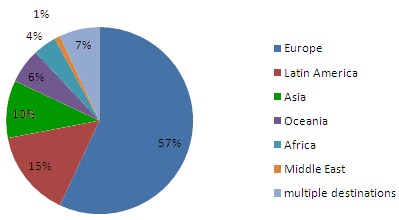
Moreover, there has been an increasing interest in non-traditional destinations. In 1996-97, Europe took in 64 percent of U.S. students studying abroad. Although it continues to attract a majority (57 percent) of such students, many other destinations are receiving more students than ever, “fueled in part by an increase in new program opportunities, partnerships between higher education institutions in the United States and abroad, and a range of fields and program durations to accommodate the needs of an increasingly diverse study abroad population.”

Percent of study abroad performed in various parts of the world, 2006-07
Europe 57%, Latin America 15% , Asia 10%, Oceania 6%, Africa 4%, Middle East 1%, multiple destinations 7%

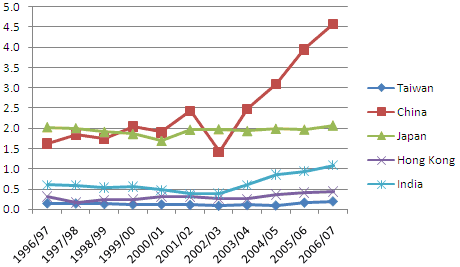
China’s growth as a destination has been strong this decade, other than a dip during the SARS outbreak. Note, however, that China has yet to receive even 5 percent of U.S. study abroad students in any given year, so please don’t misinterpret this post as yet more media hype proclaiming “Everyone’s going to China!” (For the 2006-2007 school year, the figure was 4.6 percent.)

Percent of study abroad performed in select Asian destinations, 1996-2006
percentage of study abroad students in select Asian destinations, 1996-2006; sharp growth for China; also dramatic growth for India, but from a lower baseline; Japan stays flat

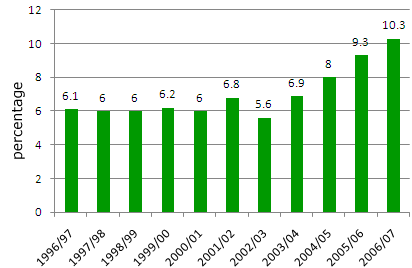
The growth of interest in China has helped fuel Asia taking in greater numbers of students. Taiwan has also more than doubled the percentage of U.S. study abroad students it takes in, though the percentage remains so low that this is difficult to see on the graph.

Percent of study abroad performed in Asia, 1996-2006
dfdfd

Note that there’s no indication of just how long people stayed in given destinations. So it’s possible that students spent much more time on average in, say, England than in China — or vice versa.

Here’s the overall breakdown for the time students spent studying abroad:

  • 55% in short-term programs (“including summer, January term and any program of 2 to 8 weeks during the academic year”)
  • about 36% in semester-long programs
  • over 40% in mid-length programs (one semester, one quarter or two quarters)
  • less than 5% spend a full academic or calendar year abroad

source: Open Doors 2008: Report on International Educational Exchange

Further reading for students interested in study abroad: IIEPassport Study Abroad Funding.

writing four-syllable idioms in Pinyin

cover of Chinese Romanization: Pronunciation and OrthographyThe latest excerpt from Yin Binyong’s book on Pinyin orthography covers how to write four-syllable idioms in Hanyu Pinyin (929 KB PDF). Here’s a key passage:

almost all four-character idioms can be broken in two halves, called yǔjié 语节 (language segments), on the basis of phonetic structure. The simple expedient of connecting the two yǔjié with a hyphen then provides idioms with their own distinctive written form, and assures ease of writing and reading. It is also a simple rule for students of HP to master.

But not all four-syllable idioms follow this rule, as the reading shows.

This is a worthwhile reading for Mandarin learners, even if you’re not particularly interested in Pinyin. There are many examples of idioms here, all given in Hanzi, Pinyin, and English.