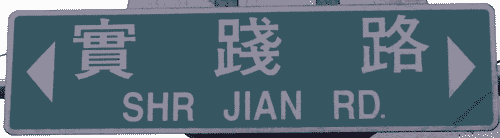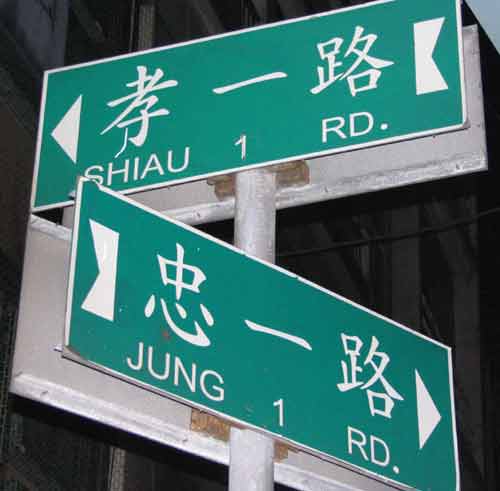
An observant reader, Sonarchic, sent in the top two photos below, both of which were taken in Taizhong (Taichung), Taiwan. The first one is especially interesting in that what would be written zhong in Hanyu Pinyin is here written two different ways: chung and zhueng.
Here’s an older street sign.
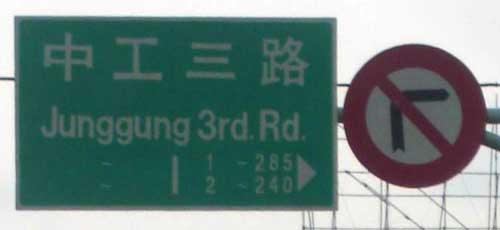
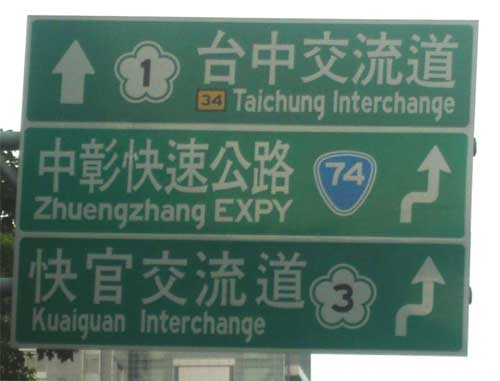
I’ve appended two photos I took myself in Taizhong about two years ago.
The first was taken on a highway near Taizhong. Since highways are under the central government’s jurisdiction, these signs are in Tongyong Pinyin.
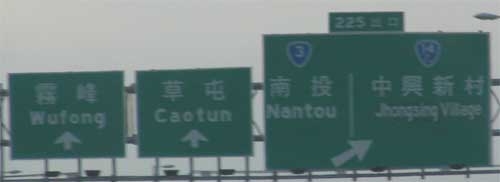
And here is a relatively new street sign with Taizhong itself. Note the use of Hanyu Pinyin, which, despite reports to the contrary, is not limited in Taiwan to Taipei City. I don’t know what “C1” refers to; I certainly hope it’s not a variant of Taipei’s idiotic nicknumbering system. Note also how any mention of the road’s sections (duan) are omitted from the romanization — very bad. Moreover, it has always seemed to me that Taizhong’s street signs suffer from too much information: just look at all those numbers. That can’t be good for readability.
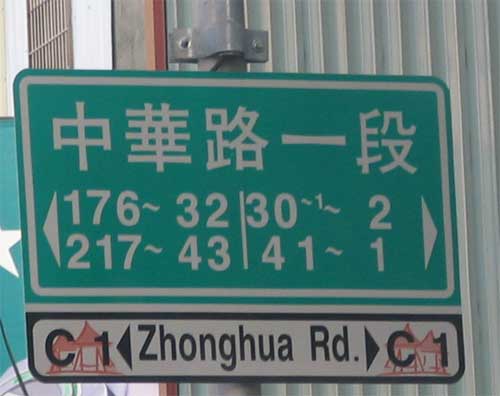
So, to wrap up, these signs in and near Taizhong, give us:
- Taichung Interchange (bastardized Wade-Giles)
- Zhuengzhang EXPY (misspelled Hanyu Pinyin) (BTW, this should be written Zhong-Zhang EXPY, as in [Tai]zhong-Zhang[hua] EXPY)
- Junggung 3rd Rd (MPS2 — not Yale)
- Jhongsing (Tongyong Pinyin)
- Zhonghua (Hanyu Pinyin)
All that for a simple zhong (中).
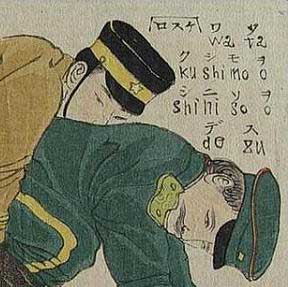 While a lot of things might be unusual about this old print of a Japanese soldier having sex with or simply raping a Western soldier, what particularly startled me is the use of romanization. Given that much of the text in the