Wulai — or something like that

All of the romanization systems commonly seen in Taiwan — bastardized Wade-Giles, MPS2, Tongyong Pinyin, and Hanyu Pinyin — use the same spelling (tones aside) for the unnecessarily ugly but scenically situated Taipei County town of Wulai (Mandarin: Wūlái / 烏來). And the formerly official but little-seen Gwoyeu Romatzyh isn’t so different: Ulai. So getting this one spelled correctly shouldn’t be a big deal.

But on a recent trip there I saw the spelling of “Ulay” on relatively recent official signage.
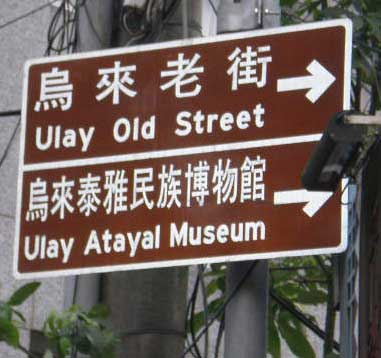
two brown (culture) signs with 'Ulay Old Street' and 'Ulay Atayal Museum', along with their respective Chinese characters

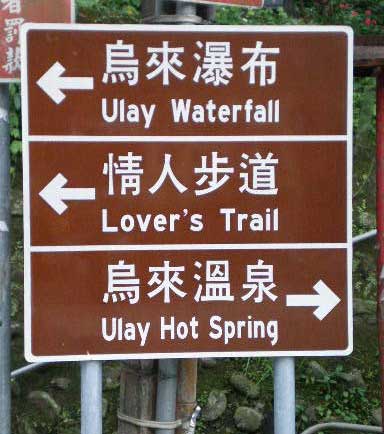
three brown (culture) signs with 'Ulay Waterfall', 'Lover's Trail', and 'Ulay Hot Spring', along with their respective Chinese characters

Actually, none of those particular signs really needed any spelling of Wulai. For example, if you’re in Wulai and a sign points toward “Old Street”, you don’t really need to wonder if perhaps it’s pointing toward the Old Street in Sanxia or some other town instead. But officialdom here relies on its lists of official names and seldom exercises anything in the way of imagination or even just common sense. (That reminds me: I really must finish that half-completed post on wordy signage.)

So, about the “Ulay” spelling: Could it be the correct spelling in the system used to write the language of the Atayal people indigenous to the area? A search of some Taiwan government Web sites leads to me to believe that, yes, it could be. But I asked several people in Wulai who said they were literate in Atayal script, and they said that “Wulai” was the correct spelling for the town’s name in the Atayal language.

Still, these were not linguists or teachers, and this is Taiwan, where chabuduo-ism and outright ignorance of romanization are strong. So when I returned home I went to Wulai’s official website, which only made matters worse. There I found all of the following forms: Wulai, WuLai, Wulia, Wulay, and Ulay.

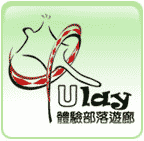
wulai_wulay_wulia
Ulay

  • Wulia — in big letters, no less. Remarkably, the township uses the URL of www.wulia.gov.tw for its site, though, fortunately, www.wulai.gov.tw also works. I doubt this is anything other than a typo that has somehow not been corrected but has instead gained force.
  • Wulai — This spelling is the one used for at least most of the text.
  • Wulay
  • WuLai — Die, intercaps, die!
  • Ulay — found in the Mandarin portion of the site.

Elsewhere I also found the form Ulai; but in these cases that spelling almost certainly has nothing to do with Gwoyeu Romatzyh.

Here are the numbers for some Google searches:

spelling .gov.tw domains all .tw domains any domains, but pages must include “Taipei County” or
“台北縣”
Wulai 2,760 10,900 5,540
Wulia 381 838 307
Ulay 50 649 592
Ulai 33 237 249
Wulay 9 25 16

So, whatever the correct spelling is, that is the government should be using, not this mishmash. And it should let people know how to pronounce it correctly in the original language, not just Mandarin. Perhaps it’s too late for this name, though, as “Wulai” is so well known.

Regardless of the spelling, though, the name is another example of Chinese characters being used to represent a name that did not originate with a Sinitic language. Thus, the name doesn’t really have anything to do with crows (烏) coming (來). Instead, it refers to the hot springs in the area.
Guangzhou opts for Pinyin ‘Lu’ over English ‘Road’

In the push for Guangzhou to revamp its street signs, it appears the initial move for all general terms to be translated into English — e.g., as road — has been overturned. I’m pleased. Thus, Guangzhou’s street signs will be written differently than those in Beijing and many other cities in China.

Of course, I’d be more pleased if, say, 白云路 were rendered as Baahk-wahn Louh (or however that should be spelled in Cantonese) instead of or in addition to Báiyún Lù. Fat chance of that happening, though. And, anyway, the ratio for stories that please me vs. those that really piss me off is not nearly what I’d like it to be, so at least today I’ll take what I can get.

Some excerpts from stories on this topic:

No, it is not “street,” nor “road”. It is simply lu.

The English translation for signs in Guangzhou will be based on Mandarin pronunciation with pinyin spelling and come into effect from May 1, the city government said.

This means busy Beijing Road will be translated as Beijinglu and east Dongfeng Road will be known as Dongfeng Donglu. Lu means road or street in English.

I really hope that “Beijinglu” is just a typo. It should be Beijing Lu / Běijīng Lù.

From a Mandarin-language story:

Zài “gōnggòng biāozhì Yīngwén yì fǎguī fàn” zuìchū de cǎogǎo xiàng shèhuì zhēngqiú yìjiàn shí, jiāng “lù” hé “dàdào” fānyì chéng Yīngyǔ dāncí Road, Avenue. Zuórì gōngbù de “gōnggòng biāozhì Yīngwén yì fǎguī fàn” dìnggǎo zhōng, cóng “dàdào” dào “lù” dào “xiàng”, “lǐ”, “jiē” děng, yīlǜ zhíjiē yòng Hànyǔ Pīnyīn jìnxíng biāozhù. Dànshì xiāngyìng de, “qiáo”, “lìjiāoqiáo”, “gōnglù”, “suìdào” děng jiāotōng shèshī, “guīfàn” zé míngquè guīdìng shǐyòng yìyì, rú “Guǎngzhōu Dà Qiáo” yì wéi Guangzhou Bridge, “Guǎngshàn Gōnglù” yìchéng Guangshan Highway.

Note the translation (which, however, won’t be used) of dàdào as “avenue.” In Taiwan, this is rendered as “boulevard.”

OK, being pleased was nice while it lasted. Now, unfortunately, it’s time to go back to being pissed off. It takes real chutzpah to bring up a U.N. resolution that backs native languages in support of putting Mandarin on signs in a Cantonese-speaking region.

A resolution made by the UN in 1967 stipulated all the English translations of place names in each country and region should be based on its mother language. The State Council issued a plan to standardize place names in 1986, stipulating all public names should be based in pinyin.

Or, as a Mandarin-language article puts it in greater detail:

Zhōng yāoqiú duì shìzhèng dàolù de fānyì cǎiqǔ pīnyīn zhíyì de fāngshì, shì yǒu jù kěchá de. 1967 nián dì-èr jiè Liánhéguó dìmíng biāozhǔnhuà huìyì zuòchū juéyì, yāoqiú gèguó guójì jiāowǎng zhōng dōu shǐyòng Luómǎ (Lādīng) zìmǔ pīnxiě, měi ge dìmíng zhǐyǒu yī zhǒng Luómǎ zìmǔ de pīnxiě xíngshì, jí “dānyī Luómǎhuà”. Yīncǐ, “báiyún lù” jiùyào yì wéi Baiyun Lu, ér bù shì Baiyun Road, yīnwèi hòuzhě shì liǎng zhǒng bùtóng de Luómǎ zìmǔ pīnxiě xíngshì, bùfú “dānyī huà”. 1977 nián, dì-sān jiè Liánhéguó dìmíng biāozhǔnhuà huìyì shàng, tōngguòle Zhōngguó tíchū de cǎiyòng Hànyǔ Pīnyīn Fāng’àn zuòwéi Zhōngguó dìmíng Luómǎ zìmǔ pīnxiěfǎ de guójì biāozhǔn. 1986 nián Guówùyuàn bānbù “dìmíng guǎnlǐ tiáolì”, guīdìng Zhōngguó dìmíng de Luómǎ zìmǔ pīnxiě, yī “Hànyǔ Pīnyīn Fāng’àn” zuò tǒngyī guīfàn. Yīncǐ “báiyún lù” yě bùnéng yì wéi White Cloud Road, yīnwèi bù fúhé “Hànyǔ Pīnyīn Fāng’àn”. Suǒyǐ, shǐyòng Hànyǔ Pīnyīn zuòwéi Zhōngguó dìmíng pīnxiě guīfàn, bùjǐn wèi wǒmen fǎlǜ fǎguī suǒ guīdìng, yěděi dàoliǎo guójì shàng de rènkě.

Well, I suppose those could be separate instances of subversive irony; but my money is still on deeply offensive and clueless chutzpah. Or doublespeak. Take your pick.

sources:

related entries

Huzhu Mongghul and Minhe Mangghuer

The latest rerelease from Sino-Platonic Papers is an enormous work (almost 300 pages) on the languages of the Huzhu Mongghul and Minhe Mangghuer, who are known in China by the Mandarin name of Tǔzú (土族).

Some of the material was written for a television program, part of which is available online, which means that people can listen to native speakers reading the texts!

The Huzhu Mongghul and Minhe Mangghuer language materials presented here are from Huzhu Mongghul Autonomous County and Minhe Hui and Mangghuer Autonomous County in eastern Qinghai Province, the People’s Republic of China. Other Monguor areas, that is Tianzhu Tibetan Autonomous County, Gansu Province and, in Qinghai, Datong Hui and Mongghul Autonomous County and Huangnan Tibetan Autonomous Prefecture, are not represented. We employ “Mangghuer” to refer to Minhe Monguor and “Mongghul” to refer to Monguor residents of Huzhu, for these are the terms the people themselves employ. When we are unsure how people refer to themselves, we use “Monguor,” which we also employ as a collective term to refer to all those classified as “Tu” by the Chinese government in the 1950s.

The material is in the form of the alphabet, numbers, and the calendar; 300 sentences rendered in English, Huzhu Mongghul and Minhe Mangghuer; 900 sentences in English and Minhe Mangghuer; Huzhu Mongghul readings, language points, the text of a television program that taught English in Huzhu Mongghul in Huzhu County and a word list.

The Mongghul/Mangghuer materials are given in a modified Chinese pinyin….

The dictionary at the back of the work is larger and more comprehensive than might be expected. Here are some sample entries:

  • frontier — jiixan
  • frost — xuutira, {SHOUDIERE}
  • froth — kusizi, {MOMOZI}
  • fruit — alimaa, {ALIMA, AMULA}
  • fry — tuusila qina, {TUOSILA CHINA}
  • fuck — mule, {MULI}
  • fuel — shdajin, shdaghua, {XIDAKUNI, GHAR JIALAKUNI}
  • fulfill — banki, gi, {GE}
  • full — diuri, {DURAN, YIGUA}
  • fumigate — funiidigha, {XUNKE}
  • fun — natigu, {NADUJI} (to make fun of)
  • funeral — rgai, {ERGU}
  • fur — ghuasi, {ARASI}
  • fury — ruari, {SHUGUO WERKURJIANG}
  • future — huina, {NINSA KHUONO}

Here’s the link to the SPP 69: Language Materials of China’s Monguor Minority: Huzhu Mongghul and Minhe Mangghuer (15 MB PDF).

The video, which is a massive 528 MB, begins with lesson 26, no. 98 (SPP p. 152, PDF p. 166), and stops abruptly about two-thirds of the way through no. 110 (SPP p. 159, PDF p. 173).

Here are a few internal points of reference in the video:

  • no. 100, p. 153, begins at 5:36
  • no. 103, lesson 27, p. 155, begins at 21:30
  • no 105, p. 156, begins at 29:50
  • no 109, lesson 28, p. 158, begins at 44:50

More of the video may be available later.

Taizhong street signs are ‘wushasha’

This isn’t much of a story, really. But since it talks, however vaguely, about the messy romanization situation in Taizhong and since I haven’t put up anything lately in Pinyin itself, I decided to go ahead and post it.

Just don’t expect any useful news herein, unless you’d be surprised to hear that Taizhong’s street signs are a mess.

Táizhōng Shì lùpái suǒ shǐyòng de Yīngwén pīnyīn qiānqíbǎiguài, pīnyīnfǎ jìyǒu Tōngyòng, Hànyǔ, zhùyīn fúhào dì-èrshì, Wēituǒmǎ pīnyīn, děng, jiù yǒu mínzhòng xiàng běnbào bào liào, zhǐchēng zhèxiē lùpái ràngrén kàn de “wùshàsha,” wàiguó guānguāngkè gèng zhǐnéng gān dèngyǎn.

Yǐ Táizhōng Shì nánqū Wǔ-quán Nánlù [i.e, “the Five Branches of Government South Road”] de xīn-jiù lùpái láishuō, jiù yǒu lùpái shì cǎiyòng Wēituǒmǎ pīnyīn, yīncǐ “權” zì shǐyòng chuan, ér gānggāng wángōng de xīnshì lùpái “權” zì zéshì shǐyòng cyuan, shìwéi Tōngyòng Pīnyīn, rán’ér xiànzài Táizhōng Shìzhèngfǔ zǎoyǐ quánmiàn gǎiyòng Hànyǔ Pīnyīn, “權” zì yīnggāi shì quan cái zhèngquè.

Lìngwài, zài nánqū xīng dàlù de lùpái, jiù yǒu lùpái “興” zì de pīnyīn wéi hsing, shì shǐyòng Wēituǒmǎ pīnyīn, rìqián gāi lùduàn yě gēnghuàn xīnshì lùpái shàng, shìyǐ Hànyǔ Pīnyīn jiāng “興” zì pīnyīn wéi xing, dàn liǎng ge lùpái dōu xuánguà zài lùkǒu, ràngrén kàn de “wùshàsha.”

Zhēnduì Táizhōng Shì lùpái suǒ shǐyòng Yīngwén pīnyīn gèzì bùtóng de qíngkuàng, Táizhōng Shìzhèngfǔ Jiāotōngchù jiāotōng guīhuà kē biǎoshì, zài gègè niándài suǒ xīngjiàn de lùpái shǐyòng bùtóng de pīnyīn fāngshì, cái huì zàochéng xiànjīn hùnluàn de qíngkuàng, mùqián Táizhōng Shì yǐjing quánmiàn cǎiyòng Hànyǔ Pīnyīn, wèile jiějué cǐ yī wèntí, yóu Táizhōng Shìzhèngfǔ dūshì fāzhǎn chǔyǐ “chéng-xiāng xīnfēngmào” de jīngfèi, jìnxíng tǒngyī lùpái pīnyīn de gōngzuò. Zài Wǔ-quán Nánlù de xīn lùpái fāngmiàn, yuánběn yīnggāi shǐyòng Hànyǔ Pīnyīn, dàn chéngbāoshāng què fāshēng cuòwù, mùqián yǐjing yāoqiú gǎijìn; zhìyú zài xīng dàlù fāngmiàn, yě huì yāoqiú chéngbāo yèzhě jiāyǐ gǎizhèng.

source: Lù míng pīnyīn luànzāozāo — kàn dé rén wùshàsha (路名拼音亂糟糟 看得人霧煞煞), Zìyóu Shíbào (Liberty Times), March 21, 2009

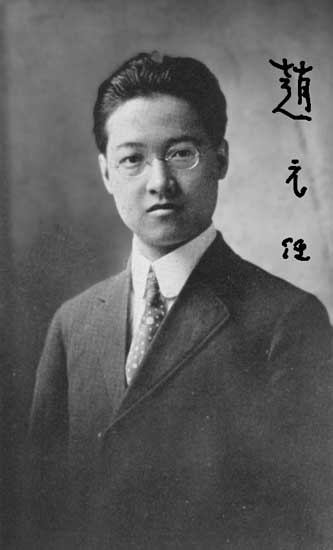
Y.R. Chao’s responses to arguments against romanization

Y.R. Chao. Also, FWIW, Wikipedia took this image from Pinyin.Info, not the other way around.Pinyin.Info has a new reading: Responses to objections to romanization, written by the brilliant linguist Y.R. Chao in 1916, when he was a young man of 24.

It’s an unfortunate irony that another writing associated with Chao, the famous “stone lions” (a.k.a. shi, shi, shi) piece, is often mistakenly cited as evidence that the author opposed romanization. In fact, Chao favored using romanization for Mandarin, as his essay reveals.

It’s written in the form of 16 “objections,” each followed by Chao’s reply. For example:

Obj. 8 Alphabetized Chinese loses its etymology.

Rep. 8 This argument is like that often urged against simplified English spelling and is to be met similarly. In actual usage, how much attention do we give to etymology in words like 學, 暴, 發, 旋, 之, through, draught, etiquette, row, disaster? Of how many of these very common words do you know the original meaning? It is not to be denied, of course, that it is useful to know the etymology of words by looking them up, and our future dictionaries of alphabetized polysyllabic words should no doubt give their derivations.

The etymology of disaster (which is pretty cool) is certainly easy enough for an educated person to guess, if you stop to think about it. But I must admit I never had.

I have added notes following the text.

How to write adverbs in Hanyu Pinyin

cover of Chinese Romanization: Pronunciation and OrthographyI thought how to write adverbs in Hanyu Pinyin (1.1 MB PDF) would be the logical follow-up to last week’s posting of the rules for verbs.

Most of these are pretty straightforward, so I won’t discuss much here.

One note: Although reduplicated verbs lose the tone on their second syllable, reduplicated adverbs do not:

  • gānggāng 剛剛 (just now)
  • jǐnjǐn 僅僅 (only; merely)
  • chángcháng 常常 (often)
  • shāoshāo 稍稍 (a bit; slightly)

Here are some of the adverbs for which examples are given:

  • dōu 都 (all)
  • zhǐ 只 (only)
  • zuì 最 (most, -est)
  • gèng 更 (even more), bǐjiào 比較/比较 (relatively)
  • hěn 很 (very), tài 太 (extremely; too)
  • gāng 剛/刚 (just now), yǐjing 已經/已经 (already), céngjing 曾經/曾经 (in the past)
  • jiù 就 (then), jiāng 將/将 (in the near future)
  • cái 才 (finally)
  • hái 還/还
  • yòu 又 (again; too)
  • zài 再 (again)
  • 也 (also, too)

As always, I recommend this to not just those interested in Pinyin orthography but also to those learning Mandarin (esp. those who are at least at the intermediate level).

How to write verbs in Hanyu Pinyin

cover of Chinese Romanization: Pronunciation and OrthographyToday’s release from Yin Binyong’s Chinese Romanization: Pronunciation and Orthography is a long, important section that covers verbs in Hanyu Pinyin (2 MB PDF).

In this post I’ll go over the rules for what to do with Mandarin’s three tense-marking particles — zhe (著/着), guo ( 過/过), and le (了) — since these participles are extremely common and people are often unaware of how they should be written in Pinyin. Fortunately, this is pretty easy: -zhe and -guo are always written solid (with no interposing space or hyphen) with the verb they follow. The case of le is more complicated (but not too much trouble).

-zhe 著/着

-zhe is added onto a verb to indicate the ongoing nature of an action or state, whether in the past, present, or future. It thus bears a certain similarity to the English verb suffix -ing. A sentence in which -zhe is used tends to emphasize the description of the action or state indicated by the verb. Since no other sentence component may be interposed between a verb and -zhe, a general rule may be stated: -zhe is always written as one unit with the verb it follows.

Some examples:

Tā wēixiàozhe duì wǒ shuō: “Nǐ lái ba!”
她微笑著對我說: “你來吧!”
(Smiling, she said to me, “Come on!”)

Nǐ xiān děngzhe, ràng wǒ jìnqu kànkan.
你先等著,讓我進去看看.
(You wait out here while I go in and look.)

Note that “kànkan” in the sentence above shows something else about verbs in Hanyu Pinyin: the second part of a reduplicated verb is in the neutral tone.

-guo 過/过

-guo is added after a verb to indicate that a given person or object has experienced the action expressed by the verb. -guo may only be used in the past tense. Since no other sentence component may be interposed between a verb and -guo, a general rule may be formulated: -guo is always written as one unit with the verb it follows.

Some examples:

Wǒ xuéguo liǎng nián Yīngyǔ, dànshì méi xuéguo Rìyǔ.
我學過兩年英語,但是沒學過日語.
(I’ve studied two years of English, but I haven’t studied Japanese.)

Nà běn shū wǒ kànjianguo, hǎoxiàng zài shūjià shang.
那本書我看見過,好像在書架上.
(I have seen that book somewhere; I think it’s on the bookshelf.)

le 了

The tense-marking particle le is added after a verb to emphasize that the action expressed has been completed or that the state indicated has been achieved. -le is ordinarily written as one unit with the verb it follows.

For example:

Zuótiān wǎnshang wǒ kànle yī chǎng diànyǐng.
昨天晚上我看了一場電影.
(I saw a movie yesterday evening.)

But here’s where it starts to get a little more complicated.

If a verb complement is interposed between the verb and the tense marker -le in a sentence, there are two possible written forms. If the verb and its complement are written as a unit, then –le is written as a unit with them; if they are written separately, then -le too is written separately.

For example:

Xiǎo Chén qīngqīng de guānshangle fángmén.
小陳輕輕的關上了房門.
(Xiao Chen gently closed the house door.)

But also:

Tā cóng shūbāo lǐ ná chūlai le liǎng běn liánhuánhuà.
他從書包裡拿出來了兩本連環畫.
(He pulled two comic books out of his bookbag.)
(ná 拿 — verb; chūlai 出來 — complement)

I suspect that’s the sort of thing that may well change (for the simpler) once Pinyin makes it out into the world of popular usage as a script in its own right. But for now I’m just givin’ the rules as I find ‘em.

Speaking of which, here’s the final twist on -le.

Apart from its function as a tense-marking particle, -le can also serve as a mood-marking particle. (The former usage is usually denominated le1 and the latter le2 in grammar texts.) In its latter capacity, le always appears at the end of a sentence or clause, just before a comma, period, or other punctuation mark. The two different le’s, le1 and le2, are sometimes quite difficult to distinguish in practice. With this in mind, and with the aim of simplifying HP orthography, the, following simple rule is set out: any le, whether le1 or le2, appearing at the end of a sentence or clause is to be written by itself.

Thus, that’s actually a good thing, since it simplified matters. So, for anyone programming a Pinyin converter, put a space before le if it is immediately followed by punctuation.

Thus, for example:

Wǒmen túshūguǎn yǐjing mǎile sānwàn duō běn shū le.
我們圖書館已經買了三萬多本書了.
(Our library has already purchased over thirty thousand books.)

Hǎo le, hǎo le, dàjiā dōu bié chǎo le.
好了好了, 大家都別吵了.
(All right, all right, everybody quiet down.)

Remember: This post covered only one small aspect of the entire reading. So be sure to download and read the entire PDF, which has many, many more examples.

It’s also a very useful reading for students of Mandarin.

Writing Taiwanese: 1999 study

This seems as good an announcement as any to end my hiatus from posting. Sino-Platonic Papers has just rereleased a popular issue of likely interest to many readers of Pinyin News: Writing Taiwanese: The Development of Modern Written Taiwanese (2.2 MB PDF), by Alvin Lin.

The table of contents gives a pretty good picture of what’s inside:

Preface
Introduction
The Status Quo: Characters and Taiwanese writing

  1. The Roots of Writing in Taiwanese: Wenyan, baihua and academic Taiwanese
  2. The Missing 15 Percent: Developing a written vernacular
  3. One Attempt at Finding the Missing 15 Percent: Yang Qingchu’s Mandarin-Taiwanese Dictionary

Writing Romanized Taiwanese

  1. The Roots of Romanized Taiwanese: Church Romanization
  2. Church Romanization Today: The Taigu listserver
  3. An Indigenous System: Liim Keahioong and Modern Literal Taiwanese

Linguistic and Social Considerations

  1. Some Linguistic Classifications
  2. Dealing with Homonyms: Morphophonemic spelling
  3. Tones in Taiwanese: Surface vs. Lexical tones
  4. Representing Dialects: Picking a standard written form or representing all dialects
  5. Summary of Linguistic Concerns: Deciding the degree of coding
  6. Writing, Reading, Printing, Computing, Indexing and other Practical Concerns
  7. Social Concerns: Tradition and Political Meaning
  8. Conclusion: Future Orthography Policy on Taiwan

Bibliography
Appendices:

  • Email Survey
  • Pronunciation guide to church romanization

List of Tables and Illustrations:

  • Table 1: Suggested Characters for Taiwanese Morphemes from Three Sources
  • Figure 1: Yang Qingchu’s Taiwanese-Mandarin Dictionary
  • Figure 2: Church romanization
  • Figure 3: Modern Literal Taiwanese
  • Figure 4: Sample e-mail from Taigu listserver

This was first published in 1999 as issue number 89 of Sino-Platonic Papers.