Taiwan gov’t releases booklet on Hoklo romanization

Taiwan’s Ministry of Procrastination Education has finally released a handbook on the use of romanization for Taiwanese: “Táiwān Mǐnnányǔ Luómǎzì pīnyīn fāng’àn shǐyòng shǒucè” (《臺灣閩南語羅馬字拼音方案使用手冊》).

Most of the pages in this are devoted to a list of the syllables of Taiwanese. Without counting tones Taiwanese has nearly twice as many unique syllables as Mandarin (797 vs. about 410, respectively).

Here’s the list of Taiwanese syllables, as given in Taiwan’s current official romanization system for Hoklo:

a, ah, ai, ainn, ak, am, an, ang, ann, ap, at, au, ba, bah, bai, bak, ban, bang, bat, bau, be, beh, bi, bian, biat, biau, bih, bik, bin, bing, bio, bit, biu, bo, bok, bong, boo, bu, bua, buah, buan, buat, bue, bueh, bui, bun, but, e, eh, enn, ga, gai, gak, gam, gan, gang, gau, ge, gi, gia, giah, giam, gian, giang, giap, giat, giau, gik, gim, gin, ging, gio, gioh, giok, giong, giu, go, gok, gong, goo, gu, gua, guan, guat, gue, gueh, gui, ha, hah, hai, hainn, hak, ham, han, hang, hann, hannh, hap, hat, hau, he, heh, henn, hennh, hi, hia, hiah, hiam, hian, hiang, hiann, hiannh, hiap, hiat, hiau, hiauh, hik, him, hin, hing, hinn, hio, hioh, hiok, hiong, hip, hit, hiu, hiunn, hiunnh, hm, hmh, hng, hngh, ho, hoh, hok, hong, honn, honnh, hoo, hu, hua, huah, huai, huainn, huan, huann, huat, hue, hueh, hui, hun, hut, i, ia, iah, iam, ian, iang, iann, iap, iat, iau, iaunn, ik, im, in, ing, inn, io, ioh, iok, iong, ip, it, iu, iunn, ji, jia, jiam, jian, jiang, jiap, jiat, jiau, jim, jin, jio, jiok, jiong, jip, jit, jiu, ju, juah, jue, jun, ka, kah, kai, kainn, kak, kam, kan, kang, kann, kap, kat, kau, kauh, ke, keh, kenn, kha, khah, khai, khainn, khak, kham, khan, khang, khann, khap, khat, khau, khe, kheh, khenn, khennh, khi, khia, khiah, khiak, khiam, khian, khiang, khiap, khiat, khiau, khiauh, khih, khik, khim, khin, khing, khinn, khio, khioh, khiok, khiong, khip, khit, khiu, khiunn, khng, kho, khok, khong, khoo, khu, khua, khuah, khuai, khuan, khuann, khuat, khue, khueh, khuh, khui, khun, khut, ki, kia, kiah, kiam, kian, kiann, kiap, kiat, kiau, kik, kim, kin, king, kinn, kio, kioh, kiok, kiong, kip, kit, kiu, kiunn, kng, ko, koh, kok, kong, konn, koo, ku, kua, kuah, kuai, kuainn, kuan, kuann, kuat, kue, kueh, kui, kun, kut, la, lah, lai, lak, lam, lan, lang, lap, lat, lau, lauh, le, leh, li, liah, liam, lian, liang, liap, liat, liau, lih, lik, lim, lin, ling, lio, lioh, liok, liong, lip, liu, lo, loh, lok, long, loo, lu, lua, luah, luan, luat, lue, lui, lun, lut, m, ma, mai, mau, mauh, me, meh, mi, mia, miau, mih, mng, moo, mooh, mua, mui, na, nah, nai, nau, nauh, ne, neh, ng, nga, ngai, ngau, nge, ngeh, ngia, ngiau, ngiauh, ngoo, ni, nia, niau, nih, niu, nng, noo, nua, o, oh, ok, om, ong, onn, oo, pa, pah, pai, pak, pan, pang, pat, pau, pe, peh, penn, pha, phah, phai, phainn, phak, phan, phang, phann, phau, phauh, phe, phenn, phi, phiah, phiak, phian, phiang, phiann, phiat, phiau, phih, phik, phin, phing, phinn, phio, phit, phngh, pho, phoh, phok, phong, phoo, phu, phua, phuah, phuan, phuann, phuat, phue, phueh, phuh, phui, phun, phut, pi, piah, piak, pian, piang, piann, piat, piau, pih, pik, pin, ping, pinn, pio, pit, piu, png, po, poh, pok, pong, poo, pu, pua, puah, puan, puann, puat, pue, pueh, puh, pui, pun, put, sa, sah, sai, sak, sam, san, sang, sann, sannh, sap, sat, sau, se, seh, senn, si, sia, siah, siak, siam, sian, siang, siann, siap, siat, siau, sih, sik, sim, sin, sing, sinn, sio, sioh, siok, siong, sip, sit, siu, siunn, sng, sngh, so, soh, sok, som, song, soo, su, sua, suah, suai, suainn, suan, suann, suat, sue, sueh, suh, sui, sun, sut, ta, tah, tai, tainn, tak, tam, tan, tang, tann, tap, tat, tau, tauh, te, teh, tenn, tha, thah, thai, thak, tham, than, thang, thann, thap, that, thau, the, theh, thenn, thi, thiah, thiam, thian, thiann, thiap, thiat, thiau, thih, thik, thim, thin, thing, thinn, thio, thiok, thiong, thiu, thng, tho, thoh, thok, thong, thoo, thu, thua, thuah, thuan, thuann, thuat, thuh, thui, thun, thut, ti, tia, tiah, tiak, tiam, tian, tiann, tiap, tiat, tiau, tih, tik, tim, tin, ting, tinn, tinnh, tio, tioh, tiok, tiong, tit, tiu, tiuh, tiunn, tng, to, toh, tok, tom, tong, too, tsa, tsah, tsai, tsainn, tsak, tsam, tsan, tsang, tsann, tsap, tsat, tsau, tse, tseh, tsenn, tsha, tshah, tshai, tshak, tsham, tshan, tshang, tshann, tshap, tshat, tshau, tshauh, tshe, tsheh, tshenn, tshi, tshia, tshiah, tshiak, tshiam, tshian, tshiang, tshiann, tshiap, tshiat, tshiau, tshih, tshik, tshim, tshin, tshing, tshinn, tshio, tshioh, tshiok, tshiong, tship, tshit, tshiu, tshiunn, tshng, tshngh, tsho, tshoh, tshok, tshong, tshoo, tshu, tshua, tshuah, tshuan, tshuang, tshuann, tshue, tshuh, tshui, tshun, tshut, tsi, tsia, tsiah, tsiam, tsian, tsiang, tsiann, tsiap, tsiat, tsiau, tsih, tsik, tsim, tsin, tsing, tsinn, tsio, tsioh, tsiok, tsiong, tsip, tsit, tsiu, tsiunn, tsng, tso, tsoh, tsok, tsong, tsoo, tsu, tsua, tsuah, tsuainn, tsuan, tsuann, tsuat, tsue, tsuh, tsui, tsun, tsut, tu, tua, tuan, tuann, tuat, tue, tuh, tui, tun, tut, u, ua, uah, uai, uainn, uan, uang, uann, uat, ue, ueh, uh, ui, un, ut
Chabuduo jiu keyi?

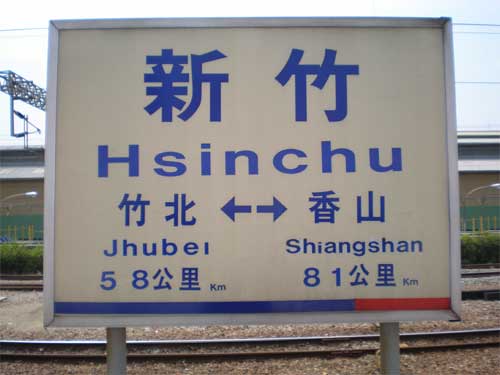
When it comes to signage and much else in Taiwan, the phrase chàbuduō jiù kěyǐ (差不多就可以) might qualify as the country’s unofficial motto. “Close enough for government work” is probably the best idiomatic translation.

The railway-station sign in this photo in many ways exemplifies this.

Hsinchu Jhubei Shiangshan

Rather than list all of the errors and oddities of this sign, I thought I’d let readers have a go at this one. How many errors and problematic points can you find?

S.P.: Surf’s uP

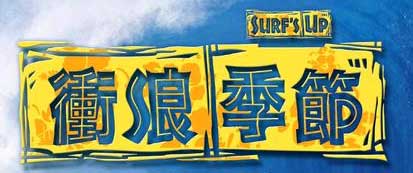
Here’s an image from the Taiwanese poster for the forthcoming movie Surf’s Up. Surfing penguins — I’m in no hurry to see this.

But I do very much like the lettering (in all senses), which incorporates two of the letters of the original title in the Chinese characters for the Mandarin name (Chōnglàng jìjié, 衝浪季節). (The title might end up translated differently in China.)

衝浪季節 -- with an S taking the place of the 'water' bushou in the 2nd character and a P taking the place of the '卩' in the final character

In the second character an S takes the place of the “water” bushou 氵 (”radical” is a misleading translation, so it’s best to avoid that word). And in the final character a P takes the place of the “卩”.

衝浪季節

See also JOHNNY DePP AND CHINeSe CHARACTeRS.

reviews of books related to China and linguistics (2)

Sino-Platonic Papers has just released online its second compilation of book reviews. Here are the books discussed. (Note: The links below do not lead to the reviews but to other material. Use the link above.)

Invited Reviews

  • William A. Boltz, “The Typological Analysis of the Chinese Script.” A review article of John DeFrancis, Visible Speech, the Diverse Oneness of Writing Systems.
  • Paul Varley and Kumakura Isao, eds., Tea in Japan: Essays on the History of Chanoyu. Reviewed by William R. LaFleur .
  • Vladimir N. Basilov, ed., Nomads of Eurasia. Reviewed by David A. Utz.

Reviews by the Editor

  • “Philosophy and Language.” A review article of Françcois Jullien, Procès ou Création: Une introduction a la pensée des lettrés chinois.

Language and Linguistics

  • W. South Coblin, A Handbook of Eastern Han Sound Glosses.
  • Weldon South Coblin. A Sinologist’s Handlist of Sino-Tibetan Lexical Comparisons.
  • ZHOU Zhenhe and YOU Rujie. Fangyan yu Zhongguo Wenhua [Topolects and Chinese Culture].
  • CHOU Fa-kao. Papers in Chinese Linguistics and Epigraphy.
  • ZENG Zifan. Guangzhouhua Putonghua Duibi Qutan [Interesting Parallels between Cantonese and Mandarin].
  • Luciana Bressan. La Determinazione delle Norme Ortografiche del Pinyin.
  • JIANG Shaoyu and XU Changhua, tr. Zhongguoyu Lishi Wenfa [A Historical Grammar of Modern Chinese] by OTA Tatsuo.
  • McMahon, et al. Expository Writing in Chinese.
  • P. C. T’ung and D. E. Pollard. Colloquial Chinese.
  • Li Sijing, Hanyu “er” Yin Shih Yanjiu [Studies on the History of the “er” Sound in Sinitic].
  • Maurice Coyaud, Les langues dans le monde chinois.
  • Patricia Herbert and Anthony Milner, eds., South-East Asia: Languages and Literatures; A Select Guide.
  • Andrew Large, The Artificial Language Movement.
  • Wilhelm von Humboldt, On Language: The Diversity of Hunan Language-Structure and Its Influence on the Mental Development of Mankind.
  • Vitaly Shevoroshkin, ed., Reconstructing Languages and Cultures.
  • Jan Wind, et al., eds., Studies in Language Origins.

Short Notices

  • A. Kondratov, Sounds and Signs.
  • Jeremy Campbell, Grammatical Man: Information, Entropy, Language, and Life.
  • Pitfalls of the Tetragraphic Script.

Lexicography and Lexicology

  • MIN Jiaji, et al., comp., Hanyu Xinci Cidian [A Dictionary of New Sinitic Terms]
  • LYU Caizhen, et al., comp., Xiandai Hanyu Nanci Cidian [A Dictionary of Difficult Terms in Modern Sinitic].
  • Tom McArthur, Worlds of Reference: Lexicography, learning and language from the clay tablet to the computer.

A Bouquet of Pekingese Lexicons

  • JIN Shoushen, comp., Beijinghua Yuhui [Pekingese Vocabulary].
  • SONG Xiaocai and MA Xinhua, comp., Beijinghua Ciyu Lishi [Pekingese Expressions with Examples and Explanations] .
  • SONG Xiaocai and MA Xinhua, comp., Beijinghua Yuci Huishi [Pekingese Words and Phrases with Explanations] .
  • FU Min and GAO Aijun, comp., Beijinghua Ciyu (Dialectical Words and Phrases in Beijing).

A Bibliographical Trilogy

  • Paul Fu-mien Yang, comp., Chinese Linguistics: A Selected and Classified Bibliography.
  • Paul Fu-mien Yang, comp., Chinese Dialectology: A Selected and Classified Bibliography.
  • Paul Fu-mien Yang, comp., Chinese Lexicology and Lexicography: A Selected and Classified Bibliography.

Orality and Literacy

  • Jack Goody. The interface between the written and the oral.
  • Jack Goody. The logic of writing and the organization of society.
  • Deborah Tannen, ed., Spoken and Written Language: Exploring Orality and Literacy.

Society and Culture

  • Scott Simmie and Bob Nixon, Tiananmen Square.
  • Thomas H. C. Lee, Government Education and Examinations in Sung China.
  • ZHANG Zhishan, tr. and ed., Zhongguo zhi Xing [Record of a Journey to China].
  • LIN Wushu, Monijiao ji Qi Dongjian [Manichaeism and Its Eastward Expansion].
  • E. N. Anderson, The Food of China.
  • K. C. Chang, ed., Food in Chinese Culture: Anthropological and Historical Perspectives.
  • Jacques Gemet, China and the Christian Impact: A Conflict of Cultures.
  • D. E. Mungello, Curious Land: Jesuit Accommodation and the Origins of Sinology.

Short Notice

  • Roben Jastrow, The Enchanted Loom: Mind in the Universe.

In Memoriam
Chang-chen HSU
August 6, 1957 – June 27, 1989

  • Hsu Chang-chen, ed., and tr., Yin-tu hsien-tai hsiao-shuo hsüan [A Selection of Contemporary Indian Fiction].
  • Hsu Chang-chen, T’o-fu tzu-huiyen-chiu (Mastering TOEFL Vocabulary).
  • Hsu Chang-chen, Tsui-chung-yao-te i pai ke Ying-wen tzu-shou tzu-ken (100 English Prefixes and Word Roots).
  • Hsu Chang-chen, Fa-wen tzu-hui chieh-koufen-hsi — tzu-shou yü tzu-ken (Les préfixes et les racines de la langue française).
  • Hsu Chang-chen, comp. and tr., Hsi-yü yü Fo-chiao wen-shih lun-chi (Collection of Articles on Studies of Central Asia, India, and Buddhism).

This is SPP no. 14, from December 1989. The entire text is now online as a 7.3 MB PDF.

See my earlier post for the contents of the first SPP volume of reviews and a link to the full volume.

reviews of books related to China and linguistics

Sino-Platonic Papers has just released online its first compilation of book reviews. Here is a list of the books discussed. (Note: The links below do not lead to the reviews but to other material.)

Invited Reviews

  • J. Marshall Unger, The Fifth Generation Fallacy. Reviewed by Wm. C. Hannas
  • Rejoinder by J. Marshall Unger
  • Hashimoto Mantaro, Suzuki Takao, and Yamada Hisao. A Decision for the Chinese NationsToward the Future of Kanji (Kanji minzoku no ketsudanKanji no mirai ni mukete). Reviewed by Wm. C. Hannas
  • S. Robert Ramsey. The Languages of China. Reviewed by Wm. C. Hannas
  • James H. Cole, Shaohsing. Reviewed by Mark A. Allee
  • Henry Hung-Yeh Tiee, A Reference Grammar of Chinese Sentences. Reviewed by Jerome L. Packard

Reviews by the Editor

  • David Pollack, The Fracture of Meaning
  • Jerry Norman, Chinese
  • N. H. Leon, Character Indexes of Modern Chinese
  • Shiu-ying Hu, comp., An Enumeration of Chinese Materia Medico
  • Donald M. Ayers, English Words from Latin and Greek Elements
  • Chen Gang, comp., A Dictionary of Peking Colloquialisms (Beijing Fangyan Cidian)
  • Dominic Cheung, ed. and tr., The Isle Full of Noises
  • Jonathan Chaves, ed. and tr., The Columbia Book of Later Chinese Poetry
  • Philip R. Bilancia, Dictionary of Chinese Law and Government
  • Charles O. Hucker, A Dictionary of Official Titles in Imperial China
  • Robert K. Logan, The Alphabet Effect
  • Liu Zhengtan, Gao Mingkai, et al., comp., A Dictionary of Loan Words and Hybrid Words in Chinese (Hanyu Wailai Cidian)
  • The Mandarin Daily Dictionary of Loan Words (Guoyu Ribao Wailaiyu Cidian)
  • Shao Xiantu, Zhou Dingguo, et al., comp., A Dictionary of the Origins of Foreign Place Names (Waiguo Diming Yuyuan Cidian)
  • Tsung-tung Chang, Metaphysik, Erkenntnis und Praktische Philosophie um Chuang-Tzu
  • Irene Bloom, trans, ed., and intro., Knowledge Painfully Acquired: The K’un-chih chi of Lo Ch’in-shun
  • Research Institute for Language Pedagogy of the Peking College of Languages, comp., Frequency Dictionary of Words in Modern Chinese (Xiandai Hanyu Pinlyu Cidian)
  • Liu Yuan, chief compiler, Word List of Modern Mandarin (Xianhi Hanyu Cibiao)
  • The Editing Group of A New English-Chinese Dictionary, comp., A New English-Chinese Dictionary
  • BBC External Business and Development Group, Everyday Mandarin

This is SPP no. 8, from February 1988. The entire text is now online as a 4.2 MB PDF.

Do Chinese characters save paper?

A common claim about Chinese characters (Hanzi) is that they take less space than alphabetic systems and so using them “saves paper.” After all, there aren’t spaces between words when writing in Chinese characters, and Chinese characters handle entire syllables rather than having to spell them out letter by letter. So this claim would seem to be self-evident. But things don’t always work out as expected.

cover of 'Did Adam and Eve Have Navels?' by Martin Gardnercover of the Mandarin translation of 'Did Adam and Eve Have Navels' 愛迪生,你被騙了!:你必須打破的27個科學迷思

A few weeks ago I was browsing the shelves of the enormous, wonderful Eslite bookstore near Taipei City Hall. (Nobody seems quite sure how the so-called English name of this chain is supposed to be pronounced, so many foreigners here prefer the Mandarin name: Chéngpǐn (誠品).) In many of the store’s sections, English-language originals and their translations into Mandarin are shelved right next to each other. So, after looking at a science book in English I pulled out the Mandarin Chinese translation of the same work and browsed through it. While I was doing so, I noticed something unexpected: the Mandarin version was longer than the English-language original.

This sparked my interest, so I pulled out some more paired titles, more or less at random, off the shelves for the purpose of comparison.

I did my best to keep the comparisons fair. In almost all of the cases I compared pairs of trade paperbacks: standard trade paperbacks in English with standard trade paperbacks in Mandarin.

Also, I didn’t count the pages taken up by indexes, since none of the translations into Mandarin had indexes. (Alphabets win hands down over Chinese characters when it comes to creating and using indexes, and I saw no reason to penalize the English books for this by counting pages that the ones in Chinese characters didn’t have the equivalent of.)

In addition, I avoided old books, since I wanted to be fairly sure the Mandarin Chinese translations were from the same English text as I was looking at. (I do, however, have one book written in German and translated into English. I didn’t check to see if the Mandarin version was done from the German original or the English translation.)

Of course, comparing across scripts and languages is certainly not the same as comparing simply across scripts (Hanzi vs. Hanyu Pinyin); but one does what one can.

Later, when I was supplementing my survey at the Eslite bookstore on Dunhua South Road when I noticed an error in my original method: I had forgotten to check where in the book page 1 fell. Many (but not all) English-language books mark the first page of the first chapter as page 1; many (but not all) books printed in Taiwan, however, include the front matter in their pagination, which leads to the first page of the first chapter being page 10 or so. So to help compensate for my oversight, it might be fair to subtract 10 pages from the Mandarin versions of those titles below followed by an asterisk. (The ones without an asterisk are those I examined most recently — and more carefully.)

Here are the results of my admittedly brief and unscientific survey:

Chronicles, Vol. 1, by Bob Dylan
English: 291 pp.
Mandarin in Hanzi: 295 pp.

Collapse, by Jared Diamond
English: 560 pp.
Mandarin in Hanzi: 609 pp.

The Death of Vishnu, by Manil Suri
English: 283 pp.
Mandarin in Hanzi: 287 pp.

Deep Simplicity: Bringing Order to Chaos and Complexity*, by John Gribbin
English: 235 pp.
Mandarin in Hanzi: 255 pp.

Did Adam and Eve Have Navels?: Debunking Pseudoscience*, by Martin Gardner
English: 310 pp.
Mandarin in Hanzi: 367 pp.

The Elegant Universe*, by Brian Greene
English: 428 pp.
Mandarin in Hanzi: 463 pp.

The Enigma of Arrival, by V.S. Naipaul
English: 350 pp.
Mandarin in Hanzi: 422 pp.

Harry Potter and the Half-Blood Prince, by J.K. Rowling
English: 607 pp. (hardback)
Mandarin in Hanzi: 716 pp.

Laboratory Earth*, by Stephen H. Schneider
English: 169 pp.
Mandarin in Hanzi: 227 pp.

The Long Tail, by Chris Anderson
English: 226 pp. (hardback, slightly larger than the Mandarin trade paperback)
Mandarin in Hanzi: 313 pp. (written left to right)

Perfume*, by Patrick Su?skind
English: 255 pp. (translation from German)
Mandarin in Hanzi: 278 pp.

Tough Choices, by Carly Fiorina
English: 309 pp.
Mandarin in Hanzi: 341 pp.

Vernon God Little, by D.B.C. Pierre
English: 275 pp. (mass market paperback)
Mandarin in Hanzi: 325 pp.

In every instance, the books in Chinese characters are longer than those in English. Moreover, the pages in the Mandarin-language trade paperbacks are somewhat larger than those in the English-language trade paperbacks. So that’s even more paper consumed by the books written in Chinese characters.

Although I certainly do not believe that all pairs of books in English and Mandarin translation follow this pattern, a pattern this very much appears to be.

My guess would be that books printed in China would have fewer pages than those printed in Taiwan. (Anyone want to check some of the above titles? Or does anyone have pairs of other titles in unexpurgated editions?) In general, books in China simply aren’t designed and printed with the same degrees of competency, attention, and concern for the reader as books in Taiwan — not to mention books in the United States and Britain. (Or have things changed very much in this regard since I lived in China?) So, among other factors, the characters tend to be smaller, along with the leading and the margins.

And then there’s the fact that translations in China sometimes omit sentences or entire sections, especially if they are deemed “sensitive.” (I doubt, however, that the books I examined suffered from Beijing’s censors.)

Also, China’s left-to-right format might have an advantage over Taiwan’s predominant top-to-bottom style in terms of space.

language reformer Qian Xuantong remembered

photo of Qian Xuantong (Ch'ien Hsuan-t'ung)Two days ago was the 68th anniversary of the death of Qian Xuantong (Qián Xuántóng / 錢玄同 / 钱玄同 / Ch’ien Hsüan-t’ung) (1887–1939), a phonetician, philologist, and professor of literature at Peking University. Although he isn’t well known today, Qian was an important contributor to the reforms associated with the May 4 movement. He also helped renew debate about script reform in China.
Just about the time that the National Phonetic Alphabet succeeded in gaining ascendancy over the Mandarin Alphabet and other schemes, the evolution of literary and political movements into a new stage gave rise to renewed consideration of the roman alphabet as the basis for reform of the Chinese written language.

What seems to have initiated the new stage of discussion was a letter written in March 1918 by Ch`ien Hsüan-t`ung, a well-known philologist and professor of literature at National Peking University, to Ch`en Tu-hsiu, who at the time was editor of La Jeunesse, the leading organ of young Chinese intellectuals, and who soon afterward became one of the founders of the Chinese Communist Party. In his letter Ch`ien Hsüan-t`ung expressed approval of Ch`en Tu-hsiu’s demand for a break with the Confucian ideology which had dominated Chinese life for more than two thousand years, and also offered his idea as to how this was to be carried out. “If you want to abolish Confucianism,” he said, “you must first abolish the Chinese script.” To his mind there was little of value in Chinese literature, 99.9 per cent of which he dismissed as merely transmitting Confucian ideology and Taoist mythology.

It seemed to Ch`ien that the ideographic [sic] script could not be adapted to the needs of modern China. He also saw no solution in the attempts which had thus far been made to apply a phonetic system of writing to Chinese. Indeed, it appeared to him that it would be impossible to apply a phonetic system of writing to Chinese at all. These views also led him to the conclusion, reached earlier by Wu Chih-hui and others, that Chinese writing itself would have to be abandoned and replaced by Esperanto.

I seem to remember that someone in Japan was driven to distraction about that country’s orthography and making a similar proposal about switching from Japanese to Esperanto. Or am I imagining that?

At any rate, others soon convinced Qian of the error of his ways, and before long he was a strong supporter of romanization, as were many others of his generation, including Lu Xun. By the way, Qian was the one who convinced Lu Xun to start writing stories. That alone should be enough to make the world forever grateful to him.

I strongly recommend the first of the readings below, from which the above quote was taken. It’s interesting reading.

sources:

Taiwan license plates and English

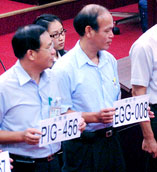
Taipei City councilors holding up signs resembling license plates with funny English: PIG-456 and EGG-008It seems that ridding Taiwan license plates of the dreaded number 4 wasn’t enough. A Taipei city councilor, Tim Chang (Cháng Zhōngtiān / 常中天) of the New Party, suggested last year that “drivers are making an ass of themselves” if they drive around with license plates that spell out something that is insulting, ill-omened, or funny in English. He called for such unfortunate combinations to be filtered out in advance and for motorists to be allowed to change their plate numbers.

As the Taipei Times article on this notes, “License plates in Taiwan are made up of two alphabetic letters and four digits for cars, while license plates on scooters have three letters and three digits.”

People in Taiwan can change to another random plate number for NT$1,250 (approx. US$38), while personalized license plates cost at least NT$3,000.

source: Lucky number plate? Not for this ASS, Taipei Times, August 23, 2006