It’s not just Taiwan that can’t seem to get its romanization situation resolved well. “Calls for a revision of the current Romanization system for the Korean alphabet, Hangul, are gaining more ground as confusion continues on the roads, signboards and government documents after the introduction of the current form in July 2000,” reports the Korea Times.
Some 75 percent of South Koreans think the government-enacted Romanization system does not reflect the original pronunciation of Hangul properly, a survey conducted by the Yoido Institute, a think tank of the opposition Grand National Party (GNP) showed yesterday.
Of the 2,150 adults polled last week, 66.1 percent wanted the current system to be revised despite the expected financial cost, according to the survey conducted on the occasion of the 560th Hangul Day which falls on Oct. 9.
I make no claims of knowledge of which romanization system would be best for Korea, so be sure to read my comments with that in mind. But I do know to be wary of polls conducted by political parties.
Hangul was first Romanized using the McCune-Reischauer (M-R) system in the early 20th century, when a number of foreign missionaries came to the Choson Kingdom. But the country’s Romanization system underwent flip-flopping policies in the following decades.
“Confusions we experience today have been caused largely due to the arbitrary attitudes of armchair linguists and some misguided government officials,’’ said Kim Bok-moon, professor emeritus of Chungbuk National University.
Scraping the traditional M-R system, which had prevailed in the past decades, the government adopted a new system on July 7, 2000, shifting “Pusan,’’ “Kobukson (turtle ship) and “kimchi’’ into “Busan,’’ “Geobukseon’’ and “gimchi.’’
The English-language media, including the state-funded Yonhap News Agency, had resisted the change for a period of time. But, as time went by, all the news media gave in to the new system except The Korea Times, which has maintained the M-R system concluding that it is the most similar to actual pronunciation.
Let alone the tremendous cost of the revision, the main problem of the current system is that it does not ensure the exact pronunciation of the original sound of various Korean words.
No romanization system — or any other script, for that matter — ensures the exact pronunciation of the words of a language for people who do not know how that system works. It seems unlikely that the South Korean government would have promulgated an inherently unworkable system, such as the bastardized version of Wade-Giles is for Mandarin Chinese. (Proper Wade-Giles, of course, could work perfectly well for Mandarin, though I certainly don’t recommend it.)
And the author shouldn’t have written “the exact pronunciation of the original sound of various Korean words” but simply “the exact pronunciation of Korean words.”
Kim, who serves as president of the Research Institute for Korean Romanization (KOROMA), has made sole efforts to end the confusion, submitting a petition to then President Kim Dae-jung and presenting a Constitutional petition.
In a seminar at the National Assembly yesterday, he presented the disastrous result of an experiment that he conducted along with KBS TV about the new system in Itaewon, downtown Seoul, and at the Kimpo International Airport.
When he asked foreign people to read “Yeoksam-dong (???)’’ and “Geobukseon (???),’’ the majority of them pronounced them “ioksaemdong (????)’’ and “jiobuksion (?????),’’ far different from the actual sound.
Oh, no. Not another “let’s ask a random and probably clueless foreigner how to pronounce something” poll. These mean nothing. There are plenty of people in the United States who would mangle even the pronunciations of items on a menu in a Mexican restaurant; but that doesn’t mean Spanish orthography needs revision.
Because a committee under Taiwan’s Ministry of Education approved a romanization method for Taiwanese last week, some grandstanding member of the legislature is almost certainly going to force some executive-branch official who doesn’t know the system to read out loud something that was written in it, thus “proving” the system doesn’t work. It might already have happened.
According to Kim, 16 out of the newly Romanized 21 vowels of Hangul are out of sync with actual sounds when they are read by English-speaking people, who have no knowledge about the premise that “eo’’ would be pronounced as “?.’’ He has devised his own system, which he claims ensures the best pronunciations.
“Disasters that many critics expected have already begun. We can easily find serious confusion here and there,’’ Kim told The Korea Times. “We have to correct the mistake without delay before it is too late, and adopt a proper system.’’
Romanization systems seldom work well when forced into the mold of an anglicization. I wonder if romanized Korean is commonly but mistakenly referred to in Korea as “English.”
And, of course, there’s always an appeal to nationalism:
One example of what Kim cited as “losses of national interests’’ was “Koguryo’’ and “Dokdo,’’ which became objects of historical and even territorial rows with China and Japan during the past couple of years.
At a time when China spelled the ancient Korean kingdom as “Koguryo,’’ South Korea’s English-language dailies, except for The Korea Times, wrote it as “Goguryeo.’’ It was later unified into Koguryo as even the UNESCO’s World Heritage called it Koguryo.
A set of South Korean tiny islets in the East Sea, Dokdo had also been divided into “Tokto’’ and “Dokdo.’’ The Korea Times agreed to unify it into Dokdo at the recommendation of the government as an exceptional case. But the foreign news media and Web sites are still left confused between them.
The article closes:
Critics say the Romanization system should be revised in a way that best reflects the characteristics of the Korean language and the reunification of the two Koreas should also be taken into consideration.
North Korea has a system similar to the M-R system, which writes its cities and places in English as “Pyongyang,’’ “Kaesong’’ and “Mt. Kumgang’’ _ not “Pyeongyang,’’ “Gaeseong’’ and “Mt. Gumgang.’’
North Korea once proposed the unification of the different Romanization systems used by South and North Korea in a meeting of linguists from the two Koreas in Berlin, Germany, in 2002.
++++++
source: Hangul Romanization Revision Proposed, Korea Times, September 26, 2006
some comments here: More romanization debate, The Marmot’s Hole, September 29, 2006
read about hangul here: Hangul Day, Language Log, October 9, 2005

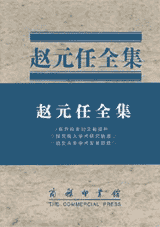
 The Commercial Press has begun issuing a set of the complete works of Y.R. Chao (Zhao Yuanren / 趙元任 / 赵元任). This project, which will comprise some twenty volumes, will contain works in both English and Mandarin Chinese. All of the many fields Chao wrote about will be covered. Letters and journals will also be included, as will sound recordings. Wonderful!
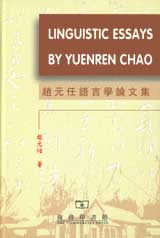
 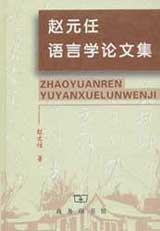 Note how the cover of Linguistic Essays, a book printed just last year in China, uses “Yuenren Chao,” the traditional spelling and Western order of his name, rather than “Zhao Yuanren,” the spelling used in Hanyu Pinyin. Also note how the Mandarin title is given in traditional, not simplified, characters: 趙元任語言學論文集, not 赵元任语言学论文集. A nice surprise, on both counts. On the other hand, the botched romanization on the cover of the Mandarin-language collection, which gives “ZHAOYUANREN YUYANXUELUNWENJI” instead of “Zhào Yuánrèn yǔyánxué lùnwénjí,” is particularly inappropriate and painful to look at on a collection of the works of this brilliant linguist. But don’t judge this book by its cover.