zhuyin
Archived Posts from this Category
news and discussions related to romanization
Archived Posts from this Category
Posted by site admin on 12 Mar 2008 | Tagged as: Chinese, Chinese characters, Hanyu, Mandarin, Tongyong, pinyin, teach Chinese, zhuyin
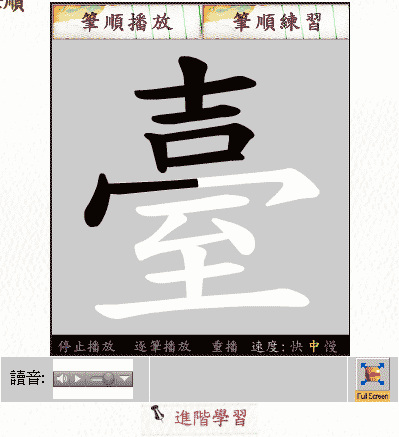
Taiwan’s Ministry of Education has put online new a Web site devoted to stroke order for Chinese characters.
Unlike the older MOE stroke-order online handbook, this new site provides animations of the stroke order for 4,808 of the most frequently used traditional Chinese characters. And they really are traditional, too. For example, a Pinyin search for tai (it doesn’t accept tone marks or numbers) doesn’t return 台, even though it is more commonly seen in Taiwan than the full form of 臺. But perhaps that’s a glitch, since 台 is within the system, as a search for that particular character reveals.
Users can also test their knowledge of official stroke order, since each character’s animation also comes with an interactive feature in which users trace the strokes with their mouse. (Click on the button to the top right of the character.) It can be a little picky, as I suppose befits the prescriptive nature of the site. (In the real world, people write many characters using orders other than what Taiwan’s Ministry of Education and your Mandarin teacher might tell you is the One True Way. But that’s another matter.)
Although there’s no English interface at present, the files are labeled in English, so positioning your mouse over the navigation elements will usually reveal enough for non-Hanzi readers to make their way around.
Unfortunately, the site doesn’t appear to work with anything other than @#$%! Internet Explorer. Also, at first the search feature allowed the entry of no more than four letters, making it impossible to use Pinyin (Hanyu Pinyin is offered along with Taiwan’s official Tongyong Pinyin) to look up characters for, say, zhong and guang, or for the Pinyin syllables with the most letters: chuang, shuang, and zhuang (not counting -r forms); but someone there is on the ball, since that was fixed after I wrote the ministry about it yesterday.
site and further reading:
Posted by site admin on 21 Feb 2008 | Tagged as: China, Chinese, Chinese characters, English, Hanyu, Mandarin, Zhou Youguang, bopomofo, linguistics, literacy, pinyin, romanization, writing systems, zhuyin
Roddy of Chinese Forums, Signese, Dreams of White Tiles, and even more sites, found a new video (4 min. 40 sec.) of Zhou Youguang speaking, in English, to a reporter from the Guardian.
I was kind of surprised to see this featured on the Guardian’s front page under the ‘Father of Pinyin’ title - I’d wager 9/10ths upwards of the Guardian’s readership doesn’t know what pinyin is. Somewhat unforgivably they’ve managed to spell the guy’s name wrong and not bothered to add tones to the pinyin used in the video, and the interview is pretty weak - basically it’s ‘here’s a nice old Chinese guy talking for a few minutes’ but there’s really very little of depth. They’ve also opted to add subtitles to what sounds to me like perfectly comprehensible English.
But enough negativity, if you want to get a look at the guy who rescued you from bopomofo, have a look.
As happy as I am about the video, I’m going to add a bit more negativity. Failure to get the word parsing correct is also a major error: not “pin yin zhi fu” but “Pīnyīn zhī fù.” Actually, even that isn’t so good, because Pinyin is meant for modern baihua, not the style of Literary Sinitic and its many short forms. Thus, “Pīnyīn de fùqin” would be better.
The accompanying article is amazingly sloppy in parts.
Although the article manages to spell Zhou Youguang’s name correctly, it consistently refers to him not by his family name but by his given name, “Youguang.” It’s almost inconceivable that any reporter in China could (repeatedly) make such an elementary mistake; so perhaps this is the fault of an overzealous copy editor.
I’m not going to sort out and list what’s correct and what’s incorrect in the rest of the article, other than mention one point at the end.
Confusingly, Taiwan uses several different romanisation methods — including a variant of pinyin, tongyong pinyin — and zuiyin.
Zuiyin? Of course what is meant is zhuyin (zhùyīn/註音/注音), which is spelled correctly earlier in the article. Zuiyin (zuìyīn/罪因) is a noun meaning “cause of a crime.”
sources:

Posted by site admin on 12 Feb 2008 | Tagged as: Chinese, Chinese characters, Hokkien, Hoklo, Mandarin, Minnan, Taiwan, Taiwanese, bopomofo, languages, writing systems, zhuyin
I’m so far behind on posts that when Taffy of Tailingua sent this to me people in Taipei probably really were wearing short sleeves. They’re certainly not wearing so little now, with the cold, damp, miserable weather we’ve been having lately. Oh well, at least it’s better than what so many people have been having to endure in China. I hope Pinyin News readers there are keeping warm and didn’t get stuck in some transportation-related hell.

This poster on the back of a bus is for Taiwan’s presidential campaign.
It reads:
Táiwān ei lìliang
Shìjiè dǎ tōngguānMǎ Yīngjiǔ — Xiāo Wàncháng
.
台灣ㄟ力量
世界打通關馬英九 蕭萬長
It’s hard to put this into English that makes sense. Perhaps “Taiwan shows its power to the world.” The idea is something like “Taiwan can overcome all obstacles.” It doesn’t strike me as a good slogan. But maybe I’m missing something.
The interesting part is that it has Taiwanese written with zhuyin (bopomofo): ㄟ (ei). But the ㄟ is basically just for show, since it doesn’t serve any linguistic purpose that the expected Chinese character — 的 (de), indicating the possessive — wouldn’t provide. The sign is still in Mandarin. (Dǎ tōngguān, for example, is not a Taiwanese expression, according to several native speakers I questioned about this.)
For those who don’t know, Mǎ Yīngjiǔ and Xiāo Wàncháng comprise the KMT’s ticket for next month’s presidential election.
Both Ma and Xiao use unusual spellings for the way they write their names in the Roman alphabet: Ma Ying-jeou and Vincent Siew, respectively.
The “Ying-jeou” of Ma’s name gives the appearance of Gwoyeu Romatzyh. But in that system his name would be “Maa Ing-jeou.”
“Siew” for Hanyu Pinyin’s Xiāo indicates that the source is likely a language other than Mandarin. But Taiwanese isn’t it, though Siew, unlike Ma, was born here. Because of that spelling, many foreigners in Taiwan pronounce his family name like the English word “shoe.” “Vincent” is of course an “English name” rather than a romanization of his birth name.
As I’m fond of pointing out, perhaps the only prominent Taiwan politician whose name is recognizably Hanyu Pinyin and only Hanyu Pinyin is President Chen Shui-bian, the man most responsible for seeing that Taiwan did not adopt Hanyu Pinyin during his tenure.
Posted by site admin on 25 Sep 2007 | Tagged as: Banqiao, Chinese, Chinese characters, Hokkien, Hoklo, Minnan, Taiwan, Taiwanese, bopomofo, literacy, writing systems, zhuyin
Imagine some white guys in a fairly large U.S. city open a restaurant named “Mr. Taiwan Slant-Eyes Asian Cuisine.” And imagine that this restaurant specializes in distinctly Americanized dishes such as egg foo yong, fortune cookies, and California wraps. Now imagine the response. Isn’t this fun?
OK, now imagine a different situation: In Taiwan’s fifth-largest city some locals open a place specializing in Taiwanized Western food and dub their restaurant “Miss UK Cafe Pointy-Nose Foreign Food.”
As you’ve probably guessed, the second scenario is real. The “Miss UK Cafe ㄚ度仔 異國美食” (Miss UK Cafe a-tok-a yìguó měishí) recently opened not far from my apartment in Banqiao.
A-tok-a (ㄚ度仔) is Taiwanese for “pointy nose” (i.e., Westerner), though perhaps the common translation of “big nose” conveys the spirit a little better. As Tempo Gain explains in the Forumosa thread on this word, “the initial ‘a’ often preceds names, and the final ‘a’ often is attached to nouns like the Mandarin ‘zi’ haizi, chezi, etc.”
Although most foreigners I know in Taiwan find the use of a-tok-a offensive to some degree, reactions are usually tempered by the knowledge that the word is very seldom used intentionally as a pejorative. It’s just the word most Hoklo speakers would use for “Westerner,” and they mean nothing bad by this and perhaps even see it as “cute” in a favorable way. So since I’m certain the restaurateurs didn’t intend any insult in choosing this name, I’m not going to carp about this any more than I already have — which is not to say that I will ever buy anything from that restaurant.
It’s still an interesting name, though. (Actually, this is probably two names: the standard one (ㄚ度仔 異國美食), which is for most people, and the English one (Miss UK Cafe), which is probably there in an attempt to look modern/foreign/cool.)
For those keeping count, that’s three scripts and as many languages on just one sign.
The mixing of scripts in “ㄚ度仔” is representative of the sad fact that most people in Taiwan are unsure how to write Taiwanese. Here are some of the ways this word gets written, along with the number of Google results and Baidu results for that exact phrase.
Also interesting is the use of yìguó (異國) instead of the more common wàiguó (外國), for “foreign.”
Yìguó měishí, however, is more common than wàiguó měishí.
This, I suspect, is because yìguó měishí “sounds fancier” because of how relatively common the word waiguo is.

further reading:
Posted by site admin on 04 Aug 2007 | Tagged as: China, Chinese, English, Hanyu, Mandarin, Taiwan, languages, zhuyin
A movie currently doing well at the box office in both the United States and Taiwan is I Now Pronounce You Chuck and Larry. In Taiwan, the film has been given the linguistically interesting title Dāng wǒmen gèi zài yīqǐ (《當我們ㄍㄟˋ在一起》 / 《當我們假在一起》 ).
The title is a Mandarin phrase that uses Taiwanese in order to make a pun involving English — an apt mix for the island.
The movie title is an allusion a well-known children’s song, “Dāng wǒmen tóng zài yīqǐ” (當我們同在一起), which was taken from the English-language children’s song “The More We Are Together.”
The more we get together,
Together, together,
The more we get together,
The happier we’ll be;
For your friends are my friends
And my friends are your friends,
The more we get together,
The happier we’ll be.
This song uses the tune of Ach du lieber Augustin but has radically different words.
Getting back to the Taiwanese title, “tóng” (同) of “Dāng wǒmen tóng zài yīqǐ” has been replaced by what in Mandarin is jiǎ (假 — false, fake). But the character 假 has been assigned a Taiwanese reading, gèi, as can be seen by the inclusion of zhuyin fuhao to the right of the character (ㄍㄟˋ = gèi in Hanyu Pinyin).
Gèi is of course meant to call to mind not just the “false” of the relationship in the movie but also the English word “gay” — this being a movie about two men pretending to be a homosexual couple.
In China, where foreign movies often receive titles different from those in Taiwan, the movie is called Wǒ shèngdà de tóngzhì hūnlǐ (《我盛大的同志婚礼》/ My Magnificent Comrade’s Wedding). Although the usual translation for tongzhi is “comrade,” the word has also become Mandarin slang for homosexual. Perhaps some readers can comment on how prominent or passé this use of tongzhi is now.
Posted by site admin on 10 Mar 2007 | Tagged as: Chinese, Chinese characters, Mandarin, Taiwan, Thailand, Tongyong, bopomofo, languages, pinyin, romanization, zhuyin
The following quote sums up a recent article on Taiwanese who are teaching Mandarin at universities in Thailand:
jiùsuàn yǒu lǎoshī cǎiyòng ㄅㄆㄇ jiāoxué, zuìzhōng háishi huíguī dào Hànyǔ Pīnyīn, zhìyú Tōngyòng Pīnyīn, gēnběn méiyǒu rén shǐyòng.
(Even if some teachers employ bopo mofo in [the early stages of] their teaching, they still ultimately revert to Hanyu Pinyin. As for Tongyong Pinyin, essentially no one uses it.)
In the penultimate paragraph, a teacher takes what for traditional Chinese education is often seen as a radical position: content over form.
“Wǒmen kěyǐ yòng Hànyǔ Pīnyīn, yòng fántǐzì qù tuīxíng Táiwān wénhuà, zhè shì bu chōngtū de. Wǒ yòng jiǎntǐzì jiǎng Táiwān, dàjiā dōu rènshi Táiwān le, wǒmen yòng Hànyǔ Pīnyīn jièshào Táiwān, dàjiā dōu rènshi Táiwān le.”
(”We can use Hanyu Pinyin and traditional Chinese characters to promote Taiwan culture; these are not conflicting. I use simplified Chinese characters to talk about Taiwan; everyone learned about Taiwan. We use Hanyu Pinyin to introduce Taiwan; everyone learned about Taiwan.”)
In the final paragraph, the reporter editorializes along the same lines. (Editorializing in news articles is a common practice here.) It’s perhaps worthy of note that this comes from what was until recently a KMT-run television network — one that remains very “blue.”
Here’s the whole article:
Táiwān nèibù, jīhū měigé yīzhènzi, jiùyào chūxiàn guānyú “wénzì” de yìshi xíng tài zhēngzhí, bāokuò jiǎntǐzì fántǐzì, bāokuò Tōngyòng Pīnyīn yǔ Hànyǔ Pīnyīn. Hǎoxiàng yòng hé dàlù bù yīyàng de xìtǒng, jiùshì ài Táiwān, jiùshì tūxiǎn Táiwān zhǔtǐ yìshi.
Rán’ér, zhè duì ài Táiwān zhēn de yǒu bāngzhù ma? Duì qiánghuà Táiwān zhǔtǐ yìshi zhēn de yǒu bāngzhù ma?
Zhè shì zài Tàiguó dàxué lǐ, xuéshengmen shàng Zhōngwén kè de qíngkuàng. Suīrán méiyǒu tǒngyī de jiàocái, dàn dàduōshù de lǎoshī shǐyòng de háishi jiǎntǐ Zhōngwén bǎnběn, jiāo de yěshì Hànyǔ Pīnyīn.
Rajamangala Kējì Dàxué Zhōngwén kèchéng zhǔrèn Fú Cuì-lán lǎoshī jiù zhíyán, wèile zài Tàiguó tuīdòng Huáyǔ kèchéng, tā duì Huáyǔ lǎoshī de yāoqiú zhǐyǒu yī ge, jiùshì shǐyòng jiǎntǐ Zhōngwén: “Xiànzài wǒmen yī shuōdào Hànyǔ, tāmen jiù shuō bù xué, juéde Hànyǔ hěn nán, wǒ yào jiéshù zhèige gàiniàn, bāng tā mànmàn de xuéxí, ràng tā zhīdao Hànyǔ bù shì hěn nán de, kěyǐ xué de.”
Shìshíshàng duì dàduōshù de Tàiguó xuésheng láishuō, xuéxí Zhōngwén de dònglì shì yīnwèi Zhōngwén zhújiàn biànchéng qiángshì yǔyán, gōutōng duì tāmen ér yán zuì zhòngyào. Xiàofāng de kǎoliáng bù nán lǐjiě.
Zhìyú pīnyīn fāngshì jiù gèng bùyòng shuō le, jiùsuàn yǒu lǎoshī cǎiyòng ㄅㄆㄇ jiāoxué, zuìzhōng háishi huíguī dào Hànyǔ Pīnyīn, zhìyú Tōngyòng Pīnyīn, gēnběn méiyǒu rén shǐyòng.
Wālái’ālōnggōng huángjiā dàxué (ed.: Walailak University) de Zhōngwén lǎoshī Liú Yǎ-píng shuōchū tā de kǎoliáng: “Zhīqián méiyǒu xiān jiāo ㄅㄆㄇ, tāmen zhíjiē jiēchù Hànyǔ Pīnyīn, jiù huì bèi Yīngwén de niàn fǎ wùdǎo, suǒyǐ hòulái zhǐyào líng chéngdu, wǒ jiù huì xiān jiāo ㄅㄆㄇ, bǎ fāyīn wěnzhù, wěnzhù zhīhòu jiù zhuǎn guòlai jiāo Hànyǔ Pīnyīn, bìjìng Hàn pīn zhēn de shì xiànzài Ōu-Měi guójiā, bǐjiào pǔbiàn de gōngjù.”
Lìngyī wèi yóu Tái-Shī-Dà péixùn qiánwǎng Tàiguó jiāo Zhōngwén de lǎoshī Lín Hóng-zhèng yě zhǐchū, gāng dào Tàiguó shí, yǒu xǔduō Zhōngwén lǎoshī duìyú gāi shǐyòng Hànyǔ Pīnyīn háishi Tōngyòng Pīnyīn ér zhēngzhá, dàjiā zuìhòu dōu xuǎnzé le Hànyǔ Pīnyīn. Bìjìng guójì dà huánjìng shǐyòng de shì Hànyǔ Pīnyīn, tāmen bùnéng ràng Tàiguó xuésheng xuéxí yī tào bùnéng yòng de pīnyīn xìtǒng. Lín Hóng-zhèng yě rènwéi, shǐyòng nǎ yī tào xìtǒng, qíshí gēnběn bìngbù zhòngyào: “Yòng Hànyǔ Pīnyīn jiùshì hóngmàozi jiùshì róng gòng, zhè gēnběn méiyǒu guānxi. Wǒmen kěyǐ yòng Hànyǔ Pīnyīn, yòng fántǐzì qù tuīxíng Táiwān wénhuà, zhè shìbu chōngtū de. Wǒ yòng jiǎntǐzì jiǎng Táiwān, dàjiā dōu rènshi Táiwān le, wǒmen yòng Hànyǔ Pīnyīn jièshào Táiwān, dàjiā dōu rènshi Táiwān le.”
Cóng Tàiguó tuīdòng Huáyǔ kèchéng de jīngyàn lái kàn, guónèi jìnxíng Hànyǔ Pīnyīn Tōngyòng Pīnyīn zhīlèi de zhēngbiàn, qíshí xiāngdāng kěxiào. Yóuqí xiàng Táiwān zhèyàng yī ge xiǎo dǎoguó, zhèngfǔ lǎoshi xiǎngzhe zhèngmíng, xiǎngzhe yào yǔ Zhōngguó dàlù qūgé de xìtǒng, bùguò ràng zìjǐ de guójì kōngjiān gèngwéi xiá’ài. Zěnyàng cáinéng ràng Táiwān zǒu chūqu, nándào zhèxiē yǔ qítā guójiā hùdòng de jīngyàn, hái bù zúyǐ gěi diǎn jǐngxùn ma?
source: Cóng Tàiguó tuīdòng Huáyǔ kèchéng kàn guónèi Huáyǔ yìshi xíng tài zhī zhēng (從泰國推動華語課程看國內華語意識型態之爭), 中廣新聞網 (BCC), March 3, 2007
Posted by site admin on 02 Feb 2007 | Tagged as: Chinese, Chinese characters, English, Mandarin, Taiwan, bopomofo, zhuyin
Something written with three different scripts (Chinese characters, zhuyin, and the roman alphabet) is very much the sort of thing that attracts my attention, as is a product that mixes scripts in its name. So this ad for a new product from Taiwan’s Pizza Hut definitely caught my eye, though it did not inspire me to actually taste the item being touted, which is a rice pizza. (Generally, I do not care for pizzas with Taiwanese characteristics, such as those with peas, corn, or squid. For that matter, I don’t even like pineapple on pizza.)
The name for this rice pizza, “米zza” (mǐzza), is a portmanteau — using two different languages and two different scripts, no less. 米 is the Chinese character for mǐ, which is used mainly in rice- and other grain-associated words. The second part of the word comes, of course, from “pizza.”
Let’s move on to the slogan:
米zza 超ㄏㄤ美味 新鮮fun
In romanization, this is
mǐzza: chāo hāng měiwèi — xīnxiān fun
Here we have Chinese characters (米zza 超ㄏㄤ美味新鮮fun), zhuyin (米zza 超ㄏㄤ美味新鮮fun), and the Roman alphabet (米zza 超ㄏㄤ美味新鮮fun). Three scripts in just one line! (Yes, yes, I know that a line in written Japanese will often have just as many scripts, if not more; but this is Mandarin.)
The zhuyin, ㄏㄤ, represent hāng, a new slang word that, according to several people I have asked, has appeared within the last five years at most. It means “hot” in the sense of “extremely popular right now.”
Also, there’s a possibility that the English word “fun” is meant to echo the Mandarin fàn (飯 / 饭/ “rice”). Such puns across languages are not uncommon here, especially in local Internet slang.
So, the whole slogan might be translated as “Rice pizza: the super-’hot’ delicious food — fresh, new fun.” Sorry, that’s not a very good translation; it works better in Mandarin.
I predict such portmanteaux and mixing will be increasingly common here in Taiwan, where code switching is a way of life for many people. “Mǐzza” could be the wave of the future — just not the culinary future, I hope.
source: Taiwan Pizza Hut menu page, accessed January 30, 2007
Posted by site admin on 08 Dec 2006 | Tagged as: China, Chinese, Chinese characters, Lu Xun, Mandarin, Taiwan, alphabet, languages, pinyin, romanization, signage, writing systems, zhuyin
Language Log has had quite a few posts in recent months on the bleeping out of letters from obscenities. I’d like to add here an example of something bleeped out of a string of Chinese characters.
The other day I noticed an ad on the side of a bus for the forthcoming British slasher film Severance. (I didn’t get a good photo of this ad, so here I’m using an image of the poster for this movie.) In Mandarin this has the rather uninspired title of Duàntóu qì (斷頭氣: “Severed Head Qi“).
What really caught my eye, however, was the tag line in Chinese characters:
員工旅遊變生死遊戲 真他X的煩 Orz
This is interesting not just for the use of Orz, which is Net slang, but also for the bleeping out of the middle character of the obscenity tāmā de (他媽的, sometimes seen as “tamade“), rendering it 他X的. (Note too that a Roman letter rather than a Chinese character was used for this.)
There’s nothing obscene about the middle character by itself (媽). It’s used in writing words related to mā (”mother”). For that matter, there’s nothing in the least impolite about any of the characters by themselves or the individual morphemes they represent. The phrase as a whole literally means simply “his mother’s.” But as a whole the phrase works as something that youngsters would get into trouble for saying around their parents or elders and that would probably not be used on television (not without bleeping the subtitles, at least).
Lu Xun (Lǔ Xùn/鲁迅/魯迅) wrote a brief essay about the expression tama de. (For an English translation and notes of Lu Xun’s tama de essay, see Lu Xun on the Chinese “national swear”, an excellent post by Huichieh Loy of From a Singapore Angle.)
Back to the bleeping. As the results of Google searches show, 他媽的 and 他X的 are both common, though the original form is much more so.
| total of all domains | within .cn domains | within .tw domains | |
|---|---|---|---|
| 他X的 | 98,100 | 22,700 | 6,960 |
| 他媽的 | 1,910,000 | 173,000 | 903,000 |
Note that .cn (PRC) domains have 23.14% of the total 他X的s but only 9.06% of the total 他媽的s. This difference is probably a result of China’s Net nanny culture. On the other hand, specifically PRC domains still have a lot of 他媽的s. (Or rather 他妈的s, using the so-called simplified form of 媽.) Taiwan domains, however, have more than five times as many, which in the spirit of this post I should probably call a fucking lot of 他媽的s.
Out of curiousity I also ran searches for the other letters of the alphabet and found a spike for the 他M的. The letter M serves here as an abbreviation for the ma of tama de. Accordingly, it’s no surprise to see that 他ma的 is also found and that both 他M的 and 他ma的 are relatively rare in .tw domains (since people in Taiwan aren’t taught romanization).
| total of all domains | within .cn domains | within .tw domains | |
|---|---|---|---|
| 他M的 | 21,200 | 4,220 | 128 |
| 他ma的 | 12,400 | 2,620 | 168 |
To my surprise, I also came across a lesser spike for the use of the letter Y: 他Y的
| total of all domains | within .cn domains | within .tw domains | |
|---|---|---|---|
| 他Y的 | 8,450 | 1,520 | 14 |
The 他Y的s are mainly referring to a sadistic Flash game Pìpì chōu tā Y de (屁屁抽他Y的).
But it appears this isn’t really intended to be the letter Y from the Roman alphabet. Instead, Y appears to be used in place of zhuyin fuhao’s similar-looking ㄚ, which represents the sound that Hanyu Pinyin assigns to the Roman letter A. Thus, 他Y的 is not read “ta Y de” but more like “taaa de.” (See Some Things Chinese Characters Can’t Do-Be-Do-Be-Do.) Oddly enough, there are thousands of pages with 他Y的 (Roman letter Y) but just a handful with 他ㄚ的 (bopo mofo ㄚ). This may be from the relative ease of typing the letter Y instead of zhuyin’s ㄚ. Another odd result is that many of the 他ㄚ的s are within .cn domains but in traditional Chinese characters. [Later addition: See the comments for clarification on this.]
Since the subject of zhuyin fuhao came up, I made some additional searches:
| total of all domains | within .cn domains | within .tw domains | |
|---|---|---|---|
| ㄊㄚㄇㄚㄉㄜ | 0 | 0 | 0 |
| 他ㄇㄚ的 | 142 | 0 | 55 |
| 他ㄇ的 | 3,820 | 16 | 1,410 |
| ㄊㄇㄉ | 408 | 0 | 2 |
“TMD” is another extremely common way to indicate tama de. But too many unrelated results turn up in searches for me to give useful numbers for this.
OK, I’m finally finished with this tama de post.