Behold, I bring you good tidings.
As I keep having to note, most of the things that are supposedly in Pinyin are terrible. This is not because Pinyin itself is inherently poor or difficult. It’s because most people who produce such things have a fundamental lack of understanding of Pinyin as a system. (And, yes, that includes most users in China.) So it is with amazement that I report today on a journal that not only offers dozens of pages in Hanyu Pinyin — good Hanyu Pinyin — but does so twice every month. It’s also well worth noting that the journal is aimed primarily at adult native speakers of Mandarin, not foreigners trying to pick up the language, though certainly it could also be read by people in the latter group.
From what I’ve seen so far, this journal gets right the things most commonly written incorrectly elsewhere, including:
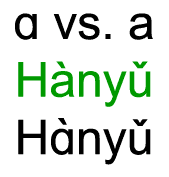
And it doesn’t use the atrocious ɑ that some people mistakenly believe is required either.
Unfortunately, punctuation and alphanumerics are not included in the Pinyin. But other than that there’s very little that doesn’t follow standard Pinyin orthography, the main exception being the indication of the tone sandhi related to the special cases of yī and bù, (e.g., the journal gives “bú shì” and “búdà” instead of the standard “bù shì” and “bùdà,” and “yìhuíshì” and “yí wèi” instead of the standard “yīhuíshì” and “yī wèi“). That said, though, tone changes related to yi and bu can be something of a pain. So although this isn’t standard, I can see why it was done and am not entirely unsympathetic to this approach.
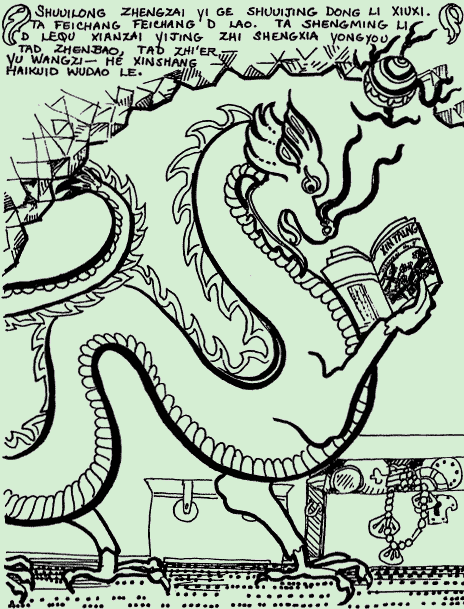
Here are a few sample lines (click to enlarge):
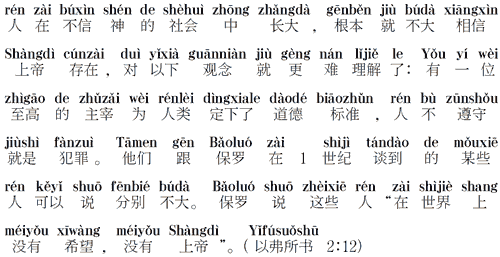
It would be nice if this were in Unicode, to help aid searches and cutting and pasting. The text, however, appears to have been made in a system devised years ago by the people at the journal. Regardless, I’m happy to see the Pinyin.
Overall, despite the lamentable absence of punctuation and Arabic numerals in the Pinyin, this is quality work, which is perhaps all the more remarkable in that the Pinyin and simplified Hanzi edition of this journal is not truly free to circulate in the land of its target audience. That’s because its publishers are Jehovah’s Witnesses, a group suppressed by the PRC (though it appears that at least at the moment their sites are not blocked by the great firewall). The journal, Shǒuwàngtái, may be more familiar to you by its English name: Watchtower. Whatever you might think of Jehovah’s Witnesses, I hope you’ll recognize the considerable accomplishment of those who put together this publication.
Getting to the Jehovah’s Witnesses Web pages that link to Shǒuwàngtái can be tricky. (Go to the magazines page, select “Chinese (Simplified)” for the language; then choose the month and file with Pinyin.) So I’m providing direct links to some documents below:
- January, part 1, part 2
- February, part 1, part 2
- March, part 1, part 2
- April, part 1, part 2
- May, part 1, part 2
- June, part 1, part 2 (compare with part 1 in English)
I haven’t found any Pinyin editions other than those. Perhaps old ones are taken offline.

With thanks to Victor Mair.

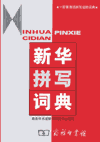 Xīnhuá Pīnxiě Cídiǎn (《新华拼写词典》 / 《新華拼寫詞典》), is the second of Yin Binyong’s two books on Pinyin orthography. The first, Chinese Romanization: Pronunciation and Orthography, is in English and Mandarin; much of it is already available here on Pinyin.Info.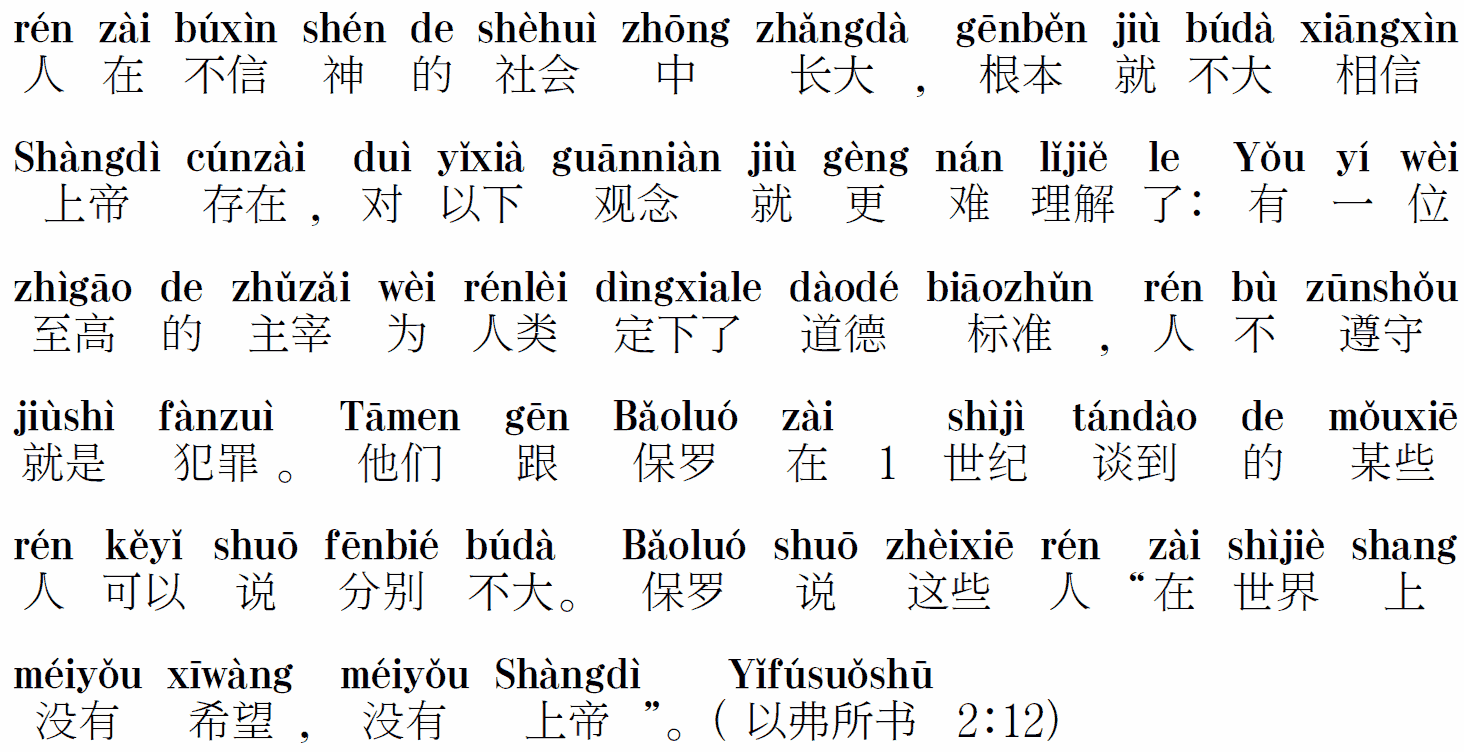
 About a year ago (which is roughly how overdue this post is),