A new look at early character forms

Cover of the book: 'Orthography of Early Chinese Writing'A review in a recent journal issue focusing on romanization led me to discover online the entire text of an interesting new book: Orthography of Early Chinese Writing: Evidence from Newly Excavated Manuscripts, by Imre Galambos.

This gives an idea of what the book covers:

Beside offering a more useful approach to both studying Warring States manuscripts and variant character forms in general, this study sheds new light on the development of the Chinese script, its transition into the clerical script stage, and the reality of the Qin reforms. The variability of Warring States character forms demonstrates that Chinese characters evolved not along a linear path that stretched from the oracle-bone inscriptions to the modern script but followed a complex process involving distinct cultures and languages. The “fuzziness” of the line of evolution with respect to the spoken languages and dialects of ancient China raises questions regarding the national identity of the Chinese script. A related issue is how far can one go back in time and say with certainty that the various scripts were not only the predecessors of the Chinese script but were in fact Chinese.

Some numbers for searches:

  • ISBN 963 463 811 2
  • ISSN 1787-7482

Journal issue focuses on romanization

cover of this issue of the Journal of the Royal Asiatic SocietyThe most recent issue of the Journal of the Royal Asiatic Society of Great Britain and Ireland (third series, volume 20, part 1, January 2010) features the following articles on romanization movements and script reforms.

  • Editorial Introduction: Romanisation in Comparative Perspective, by İlker Aytürk
  • The Literati and the Letters: A Few Words on the Turkish Alphabet Reform, by Laurent Mignon
  • Alphabet Reform in the Six Independent ex-Soviet Muslim Republics, by Jacob M. Landau
  • Politics of Romanisation in Azerbaijan (1921–1992), by Ayça Ergun
  • Romanisation in Uzbekistan Past and Present, by Mehmet Uzman
  • Romanisation of Bengali and Other Indian Scripts, by Dennis Kurzon
  • The Rōmaji movement in Japan, by Nanette Gottlieb
  • Postscript from the JRAS Editor, Sarah Ansari

Unfortunately, none of these cover any Sinitic languages or the case of Vietnam. And Gottlieb’s take on rōmaji is certainly more conservative than Unger’s. But I expect this will all make for interesting reading.

I am able to view all of the articles on my system. But perhaps others will run up against a subscription wall.

I thank Victor H. Mair for drawing this publication to my attention.

Google Translate’s new Pinyin function sucks

Google Translate has a new function: conversion to Hanyu Pinyin, which would be exciting and wonderful if it were any good. But unfortunately it’s terrible, all things considered.

What Google has created is about at the same level as scripts hobbyists cobbled together the hard way about a decade ago from early versions of CE-DICT. Don’t get me wrong: I greatly admire what sites such as Ocrat achieved way back when. But for Google — with all of its data, talent, and money — to do essentially no better so many years later is nothing short of a disgrace.

To see Google Translate’s Pinyin function in action you must select “Chinese (Simplified)” or “Chinese (Traditional)” — not English — for the “Translate into” option. And then click on “Show romanization”.

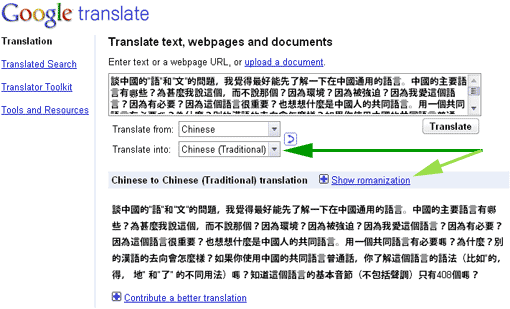
For example, here’s what happens with the following text from an essay on simplified and traditional Chinese characters by Zhang Liqing:

談中國的“語”和“文”的問題,我覺得最好能先了解一下在中國通用的語言。中國的主要語言有哪些?為甚麼我說這個,而不說那個?因為環境?因為被強迫?因為我愛這個語言?因為有必要?因為這個語言很重要?也想想什麼是中國人的共同語言。用一個共同語言有必要嗎?為什麼?別的漢語的去向會怎麼樣?如果你使用中國的共同語言普通話,你了解這個語言的語法(比如“的, 得, 地“ 和“了” 的不同用法)嗎? 知道這個語言的基本音節(不包括聲調)只有408個嗎?

screenshot of Google Translate with the text above

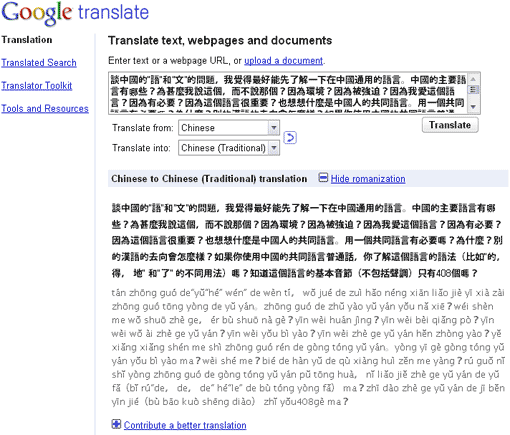
Google Translate will produce this:
screenshot of Google Translate with the text above and how Google Translate puts this into Pinyin (see text below)

tán zhōng guó de“yǔ“hé” wén” de wèn tí, wǒ jué de zuì hǎo néng xiān liǎo jiè yī xià zài zhōng guó tōng yòng de yǔ yán。zhōng guó de zhǔ yào yǔ yán yǒu nǎ xiē?wéi shèn me wǒ shuō zhè ge, ér bù shuō nà gè?yīn wèi huán jìng?yīn wèi bèi qiǎng pò?yīn wèi wǒ ài zhè ge yǔ yán?yīn wèi yǒu bì yào?yīn wèi zhè ge yǔ yán hěn zhòng yào?yě xiǎng xiǎng shén me shì zhōng guó rén de gòng tóng yǔ yán。yòng yī gè gòng tóng yǔ yán yǒu bì yào ma?wèi shé me?bié de hàn yǔ de qù xiàng huì zěn me yàng?rú guǒ nǐ shǐ yòng zhōng guó de gòng tóng yǔ yán pǔ tōng huà, nǐ liǎo jiě zhè ge yǔ yán de yǔ fǎ(bǐ rú“de, de, de“ hé“le” de bù tóng yòng fǎ) ma?zhī dào zhè ge yǔ yán de jī běn yīn jié(bù bāo kuò shēng diào) zhǐ yǒu408gè ma?

Here’s what’s wrong:

  • This is all bro ken syl la bles instead of word parsing. (So it’s never even a question if they get the use of the apostrophe correct.)
  • Proper nouns are not capitalized (e.g., zhōng guó vs. Zhōngguó).
  • The first letter in each sentence is not capitalized.
  • Punctuation is not converted but remains in double-width Chinese style, which is wrong for Pinyin.
  • Spacing around most punctuation is also incorrect (e.g., although a space is added after a comma and a closing parenthesis, there’s no space after a period or a question mark. See also the spacing or lack thereof around quotation marks, numerals, etc.)
  • Because of lack of word parsing, some given pronunciations are wrong.

In my previous post I complained about Google Maps’ unfortunately botched switch to Hanyu Pinyin. I stated there that, unlike Google Maps, Google Translate would correctly produce “Chengdu” from “成都” (which it does when “translate into” is set for English). But I see that the romanization bug feature of Google Translate also fails this simple test. It generates the incorrect “chéng dōu”.

All of this indicates that Google apparently is using a poor database and not only has no idea of how Pinyin is meant to be written but also lacks an understanding of even the basic rules of Pinyin.

If you should need to use a free Web-based Pinyin converter, avoid Google Translate. Instead use Adso (from the fine folk at Popup Chinese) or perhaps NCIKU or MDBG — all of which, despite their limitations (c’mon, guys, sentences begin with capital letters), are significantly better than what Google offers.

By the way, Google Translate will also romanize Japanese texts written in kanji and kana, Russian texts written in Cyrillic, etc. But I’ll leave those to others to analyze.

For lagniappe, here’s a real Hanyu Pinyin version of the text above:

Tán Zhōngguó de “yǔ” hé “wén” de wèntí, wǒ juéde zuìhǎo néng xiān liǎojiě yīxià zài Zhōngguó tōngyòng de yǔyán. Zhōngguó de zhǔyào yǔyán yǒu nǎxiē? Wèishénme wǒ shuō zhège, ér bù shuō nàge? Yīnwei huánjìng? Yīnwei bèi qiǎngpò? Yīnwei wǒ ài zhège yǔyán? Yīnwei yǒu bìyào? Yīnwei zhè ge yǔyán hěn zhòngyào? Yě xiǎngxiang shénme shì Zhōngguórén de gòngtóng yǔyán? Yòng yīge gòngtóng yǔyán yǒu bìyào ma? Weishenme? Biéde Hànyǔ de qùxiàng huì zěnmeyàng? Rúguǒ nǐ shǐyòng Zhōngguó de gòng tóng yǔyán Pǔtónghuà, nǐ liǎojiě zhège yǔyán de yǔfǎ (bǐrú “de” hé “le” de bùtóng yǒngfǎ) ma? Zhīdao zhège yǔyán de jīběn yīnjié (bù bàokuò shēngdiào) zhǐ yǒu 408 ge ma?

Google Maps switches to Hanyu Pinyin for Taiwan (sloppily)

Until very recently, Google Maps gave street names in Taiwan in Tongyong Pinyin — most of the time, at least. This was the case even for Taipei, which most definitely has long used Hanyu Pinyin, not Tongyong Pinyin. The romanization on Google Maps was really a hodgepodge in the maps of Taiwan. And it’s still kind of a mess; but now it’s at least more consistent — and more consistent in Hanyu Pinyin.

First the good. In Google Maps:

  • Hanyu Pinyin, not Tongyong Pinyin, is now used for street names throughout Taiwan
  • Tone marks are indicated. (Previous maps with Tongyong did not indicate tones.)

Now the bad, and unfortunately there’s a lot of it and it’s very bad indeed:

  • The Hanyu Pinyin is given as Bro Ken Syl La Bles. (Terrible! Also, this is a new style for Google Maps. Street names in Tongyong were styled properly: e.g., Minsheng, not Min Sheng.)
  • The names of MRT stations remain incorrectly presented. For example, what is referred to in all MRT stations and on all MRT maps as “NTU Hospital” is instead referred to in broken Pinyin as “Tái Dà Yī Yuàn” (in proper Pinyin this would be Tái-Dà Yīyuàn); and “Xindian City Hall” (or “Office” — bleah) is marked as Xīn Diàn Shì Gōng Suǒ (in proper Pinyin: “Xīndiàn Shìgōngsuǒ” or perhaps “Xīndiàn Shì Gōngsuǒ“). Most but not all MRT stations were already this incorrect way (in Hanyu Pinyin rather than Tongyong) in Google Maps.
  • Errors in romanization point to sloppy conversions. For example, an MRT station in Banqiao is labeled Xīn Bù rather than as Xīnpǔ. (埔 is one of those many Chinese characters with multiple Mandarin pronunciations.)
  • Tongyong Pinyin is still used in the names of most cities and townships (e.g., Banciao, not Banqiao).

Screenshot from earlier this evening, showing that Tongyong Pinyin is still being used in Google Maps for some city and district names (e.g., Gueishan, Sinjhuang, Banciao, Jhonghe, Sindian, and Jhongjheng rather than Hanyu Pinyin’s Guishan, Xinzhuang, Banqiao, Zhonghe, Xindian, and Zhongzheng, respectively).
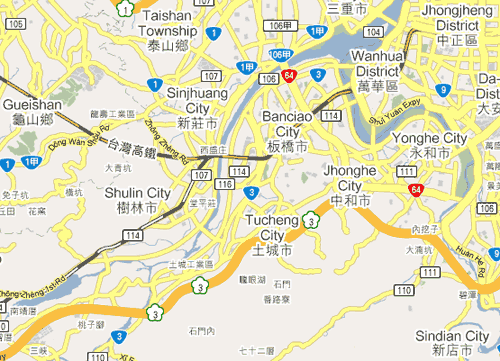
map of Taipei area, with names as shown above

I don’t have any old screenshots of my own available at the moment, so for now I’ll refer you to an image that Fili used in an old post of his. Compare that with this screenshot I took a few minutes ago from Google Maps of the same section of Tainan:
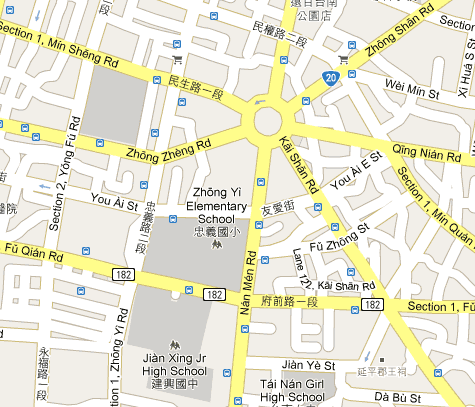
tainan_google_maps2

Note especially how the name of the junior high school is presented.

  • Previously “Jian Xing Junior High School”.
  • Now “Jiàn Xìng Jr High School”.

This is typical of how in old maps some things were labeled (poorly) in Hanyu Pinyin. (Words, not bro ken syl la bles, are the basis for Pinyin orthography. This is a big deal, not a minor error.) And now such places are still labeled poorly in Hanyu Pinyin, but with the addition of tone marks.

I’d like to return to the point earlier on sloppy conversions. Surprisingly, 成都路 is given as “Chéng Doū Road” rather than as “Chéngdū Road“.
screenshot from Google Maps of 'Cheng Dou [sic] Rd', near Taipei's Ximending
Although “Xinpu” might not be the sort of name to be contained in some romanization databases, there is nothing in the least obscure about Chengdu, the name of a city of some 11 million people. Google Translate certainly knows the right thing to do with 成都路:
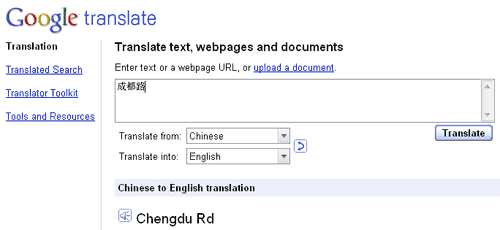
screenshot from Google Translate, showing how Google will translate '成都路' as 'Chengdu Rd'

But Google Maps doesn’t get this simple point right, which likely points to outsourcing. Why would Google do this? And why wouldn’t it ensure that a better job was done? Because, really, so far the long-overdue conversion to Hanyu Pinyin in Google Maps for Taiwan is something of a botch.

Script differences complicate matters for Uzbeks in Kyrgyzstan

Ethnic Uzbeks in southern Kyrgyzstan are reportedly suffering from problems with the education system, including that Uzbekistan has switched to the Latin alphabet but Kyrgyzstan has not.

Kyrgyzstan is home to more than 766,000 ethnic Uzbeks out of an overall population of roughly 5 million, according to figures compiled by the State Statistics Committee. Although their numbers are slowly declining, Uzbeks remain the largest minority group in the country. Today, there are just 14 Uzbek language schools in Osh, compared with 21 in 1991….

A shortage of Uzbek-language textbooks and teaching materials constitutes another large obstacle. Many children in Uzbek-language schools must use textbooks that were published in Uzbekistan during the Soviet era. “The situation [became] complicated after Uzbekistan changed from using Cyrillic and started using the Latin [alphabet] in 1993,” explained Erkin Bainzarov, the editor of the Uzbek section of the Osh Shamy (“Evening Osh”) newspaper. “As a result, Kyrgyzstan’s Uzbek schools were forced to stop using textbooks published by Tashkent,” and must rely on antiquated materials. Teachers in Kyrgyzstan have not adapted to the Latin alphabet.

To help, the Kyrgyz-Uzbek University, the only university in the country to provide instruction in Uzbek, established a Textbook Development Center in 1997 with the help of Batyrov’s Friendship of Peoples University in Jalalabad.

“Since Uzbekistan switched to Latin, we started developing our own [Uzbek] textbooks [written in Cyrillic],” said Tursunbai Kamilov, the director of the center. “Since 1997, we have developed a set of seven textbooks for the primary school and 20 textbooks for secondary and high schools.” Yet more is needed. Kamilov says that due to inadequate financing, Uzbek schools only have 34 percent of the textbooks they need.

Some representatives of the Uzbek community say that if current trends persist, southern Kyrgyzstan’s Uzbek-language educational structure could experience a complete collapse. “We have to maintain our schools, and have our children go to Uzbek language schools to preserve our language, culture and identity,” said Khalturaev, the school principal.

source: Kyrgyzstan: Uzbeks in Southern Regions Wrestle with Cultural Dilemma, Eurasianet, October 27, 2009

further reading:

Taipei County switches to Hanyu Pinyin

Street signs in Taipei County are beginning to be changed to Hanyu Pinyin. For Pinyin supporters here, this is a long-awaited development.

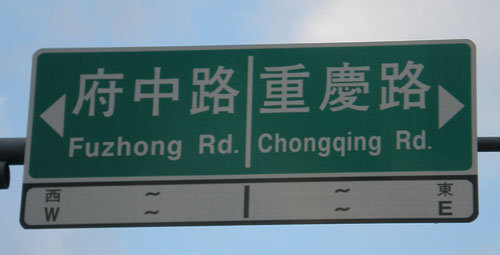
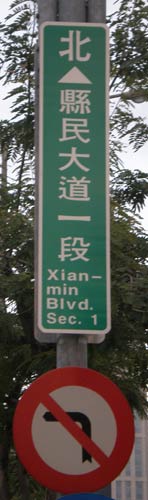
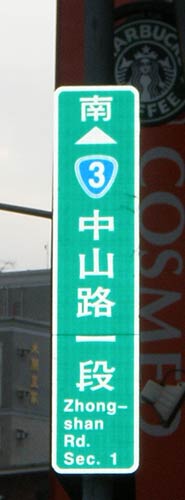
Here are some examples of new signs in Banqiao, the seat of the Taipei County Government. They were taken near the Fuzhong MRT station.

street sign in Banqiao, Taiwan, in Hanyu Pinyin: 'Fuzhong Rd.' 'Chongqing Rd.'

Xianmin Blvd. Sec. 1 (This is a vertical sign, too narrow for 'Xianmin' on one line, so it's hyphenated, with 'min' on the second line)

Zhongshan Rd. Sec. 1

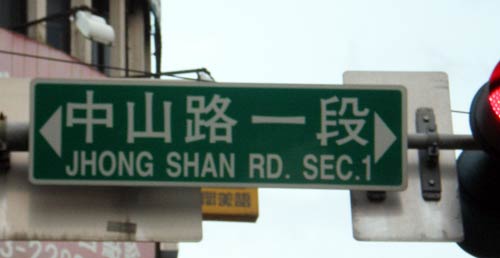
This is one of the Tongyong signs about to be taken down. It’s at the same intersection as the “Zhongshan” sign at above right. [November 17 update: The sign is now gone.]
JHONG SHAN RD. SEC.1

The first roads to receive these signs are large ones, especially those connecting one city to another. This is probably going to be a long, slow process, which is certainly to be expected given (a) how damn long it took them to get this started and (b) that most signs never got changed to Tongyong Pinyin during the previous administration. My impression is that most street signs in Taipei County, especially in smaller towns and on smaller roads, remain in MPS2 (the Tongyong Pinyin of the 1980s).

Has anyone noticed any changes yet in Xindian, etc.?

I wish I could provide links to official announcements, etc. But so far I haven’t been able to find any. I have, however, spoken with officials from the county government who confirm the new policy, so I’m going ahead and announcing this here.

Nice to see no InTerCaps. Unfortunately, the apostrophe situation is SNAFU, with those responsible for the signage using outdated guidelines (calling for a hyphen instead of an apostrophe). But I’ve forwarded the central government’s current rules on this to those concerned, which I hope will help get the problem fixed before any such signs go up.

Simplified or traditional characters for Malaysian heritage zone road signs: poll

Parts of Penang, Malaysia’s George Town are scheduled to get some new street signs that will include Chinese characters. (Penang has a high concentration of ethnic Chinese.) Controversy over whether to pick traditional Chinese characters or simplified Chinese characters has led authorities there set up an online poll to help resolve the matter.

Voting began today and will continue until Sunday, October 25, at www.heritageroadsign.com.

The site also provides some photos of signs.

The signage project, which involves putting up a total of 300 bilingual road signs on 82 roads, is expected to cost RM45,000 (US$13,400, or about US$45 per sign).

source: Online poll to pick Chinese road signs, The Star, October 10, 2009

-r endings, their pronunciation, and Pinyin spelling

cover of Chinese Romanization: Pronunciation and OrthographyArrr! In recognition of International Talk Like a Beijinger Pirate Day, here are the rules for how to spell those -r endings in Hanyu Pinyin and how those endings affect the pronunciation of syllables. In many cases, it’s more complicated than just adding an -r sound at the end of the standard syllable.

This information is from Yin Binyong’s Chinese Romanization: Pronunciation and Orthography. The full section from this book is available in PDF form: r- Suffixed Syllables.

Written form Actual pronunciation
-ar (mǎr, horse) -ar (mǎr)
-air (gàir, lid) -ar (gàr)
-anr (pánr, plate) -ar (pár)
-aor (bāor, bundle) -aor (bāor)
-angr (gāngr, jar) -ãr (gãr)
-or (mòr, dust) -or (mòr)
-our (hóur, monkey) -our (hóur)
-ongr (chóngr, insect) -õr (chõr)
-er (gēr, song) -er (gēr)
-eir (bèir, back) -er (bèr)
-enr (ménr, door) -er (mér)
-engr (dēngr, lamp) -ẽr (dẽr)
-ir* (zìr, Chinese character) -er (zèr)
-ir (mǐr, rice) -ier (mǐer)
-iar (xiár, box) -iar (xiár)
-ier (diér, saucer) -ier (diér)
-iaor (niǎor, bird) -iaor (niǎor)
-iur (qiúr, ball) -iour (qióur)
-ianr (diǎnr, bit) -iar (diǎr)
-iangr (qiāngr, tune) -iãr (qiãr)
-inr (xīnr, core) -ier (xīer)
-ingr (língr, bell) -iẽr (liẽr)
-iongr (xióngr, bear) -iõr (xiõr)
-ur (tùr, rabbit) -ur (tùr)
-uar (huār, flower) -uar (huār)
-uor (huór, work) -uor (huór)
-uair (kuàir, piece) -uar (kuàr)
-uir (shuǐr, water) -uer (shuěr)
-uanr (wánr, to play) -uar (wár)
-uangr (kuāngr, basket) -uãr (kuãr)
-unr (lúnr, wheel) -uer (luér)
-ür (qǔr, song) -üer (qǔer)
-üer (juér, peg) -üer (juér)
-üanr (quānr, loop) -üar (quār)
-ünr (qúnr, skirt) -üer (quér)

Notes:

  • ã, õ, ẽ indicate nasalized a, o, e.
  • The -i marked with an asterisk indicates either of the apical vowels that follow zh, ch, sh, r and z, c, s.