
OMG, it’s Hanzified English

Taiwanese movie poster in Mandarin for 'Date Night', a.k.a. '約會喔麥尬'In Taiwan, the new movie Date Night has been given the Mandarin title Yuēhuì o mài gà (約會喔麥尬/约会喔麦尬).

Yuēhuì is simply the word for “date.” The interesting part is “o mài gà” (喔麥尬), which is a Mandarinized form of the English “oh my god.” (I wonder if this, being written in Hanzi despite still being basically English, would pass China’s new need for supposed purity.)

Most people here — especially those younger than about 40 — would simply write “oh my god” (or, less frequently, “o my god”) in English in the middle of an otherwise Mandarin text. (I’ll spare everyone the chart of Google searches; but it backs this up.) But brevity is standard in movie titles here, and “喔麥尬” is a lot more compact on a movie poster than “oh my god.” This, however, raises the question of why “喔麥尬” instead of the equally concise “OMG”. I don’t know the answer to that. But the path of lettered words in Mandarin is certainly not without twists and turns.

Like most other uses of Hanzified English, the results are not entirely faithful to the original sounds.

Mandarin’s ou would be a closer phonetic fit than o for the English “oh”.
There’s Ōu (區/区), a surname. But most of the time this Chinese character is pronounced (being one of those many Chinese characters with multiple pronunciations), so that certainly wouldn’t work well. There’s ǒu, which has a more clearly phonetic Hanzi (嘔/呕), but which has to do with vomit (ǒutù/嘔吐/呕吐). Another possible choice would be ōu (歐/欧); but that is associated mainly with Europe and doesn’t get used much as a phonetic component in non-Europe-related loan words outside the word for ohm: ōumǔ (歐姆/欧姆).

Mài (the Mandarin word for wheat), unlike most other Mandarin morphemes pronounced mai (various tones), gets used phonetically in lots of various loan words, such as Màidāngláo (McDonald’s/麥當勞/麦当劳), Màijiā (Mecca/麥加/麦加), Dānmài (Denmark/丹麥/丹麦), and Kāmàilóng (Cameroon/喀麥隆/喀麦隆). So its use is to be expected, though semantically there’s no link. And mài is certainly a better fit for the English my than it is for the Mc of McDonald’s, the Mec of Mecca, the mark of Denmark, or the me of Cameroon.

For ga there’s not a lot of choice. 咖 is often seen in the phonetic loan gālí (curry). The biggest problem here is that the same 咖 is also used as in a different, common phonetic loan: kāfēi (coffee). There’s 嘎; but, like 尬, it’s not exactly a well-known character.

Anyway, I could go on for a long time listing various possibilities. But the main point is that Chinese characters just don’t do well at this sort of thing.

As for Pinyin, I suppose the orthography could get interesting: o mài gà, o màigà, omài gà, or omàigà. But a Pinyin orthography would probably simply encourage people to write this in the original: oh my god.

BTW, you may wish to try the following experiment. The in o mài gà is most often seen in writing the word gāngà (尷尬/尴尬), which means awkward/embarrassed. Ask native speakers of Mandarin to write gāngà in Hanzi for you by hand without using a dictionary, a computer, or any other form of assistance. I bet that most people — even those with university degrees — won’t be able to write this common, ordinary word correctly.

And for lagniappe, the character 尬 is also sometimes seen in written Taiwanese as the equivalent of Mandarin’s jiā (加/add). I spotted an example of this just the other day on a cafe sign (in the sense of “buy something and ga something else for a special price”) but didn’t have a camera with me.
Hoklo dictionaries: a list

The newly redesigned Tailingua has just issued a useful list of dictionaries of the Taiwanese language and related dialects (PDF).

Here’s a random sample:

  • Dyer, Samuel 萊撒母耳 (1838 ). A Vocabulary of the Hok-keen Dialect as Spoken in the County of Tsheang- Tshew [漳州音字典]. Malacca: Anglo-Chinese College Press.
  • Embree, Bernard L.M. 晏寶理 (1973). A Dictionary of Southern Min [閩南語英語辭典]. Kowloon: Hong Kong Language Institute.
  • Fùxīng wénhuà shìyèshè 復興文化事業社 (2004). Táiwān mǔyǔ yīnbiāo zìdiǎn 臺灣母語音標字典 [Taiwanese mother tongue pronunciation dictionary]. Táinán: Fùxīng Wénhuà Shìyèshè 復興文化 事業社.
  • Hare, G.T. (1904). The Hokkien Vernacular [福建白話英文字典]. Kuala Lumpur: Straits Settlements and Selangor Government Printing Offices.
  • Hóng Guóliáng 洪國良 (2004). Héluòyǔ yīnzì duìzhào diǎn 河洛語音字對照典 [Comparative dictionary of Ho-lo pronunciation]. Gāoxióng: Fùwén 復文.
  • Hóng Hóngyuán 洪宏元 (2009). Xuéshēng Tái–Huá shuāngyǔ huóyòng cídiǎn 學生台華雙語活用辭典 [Bilingual everyday Taiwanese–Mandarin dictionary for students]. Táiběi: Wǔ Nán Túshū Chūbǎn Yǒuxiàn Gōngsī 五南圖書出版有限公司.
  • Hú Xīnlín 胡鑫麟 (1994). Shíyòng Táiyǔ xiǎo cídiǎn 實用臺語小辭典 [Practical pocket Taiwanese dictionary]. Táiběi: Zìlì Wǎnbào Chūbǎnbù 自立晚報出版部.

Google Maps switches to Hanyu Pinyin for Taiwan (sloppily)

Until very recently, Google Maps gave street names in Taiwan in Tongyong Pinyin — most of the time, at least. This was the case even for Taipei, which most definitely has long used Hanyu Pinyin, not Tongyong Pinyin. The romanization on Google Maps was really a hodgepodge in the maps of Taiwan. And it’s still kind of a mess; but now it’s at least more consistent — and more consistent in Hanyu Pinyin.

First the good. In Google Maps:

  • Hanyu Pinyin, not Tongyong Pinyin, is now used for street names throughout Taiwan
  • Tone marks are indicated. (Previous maps with Tongyong did not indicate tones.)

Now the bad, and unfortunately there’s a lot of it and it’s very bad indeed:

  • The Hanyu Pinyin is given as Bro Ken Syl La Bles. (Terrible! Also, this is a new style for Google Maps. Street names in Tongyong were styled properly: e.g., Minsheng, not Min Sheng.)
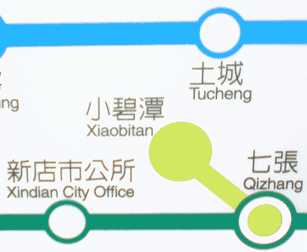
  • The names of MRT stations remain incorrectly presented. For example, what is referred to in all MRT stations and on all MRT maps as “NTU Hospital” is instead referred to in broken Pinyin as “Tái Dà Yī Yuàn” (in proper Pinyin this would be Tái-Dà Yīyuàn); and “Xindian City Hall” (or “Office” — bleah) is marked as Xīn Diàn Shì Gōng Suǒ (in proper Pinyin: “Xīndiàn Shìgōngsuǒ” or perhaps “Xīndiàn Shì Gōngsuǒ“). Most but not all MRT stations were already this incorrect way (in Hanyu Pinyin rather than Tongyong) in Google Maps.
  • Errors in romanization point to sloppy conversions. For example, an MRT station in Banqiao is labeled Xīn Bù rather than as Xīnpǔ. (埔 is one of those many Chinese characters with multiple Mandarin pronunciations.)
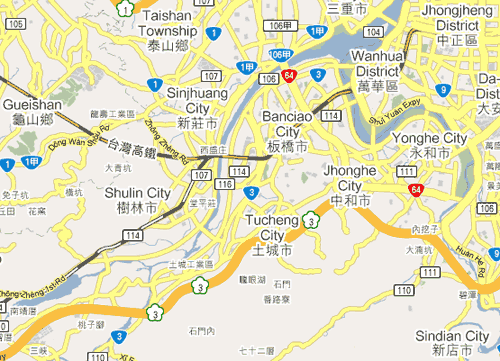
  • Tongyong Pinyin is still used in the names of most cities and townships (e.g., Banciao, not Banqiao).

Screenshot from earlier this evening, showing that Tongyong Pinyin is still being used in Google Maps for some city and district names (e.g., Gueishan, Sinjhuang, Banciao, Jhonghe, Sindian, and Jhongjheng rather than Hanyu Pinyin’s Guishan, Xinzhuang, Banqiao, Zhonghe, Xindian, and Zhongzheng, respectively).
map of Taipei area, with names as shown above

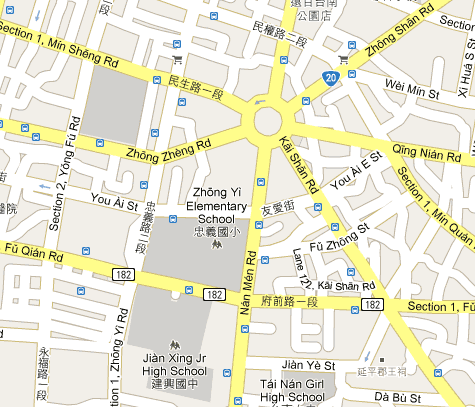
I don’t have any old screenshots of my own available at the moment, so for now I’ll refer you to an image that Fili used in an old post of his. Compare that with this screenshot I took a few minutes ago from Google Maps of the same section of Tainan:
tainan_google_maps2

Note especially how the name of the junior high school is presented.

  • Previously “Jian Xing Junior High School”.
  • Now “Jiàn Xìng Jr High School”.

This is typical of how in old maps some things were labeled (poorly) in Hanyu Pinyin. (Words, not bro ken syl la bles, are the basis for Pinyin orthography. This is a big deal, not a minor error.) And now such places are still labeled poorly in Hanyu Pinyin, but with the addition of tone marks.

I’d like to return to the point earlier on sloppy conversions. Surprisingly, 成都路 is given as “Chéng Doū Road” rather than as “Chéngdū Road“.
screenshot from Google Maps of 'Cheng Dou [sic] Rd', near Taipei's Ximending
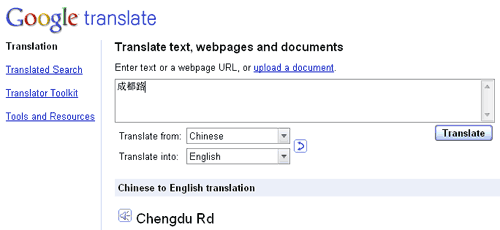
Although “Xinpu” might not be the sort of name to be contained in some romanization databases, there is nothing in the least obscure about Chengdu, the name of a city of some 11 million people. Google Translate certainly knows the right thing to do with 成都路:
screenshot from Google Translate, showing how Google will translate '成都路' as 'Chengdu Rd'

But Google Maps doesn’t get this simple point right, which likely points to outsourcing. Why would Google do this? And why wouldn’t it ensure that a better job was done? Because, really, so far the long-overdue conversion to Hanyu Pinyin in Google Maps for Taiwan is something of a botch.

Taipei County switches to Hanyu Pinyin

Street signs in Taipei County are beginning to be changed to Hanyu Pinyin. For Pinyin supporters here, this is a long-awaited development.

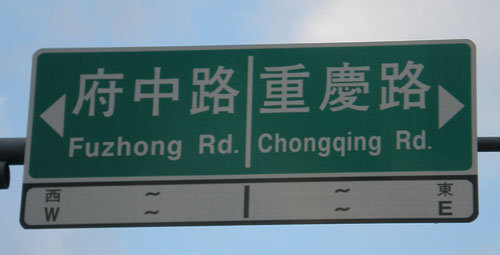
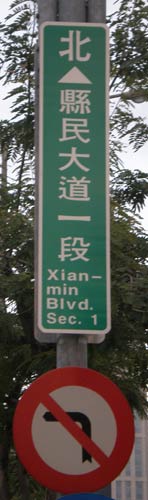
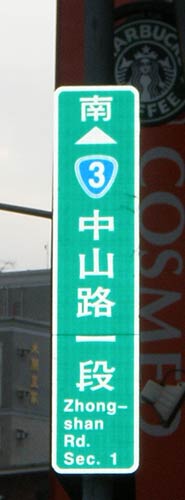
Here are some examples of new signs in Banqiao, the seat of the Taipei County Government. They were taken near the Fuzhong MRT station.

street sign in Banqiao, Taiwan, in Hanyu Pinyin: 'Fuzhong Rd.' 'Chongqing Rd.'

Xianmin Blvd. Sec. 1 (This is a vertical sign, too narrow for 'Xianmin' on one line, so it's hyphenated, with 'min' on the second line)

Zhongshan Rd. Sec. 1

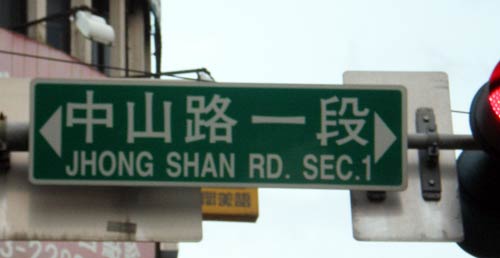
This is one of the Tongyong signs about to be taken down. It’s at the same intersection as the “Zhongshan” sign at above right. [November 17 update: The sign is now gone.]
JHONG SHAN RD. SEC.1

The first roads to receive these signs are large ones, especially those connecting one city to another. This is probably going to be a long, slow process, which is certainly to be expected given (a) how damn long it took them to get this started and (b) that most signs never got changed to Tongyong Pinyin during the previous administration. My impression is that most street signs in Taipei County, especially in smaller towns and on smaller roads, remain in MPS2 (the Tongyong Pinyin of the 1980s).

Has anyone noticed any changes yet in Xindian, etc.?

I wish I could provide links to official announcements, etc. But so far I haven’t been able to find any. I have, however, spoken with officials from the county government who confirm the new policy, so I’m going ahead and announcing this here.

Nice to see no InTerCaps. Unfortunately, the apostrophe situation is SNAFU, with those responsible for the signage using outdated guidelines (calling for a hyphen instead of an apostrophe). But I’ve forwarded the central government’s current rules on this to those concerned, which I hope will help get the problem fixed before any such signs go up.

Taiwan train stations and the switch to Hanyu Pinyin

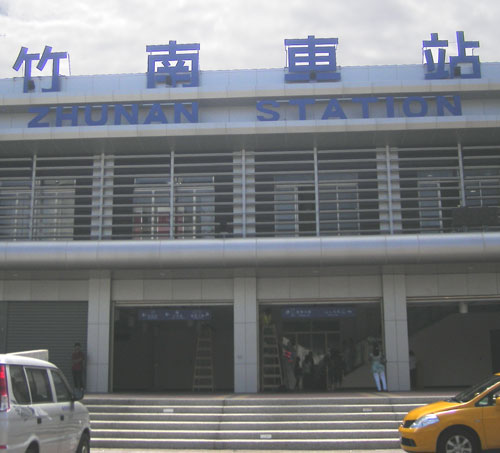
Although Hanyu Pinyin has been Taiwan’s official romanization system since the beginning of this year, progress in implementation on signage has so far been little to none (at least in what I’ve witnessed). So I was pleased to see this sign earlier this week at the remodeled train station in Zhunan, Miaoli County.

sign atop train station reading 'ZHUNAN STATION' in large letters

Those big letters unmistakably spell out the name of the city in Hanyu Pinyin. Good.

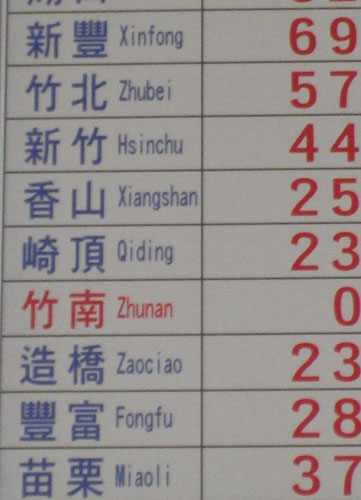
But what about the use of romanization inside the station? Here’s a shot of part of a board listing the stations near Zhunan.

train_station_names

Let’s look at the systems used in the names above:

  • Xinfong — Hanyu Pinyin and Tongyong Pinyin mix
  • Zhubei — Hanyu Pinyin
  • Hsinchu — Wade-Giles
  • Xiangshan — Hanyu Pinyin
  • Qiding — Hanyu Pinyin (BTW, that’s a terrible Q, as it’s too little distinct from an O, especially at a distance.)
  • Zhunan — Hanyu Pinyin
  • Zaociao — Tongyong Pinyin
  • Fongfu — Tongyong Pinyin
  • Miaoli — same in most systems

Once again we see the government’s incompetence when it comes to such simple things as spelling names correctly on signage.

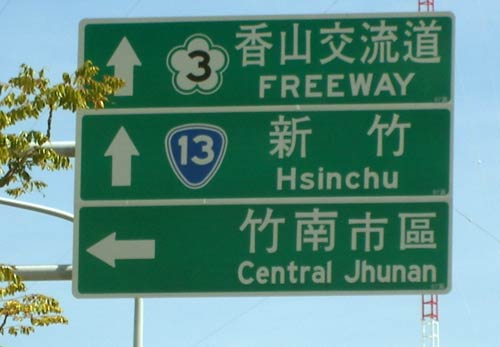
But since at least “Zhunan” was right, what about signage for the same name beyond the train station?

Well, there’s still Tongyong Pinyin (“Jhunan”):

directional sign reading 'Central Jhunan'

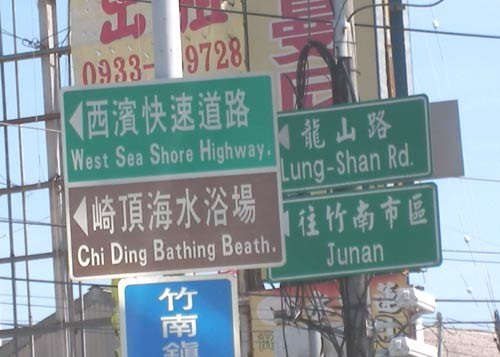
And there’s still Tongyong’s predecessor, MPS2 (“Junan”), along with other systems, typos, and sloppy English:

signs reading 'Junan', 'West Sea Shore Highway.', 'Lung-Shan Rd.', and 'Chi Ding Bathing Beath.'

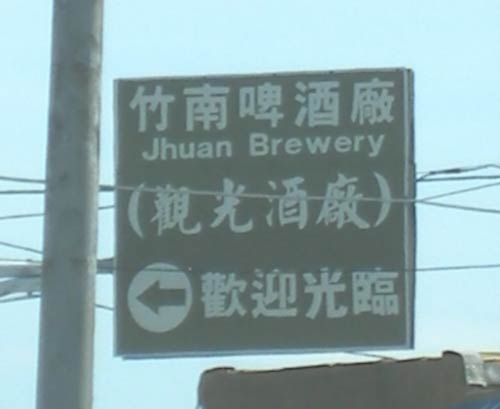
And there are still spellings that are simply wrong (“Jhuan”), regardless of the system:
directional sign above the highway, reading 'Jhuan Brewery'

I’ve said it before, I’ll say it again: “Taiwan’s romanization situation: plus ça change, plus c’est la même chose.”

photos of and around Xindian City Hall MRT station

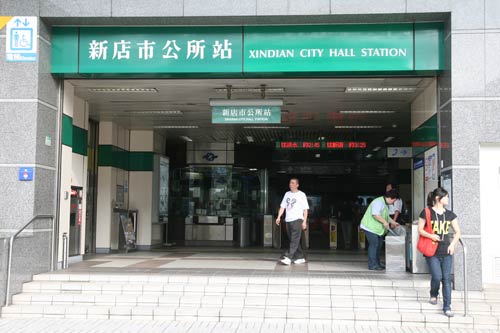
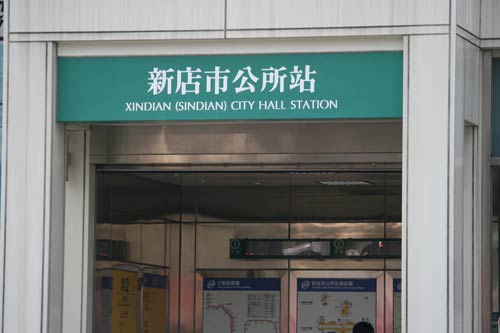
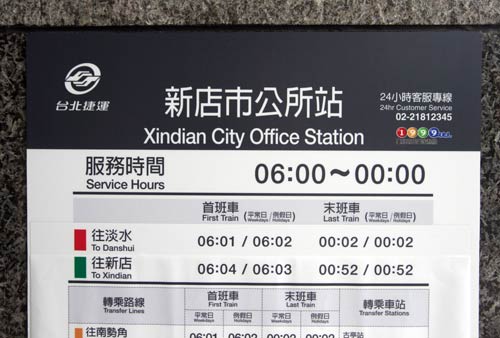
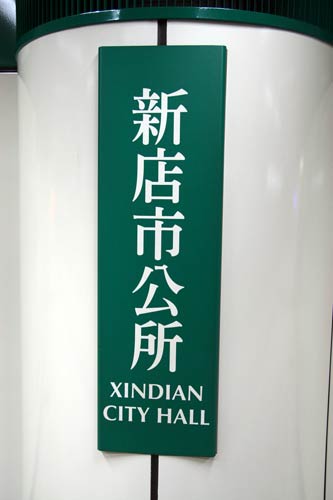
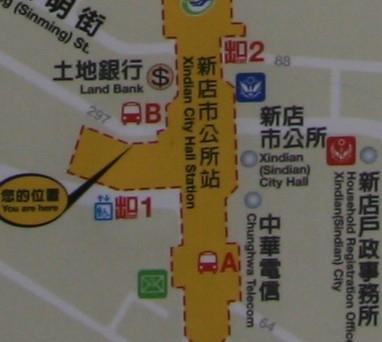
My friend David of David on Formosa kindly sent me lots of photos of the current signage at Xindian City Something-or-other Station. Here they are.

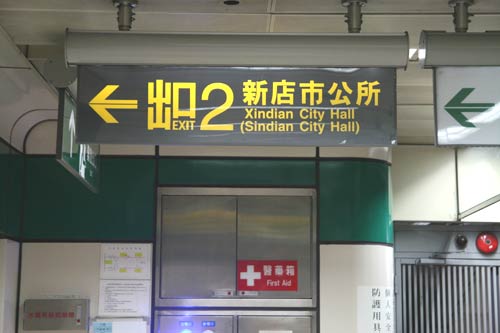
Note that some of the signage at the station itself gives the Tongyong Pinyin form (Sindian) as well as the Hanyu Pinyin form; but other signage does not. And the newest signs give Xindian City Office rather than Xindian City Hall.

MRT station main entrance, marked 'Xindian City Hall Station'

MRT station side entrance, marked 'Xindian (Sindian) City Hall Station'

Sign of things to come?
photo of station operation hours, with station name marked 'Xindian City Office Station'

sign on a pillar on the MRT platform reading 'Xindian City Hall'

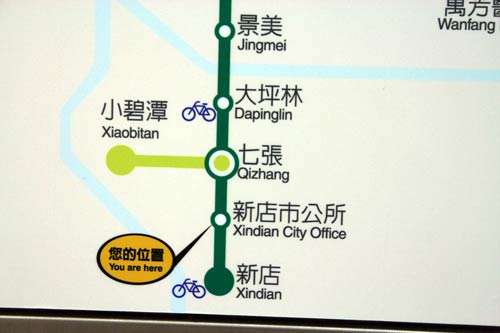
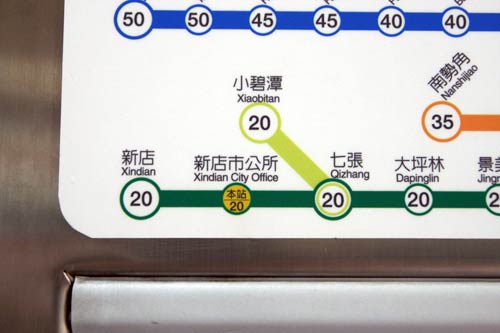
closeup of a new map on a station wall, with the station called 'Xindian City Office'

map_detail

exit2

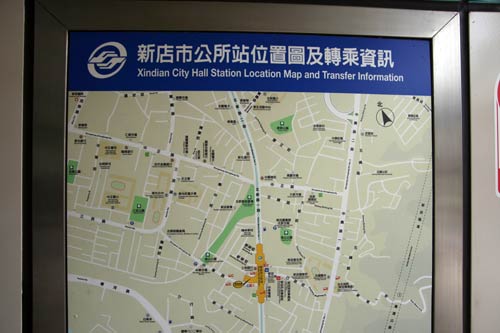
area_map

This closeup from the map above reveals that even city hall itself (not the MRT station) is labeled “City Hall.”

closeup from the photo above, as described

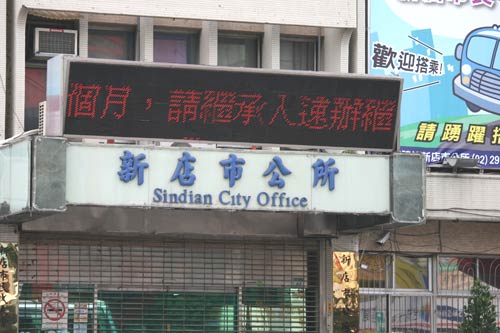
More than three years ago Taipei County Magistrate Zhōu Xīwěi (Chou Hsi-wei / 周錫瑋 / Zhou Xiwei) said that Taipei County should use the same romanization system as the city of Taipei (i.e., Hanyu Pinyin). But nothing has happened yet — not unlike his administration in general. So here we still see the Tongyong Pinyin form of “Sindian” rather than the Hanyu Pinyin form (now official at the national level) of “Xindian.”
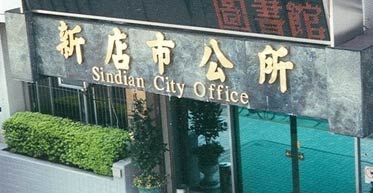
photo of Xindian City Hall (the actual building, not the MRT station). It's labeled 'Sindian City Office'

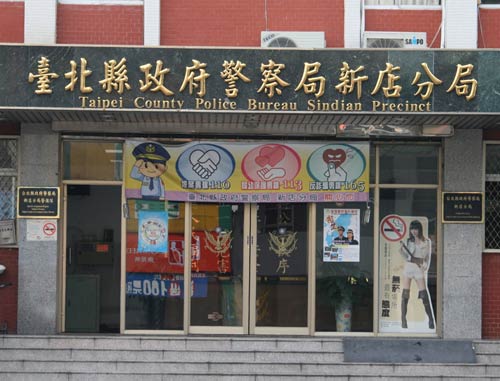
Taipei County Police Bureau Sindian Precinct

You can’t fight city hall, er, office

This follows up my previous post: new Taipei MRT stations and wordy names.

Although the MRT system resists fixing the mistakes in its station names — such as in wordy, unnatural English names or misuse of Hanyu Pinyin — that doesn’t mean it never changes a name. It does — and here I’m referring to things beyond the usual matter of romanization systems. In recent weeks a long-established MRT station name has been undergoing a quiet change. As this case reveals, however, it appears that the authorities have a rule that opposes change unless they want to take a perfectly good name and make it worse.

I recently complained about the needless and indeed counterproductive insertion of Taipei and Nangang into station names, such as in the case of adding “Taipei” to the English name of what in Mandarin is only “Nángǎng Zhǎnlǎnguǎn” (南港展覽館). But that’s not the only case of “Taipei” given in an English name that doesn’t have the city name included in Mandarin. Two more instances of this are “Taipei Zoo,” which in Mandarin is simply Dòngwùyuán (動物園), and “Taipei City Hall,” which in Mandarin is Shìzhèngfǔ (市政府).

First let’s examine the case of “Taipei Zoo.” The Mandarin name for this is simply the word for zoo: dòngwùyuán. So in English why not call this stop simply Zoo instead of Taipei Zoo? (There’s certainly no Xindian Zoo, Banqiao Zoo, Xinzhuang Zoo, Sanchong Zoo, etc., anywhere on the MRT system.)

There’s no clear answer. Although Hanziphiles love to proclaim “Just one Chinese character is enough,” the Mandarin language is most definitely not a monosyllabic one, especially when it comes to place names. (See, for example, Taipei street names and the monosyllabic myth.) So it’s possible that what’s happening here is the habits of Mandarin are being overwritten upon English.

Interestingly, in metropolitan Taipei most native Mandarin speakers, if they had to add a geographical distinction, would probably call this the Mùzhà Dòngwùyuán (木柵動物園) rather than the Táiběi Dòngwùyuán (台北動物園).

I’m more interested, however, in the case of “Taipei City Hall,” which in which in Mandarin is Shìzhèngfǔ (市政府) — again, no Táiběi. In this case adding “Taipei” makes sense because there really is another city hall stop on the MRT system: Xindian City Hall, which in Mandarin is Xīndiàn Shìgōngsuǒ (新店市公所).

Translated literally, shìzhèngfǔ is city government and shìgōngsuǒ is city administrative office. They have different names in Mandarin because of Taiwan’s somewhat convoluted governmental structure, a shìzhèngfǔ having somewhat greater autonomy than a shìgōngsuǒ. Nevertheless, in English both would usually be called simply city hall. Although New York City has hundreds of times more people than, say, Hays, Kansas (population 20,000), both places have a city hall … because usually that’s what cities have, regardless of their size or importance.

And for years the Taipei MRT has had a station named “Taipei City Hall” and another named “Xindian City Hall,” which is of course as it should be.

Unfortunately, however, Taiwan’s bureaucracy does not agree. The RDEC, keeper of the government’s bilingual stylebook for organizations, says that a shìgōngsuǒ is a city office, not a city hall, which is perhaps what has prompted the authorities with the MRT to change the perfectly good English name of “Xindian City Hall Station” to the distinctly worse “Xindian City Office Station.”

Basically, if there’s a discrepancy between how something is usually said in English and how some government official in Taiwan thinks it’s supposed to be said in English, real English loses. The same applies to Pinyin, whose clear and simple rules continue to be ignored here.

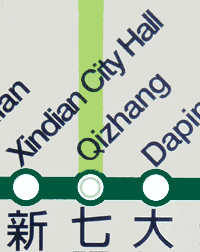
Both names — Xindian City Hall and Xindian City Office — can currently be seen on signage in the MRT system. The system maps next to MRT car doors have Xindian City Hall (see image at the left below). But the new long strips above the MRT doors (right) have Xindian City Office.

I expect Xindian City Hall to disappear soon.

Can anyone tell me what’s currently on that station itself?

xindian_city_hall xindian_city_office

photo of the front of Xindian City Hall, across the street from the MRT station. The sign reads 'Sindian City Office'