Going south with official Taiwan map

In the past, when I found romanization errors in official government documents I often contacted the agencies in charge so they could make improvements. But as those who live in Taiwan may have noted, this practice has had limited success. And in the process I’ve built up a great deal of bile from encountering bureaucratic roadblocks to fixing mistakes. So is it any wonder that when I see things like this map, I often think, “Wǒ hǎo xiǎng tù.” Maybe now it’s time to start going with that feeling — metaphorically speaking. And what could be more appropriate, given that we are about to have a tùnián? (I know, I know: That pun’s probably not going to make any of the New Year cards.)

So today I’ll post in public about one such mess. I recently looked over a map of southern Taiwan issued by Taiwan’s official Tourism Bureau and was not surprised to find errors — a lot of errors. (This particular map was published in June 2010 and is, as far as I know, the most recent edition.)

Most of the errors are cases of remnants of Tongyong Pinyin (e.g., Cingshuei for what is written Qingshui in Hanyu Pinyin). Oddly, on this map Tongyong Pinyin is often seen in only part of a name (e.g., what is written 豐丘 in Chinese characters is given as Fengciou, which has Hanyu Pinyin’s Feng rather than Tongyong’s Fong but Tongyong’s ciou rather than Hanyu’s qiu).

What at first glance would appear to be another example of this mixing is Xizih, a bay next to Gaoxiong. There being no xi in Tongyong Pinyin and no zih in Hanyu Pinyin, one might guess this should be Xizi. But in fact this should be Sizi (written Sihzih in Tongyong). Or is also a typo in the Chinese characters (四子灣) and thus should be something else?

Other errors are even more mysterious, such as Tainan’s “Eternal For Cves” for 億載金城 (yì zǎi jīnchéng). I suspect they were going for “Eternal Fortress” but got lost somewhere along the way.

I estimate the map has about 100 errors. Of course, here I’m referring to just the map side itself and not the text on the reverse, which is filled with similar mistakes. Also, it’s just for southern Taiwan. The other two or three maps needed to cover most of the country likely each have just as many mistakes or more.

Turning back to the map at hand, here are some errors in just the area covering the southern tip of Taiwan (map sections C8 and C9).

On the map Should be
Haikau Desert Haikou Desert
Kenting National Forest Recreation Area Kending National Forest Recreation Area
Kenting National Park Kending National Park
Kenting National Park Administration Kending National Park Administration
Natural Center Nature Center
Ping-e Ping’e
(Shizih) (Shizi)
Shuangliou Shuangliu
Sihchongxi Sichongxi
Sihchong River Sichong River
Sihchongxi Hot Springs Sichongxi Hot Springs
Syuhai Xuhai
Syuhai Hot Springs Xuhai Hot Springs
Syuhai Prairie Xuhai Prairie

Keep in mind that more than half of the area in sections above is water and thus lacking in any place names that could be misspelled.

I should note that Kenting for what should be Kending appears to be what might be labeled an official error — another case of the government mistakenly believing that using old, misleading spellings from the days of bastardized Wade-Giles is necessary lest foreigners be confused. (The worst examples of this are the names of counties and many cities, such as Taichung rather than Taizhong, Pingtung rather than Pingdong, Hualien rather than Hualian, and Chiayi rather than Jiayi.) But if Kenting somehow ended up being official, then the map is still wrong, because the correct Hanyu Pinyin spelling “Kending” (which is also the correct spelling in Tongyong Pinyin) is also seen.

In short, this map is, regrettably, another example of the Taiwan government’s failure to maintain quality control in its use of romanization. It’s been said before but perhaps it needs to be said again: It’s a sad state of affairs when a country can’t manage even the simple task of correctly spelling the names of its own towns and special attractions on its own maps — not that anyone else has managed to get their maps of Taiwan correct either; and some that should be good remain awful. (Yeah, I’m talking about you, GooGle.)

Pingdong signage

I was recently in southern Taiwan’s Pingdong County to spend a few quiet days — I wish it had been more — by the sea. (Taiwan’s official spelling for this county remains the bastardized Wade-Giles form, Pingtung, rather than Pingdong, which is how it is spelled in MPS2, Tongyong Pinyin, and Hanyu Pinyin.)

The official signs I saw were predominantly in Tongyong Pinyin. The exceptions to this were generally errors (though perhaps official errors — see below) rather than instances of Hanyu Pinyin or other systems. I was surprised to see that this was the case not only with street signs but also with highway signage. Street signs are local. But highway signs fall under the jurisdiction of a ministry of the central government and thus usually follow national guidelines — and follow them more quickly than other signage. But while highway signs in many other parts of Taiwan have been changed to Hanyu Pinyin, Pingdong lags, for whatever reason.

Click on the photos for larger versions.

Here’s a street sign unmistakably in Tongyong Pinyin. “Wunzih” is written “Wenzi” in Hanyu Pinyin.
street sign reading 'Wunzih Rd.'

Here’s a fancy street sign for the tourists in Hengchun — thus the stylized “春” (below “Hengnan Rd.”) for “恆春” (Héngchūn). “Hengnan” could be any of lots of romanization systems. The interesting parts are the use of a counter-productive English translation (“South Bay”) rather than the Mandarin place name “Nanwan” and the use of the bastardized Wade-Giles form Kenting for Kending. The Kenting spelling, though wrong, was by far the most common one on official signage, which leads me to suspect that this is another case of the Taiwan government embracing the delusion that an obscure-to-the-world place is actually world famous in its bastardized Wade-Giles spelling and thus foreigners would be confused if signs actually represented the right way to pronounce this. Ugh. So even though every one of Taiwan’s official romanization systems for the past quarter century would spell this the same, Kending, the government says it should be spelled Kenting … at least from one source; but the Ministry of the Interior, which should have the greater jurisdiction, says to use Kending.

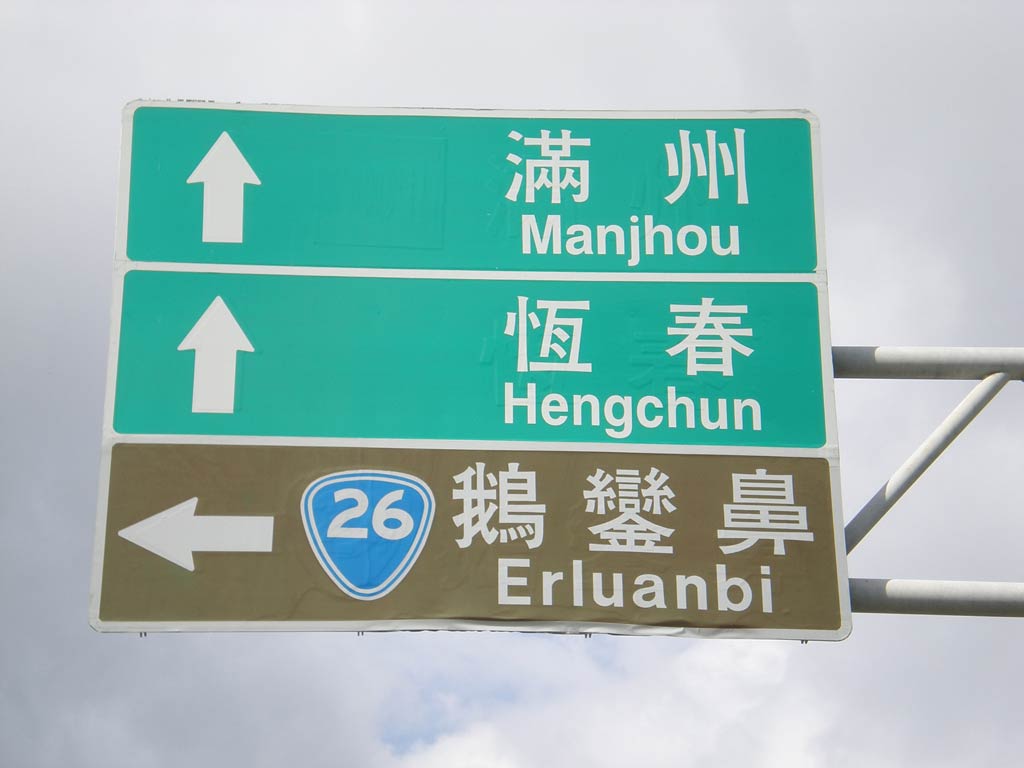
If you look carefully (click on the image to zoom in), you can see that the previous version of the sign (underneath the new one) did not have any romanization. The ‘r’ in Erluanbi is especially odd, given that it doesn’t belong there. (Éluánbí / 鵝鸞鼻 / n.: bulbous nose) The error appears to come from Taiwan government itself, whose Research, Development, and Evaluation Commission’s site on “bilingual” forms gives the r spelling — though it also gives the correct “Eluanbi” spelling for other instances of this.
3 highway signs, reading 'Manjhou', 'Hengchun', and 'Erluanbi'

Or maybe the sign makers just borrowed the r from this sign.

Another distinctly Tongyong sign:

I was pleased to see this trilingual sign, with Mandarin, English, and Vietnamese.

new book in Pinyin

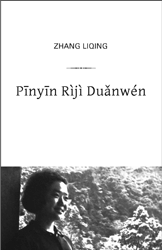
image of the cover of the printed edition of Pinyin Riji DuanwenI’m very pleased to announce the publication of a new book, Pīnyīn Rìjì Duǎnwén, by Zhāng Lìqīng. Other than one introductory letter in English, the work is entirely in Mandarin.

This is perhaps the world’s first Mandarin-language book to be published in Hanyu Pinyin without so much as one Chinese character. Thus, it is of historic importance. But it’s also a wonderful collection of stories. The author generously granted Pinyin.info the right to release all of this book online.

The work will also soon be available in an inexpensive printed edition.

Some of you will recall Zhang’s lovely story Dàshuǐ Guòhòu (“After the Flood”), which first appeared here three years ago. It leads the new collection. The remaining twelve memoirs/stories are mainly in the same vein, recalling a childhood in China and Taiwan.

Zhè shì yī gè lǎo gùshi. Shìqing fāshēng zài 1946 nián xiàtiān. Nà nián wǒ jiāngjìn shí suì, zhù zài Sìchuān Chéngdū jiāoqū d Bǎihuā Qiáo. Zhōngguó Kōngjūn Tōngxìn Xuéxiào d jīdì zài nàli. Wǒ bàba shì nà ge xuéxiào d jūnguān….

The author died earlier this year. She was able to view proofs of the work, though her illness prevented her from making any corrections herself. Fortunately, several people stepped in, contributing substantially to the checking of the Pinyin and other aspects of the work. I’d like especially to thank the following people: David W. Goodrich, Jiao Liwei, Kuo Hsin-chun, Melvin Lee, and Victor H. Mair. Any errors found in the book should be considered my own.

Please report any divergences from the Pinyin orthography established by Yin Binyong and the spellings used in the ABC Chinese-English Comprehensive Dictionary (Zhang was, after all, one of the associate editors of that massive work) to me. I’ve made very few intentional departures from those.

Please note that the use of “d” (where most authors would use “de”) is intentional. This is not a bug but a feature, something I came to understand better the more time I spent with this text. The use of “d” is explained in the second introductory letter (Liǎng Fēng Gěi Biānzhě d Xìn: 2).

persistent MPS2

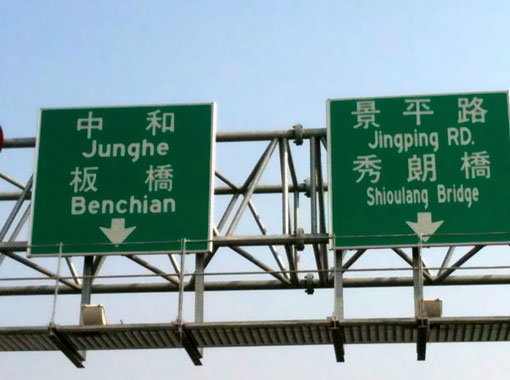
Poagao sent me this photo of signs on Zhong’an Bridge, which joins Xindian and Zhonghe (both in Taipei County). (So the zhong is probably for Zhonghe; but I’m not sure what the an is meant to be short for.) The signs are a good illustration of the sloppy approach to romanization in Taiwan. Because this is a new bridge, these are definitely new signs and thus should be in Hanyu Pinyin, which is official not just in Taipei County but nationally.

two large directional signs above a road across a bridge, as described in this post

As the table below shows, however, the only name that definitely isn’t written in MPS2 — the romanization system that predated Tongyong, which in Taiwan predated Hanyu Pinyin — is a typo. MPS2 hasn’t been official for the better part of a decade.

on the sign system Hanyu Pinyin
Junghe MPS2 Zhōnghé
Benchian wrong in all systems Bǎnqiáo
Jingping (MPS2, Tongyong, Hanyu Pinyin) Jǐngpíng
Shioulang MPS2 Xiùlǎng

And there’s no excuse for making “Shioulang Bridge” so small and squashed. This also brings to mind another aspect of Hanyu Pinyin: because of its design and the fact that it uses abbreviated forms of some vowel combinations (e.g., uei -> ui, iou -> iu), it doesn’t need as much horizontal space as MPS2 or Tongyong Pinyin, which means it can be written with larger letters — an important factor in signage. (See the second table of the comparative typing chart to see such differences between Hanyu Pinyin and Tongyong Pinyin.)

system spelling
MPS2 Shioulang
Tongyong Pinyin Sioulang
Hanyu Pinyin Xiulang

Chomsky to lecture on linguistics in Xinzhu, Taiwan

Noam Chomsky will come to Taiwan in August to deliver two lectures.

The first lecture — on Monday, August 9 — is “Contours of World Order: Continuities and Changes.” This will likely cover political and human rights concerns, not linguistics.

The second, “Poverty of Stimulus: The Unfinished Business,” held the following day at Q?nghuá Dàxué (Tsinghua University) in Xinzhu (Hsinchu), will focus on linguistics.

Online registration for the lectures starts on Thursday, July 15.

For more information, see Qinghua’s Web pages (in Mandarin) on this.

Hat tip to Dan for this.

X marks the spot?

In December Taiwan will be getting a new city. In fact, it will be the most populous city in the entire country: Xīnběi Shì (新北市).

For those not familiar with the situation, I should perhaps give a bit of background. Taiwan won’t suddenly have more people or buildings. Instead, the area known as Taipei County (which does not include the city of Taipei but which occupies a much greater area than Taipei and has a much greater total population) will be getting a long-overdue official upgrade to a “special municipality,” which means that it will get a lot more money and civil servants per capita from the central government. And as such the area will be dubbed a city, even though in appearance and demographic patterns it isn’t really a city at all but still a county containing several cities (which are to become “districts” despite having hundreds of thousands more inhabitants than some other places labeled “cities”), lots of towns, and plenty of empty countryside.

The Mandarin name will change from Táiběi Xiàn to Xīnběi Shì. (Xīn is the Mandarin word for “new.” Xiàn is “county.” Shì is “city.” And běi is “north.”)The official so-called English name is, tentatively, “Xinbei City.” Hanyu Pinyin! Yea!

Talking about “English” names is often misleading, since many people conflate English and romanization of Mandarin; and the usual pattern of Taiwanese place names not written in Chinese characters tends to be MANDARIN PROPER NAME + ENGLISH CATEGORY (e.g., “Taoyuan County”). So, at least in this post, I’m going to be a bit sloppy about what I’m calling “English.” Forgive me. OK, now back to the subject.

A couple of days ago, however, both major candidates for the powerful position of running the area currently known as Taipei County (Táiběi Xiàn) had a rare bit of agreement: both expressed a preference for using “New Taipei City” instead of “Xinbei City.” Ugh.

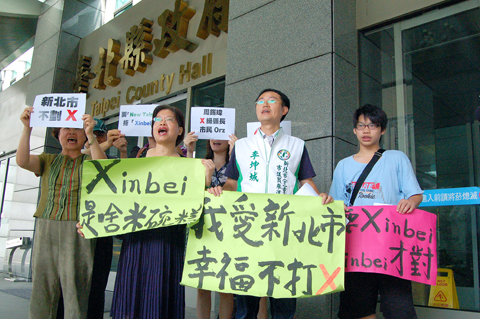
And to top things off, a couple dozen pro-Tongyong Pinyin protesters were outside Taipei County Hall the same day to protest against using Xinbei because it contains what they characterize as China’s demon letter X. Actually, that last part of hyperbole isn’t all that much of an exaggeration of their position. The X makes it look like the city is being crossed out, some of the protesters claimed.

This is, of course, stupid. But unfortunately it’s the sort of stupidity that sometimes plays well here, given how this is a country that pandered to the superstitious by removing 4′s from license plate numbers and ID cards and by changing the name of a subway line because if you cherry-picked from its syllables you could come up with a nickname that might remind people of a term for cheating in mah-jongg (májiàng). (Why bother with letting competent engineers do things the way they need to be done when problems can be fixed magically through attempts to eliminate puns!)

pro-Tongyong protesters hold up signs against using Hanyu Pinyin

The protesters would prefer the Tongyong form, Sinbei. I suspect foreigners here would rapidly change that to the English name “Sin City,” which I must admit would have a certain ring to it and might even be a tourist draw. Still, Tongyong has already done enough damage. Those wanting to promote Taiwan’s identity would be much better off channeling their energy into projects that might actually be useful to their cause.

The reason the government selected “Xinbei City” is that “New Taipei City” would be too similar to “Taipei City,” according to the head of the Taipei County Government’s Department of Civil Affairs. And, yes, they would be too similar. Also, Xinbei is simply the correct form in Hanyu Pinyin, which is Taiwan’s (and Taipei County’s) official romanization system. It would also be be much better still to omit “city” altogether.

Consider how this might work on signs, keeping in mind that Taipei and Xīnběi Shì are right next to each other. So such similar names as “New Taipei City” and “Taipei City” would run the risk of confusion, unlike, say, the case of New Jersey and Jersey. I wonder if the candidates for mayor of Xinbei are under the impression that they should change the name of the town across from Danshui from Bālǐ to something else because visitors to Taiwan might otherwise think they could drive to the Indonesian island of Bali from northern Taiwan.

They probably said they liked “New Taipei City” better because it sounds “more English” to them. And it is more English than “Xinbei.” But that’s not a good thing.

Once again it may be necessary to point out what ought to be obvious: The reason so-called English place names are needed is not because foreigners need places to have names in the English language. If it were, I suppose we could redub many places with appropriate names in real English: “Ugly Dump Filled With Concrete Buildings” (with numbers appended so the many possibilities could be distinguished from each other), “Nuclear Waste Depository,” “Armpit of Taiwan,” “Beautiful Little Town that Turns Into a Tourist Hell on Weekends,” etc. The possibilities are endless, though perhaps some of the nicer places would need to be given awful names — following the Iceland/Greenland model — lest they be overrun. The problem is that Chinese characters are too damn hard, and people who can’t read them (i.e., most foreign residents and tourists) need to be able to find places on maps, on Web pages, through signs, etc. And they need to be able to communicate through speech with people in Taiwan about places. Having two different names — the Mandarin one and the so-called English one — is just confusing. Having one name in Mandarin written in two systems (Chinese characters and romanization), however, makes sense and works best. (If Taiwan were to switch to using Taiwanese instead of Mandarin, that would be a whole ‘nother kettle of fish.)

But things that make sense and politicians don’t often fit well together.

Consider the signs. What a @#$% mess this could be. Let’s compare a few ramifications of using Xinbei and Taipei vs. using New Taipei City and Taipei City.

Xinbei and Taipei.

  • basically no chance of confusing one with the other
  • short (6 characters each), thus fitting better on signs
  • preexisting “Taipei [City]” signs wouldn’t have to be changed
  • Xinbei would be the correct romanization and not repeat the misleading pei of bastardized Wade-Giles
  • definitely no need to add “city” to either name, because there would be no “Taipei County” that might need to be distinguished from the city of Taipei, nor would there be a “Xinbei County” that would need to be distinguished from the city of Xinbei

Now let’s look at the case of New Taipei City and Taipei City.

  • relatively easy to confuse at a glance
  • relatively easy to confuse in general
  • long, and don’t fit as easily on signs (“New Taipei City” = 15 characters, including spaces; “Taipei City” = 11 characters, including the space)
  • “New Taipei City” would continue to ill-advised and outdated practice of using bastardized Wade-Giles spellings
  • any time the common adjective new needs to be applied to something dealing with “New Taipei City” or “Taipei City” the chances for confusion and mistakes would increase even more, esp. in headlines
  • the worst choice

The Taipei County Council will determine the final version of the name in September.

sources:

See also

(By the way, if any Taiwan reporters want to pick up on this blog post, please don’t just follow the usual practice here of simply asking one or two random foreigners if they think the name “New Taipei City” sounds OK, so then you conclude that there’s no problem. Try to get people who’ve actually thought about the situation for more than a few seconds and who could give you an informed opinion. My apologies to those reporters who of course know better.)

Taiwanese-English, English-Taiwanese dictionaries posted

Maryknoll Language Service Center has put online the complete texts of its Taiwanese-English and English-Taiwanese dictionaries. Better still, these have been released under a Creative Commons license. These are a terrific resource for anyone who’s interested in Hoklo.

Maryknoll deserves praise for this great work. Thanks are due, too, to Tailingua, which I know has been working behind the scenes to help make this happen.

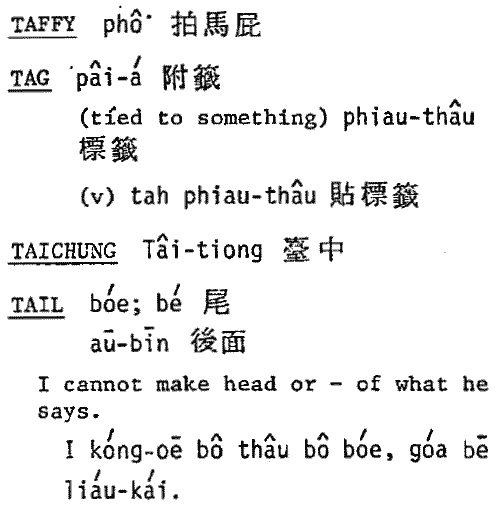
From the English Amoy Dictionary (英語閩南語字典):
screenshot from the English-Taiwanese dictionary

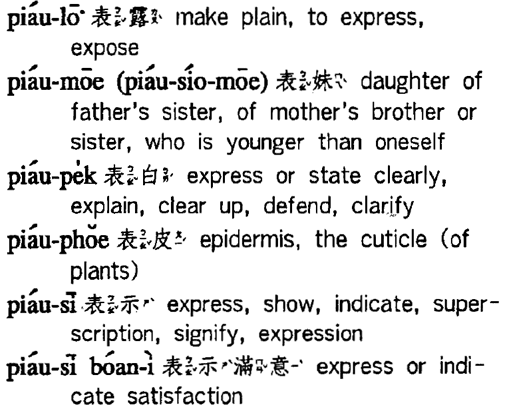
And from the Taiwanese-English Dictionary (台語英語字典):
screenshot from the dictionary

source: Maryknoll dictionaries now free to download, Tailingua, June 17, 2010

Le Grand Ricci now available on DVD

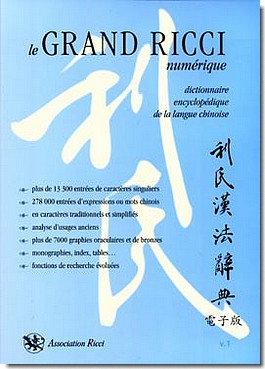
cover of le Grand Ricci numeriqueThe magnificent Grand dictionnaire Ricci de la langue chinoise, better known as le Grand Ricci, has just been released on DVD, almost a decade after its release in book form and exactly four hundred years after the death of Matteo Ricci.
The list price is 120 euros (about US$150), which is much cheaper than the printed edition. A long video in French (16:31) discusses the work. For those who would prefer something in English, a PDF gives background information on the dictionary project.

For a sample of the dictionary’s format and entries, see the 25 pages of entries for shan. Alas, as this example shows, the entries are not word parsed. But at least Hanyu Pinyin is now available for those who prefer it to Wade-Giles.

As long as I’m mentioning Ricci-related work, I might as well use the occasion to note that the Taipei Ricci Institute is putting its collection of books on permanent loan to Taiwan’s National Central Library.

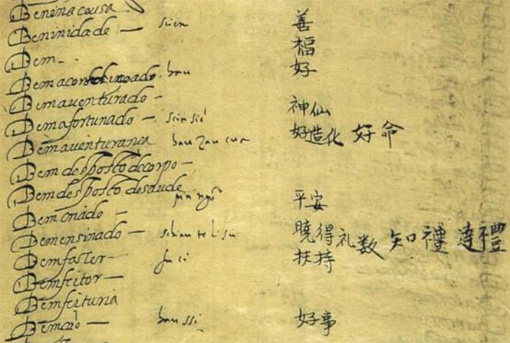
Also, I’d like to note that parts of Matteo Ricci’s original dictionary can now be viewed through the Google Books scan of a publication from earlier this century of his Dicionário Português-Chinês.

Enjoy.

image from a manuscript page of Ricci's original dictionary