Taizhong street signs are ‘wushasha’

This isn’t much of a story, really. But since it talks, however vaguely, about the messy romanization situation in Taizhong and since I haven’t put up anything lately in Pinyin itself, I decided to go ahead and post it.

Just don’t expect any useful news herein, unless you’d be surprised to hear that Taizhong’s street signs are a mess.

Táizhōng Shì lùpái suǒ shǐyòng de Yīngwén pīnyīn qiānqíbǎiguài, pīnyīnfǎ jìyǒu Tōngyòng, Hànyǔ, zhùyīn fúhào dì-èrshì, Wēituǒmǎ pīnyīn, děng, jiù yǒu mínzhòng xiàng běnbào bào liào, zhǐchēng zhèxiē lùpái ràngrén kàn de “wùshàsha,” wàiguó guānguāngkè gèng zhǐnéng gān dèngyǎn.

Yǐ Táizhōng Shì nánqū Wǔ-quán Nánlù [i.e, “the Five Branches of Government South Road”] de xīn-jiù lùpái láishuō, jiù yǒu lùpái shì cǎiyòng Wēituǒmǎ pīnyīn, yīncǐ “權” zì shǐyòng chuan, ér gānggāng wángōng de xīnshì lùpái “權” zì zéshì shǐyòng cyuan, shìwéi Tōngyòng Pīnyīn, rán’ér xiànzài Táizhōng Shìzhèngfǔ zǎoyǐ quánmiàn gǎiyòng Hànyǔ Pīnyīn, “權” zì yīnggāi shì quan cái zhèngquè.

Lìngwài, zài nánqū xīng dàlù de lùpái, jiù yǒu lùpái “興” zì de pīnyīn wéi hsing, shì shǐyòng Wēituǒmǎ pīnyīn, rìqián gāi lùduàn yě gēnghuàn xīnshì lùpái shàng, shìyǐ Hànyǔ Pīnyīn jiāng “興” zì pīnyīn wéi xing, dàn liǎng ge lùpái dōu xuánguà zài lùkǒu, ràngrén kàn de “wùshàsha.”

Zhēnduì Táizhōng Shì lùpái suǒ shǐyòng Yīngwén pīnyīn gèzì bùtóng de qíngkuàng, Táizhōng Shìzhèngfǔ Jiāotōngchù jiāotōng guīhuà kē biǎoshì, zài gègè niándài suǒ xīngjiàn de lùpái shǐyòng bùtóng de pīnyīn fāngshì, cái huì zàochéng xiànjīn hùnluàn de qíngkuàng, mùqián Táizhōng Shì yǐjing quánmiàn cǎiyòng Hànyǔ Pīnyīn, wèile jiějué cǐ yī wèntí, yóu Táizhōng Shìzhèngfǔ dūshì fāzhǎn chǔyǐ “chéng-xiāng xīnfēngmào” de jīngfèi, jìnxíng tǒngyī lùpái pīnyīn de gōngzuò. Zài Wǔ-quán Nánlù de xīn lùpái fāngmiàn, yuánběn yīnggāi shǐyòng Hànyǔ Pīnyīn, dàn chéngbāoshāng què fāshēng cuòwù, mùqián yǐjing yāoqiú gǎijìn; zhìyú zài xīng dàlù fāngmiàn, yě huì yāoqiú chéngbāo yèzhě jiāyǐ gǎizhèng.

source: Lù míng pīnyīn luànzāozāo — kàn dé rén wùshàsha (路名拼音亂糟糟 看得人霧煞煞), Zìyóu Shíbào (Liberty Times), March 21, 2009

How to write adverbs in Hanyu Pinyin

cover of Chinese Romanization: Pronunciation and OrthographyI thought how to write adverbs in Hanyu Pinyin (1.1 MB PDF) would be the logical follow-up to last week’s posting of the rules for verbs.

Most of these are pretty straightforward, so I won’t discuss much here.

One note: Although reduplicated verbs lose the tone on their second syllable, reduplicated adverbs do not:

  • gānggāng 剛剛 (just now)
  • jǐnjǐn 僅僅 (only; merely)
  • chángcháng 常常 (often)
  • shāoshāo 稍稍 (a bit; slightly)

Here are some of the adverbs for which examples are given:

  • dōu 都 (all)
  • zhǐ 只 (only)
  • zuì 最 (most, -est)
  • gèng 更 (even more), bǐjiào 比較/比较 (relatively)
  • hěn 很 (very), tài 太 (extremely; too)
  • gāng 剛/刚 (just now), yǐjing 已經/已经 (already), céngjing 曾經/曾经 (in the past)
  • jiù 就 (then), jiāng 將/将 (in the near future)
  • cái 才 (finally)
  • hái 還/还
  • yòu 又 (again; too)
  • zài 再 (again)
  • 也 (also, too)

As always, I recommend this to not just those interested in Pinyin orthography but also to those learning Mandarin (esp. those who are at least at the intermediate level).

‘dialects’ wasting ‘important neurons’ needed for Mandarin, English: Lee Kuan Yew

In 1979 Singapore launched its campaign for people there to “Strike Hard Against Hoklo, Cantonese, and Other Languages that Your Government Says Are Puny and Insignificant Because They Have Only Tens of Millions of Speakers Apiece,” er, “Speak Mandarin” (Jiǎng Huáyǔ Yùndòng / 讲华语运动). The city-state has been marking the the 30th anniversary of this with some speeches, such as one a couple of weeks ago by former prime minister Lee Kuan Yew (Lǐ Guāngyào), now “minister mentor.”

Lee described the situation:

Thirty years ago I launched the Speak Mandarin campaign. [Singaporean] Chinese students learned Mandarin at school. Unfortunately, they used to speak dialects amongst themselves, at home, and with their friends — a variety of dialects.

Here, “dialects” is of course the standard misnomer for Sinitic languages other than Mandarin.

Lee said that he himself was setting a bad example during the 1960s and 1970s by doing such highly irresponsible things as giving speeches in the native language of the majority of Singapore’s citizens. So he stopped all that. And he had the government shut down almost all broadcasts in Hokkien (Hoklo) and other such languages.

Lee said that although he understands “the strong emotional ties to one’s mother tongue … the trend is clear. In two generations, Mandarin will become our mother tongue.”

Actually, no, that’s not clear at all. Rather, a very different trend is apparent. During his speech Lee displayed the graph below, with data taken from surveys conducted by Singapore’s Ministry of Education.

Dominant Home Language of Singaporean Chinese Primary-1 Students (1980 to 2009)
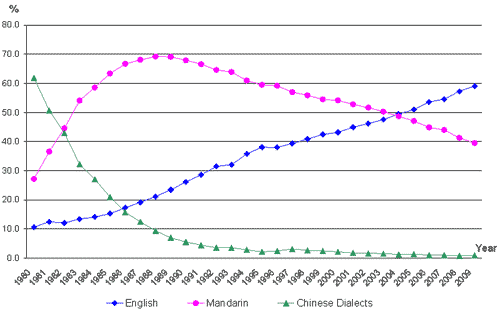
graph showing English in a steady climb from 10% -- all numbers are approximate -- (1980) to 60% (2009); 'Chinese dialects' in steep decline from 1980 (62%) to 1988 (9%) and continuing to decline to only 1% or 2% in 2009; and Mandarin, which begins in 1980 at 28% and quickly tops 60% in 1985, with slower growth until 1988 (69%), after which it enters a steady decline to 39% (2009)

As the primary language of the home for young students, Mandarin has dropped steadily since the late 1980s, while English has risen steadily since 1980, with English surpassing Mandarin in 2004. (Language data for the whole population is more complicated. See, for example, the 2005 General Household Survey.)

Of course the government and Lee recognize this. But they don’t want to fight against English, which is crucial to Singapore’s success. So what Lee is proposing is that parents — both parents — speak Mandarin, not English, to their children.

(I see from my stats that this site gets lots of visitors from Singapore. Can any of you comment on how well you think the public will respond to Lee’s proposal.)

Lee explained in his speech that people have only so many “gigabytes” in their brains to devote to languages.

Though stating that speaking “dialects” in some situations can provide “extra warmth,” he warns that by using such languages: “You are losing important neurons with data which should not be there. And like the computer, when you delete it, it doesn’t really go away. It’s there at the back, and you’ve got to go to the rubbish channel and say ‘destroy.’ And it’s still disturbing your hard disk.”

Thus, those rubbish languages must be destroyed “dialects” must be let go, he said.

On March 8 a linguist at Nanyang Technological University (NTU) in Singapore was quoted in the newspaper as saying, “Although Singaporeans are still multilingual, 40 years ago, we were even more multilingual. Young children are not speaking some of these languages at all any more…. All it takes is one generation for a language to die.” But even after all these years, with Sinitic languages other than Mandarin fading fast there, this is apparently still no time to be slacking off, as Lee’s principal private secretary, Chee Hong Tat, promptly responded, “It would be stupid for any Singapore agency or NTU to advocate the learning of dialects, which must be at the expense of English and Mandarin.”

Part of the reason behind Lee’s call, however, is a basic misunderstanding. Setting aside the matters of educating children in a language not native to them and how many languages most people are capable of speaking effectively, the main difficulty with learning Mandarin is not the language itself (especially for those who speak other Sinitic languages) but Chinese characters as its near-exclusive script.

If Singapore is smart about promoting Mandarin, sooner rather than later it will develop a two-track system, with most students studying how to read and write Mandarin exclusively in Hanyu Pinyin, while those who wish become more specialized can go on to study Chinese characters as well. For this to work, Singapore will need to produce plenty of material to read in Pinyin. (A newspaper, for example, would be a must — and one with real news, not just cute stories for kids.) The city-state certainly has the means and motive for this. But does it have the imagination? If it does, most students could save their precious neurons and gigabytes for other things — perhaps even their families’ traditional native languages.

SOURCES:
Lee Kuan Yew speech:

Some Singapore blog posts:

newspaper stories:

letter to the editor:

additional:

How to write verbs in Hanyu Pinyin

cover of Chinese Romanization: Pronunciation and OrthographyToday’s release from Yin Binyong’s Chinese Romanization: Pronunciation and Orthography is a long, important section that covers verbs in Hanyu Pinyin (2 MB PDF).

In this post I’ll go over the rules for what to do with Mandarin’s three tense-marking particles — zhe (著/着), guo ( 過/过), and le (了) — since these participles are extremely common and people are often unaware of how they should be written in Pinyin. Fortunately, this is pretty easy: -zhe and -guo are always written solid (with no interposing space or hyphen) with the verb they follow. The case of le is more complicated (but not too much trouble).

-zhe 著/着

-zhe is added onto a verb to indicate the ongoing nature of an action or state, whether in the past, present, or future. It thus bears a certain similarity to the English verb suffix -ing. A sentence in which -zhe is used tends to emphasize the description of the action or state indicated by the verb. Since no other sentence component may be interposed between a verb and -zhe, a general rule may be stated: -zhe is always written as one unit with the verb it follows.

Some examples:

Tā wēixiàozhe duì wǒ shuō: “Nǐ lái ba!”
她微笑著對我說: “你來吧!”
(Smiling, she said to me, “Come on!”)

Nǐ xiān děngzhe, ràng wǒ jìnqu kànkan.
你先等著,讓我進去看看.
(You wait out here while I go in and look.)

Note that “kànkan” in the sentence above shows something else about verbs in Hanyu Pinyin: the second part of a reduplicated verb is in the neutral tone.

-guo 過/过

-guo is added after a verb to indicate that a given person or object has experienced the action expressed by the verb. -guo may only be used in the past tense. Since no other sentence component may be interposed between a verb and -guo, a general rule may be formulated: -guo is always written as one unit with the verb it follows.

Some examples:

Wǒ xuéguo liǎng nián Yīngyǔ, dànshì méi xuéguo Rìyǔ.
我學過兩年英語,但是沒學過日語.
(I’ve studied two years of English, but I haven’t studied Japanese.)

Nà běn shū wǒ kànjianguo, hǎoxiàng zài shūjià shang.
那本書我看見過,好像在書架上.
(I have seen that book somewhere; I think it’s on the bookshelf.)

le 了

The tense-marking particle le is added after a verb to emphasize that the action expressed has been completed or that the state indicated has been achieved. -le is ordinarily written as one unit with the verb it follows.

For example:

Zuótiān wǎnshang wǒ kànle yī chǎng diànyǐng.
昨天晚上我看了一場電影.
(I saw a movie yesterday evening.)

But here’s where it starts to get a little more complicated.

If a verb complement is interposed between the verb and the tense marker -le in a sentence, there are two possible written forms. If the verb and its complement are written as a unit, then –le is written as a unit with them; if they are written separately, then -le too is written separately.

For example:

Xiǎo Chén qīngqīng de guānshangle fángmén.
小陳輕輕的關上了房門.
(Xiao Chen gently closed the house door.)

But also:

Tā cóng shūbāo lǐ ná chūlai le liǎng běn liánhuánhuà.
他從書包裡拿出來了兩本連環畫.
(He pulled two comic books out of his bookbag.)
(ná 拿 — verb; chūlai 出來 — complement)

I suspect that’s the sort of thing that may well change (for the simpler) once Pinyin makes it out into the world of popular usage as a script in its own right. But for now I’m just givin’ the rules as I find ‘em.

Speaking of which, here’s the final twist on -le.

Apart from its function as a tense-marking particle, -le can also serve as a mood-marking particle. (The former usage is usually denominated le1 and the latter le2 in grammar texts.) In its latter capacity, le always appears at the end of a sentence or clause, just before a comma, period, or other punctuation mark. The two different le’s, le1 and le2, are sometimes quite difficult to distinguish in practice. With this in mind, and with the aim of simplifying HP orthography, the, following simple rule is set out: any le, whether le1 or le2, appearing at the end of a sentence or clause is to be written by itself.

Thus, that’s actually a good thing, since it simplified matters. So, for anyone programming a Pinyin converter, put a space before le if it is immediately followed by punctuation.

Thus, for example:

Wǒmen túshūguǎn yǐjing mǎile sānwàn duō běn shū le.
我們圖書館已經買了三萬多本書了.
(Our library has already purchased over thirty thousand books.)

Hǎo le, hǎo le, dàjiā dōu bié chǎo le.
好了好了, 大家都別吵了.
(All right, all right, everybody quiet down.)

Remember: This post covered only one small aspect of the entire reading. So be sure to download and read the entire PDF, which has many, many more examples.

It’s also a very useful reading for students of Mandarin.

writing four-syllable idioms in Pinyin

cover of Chinese Romanization: Pronunciation and OrthographyThe latest excerpt from Yin Binyong’s book on Pinyin orthography covers how to write four-syllable idioms in Hanyu Pinyin (929 KB PDF). Here’s a key passage:

almost all four-character idioms can be broken in two halves, called yǔjié 语节 (language segments), on the basis of phonetic structure. The simple expedient of connecting the two yǔjié with a hyphen then provides idioms with their own distinctive written form, and assures ease of writing and reading. It is also a simple rule for students of HP to master.

But not all four-syllable idioms follow this rule, as the reading shows.

This is a worthwhile reading for Mandarin learners, even if you’re not particularly interested in Pinyin. There are many examples of idioms here, all given in Hanzi, Pinyin, and English.

Lugang signs

My wife and I also recently traveled to Lugang (Lùgǎng / 鹿港 / often spelled “Lukang”). This is in Zhanghua (Changhua) County, not far from Taizhong. It makes a nice day trip from Taipei, especially if using the high-speed rail for transportation.

Despite this being the second photo-laden post in a row, I haven’t dropped my general love of low-bandwidth entries. These photos are in part evidence toward an important point that I think is getting overlooked in the discussions of how much it will cost Taiwan to change to Hanyu Pinyin: The signs in much of Taiwan remain inconsistent and something of a mess despite the at-best partially instituted change several years ago to Tongyong Pinyin. More on that in a later post.

Now for the signs.

Lugang, whose name means “deer harbor,” put deer signs atop some signposts.

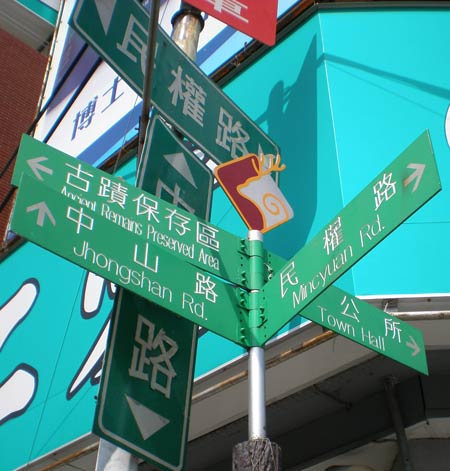
Many of the signs in Lugang are in Tongyong Pinyin (e.g., Jhongshan and Mincyuan, for what in Hanyu Pinyin would be Zhongshan and Minquan). Note that other signs are in English — or in Chinese characters with no romanization at all. (Note, too, that the two signs for Minquan Road (民權路) — one of which is partially covered — point in different directions!)

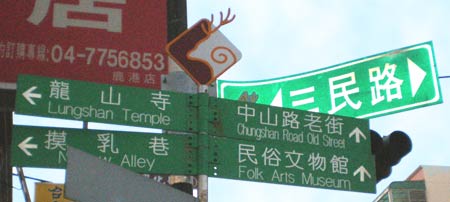
But Tongyong Pinyin certainly isn’t the only romanization system found there. Here, for example, we have Wade-Giles (“Longshan,” “Zhongshan”). (Note that there’s no romanization given for Sānmín Road / 三民路.)
Lungshan Temple, Jhongshan Road Old Street, 三民路, Folk Arts Museum

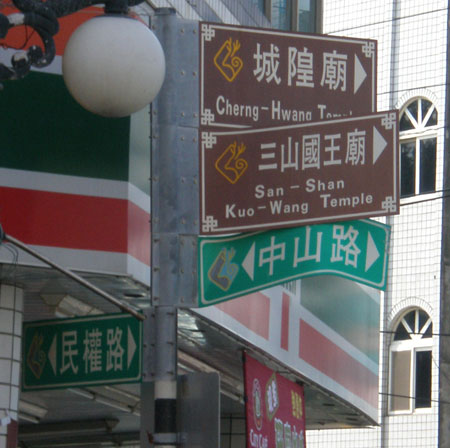
And here’s yet another romanization system on official signage within Lugang. In the photo below the top sign is in the rarely seen Gwoyeu Romatzyh: Cherng-Hwang Temple, which in Hanyu Pinyin is Chénghuáng (“city god”) Miào (城隍廟). The sign below that (“San-Shan Kuo-Wang”) is in Wade-Giles. And the two signs below that don’t have any romanization at all. None of these signs are likely very old.

About 150 years ago “bilingual” signage meant something very different in Taiwan than it does today. Back then it was Literary Sinitic and Manchu, as seen on this stela outside a temple in Lugang.
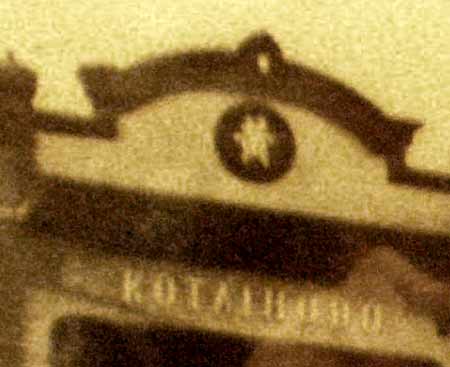
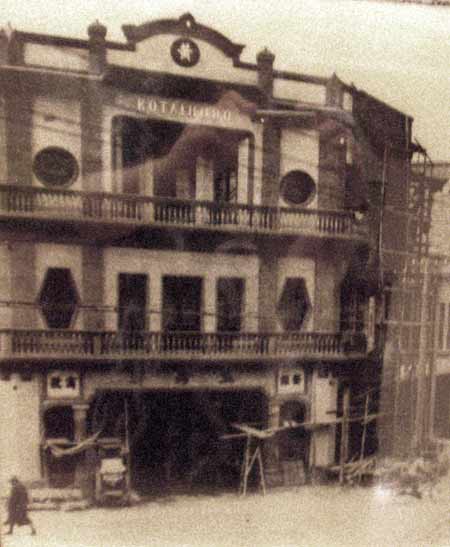
While in the Lugang Folk Arts Museum I spotted a photo from the Japanese era of a building with romanization. Note, too, the “Huang” (黃) at the top, which marks the ownership of the Huang family. Many buildings in Lugang bear that mark.

Here’s the whole building:

I didn’t notice that particular building while I was walking around the town. But I did see this one, with “CHIN” in large letters:

No less interesting are the letters, now largely effaced, near the top of the same building (click to enlarge). They were used to write something in Taiwanese.
taioan

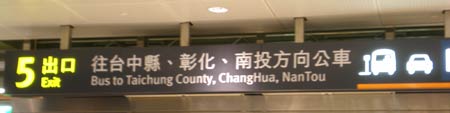
After leaving Lugang, what should I see at the Taizhong high-speed rail station but InTerCaPiTaLiZation. That practice is a cancer on romanization everywhere.
exit sign at the Wuri (Taizhong) high-speed rail station, reading 'Bus to Taichung County, ChangHua, NanTou'

I feel a little guilty because much of Lugang — at least its historic section — is lovely and worth visiting. But here I’ve been showing you a bunch of signs. If you’d like to see what Lugang looks like beyond its signs, try parts one, two, and three of Craig Ferguson’s posts on his visit there.

Penghu street signs

My wife and I recently spent a weekend in Penghu, a beautiful, stark archipelago between the main island of Taiwan and China.

Since Penghu is under KMT rule, I expected to find street signs in Magong, the capital, in some old system (e.g., MPS2 or perhaps bastardized Wade-Giles) or perhaps even Hanyu Pinyin. (Highway signs, however, are a different matter. They’re put up by the central government, which means that relatively recent ones are in Tongyong Pinyin, regardless of which party might control the area.)

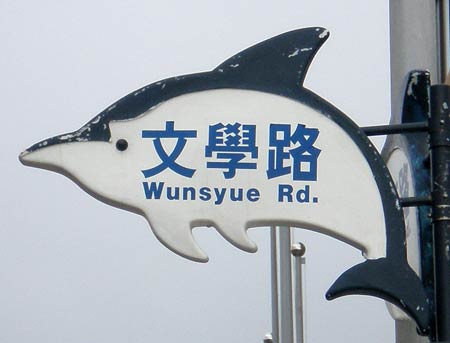
This first street sign, however, is unmistakably in Tongyong Pinyin, giving “Wunsyue” (for what in Hanyu Pinyin would be “Wenxue”).
street sign reading 'Wunsyue Rd.' (Wenxue Road)

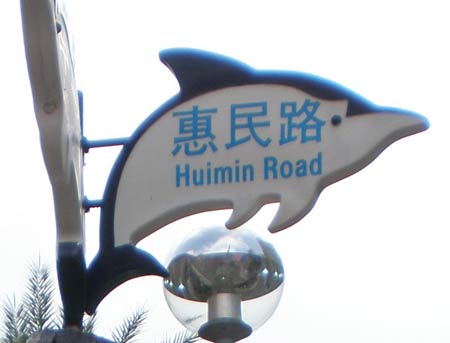
But I looked around some more and saw signs in Hanyu Pinyin, such as “Huimin” for what in Tongyong would be “Hueimin” and “Hui[‘]an” for what in Tongyong would be “Huei[-]an.”
street sign reading 'Huimin Road'

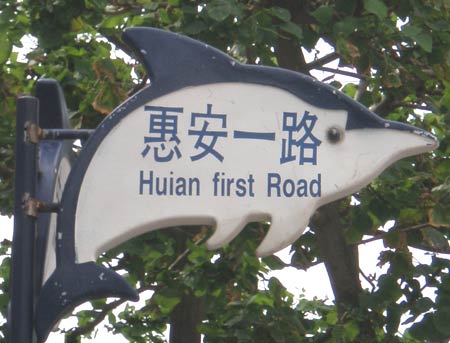
street sign reading 'Huian first Road'

So were there some signs in Hanyu Pinyin after all? Apparently only coincidentally. The previous two hui signs were probably just a mistake, the result of Taiwan’s standard, sloppy chabuduo jiu keyi approach to signage. Here’s a sign on the same street as above; but in this case “惠” is romanized huei and not hui. (And “first” is missing, from both the Hanzi and romanization.)
street sign reading 'Hueian Rd.'

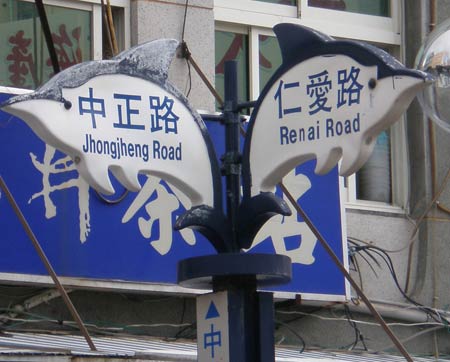
Most signs were in Tongyong, such as these. (Note that Penghu, too, has a Hot Milk Road.)
street signs: 'Jhongjheng Road' (Zhongzheng Road) and 'Renai Road' (Ren'ai Road)

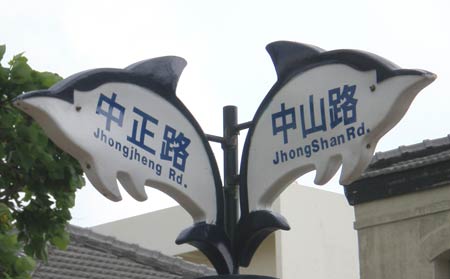
So, Tongyong after all. Well, at least they don’t have InTerCaPiTaLiZaTion … or do they?
street signs reading 'JhongShan Rd.' -- note InTerCaPiTaLiZaTion -- (Zhongshan Road) and 'Jhongjheng Rd.' (Zhongzheng Road) -- no intercapping

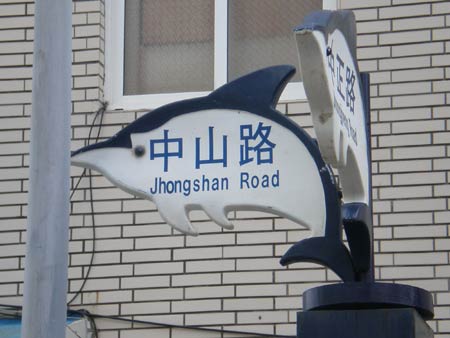
Fortunately, that sign was a one-off. I didn’t spot InTerCaPiTaLiZaTion elsewhere. Here’s another sign from the same road:
street sign reading 'Jhongshan Rd.' (Zhongshan Road)

So, in short, Penghu’s street signs are in Tongyong Pinyin — but with plenty of mistakes and inconsistencies (e.g., missing apostrophes/hyphens, “first” rather than “1st”, and both “Road” and “Rd.”). It’s especially ridiculous that the KMT-administered Penghu bothered with Tongyong, especially since it was free to adopt Hanyu Pinyin. Now it’s going to have to change its signs over to Hanyu Pinyin. But some of the signs would need to be updated anyway, since many already show signs of age, with letters missing. (My guess is that Penghu put up such low-quality signs that in the annual windy season some of the letters just get blown away.)

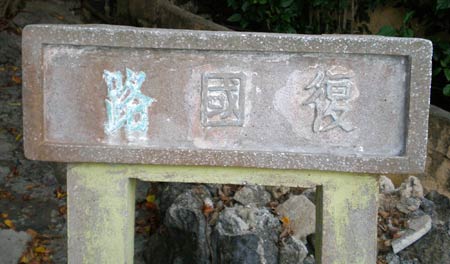
Here’s a sign in little danger of having its writing blow away any time soon. This is what a much older Magong street sign looks like. Note that it must be read from right to left: 復國路 (Fuguo Road — “Recover Atlantis the Lost Country Road”).
old concrete street sign reading, right to left, '復國路' (Fuguo Road)

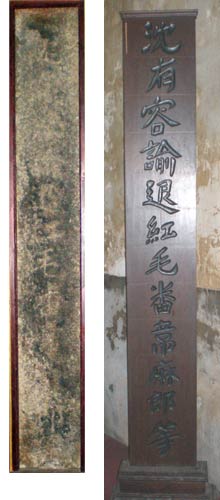
Finally, here’s something that isn’t a street sign at all. But it is nonetheless a sign of historic importance, since it’s a stela that commemorates the Ming Chinese official Shen Yourong telling the red-haired barbarians (i.e., Westerners — in this case, the Dutch) to get the hell out of Penghu. (The Dutch were told they could instead go to Taiwan, since back then China didn’t care about it in the least.) The composite photo shows both the 400-year-old stone original and a modern reproduction in wood.

photos of the original stone stela and a modern reproduction in wood

The text reads “Shěn Yǒuróng yù tuì hóngmáo fān[zi] Wéimálàng děng” (「沈有容諭退紅毛番韋麻郎等」): “Shen Yourong orders the red-haired foreigners under [Dutch commander] Wybrand van Warwijck to withdraw.”

another nail in the coffin of nicknumbering

I haven’t posted anything in Pinyin lately. So here’s a story from a couple of days ago, giving some of the history of Taipei’s stupid and now disavowed “nicknumbering” system, under which the city’s main roads were given numbers for the supposed convenience of foreigners. But since no locals knew these numbers, the nicknumbering system helped basically no one find anything — something the city should have figured out before it wasted all that money putting up signs. The real problem was that the romanization on the city’s signs was FUBAR — something that was finally addressed a little later.

Táiběi shìyìyuán Lǐ Xīn zhǐchū, Táiběi shìzhèngfǔ zài Mínguó 89 nián [2000 — I’ve changed the rest of the dates to international years] tuīchū de “dàjiē dàdào” (lùpái jiāzhù Yīngwén xùhào) zhèngcè, jìngrán zài 7 yuè jīng shìzhǎng Hǎo Lóngbīn tóngyì, juédìng “bù wán le”. Tā tòng pī shì-fǔ zhèngcè fǎnfù, bànlǐ dānwèi Mínzhèngjú zéwúpángdài, yīng gěi shìmín yī ge jiāodài.

Mínzhèngjú biǎoshì, zǎo zài 2002 nián tǒngyī shǐyòng Hànyǔ Pīnyīn qián, yǐ tuīdòng “dàjiē dàdào” zhèngcè, gù bùfen biāoshì pái cǎi Tōngyòng Pīnyīn, liǎngzhě luóji bìngbù yīzhì; cǐwài, yuèláiyuè duō wàijí guānguāngkè juéde lái Táiwān jiùshì yào tǐhuì “Zhōng-xiào, Rén’ài, Xìnyì, Hépíng” de Rújiā jīngshén shì mìngmíngfǎ, shùzì xíng jiēdào míng fǎn’ér xiǎnde méiyǒu tèsè.

Mínzhèngjú juédìng cóngshànrúliú, gǎi yǐ Hànyǔ Pīnyīn zuòwéi tǒngyī yìyīn, bùzài zhíxíng “dàjiē dàdào” zhèngcè.

Lǐ Xīn biǎoshì, shì-fǔ yǐ “fāzhǎn guānguāng, xiézhù wàijí rénshì biànrèn” wéi yóu, 2000 nián qǐ dàzhāngqígǔ, jiāng shìnèi 10 tiáo dōng-xī xiàng zhǔyào dàolù dìng míngwéi “dì-yī zhì dì-shí dàdào”; 14 tiáo nán-běi xiàng zhǔyào dàolù dìng míngwéi “dì-yī zhì dì-shísì dàjiē”.

Bùjǐn zài zhèxiē lùduàn de lùpái, shì-fǔ xuānchuánpǐn dōu xīnzēng xiāngguān Yīngwén biāoshì, yě yāoqiú yuánjǐng shújì, yǐbiàn zhǐyǐn wàijí guānguāngkè.

Bùliào shíguòjìngqiān, céngjīng bèi lièwéi qián Táiběi shìzhǎng Mǎ Yīngjiǔ zhòngyào zhèngjì de dàjiē dàdào zhèngcè, yīn shíshī guòchéng hùnluàn, xiàoguǒ bùjiā, yǐ yóu Hǎo Lóngbīn qiānzì juédìng “shōubīng” bùzài shīxíng, wèilái jiāng zhúbù yǐ Hànyǔ Pīnyīn tǒngyī yìyīn.

Mínzhèngjú biǎoshì, 1998 nián guānguāng wěiyuánhuì wěiyuán kāihuì shí, dāngshí yà dōu lí zhì zǒngcái Yán Chángshòu tíchū fǎngxiào guówài dàjiē dàdào mìngmíng fāngshì, huòkě tíshēng lái Táiwān guānguāng de wàijí lǚkè, zài Táiběi jiào yì biànshí fāngwèi; shì-fǔ jīngguò duōfāng pínggū, 2000 nián zhèngshì tuīdòng dàjiē dàdào zhèngcè.

Bùguò zài lùpái jiāzhù Yīngwénbǎn dàjiē dàdào míng hòu, duì wàijí lǚkè bāngzhù bùdà, bùshǎo běndì mínzhòng bèi wèndào “dì-yī dàdào zài nǎli?” fǎn’ér yī tóu wùshuǐ, gēnběn huídá bù chūlai. Yīncǐ jiēxiàlái shì-fǔ huì zhúnián biānliè yùsuàn, yǐ Hànyǔ Pīnyīn tǒngyī lùpái yìyīn.

Thanks, Dan, for alerting me to this.

source: Dàjiē dàdào bù wán le — yìyuán tòng pī (大街大道不玩了 議員痛批), United Daily News, October 27, 2008