Gaoxiong
Archived Posts from this Category
news and discussions related to romanization
Archived Posts from this Category
Posted by Pinyin Info on 22 Sep 2008 | Tagged as: Chinese, Gaoxiong, Hanyu, Kaohsiung, Mandarin, Tongyong, pinyin, signage
The news on Taiwan’s romanization situation has been coming in fast over the past few days. Unfortunately I’ve been too busy to report much on this. But rest assured that I am trying to get some things done behind the scenes … for all the good that will do given Taiwan’s piss-poor record on this issue. Still, I’m trying to remain hopeful.
Last week the deputy chief of Gaoxiong’s (Kaohsiung’s) Bureau of Education said that he was in favor of the city adopting the international system for romanizing Mandarin, Hanyu Pinyin. But on Friday his boss, Cài Qīnghuá, slapped down that idea.
Cai said that almost no schools reported problems with Tongyong Pinyin. I have no idea what that has to do with anything. But that was part of his justification for backing Tongyong.
He also said it would cost too much money to change, throwing out a reportedly conservative estimate of NT$900 million (US$28 million), which I think is likely a gross overestimate.
Here’s the story:
Gāoxióng shìzhèngfǔ dàodǐ zhī bù zhīchí Hànyǔ Pīnyīn? Gāoxióng Shì Jiàoyùjú zhǎng Cài Qīnghuá zuótiān biǎoshì, quán shì yī sì wǔ suǒ huíbào xuéxiào zhōng, zhǐyǒu sì suǒ tíjí Tōngyòng Pīnyīn shǐyòng de wèntí, juédàduōshù xuéxiào bìngwú yìjian, Gāoxióng shìzhèngfǔ jiù “zhǔguǎn dānwèi zài yèwù tuīdòng shàng, shì-fǒu yǒu xūyào xiézhù shìxiàng” wèntí shí, huífù “pīnyīn zhèngcè xū yǔ guójì jiēguǐ, jiànyì cǎiyòng guójì jiān duōshù shǐyòng de pīnyīn xìtǒng Hànyǔ Pīnyīn.” Shì Jiàoyùjú zhǔ mì de yìjian, tā méi zhùyìdào.
Cài Qīnghuá shuō, mùqián háishi zhǔzhāng yányòng Tōngyòng Pīnyīn, fǒuzé gēnggǎi Gāoxióng Shì guāngshì lùbiāo, dìbiāo, biāozhì děng, bǎoshǒu gūjì jiù xū huāfei yīdiǎn jiǔyì yuán.
source: Gāoxióng Shì Jiàoyùjú zhǎng zhǔzhāng: yányòng Tōngyòng Pīnyīn (高市教育局長 主張沿用通用拼音), Zìyóu Shíbào (Liberty Times), September 20, 2008
Posted by Pinyin Info on 08 Jun 2008 | Tagged as: Chinese, Chinese characters, English, Gaoxiong, Kaohsiung, Mandarin, Taiwan, Tongyong, pinyin, romanization, signage
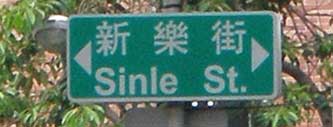
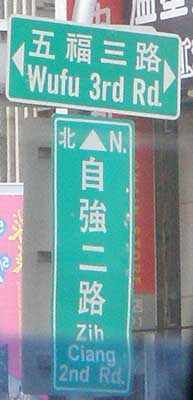
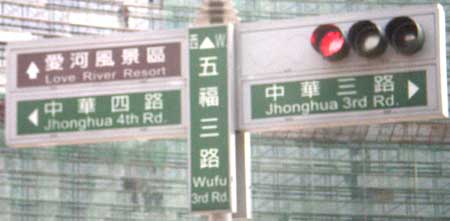
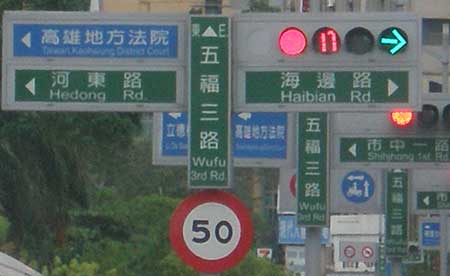
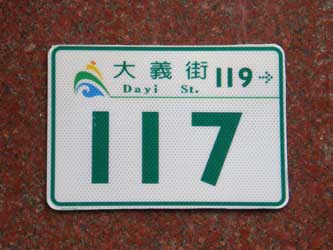
During an extremely brief trip a few weeks ago to Gāoxióng, Taiwan’s second-largest city, I was able to grab a few photos of signage there. Most of these were taken from a moving taxi; thus the poor quality and lack of much diversity. But these are the best I could do under the circumstances.
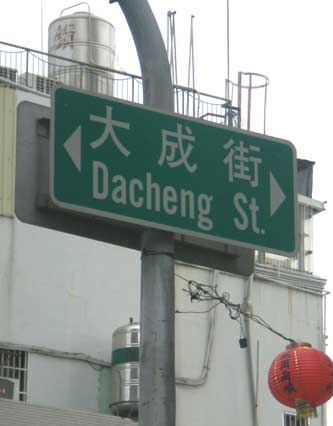
First, a few basic points:
In short, other than the choice of romanization most of these signs aren’t all that bad. They’re certainly much better (and more consistent) than the ones that Taipei County put up in Tongyong Pinyin a few years ago. (Although Taipei County’s current magistrate said more than two years ago that he was in favor of switching to Hanyu Pinyin, as far as I can see he has done absolutely nothing about this. Of course, some might say that he’s done absolutely nothing about anything; but I’ll leave discussion of that to the political blogs.)
Here’s another Gāoxióng sign with romanization that isn’t too small.

I’m not a fan of the practice of force-justifying the Chinese characters and romanization/English to the same width. This style can be seen in many of these signs. Sometimes this results in the romanized/English words being spaced too far apart; more often, though, the Chinese characters are left with lots of space between them — so much space that it would be easy to have spaces indicate word divisions for the texts in Hanzi (something Y.R. Chao recommended nearly a century ago), which might be an interesting thing to try on signs. I wonder if anyone has ever performed any experiments on this.

The full Mandarin name of the school indicated by the blue sign on the left is rather long:
Gāoxióng shìlì Gāoxióng nǚzǐ gāojí zhōngxué
(高雄市立高雄女子高級中學)
Whoever made the sign wisely desided to cut that down to 高雄女中 (Gāoxióng nǚ zhōng). If only someone had realized that it would have been better to use something shorter than the full English name, too. “Kaohsiung Municipal Girls’ Senior High School” is a lot to fit on one small sign. “Kaohsiung Girls’ High School”, “Girls’ Municipal High School”, or something even shorter would have been much better.
Here are some more signs.


And finally an address plate on a building. This style could certainly be better.

Posted by Pinyin Info on 06 Aug 2007 | Tagged as: Aborigine languages, Chinese, Gaoxiong, Hanyu, Kaohsiung, Mandarin, Taiwan, aborigines, languages
In 1957, Maya, a small town in Taiwan’s Gaoxiong (Kaohsiung) County, was assigned a new name: Sanmin Township (Sānmín Xiāng, 三民鄉), after Sun Yat-sen’s Sānmínzhǔyì (三民主義 / Three Principles of the People). Although the residents of Maya — then, as now, predominantly members of the Bunun tribe — were likely not in favor of this change, Taiwan was then under an authoritarian regime with an assimilationist policy, so there’s little to nothing they could have done.
During KMT rule, when the change to Sanmin was made, a major point of government policy was stressing the Chineseness of Taiwan — even if, such as in this case, the links had to be manufactured. The Kuomintang (Guómíndǎng), after all, was and still officially is the Chinese Nationalist Party, as the Taipei Times likes to remind its readers.
Fortunately, Taiwan no longer has the same political situation as 50 years ago. Some activists are now trying to get the name of the town changed back to Maya. President Chen Shui-bian recently expressed his support for this, which is not surprising considering that the current administration prefers to stress Taiwan’s historical links with just about anyplace but China. In recent years Taiwan’s ties with Austronesia have been receiving increasing attention.
I’m still trying to find out if “Maya” represents the proper spelling or if it’s merely a romanization of a Mandarinized form of the Bunun name. In Chinese characters this place is written 瑪雅鄉 (Mǎyǎ Xiāng / Maya Township). The characters 瑪雅 are also used for the Maya people of southern Mexico and northern Central America.
sources:
further reading: Pinyin News on aborigine names
Posted by Pinyin Info on 17 Jan 2007 | Tagged as: Chinese, English, Gaoxiong, Kaohsiung, Mandarin, Olympics, Taiwan, Tongyong, pinyin, romanization, signage
The government of Gaoxiong (Kaohsiung) has recently secured funding from the Executive Yuan to
The stories didn’t mention how much money will be involved in this. The project will be headed by the recently promoted Xǔ Lì-míng (許立明 / Xu Liming / Hsu Li-ming).
Let’s all hope the city does a much better job than is to be expected from past experience throughout Taiwan.
sources:
Posted by Pinyin Info on 01 Dec 2006 | Tagged as: Chinese, English, Gaoxiong, Kaohsiung, Mandarin, Taiwan, Tongyong, languages, pinyin, romanization, signage, tone marks, writing systems
Looking through Hao’s photos (linked to in his comment on yesterday’s post) reminded me that the MRT system in Gaoxiong is at least partially open. Since Gaoxiong is in Tongyong land, and since the signage there mixes romanization and English, and since no tone marks are given, I thought I’d share with everyone these Hanyu Pinyin guides I just made.
Here are the stations of the Gaoxiong subway system as given in Hanyu Pinyin (with tone marks), Hanyu Pinyin and English, Chinese characters, and Tongyong Pinyin and English:
See also Hao’s photos of the KMRT.
I don’t know Gaoxiong well, having been there only once, so if I got the word parsing for any of the stations wrong, please let me know.
Posted by Pinyin Info on 02 Oct 2006 | Tagged as: Chinese, Gaoxiong, Hokkien, Hoklo, Kaohsiung, Minnan, Taiwan, Taiwanese, Tongyong, languages, literacy, romanization
Years of valuable time has been lost in the squabbling over romanization systems for Taiwanese. And that squabbling will no doubt continue, as the links below make clear. But an important step was taken on Thursday. Finally, finally, Taiwan’s Ministry of Education has approved a romanization system for Taiwanese: Tái-luó-bǎn Pīnyīn (台羅版拼音), to give its Mandarin name.
I’m already on the record as having called Tongyong Pinyin, in its various incarnations, a national embarrassment for Taiwan, so I won’t bother to disguise the fact that I got a real kick out of the fact that the Tongyong Pinyin scheme for the Taiwanese language was roundly rejected. I know that more than a few readers of Pinyin News will be cheering this news. For many, this has as much or more to do with the methods used to push through the much-despised Tongyong Pinyin system for Mandarin than any defects, real or imagined, in the Tongyong Pinyin system for Taiwanese.
Predictably, Yu Bo-quan (余伯泉, I’ve given up bothering to figure out which of the various spellings for his name he’s using now), the main person behind the Tongyong romanization systems, is unhappy. Reportedly, after it was clear things were not going his way he stormed out of the meeting. After he left the new system was approved unanimously.
Yu’s remarks make clear the political nature of his approach.
Tái-luó-bǎn pīnyīn xìtǒng zuó chuǎngguān chénggōng hòu, Yú Bó-quán qìfèn de shuō, Tái-luó xìtǒng de qǐyuán shì Táiwān Mǐnnányǔ yīnbiāo xìtǒng (TLPA), shì Guómíndǎng shídài de chǎnwù, ér 2002 Tōngyòng Pīnyīn shì Mínjìndǎng zhízhèng nèi tōngguò de, zhìyí wèihé Jiàoyùbù wúfǎ hànwèi zhízhèngdǎng de Mǐnnányǔ pīnyīn xìtǒng zhǔzhāng, Jiàoyùbù duànrán tōngguò Tái-luó-bǎn, Táiwānyǔ Tōngyòng Liánméng hòuxù jiāng zhǔnbèi kàngzhēng. (台羅版拼音系統昨闖關成功後,余伯泉氣憤地說,台羅系統的起源是台灣閩南語音標系統(TLPA),是國民黨時代的產物,而二○○二通用拼音是民進黨執政內通過的,質疑為何教育部無法捍衛執政黨的閩南語拼音系統主張,教育部斷然通過台羅版,台灣語通用聯盟後續將準備抗爭。)
That doesn’t sound all that far from calling those on the committee dupes of the KMT, which isn’t likely to win him any friends with those in power. But it may well be that by this point he has so alienated others he thinks he has nothing to lose.
Apparently Tongyong for Taiwanese will retain something of a foothold in southern Taiwan. (See source no. 8 below.)
Later, I’ll try to put up more about just what system was approved and under what circumstances it will (and will not) be used — unless the ever-knowledgeable a-giâu beats me to it.
Because there’s a lot of confusion about Tongyong, a few notes are in order:
sources:
Posted by Pinyin Info on 06 Sep 2006 | Tagged as: Aborigine languages, Chinese, Chinese characters, Gaoxiong, Kaohsiung, Mandarin, Taiwan, aborigines, languages, romanization
The head of the Gaoxiong County Government’s Indigenous Peoples Bureau announced on Monday that henceforth he would like to be known by his original name, Alang Manglavan, rather than the Sinitic name Du Shi-luan (杜石鑾), and that he had completed the forms for official recognition of this.
As of the end of last year, Gaoxiong County had some 15,700 members of indigenous tribes. Only about 5 percent of these, however, had applied for an official change of name, Manglavan reported. He encouraged others to apply for the change.
Here’s one story:
Gāoxióng Xiànzhèngfǔ Yuánzhùmín Júzhǎng Dù Shí-luán, yǐjīng* shēnqǐng zhèngmíng wéi “Alang Manglavan” (阿浪、滿拉旺), jīntiān gǔlì xiàn nèi yuánzhùmín kě yīfǎ huífù chuántǒng xìngmíng, yǐ xiǎnxiàn yuánzhùmín chuántǒng yuánmào.
Dù Shí-luán biǎoshì, wèi xiǎngyìng tuīdòng huífù yuánzhùmín chuántǒng míngzi cuòshī, tā jǐ wánchéng zhèngmíng, shì cǎixíng chuántǒng míngzi Hànzì zhùjì hé bìngliè Luómǎ pīnyīn.
“Alang” shì míngzi, “Manglavan” shì xìng, shì “duànyá” de yìsi, Dù Shí-luán jiěshì shuō, yīnwèi zǔxiān zhù zài duànyá pángbiān, suǒyǐ yǐcǐ wéi xìng. Xīwàng dàjiā yǐhòu yào jiào tā “Ālàng”, bùzài xìng “Dù” le.
Dù Shí-luán gǔlì yuánzhùmín bǎwò jīhuì, duō gǔlì jiārén, péngyou qiánwǎng hùzhèng shìwùsuǒ bànlǐ huífù chuántǒng xìngmíng zhù jì.
* The original version in characters has a mistake: 己 instead of 已[经]. A Wubi-based typo?
sources:
Posted by Pinyin Info on 05 Sep 2006 | Tagged as: Chinese, Chinese characters, Gaoxiong, Mandarin, Taichung, Tainan, Taipei, Taiwan, Taizhong, Tongyong, languages, pinyin, romanization, signage
As most readers of this site know, Taiwan has approached romanization and signage with a sloppiness that sometimes beggars belief. Although the situation has improved somewhat this decade, many errors remain. And even where there are not errors, people still must often contend with a variety of romanization systems.
Thus, my list of Taiwan place names may come in handy.
I made the list more than a year ago but put it on another website and never drew much attention to it. Now I’ve moved it here to Pinyin Info, where it may do more good.
The list, which is arranged by county and then by city, gives Chinese characters, Hanyu Pinyin (both with and without tone marks), Tongyong Pinyin (ugh!), and a commonly seen older form (usually bastardized Wade-Giles).
I have not bothered to include MPS2, because it is seen more on street signs than on maps. And, anyway, it’s on its way out. I strongly recommend using Hanyu Pinyin.