dialect
Archived Posts from this Category
news and discussions related to romanization
Archived Posts from this Category
Posted by site admin on 01 Mar 2008 | Tagged as: Cantonese, China, Chinese, Guangzhou, Hokkien, Hoklo, Hong Kong, Minnan, Shanghainese, Sino-Platonic Papers, Taiwanese, dialect, languages, linguistics
The latest new release from Sino-Platonic Papers is one that I think will be of particular interest to readers of Pinyin News. It’s an extensive study of not only the attitudes of speakers of Cantonese and Mandarin toward the status of Cantonese but also their beliefs about its future, especially in Hong Kong: Language or Dialect–or Topolect? A Comparison of the Attitudes of Hong Kongers and Mainland Chinese towards the Status of Cantonese (650 KB PDF), by Julie M. Groves.
This study reports on a comparative survey of three groups of Chinese: 53 Hong Kong Cantonese speakers, 18 Mainland Chinese Cantonese speakers, and 72 Mainland Chinese Putonghua speakers. It was found that the Putonghua speakers held more ‘classic’ views, the majority seeing Cantonese as a dialect. In contrast, only just over half the Hong Kongers and two-fifths the Mainland Cantonese speakers considered it clearly a dialect, while one-third of all respondents favoured a mid-point classification. The differing perspectives held by the groups can be traced to their different political and linguistic situations, which touch issues of identity.
The author notes, “The uncertainties in classification also reflect a problem with terminology. The Chinese word usually translated dialect, fangyan (方言), does not accurately match the English word dialect.” Groves recommends the adoption of Victor Mair’s proposed English word for fangyan: topolect.
Although this focuses on the dialect vs. language debate, it covers much more than that. Those being surveyed were also asked questions such as:
The results of the study may also prove useful for those interested in the future of other languages of China and Taiwan, such as Taiwanese and Shanghainese.
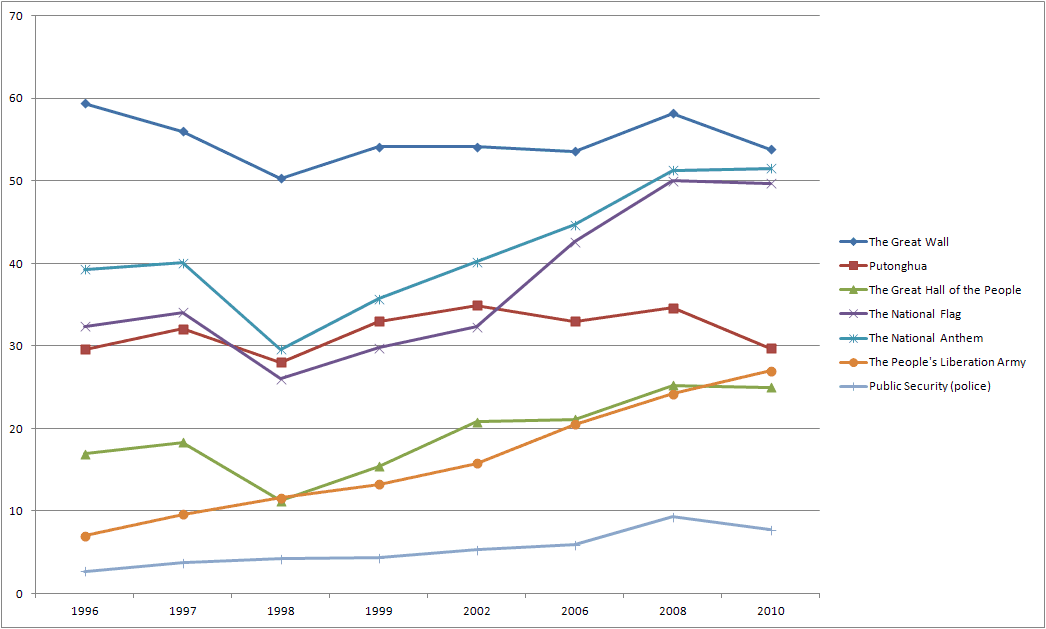
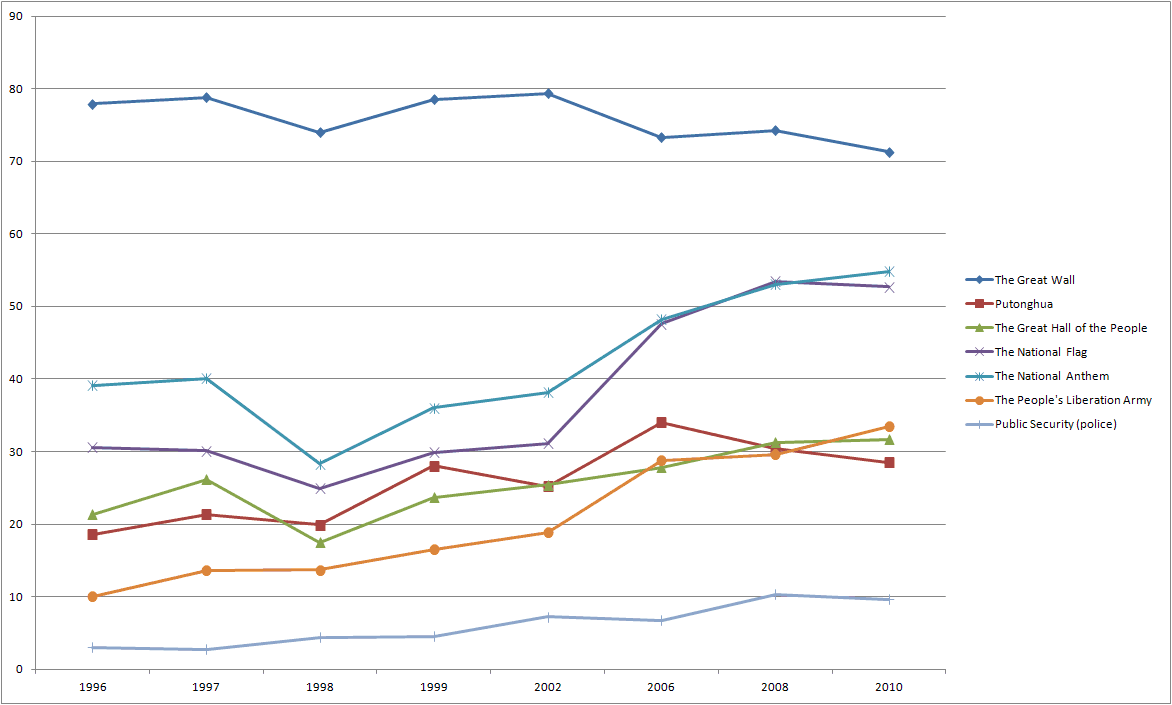
Here are a couple of the many graphs found in the study.
HK Cant = Hong Kong Cantonese speakers
MCant = mainland Cantonese speakers
MPTH = mainland speakers of Mandarin (”Pǔtōnghuà“)


Posted by site admin on 07 Feb 2008 | Tagged as: Chinese, Hanyu, Mandarin, dialect, languages
Happy year of the rat, everyone!
Several years ago I made some resolutions for Chinese New Year that others might find useful, if you haven’t adopted similar ones already.
Pretty basic. But these greatly help clarity. And they have the benefit of being correct.
The reason you’ll sometimes find the phrase “Mandarin Chinese” rather than just “Mandarin” on my site is I want to help people find this through search engines. But for the most part the inclusion of the word “Chinese” is easily accomplished through tags or mention of “Chinese characters.”
I’d like to note that even many of those who really should know better have things backwards. They might note that “Chinese” is not a language but a family of languages — and even then one that should be known as Sinitic rather than “Chinese.” And they tend to spend a line or so explaining that what many people refer to as Chinese “dialects” are really languages. This is all well and good. But then they go on to use “Chinese” and “dialects” over and over.
The messages they’re sending out:
Chinese Chinese Chinese Mandarin Chinese Chinese Chinese Chinese Chinese Chinese Chinese Chinese Chinese Chinese Chinese Chinese Chinese Chinese Chinese Chinese.
and
Dialect dialect language dialect dialect dialect dialect dialect dialect dialect dialect dialect dialect dialect dialect dialect dialect dialect dialect.
So what people hear is “Chinese” and “dialect” — both of which are usually wrong.
I have made some resolutions of my own for this year: the first being to answer e-mail messages much quicker than my present average of three or more months behind when I should. Although I’m terrible at writing, I am indeed grateful for all of the messages I receive.
Xinnian kuaile!
Posted by site admin on 27 Jan 2008 | Tagged as: India, Sino-Platonic Papers, dialect, languages, linguistics
The most recent reissue from Sino-Platonic Papers is On Attitudes towards Language in Ancient India, by George Cardona of the University of Pennsylvania. Cardona discusses how grammar “became part of a soteriological system, with linguistic usage a means to acquiring merit and the ultimate good.” [I had to look that one up.]
“In this respect,” he concludes, “the Indian attitude towards language is probably unique.”
He gives several examples from early writings, including this one:
“The demons, with speech taken away from them, said he’lavo he ‘lavaḥ and were thus vanquished. They uttered this indistinct speech there. That is barbaric speech (mlecchaḥ). Therefore, a Brāhmaṇa is not to utter barbaric speech (na mlecchet), for this speech is of the demons. One who know thus takes the speech of his competitors who hate him; they are vanquished with their speech taken from them.”Now, the contrast here is not between Ārya and non-Ārya pure and simple. Instead, the emphasis is placed on usage that is correct according to an accepted norm and usage that is considered barbaric because of its deviation from the norm. Thus, the demons are said to have been vanquished because, incapable of uttering the correct form he3arayo he3arayaḥ, they said he’lavo he’lavaḥ. That is, instead of the accepted form arayaḥ, with -r- and -y-, they used a dialectal and unacceptable form alavaḥ, with -l- and -v-; and instead of using a prolated (trimoric) -e3 that is exempt from phonological alternation, they used an ordinary vowel -e and followed the rule of phonologic alternation whereby word-final -e and word-initial a- together give -e-.
Although some of that may sound complicated, depending on your familiarity with that field, the essay as a whole is aimed at nonspecialists.
This was first published in January 1990 as issue no. 15 of Sino-Platonic Papers.
Posted by site admin on 03 Jan 2008 | Tagged as: China, Chinese, Chinese characters, Cyrillic, Dungan, Hanyu, Mandarin, alphabet, dialect, languages, linguistics
The state radio station of Kyrgyzstan offers a weekly broadcast in Dungan, which is basically a spin-off of northwestern Mandarin with lots of loan words from Persian, Arabic, and Russian. Of particular interest is that the language — which, permit me to note again, is basically Mandarin — is written with an alphabet (at present, one based on the Cyrillic alphabet). Chinese characters are of course not necessary and are not used. For details of the language, script, and people, see Implications of the Soviet Dungan Script for Chinese Language Reform, by Victor H. Mair, and Ethnolinguistic Notes on the Dungan, by Lisa E. Husmann and William S-Y. Wang (available online in Schriftfestschrift: Essays in Honor of John DeFrancis on His Eightieth Birthday, pp. 71-84).
The Dungan radio show is broadcast on Mondays between 6:35 and 7:05 p.m., Taipei time (4:35-5:05 a.m. U.S. central standard time). The show usually starts closer to 6:40 and ends about 7:03.
I made a recording of the latest broadcast (Dec. 31, 2007): Dungan radio broadcast (23 MB mp3).
[Here's another: Dungan radio broadcast, January 14, 2008 (23 MB mp3).]
I mainly understand words, not entire sentences, though my comprehension improves a little with repeated listenings.
This Kyrgyz radio station (Кыргызское радио) is available through at least three different Internet links:
I have had the best luck with link no. 1.
I made the recording with Total Recorder for Windows and edited it in Audacity.
I’ve heard that Mac users can get good results with Audio Hijack.
Posted by site admin on 20 Nov 2007 | Tagged as: China, Chinese, Mandarin, Sino-Platonic Papers, Tibet, Tibetan, dialect, linguistics
The latest rerelease from Sino-Platonic Papers is Interethnic Contact on the Inner Asian Frontier: The Gangou People of Minhe County, Qinghai (3.3 MB PDF), by FENG Lide and Kevin Stuart.
According to the authors, the Gangou people raise important questions as to the meaning of “Han” and indeed, to ethnic classification in China.
This work also contains a section on language in the area.
Here is the opening of the introduction, minus the Chinese characters:
China cultural studies have often pigeon-holed the subject in a convenient ethnic category giving cultural phenomena ethnic tabs. The preponderance of Han in China has meant that some minority groups or a substantial portion of the same have been sinicized to the extent that little remains of the original minority culture. Examples include the Manchu and nearly all minority people reared in urban areas.
Unfortunately, little attention has been paid to “Han” who have been much influenced by minority people, which this study focuses on. We have chosen a village in Qinghai that illustrates this. It is an area where multicultural contact and mingling have a history of more than 2,000 years. For example, in 202 BC, speakers of an eastern Iranian Indo-European language fled to Qinghai where they settled and were absorbed by Qiangh tribes. Succeeding centuries saw migrations of Xianbei, Xiongnu, Tuyuhun, Tibetans, Uygur, Mongolians, Han, and various Turkish stock into Qinghai, which formally became a province of China in 1928. Prior to that time, it was the Tibetan frontier district of the present Gansu Province (Schram 1954, 17-22).
The post-1949 period has seen a large influx of Han into Qinghai — particularly in urban areas.
This is issue no. 33 of Sino-Platonic Papers. It was first published in September 1992.
Posted by site admin on 22 Sep 2007 | Tagged as: Buddhism, China, Chinese, Chinese characters, Classical Chinese, Hanyu, India, Mandarin, Sino-Platonic Papers, Victor H. Mair, dialect, dictionary, languages, linguistics, oracle bones, pinyin, writing systems
Sino-Platonic Papers has rereleased the third volume in its series of book reviews: Reviews III (8.3 MB PDF).
This volume was first published in October 1991.
The main topics of the books in this volume are
For those who hesitate to download such a large file without knowing which books were reviewed, you may consult the table of contents (small HTML file).
Posted by site admin on 28 Aug 2007 | Tagged as: China, Chinese, Chinese characters, Classical Chinese, Hokkien, Hoklo, Malaysia, Sino-Platonic Papers, Tainan, Taiwan, Taiwanese, alphabet, dialect, languages, linguistics, romanization, writing systems
Sino-Platonic Papers has rereleased its August 1991 issue: Linguistic Nationalism: The Case of Southern Min.
An excerpt from the introduction:
In this paper, I will explore aspects of the social value of Southern Min. I draw on data collected in three Southern Min-speaking communities in which I have done participant-observation fieldwork: Penang, Malaysia; Tainan, Taiwan, and Xiamen (Amoy), the People’s Republic of China, focusing in particular on the political importance of Southern Min in Tainan. I take as one goal that of drawing attention to the importance of regional identities and differences in Chinese society, differences all too often disregarded by those who seek to reify ‘Chinese culture’ as a monolithic entity.
Also, the color scheme of the online catalog for Sino-Platonic Papers has been adjusted a little in order to make clearer which issues are presently available for free download.
Posted by site admin on 08 Aug 2007 | Tagged as: Cantonese, China, Chinese, Hanyu, Hokkien, Hoklo, Mandarin, Minnan, Shanghai, Taiwanese, dialect, languages
This week’s news provides a good example of how petty China’s language police can be.
Workers in Shanghai’s metro service must often deal with Chinese who do not speak either Shanghainese or standard Mandarin, so they began to collect useful phrases so staff members could better understand and answer some questions. They focused on Cantonese, Hoklo (a.k.a. Minnan, Southern Fujianese, Taiwanese, etc.), Wenzhouhua (although this is generally classified as part of the same language that contains Shanghainese, it is largely incomprehensible to most people in Shanghai), Wuhanhua (although classified as a Mandarin dialect, it is far removed from standard Mandarin), and Changsha (a dialect of Hunanese). More than fifty metro employees are to study the phrases.
This caught the attention of Shanghai’s Spoken and Written Language Work Committee (Yǔyán Wénzì Gōngzuò Wěiyuánhuì). On Tuesday, Zhu Lei (朱蕾), a committee official, reported that her office had “contacted the Metro management …, stating that the program could violate the country’s language policy to promote the use of Putonghua [i.e., Mandarin].”
“The right way to solve communication barrier is to speak Putonghua,” she is quoted as saying.
sources: