tone marks on signage: a debate

Check out the “dueling laowai” debate over whether to use tone marks on street signs in Taiwan. This is a series of pieces written by Mark of Doubting to Shuo and Prince Roy of Prince Roy’s Realm. Unfortunately, some of the comments have gone off into the land of myths and shadows, and I just don’t have the time or the energy to deal with all of that now. But the basics of the tone-mark debate are well worth reading.

Ministry of Education and romanization for Taiwanese … again

The matter of Taiwanese, script, and pedagogy is in the news again. But it’s still hard to figure out exactly what’s going on. And the government has been so slow to get much done in this area that even complete agreement about what to do wouldn’t convince me that anything substantial is going to happen soon.

So I’ll just refer those interested in the topic to the stories and hope people can provide some clarity in the comments here.

17th century proposal for a universal alphabet

Another article in the late seventeenth century journal discussed in my previous post addresses the issue of a “universal alphabet.” Although I hate to admit it, it’s a lot more interesting — and easy to read — than the piece on Chinese characters.

Here is the Lord’s Prayer in English, rendered in the alphabet of the author, Francis Lodwick.

the Lord's Prayer in English, rendered in an early proposal for a universal phonetic alphabet

Lodwick didn’t just stop at letters. He addressed punctuation as well.

The Characters signifying the various Modes of Expression may be these following, and ought to be placed at the beginning and end of every Sentence requiring it.

  • [ ] explication
  • ? ? interrogation
  • ( ) parenthesis
  • ! ! wonder
  • ¡ ¡ emphasis
  • ¿ ¿ irony

Some of those marks far outdate similar proposals I’ve seen.

sources and further readings:

early British article on Chinese characters

Matt at No-sword tells of the welcome news that many back issues of the journals of the Royal Society are now online. What makes this particularly interesting is that the Royal Society has been publishing these since at least 1665.

So I dug around and found “Some Observations, and Conjectures concerning the Chinese Characters,” which dates from the late 1600s. It was published in an issue of Philosophical Transactions that contains not one but two articles by Edmond Halley. Wow.

The article on Chinese characters, however, is in many places opaque — not that that’s really a big surprise considering this was written more than 300 years ago. The author is intrigued by the notion of a universal artificial language. He concludes, “Now as by such a Language the Character might be made Effable without Musical Tones or Difficult Aspirations, so had we Dictionarys of the Signification of the Characters, we might as soon learn the Chinese Character, as we can Latine, or any other Language to be learnt by Book, and not by Speaking.”

This appears to be an early example of several myths about Chinese characters, such as the ideographic myth, which was first debunked in the West about 150 years later by Peter DuPonceau.

The author also tells of what he believes is the “true design” of the Yi Ching (Yìj?ng ??):

both the Chinese and European Commentators assert it to be a Conjuring Book, or a Book to tell Fortunes by, and to be made use of by the Chinese for that purpose; whereas by the small Specimen I have seen of it, I conceive it to contain the whole Ground, Rule or Grammer, of their Character, Language and Philosophy, and that by the understanding of it, the Foundation and Rule of their Language and Character, may be without much difficulty Deciphered and Understood.

I don’t think that particular line of thought got very far.

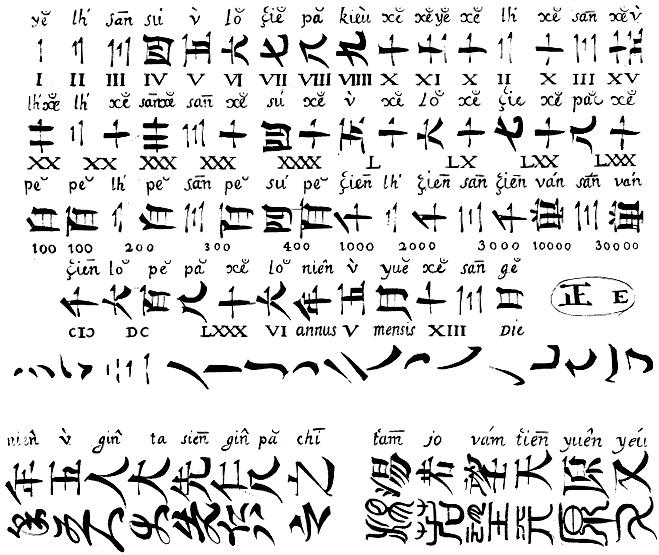
The article concludes with an illustration that mainly features numbers in Chinese characters. What makes this particularly interesting, at least for me, is the addition of romanization. I have rotated the image counter-clockwise to make it easier to read the romanization. Note especially the use of the letter x. (Click the image to see it slightly enlarged.)

click for slightly larger image, mostly of numbers in Chinese characters and romanization

sources and further readings:

a shameless proposal

A Taipei city councilor with the KMT on Tuesday launched an attack on President Chen Shui-bian disguised as a signage proposal. His idea: Change the name of Ketagalan Boulevard (凱達格蘭大道 Kǎidágélán Dàdào), the street leading to the Presidential Office.

The city councilor, Yang Shi-qiu (楊實秋, Yang Shih-chiu), called for a change to Lǐ-yì-lián Dàdào, which is literally Propriety, Righteousness, [and] Honesty Boulevard. While that might sound nice, it’s actually a disguised insult.

John DeFrancis was all over this word play a long time ago in “The Singlish Affair,” the biting satire that leads off his essential book The Chinese Language: Fact and Fantasy. DeFrancis explains assigning the name Li Yilian to a person in his story:

The most complex is the name Lǐ Yìlián. Those who know Chinese may get the point if it is written in characters: 禮義廉 or, in simplified characters, 礼义廉. The three characters mean respectively “propriety, morality, modesty” and form part of a four-character phrase listing a number of Confucian virtues of which the fourth is 恥 (chǐ “a sense of shame”). The omission of the fourth character is part of a Chinese word game in which the reader is supposed to guess the last item when it is omitted — much as if we had to tell what is lacking in the list of the three Christian virtues of “Faith, Hope, and ______.” The omission of the fourth character is expressed as 無恥 or 无耻 (wúchǐ “lacking a sense of shame”). In short, calling someone Mr. Lǐ Yìlián seems to praise him as Mr. Propriety, Morality, and Modesty but actually insults him as Mr. Shameless.

By renaming the street “people will know that the person who works at the Presidential Office at the end of the boulevard has no sense of chi [恥, shame],” Yang said.

Taipei Mayor Ma Ying-jeou, who also serves as chairman of the KMT, didn’t care for the idea of his city having a Lǐ-yì-lián Dàdào or Wúchǐ Dàdào (both of which could be translated as “Shameless Boulevard” — the first figuratively, the second literally) but said that the name Lǐ-yì-lián-chǐ Dàdào (“Propriety, Righteousness, Honesty, and a Sense of Shame Boulevard”) could be discussed.

The name of Ketagalan Boulevard is especially interesting from a number of standpoints.

  • Since the street is named after a tribe that lived long ago in what is now Taipei, Ketagalan Boulevard is one of the only road names in all of the capital of Taiwan that has much of anything to do specifically with Taiwan, as opposed to China. (Jilong/Keelung Road is the only other one that springs to mind at the moment.)
  • It is one of the only Taipei street names that isn’t bisyllabic.
  • The street itself is not really independent as much as an extention of Ren’ai Road. (Don’t forget that apostrophe.)
  • The name has been changed before. As Mark Caltonhill notes in What’s in changing a name?, “the vast majority of the island’s streets and even many towns were simply renamed by the KMT regime”. But in this case I’m referring to a relatively recent renaming. In 1996, Chen Shui-bian, who was then mayor of Taipei, oversaw the renaming of the street from Jieshou Road (介壽, Jièshòu Lù, i.e., “Long Live Chiang Kai-shek Road”).
  • Chinese characters aren’t a good fit for “Ketagalan,” which comes out 凱達格蘭 (Kǎidágélán).

Here’s a Mandarin-language story on this:

Miànduì dào Chén Shuǐ-biǎn huódòng bùduàn, Táiběi Shìyìyuán Yáng Shí-qiū jīntiān biǎoshì, tā yǐ zhǎnkāi lián shǔ, tí’àn bǎ Ketagalan Dàdào gēngmíng wéi Lǐ-yì-lián Dàdào; Táiběi shìzhǎng Mǎ Yīngjiǔ suī rènwéi yǒu chuàngyì, dànshì yǒu màrén “wúchǐ” zhī xián, tā bù zànchéng.

Táiběi Shìyìhuì xiàwǔ jǔxíng shìzhèng zǒng zhìxún shí, Yáng Shí-qiū zhìxún biǎoshì, Chén Shuǐ-biǎn zǒngtǒng zài Táiběi shìzhǎng rènnèi zài wèijīng mínyì zhēngxún xià, jiù bǎ jièshòu lù gǎimíng wéi Ketagalan Dàdào, rìqián yòu làngfèi Xīn Táibì shàng yì yuán, bǎ Zhōngzhèng Guójì Jīchǎng gēngmíng wéi Táiwān Táoyuán Jīchǎng. Yáng Shí-qiū yě lián shǔ tí’àn, yāoqiú shì-fǔ jiāng Ketagalan Dàdào gēngmíng wéi “Lǐ-yì-lián Dàdào”.

Mǎ Yīngjiǔ huídá shuō, dàolù yǐ zhèngmiàn mìngmíng wèi yuánzé, ér bù shì fùmiàn mìngmíng, yìyuán de yòngyì yǒu chuàngyì, dànshì kèyì shěnglüè jiùshì màrén “wúchǐ” zhī xián. Yáng Shí-qiū huíyìng shuō, ruò shì-fǔ yǒu yílǜ, Ketagalan Dàdào kě gǎiwéi “Lǐ-yì-lián-chǐ Dàdào”.

Mǎ Yīngjiǔ huíyìng shuō, tā bù zànchéng Ketagalan Dàdào gǎiwéi “Lǐ-yì-lián Dàdào”, zhèyàng huì biànchéng “Wúchǐ Dàdào”, dànshì ruòshì “Lǐ-yì-lián-chǐ Dàdào”, zhè kěyǐ tǎolùn.

Yìyuán Jiǎng Nǎi-xīn suíhòu qiángdiào, Yáng Shí-qiū de tí’àn jiùshì tíxǐng wéizhèng zhě bùkě wúchǐ, ruò Mǎ Yīngjiǔ dānxīn bèi rén zhǐwéi yǒu màrén wúchǐ de yìsi, tā jiànyì gǎiwéi “Bùkě Wúchǐ Dàdào”. Mǎ Yīngjiǔ xiào shuō, zhèige jiànyì gèng yǒu chuàngyì, dànshì xū jīngguò shì-fǔ nèibù tǎolùn.

sources:

    more claims on eliminating illiteracy in China

    Carnival rube: Hey honey, let’s see how good this guy is. What would I win?

    Navin (Steve Martin’s character): Uh, anything in this general area right in here. Anything below the stereo and on this side of the bicentennial glasses. Anything between the ashtrays and the thimble. Anything in this three inches right in here in this area. That includes the Chiclets, but not the erasers.

    —from The Jerk

    It’s easy for people to be declared winners when the barriers for winning are set low enough and everyone is going to be declared a winner no matter what. Here’s what Xinhua reported on Saturday: “The Chinese government plans to eliminate all illiteracy among people aged between 15 and 24 by 2010.” As long as Chinese characters are the sole accepted script for the vast majority of people in China, the chances for this plan to really succeed are zero. But I’m certain it will be declared a great success anyway.

    Remarkably, Xinhua included something in the article that rings true and hints at the prospects for any real success:

    “The central government only appropriates eight million yuan (about one million US dollars) each year to tackle illiteracy, which means each illiterate person only has seven cents (less than one US cent) a year,” according to another MOE official who declined to be named. “And the increasing number of migrant workers has made education a tough task for the government,” he said.

    Less than one US cent won’t buy even so much as one Chiclet, much less a whole pack. And it damn sure won’t be enough to boost literacy in any significant way.

    That’s also basing things on the number of illiterate people in China as 114 million, which is far, far too low. But even if we accept both that claim and the BS claim by an official of the Ministry of Education who would identify himself that “China has maintained an illiteracy ratio of around 4 percent among the youth and the middle aged,” that doesn’t leave much money.

    In 2010, China’s 15-24 age group will total some 190 million people. If 4 percent of those are counted as illiterate, then 7.6 million people would receive a total of 8 million yuan per year. So, even if China decided to axe all literacy programs for people over the age of 24 (which it won’t do) and commits all its alloted resources to the 15-24 age group, the funding would barely top US$1 per person per year to learn the modern world’s most difficult script. Then consider the fact that illiteracy is highest in China’s countryside — a vast area with inadequate infrastructure.

    sources:

    Tibet to eliminate illiteracy by 2010, says Xinhua

    Of course, I don’t believe a word of this. But I’m putting it up here for reference.

    Southwest China’s Tibet Autonomous Region intends to reduce its illiteracy rate to less than five percent in 2007 and to less than three percent in 2010, a senior regional education official announced on Friday.

    The ongoing campaign to eliminate illiteracy in the region mainly targets people aged 15 to 50, the official said. Last year 15 percent of that group were illiterate, down from 39 percent in 2000, he added.

    According to the regional education authorities, literacy in the region means knowing 30 Tibetan letters by heart and being able to read a phonetic transcript of the Tibetan or being able to read and write 1,500 Chinese characters.

    And another article on a related topic:

    Wǒguó shǎoshù mínzú wénmáng bànwénmáng lǜ 10 nián xiàjiàng 16 ge bǎifēndiǎn

    Guójiā Mín-wěi Jiàoyùsī jīchǔ jiàoyù chù chùzhǎng zhōu lì rìqián biǎoshì, jìn shí niánlái, mínzú dìqū de sǎománg gōngzuò chéngjì xiǎnzhù. Zhōu lì shì zài Xīníng zhàokāi de 2006 niándù Zhōngxībù sǎománg gōngzuò huìbào huì shàng zuò shàngshù biǎoshì de. Gēnjù 1990 nián de rénkǒu pǔchá tǒngjì zīliào, shǎoshù mínzú 15 suì jí 15 suì yǐshàng wénmáng bànwénmáng rénkǒu bǐlì shì 30.83%, dàoliǎo 2000 nián, zhèige bǐlì yǐjing xiàjiàng dào 14.54%, qízhōng Xīzàng, Qīnghǎi, Yúnnán, Guìzhōu, Gānsù, Níngxià děng liù shěngqū wénmáng lǜ xiàjiàng de fúdù gāoyú quánguó píngjūn fúdù de 14.55%. Zhōu lì shuō, shǎoshù mínzú 15 suì jí 15 suì yǐshàng wénmáng bànwénmáng rénkǒu bǐlì zài shí niánjiān xiàjiàng 16 ge bǎifēndiǎn, yǔguó jiā de zhīchí yǔ mínzú dìqū zìshēn de nǔlì fēnbukāi.

    They forgot to add that all the children of the world will join hands and sing songs of joy and peace….

    sources:

    carvings said to be in oldest script ever discovered in Western Hemisphere

    drawing of the writing discussed in this blog entryThe latest issue of Science features an article on a stone slab found in Veracruz, Mexico. Scholars have identified the inscriptions on the stone — tentatively dated to at least 900 B.C.E. — as the earliest writing yet found in the Americas.

    Dr. Houston, who was a leader in deciphering Maya writing, examined the stone looking for clues that the symbols were true writing and not just iconography unrelated to a language. He said in an interview that he detected regular patterns and order, suggesting “a text segmented into what almost look like sentences, with clear beginnings and clear endings.”

    Some of the pictographic signs were frequently repeated, Dr. Houston said, particularly ones that looked like an insect or a lizard. He suspected that these might be signs alerting the reader to the use of words that sound alike but have different meanings – as in the difference between “I” and “eye” in English.

    All in all, Dr. Houston concluded, “the linear sequencing, the regularity of signs, the clear patterns of ordering, they tell me this is writing. But we don’t know what it says.”

    The New York Times‘ use of the word “pictographic” prompts me to dig out DeFrancis’s important observation:

    With regard to the principle, it matters little whether the symbol is an elaborately detailed picture, a slightly stylized drawing, or a drastically abbreviated symbol of essentially abstract form. What is crucial is to recognize that the diverse forms perform the same function in representing sound. To see that writing has the form of pictures and to conclude that it is pictographic is correct in only one sense — that of the form, but not the function, of the symbols. We can put it this way:

    QUESTION: When is a pictograph not a pictograph?
    ANSWER: When it represents a sound.

    It looks like those working on the inscription know what they’re doing. But thinking of writing in terms of pictographs or ideographs certainly hindered earlier scholars of the ancient Americas. For a brief essay on this see “The Ideographic Myth as a Barrier to Deciphering Maya Writing,” by Michael D. Coe. This is found in Difficult Characters: Interdisciplinary Studies of Chinese and Japanese Writing, by Mary S. Erbaugh. Or see some of the other many works by Coe.

    sources: