Hainan primary school kicks out new student for poor Mandarin

A man surnamed Huang enrolled his boy in school in Sanya, Hainan Province, China. But the boy’s teacher, after receiving no response to his question in Mandarin as to which student was named A Hao, decided school was no place for a child who didn’t speak Mandarin. The youngster could return after mastering Mandarin, the teacher said. (“Xuéhuì Pǔtōnghuà zàilái shàngxué ba.”)

Although the school has defended the indefinite suspension of the small child, citing “safety concerns,” it doesn’t seem to have many supporters of this action. Mr. Huang is considering a lawsuit against the school, and the district’s authorities have launched an investigation.

Mandarin is not even the native language for that part of China. The linguistic situation on Hainan is similar to that in Taiwan: most of the native population grew up speaking Hoklo or a non-Sinitic “minority” language, which are all suppressed in favor of Mandarin, whose speakers have poured in relatively recently. Although the active suppression of non-Mandarin languages in Taiwan is no longer as active as before or as the situation remains in China, indirect suppression remains very much in force.

Huáng xiānsheng xiàng jìzhě fǎnyìng, yóuyú gōngzuò xūyào, tā jiāng qī’ér cóng Hǎinán Shěng Wànnìng Shì bāndào Sānyà Shì Ānyóu Dìqū. Tā dǎsuan jiāng háizi sòngdào fùjìn de Ānyóu Xiǎoxué dúshū, dànshì háizi yīn bù huì Pǔtōnghuà ér bèi lèlìngtuìxué.

Qǐyīn: háizi zǒucuò jiàoshì

Huáng xiānsheng duì jìzhě shuō, háizi dì-yī tiān kāixué huílai hòu jiù duì tā shuō: “Bàba, wǒ zǒucuò jiàoshì le, lǎoshī jiào nǐ míngtiān qù yīxià xuéxiào.”

Dì-èr tiān, Huáng xiānsheng láidào xuéxiào hòu cái dézhī wèntí de yánzhòngxìng. Xiàozhǎng gàosu tā, tā de háizi yīn zǒu cuòle jiàoshì, ràng quán xuéxiào lǎoshī wèicǐ xūjīng yī chǎng. Bānzhǔrèn liǎng cì dào xuésheng qián bān xúnwèn něige xuésheng jiào Ā Hào, dànshì Ā Hào zuòzài jiàoshì lǐ què méiyǒu huídá. Bānzhǔrèn duì Huáng xiānsheng shuō, “Wǒ yī dào xuéxiào, Lóng lǎoshī jiù gēn wǒ shuō, ràng nǐ de háizi huíjiā ba, xuéhuì Pǔtōnghuà zàilái shàngxué ba.”

Huáng xiānsheng shuō, tā de háizi yuánlái zài lǎojiā dúguò yī niánjí, chéngjì bùcuò, dàn zài jiāxiāng jiǎng de duō shì Hǎinán huà, yīncǐ, tā de háizi shuō Pǔtōnghuà de nénglì hěn chà, zhǐnéng jiǎndān de tīngdǒng yīdiǎn.

Jiāzhǎng: yào dǎ guānsi tǎo gōngdào

Huáng xiānsheng duì jìzhě shuō, tā de xiǎohái yòu méiyǒu fàn cuòwu, méiyǒu shénme guòcuò, jiù yīnwèi bù huì Pǔtōnghuà, zǒu cuòle jiàoshì, jiù zhèyàng bèi chéngfá, zhè tài bù gōngpíng le. Jìrán xuéxiào yǐ tōngguò kǎoshì tóngyì qí bàomíng, jiù xiāngdāngyú shuāngfāng qiān le héyuē, xuéxiào bùnéng dānfāngmiàn huǐyuē.

Huáng xiānsheng chēng, wèile háizi de dúshū quánlì, tā jiāng dào jiàoyù zhǔguǎn bùmén tóusù, bìng dǎsuan jiāng xuéxiào gào shàng fǎtíng, wèi háizi tǎo huí gōngdào.

Xuéxiào: shìwéi ānquán kǎolǜ

Jìzhě jiù Huáng xiānsheng fǎnyìng de qíngkuàng láidào Ānyóu Xiǎoxué héshí qíngkuàng. Gāi xuéxiào Shàn xiàozhǎng jiēshòu jìzhě cǎifǎng shí chēng, gāi xuésheng bù shì běnxiào fànwéi nèi de xuésheng, yòu tīngbudǒng Pǔtōnghuà, bù huì yǔ rén jiāoliú. Shàn xiàozhǎng shuō, ràng gāi xuésheng tuìxué de zhíjiē yuányīn shì, gāi xuésheng zǒu cuòle jiàoshì, quán xuéxiào shī-shēng dàochù zhǎo, tā què zuòzài xué; qián bān de jiàoshì lǐ yī shēng bù kēng, xià de quán xuéxiào lǎoshī xūjīng yī chǎng. Shàn xiàozhǎng biǎoshì, rúguǒ bù fāshēng zhèyàng de shì, xuéxiào jiù bù huì lèlìng qí tuìxué le, zhè zhǔyào shì cóng ānquán fāngmiàn lái kǎolǜ de.

Jiàoyùjú: xuéxiào zuòfǎ bùduì

Jiù Huáng xiānsheng fǎnyìng qí háizi yīn bù huì Pǔtōnghuà ér bèi lèlìngtuìxué yīshì, jìzhě cǎifǎng le Sānyà Shì Jiàoyùjú fù júzhǎng zhāng wèi lán. Zhāng fù júzhǎng shuō, xuéxiào de zuòfǎ kěndìng bùduì, bùnéng yīnwèi xuésheng bù huì shuō Pǔtōnghuà jiù lèlìngtuìxué. Háizi bù huì Pǔtōnghuà, dào xuéxiào zhèyàng de huánjìng zhōng jiù kěyǐ xuéhǎo Pǔtōnghuà, zhè yěshì yī zhǒng xuéxí de guòchéng.

Zhāng fù júzhǎng shuō, huì pài yǒuguān rényuán yǔ xuéxiào xiétiáo, zélìng Ānyóu Xiǎoxué gǎizhèng cuòwù, jìxù ràng Huáng xiānsheng de háizi lái shàngxué.

Lǜshī: háizi yǒu dúshū quánlì

Jiù gāi xuésheng bèi xuéxiào lèlìngtuìxué yīshì, jìzhě cǎifǎng le Sānyà Shì yán bì xìn lǜshī shìwùsuǒ lǜshī chén chuān Huà xiānsheng. Chén lǜshī shuō, gēnjù wǒguó wèichéngniánrén bǎohù fǎ hé jiǔ nián zhì yìwù jiàoyùfǎ, wèichéngniánrén tóngyàng xiǎngyǒu shòu jiàoyù de quánlì, xuéxiào, shèhuì, jiātíng yǒu yìwù ràng wèichéngniánrén dúshū. Chén lǜshī rènwéi, Ānyóu Xiǎoxué de zuòfǎ shì wéifǎn yǒuguān fǎlǜ fǎguī de, xuésheng jiāzhǎng wánquán kěyǐ tōngguò fǎlǜ tújìng wèi qí háizi tǎo huí gōngdào.

sources:

Chinglish International Airport?

In what many view as a long-overdue move, Taiwan’s government has removed the name of Chiang Kai-shek, the island’s one-time dictator, from the title of the country’s main international airport. What has been reported as the new English name, however, is a bit strained in that the country’s name precedes the county/city name.

  English Pinyin Hanzi
old Chiang Kai-shek International Airport Zhōngzhèng Guójì
Jīchǎng
中正國際機場
new Taiwan Taoyuan International Airport Táiwān Táoyuán Guójì
Jīchǎng
台灣桃園國際機場

In Mandarin, there’s nothing tremendously odd about using “Taiwan Taoyuan.” In English, however, it’s a completely different story.

exact phrase romanization no. of results in Google
Taoyuan Taiwan   241,000
Taiwan Taoyuan   42,400
 
臺灣桃園 Taiwan Taoyuan 43,200
台灣桃園 Taiwan Taoyuan 220,000
total for 臺灣桃園
and 台灣桃園
263,200
 
桃園臺灣 Taoyuan Taiwan 5,720
桃園台灣 Taoyuan Taiwan 461
total
for 桃園臺灣 and 桃園台灣
6,181

Almost all of the examples in English of “Taiwan Taoyuan” have punctuation (stronger than a comma, that is) or new lines separating the words, so running the two names together in that order is less common than the Google result implies, as most English speakers know intuitively.

“Taiwan Taoyuan,” when used in English, reminds me of nothing so much as the annoying term “Chinese Taipei” (Zhonghua Taibei / 中華台北). This name represents the international kissing of Beijing’s ass diplomatic solution worked out so Taiwan’s teams can participate in international sporting events without China throwing too much of a hissyfit. (We we still get some of those anyway, of course.)

Since using anything along the lines of “Chinese Taipei” would be anathema to the present administration in Taiwan, what’s going on with the new name for the airport? The logical name would probably be simply “Taoyuan International Airport,” the airport being in Taoyuan County rather than Taipei County. But outside of Taiwan, who has ever heard of Taoyuan? (That’s probably just as well for Taiwan, because much of Taoyuan is downright ugly.) And, anyway, I think that those deciding on the new name regarded adding “Taiwan” and taking out “Chiang Kai-shek” as the top priorities.

Of course, it could be worse. Some in the KMT have called for the name to be changed to “Taiwan Taoyuan Chiang Kai-shek International Airport.” Ugh.

However, the code letters for the airport, TPE and RCTP, will not be changed. These are both rooted in the Wade-Giles romanization system, under which we have Taipei (properly T’ai-pei) rather than Taibei.

Fortunately for all concerned, both “Taoyuan” and “Taiwan” are examples of names spelled the same in most romanization systems. So, at least in this case, the current administration’s attachment to the Tongyong Pinyin romanization system won’t lead to further international embarrassment.

I spoke earlier today with someone at the Ministry of Transportation and Communications, who informed me that although the Mandarin name of the airport was now officially Táiwān Táoyuán Guójì Jīchǎng, the English name has yet to be set by the Ministry of Education. So it’s possible the English name could change.

Anyone want to play Name That Airport? I’m more than half serious. The authorities here no doubt need some help with this. (Even though Taoyuan is one of the ugliest places in Taiwan, let’s keep this nice.)

Oh, in case anyone’s puzzled that “Chiang Kai-shek” and “Zhōngzhèng” don’t look much like each other or even have the same number of syllables, the reason is that Zhōngzhèng is a sort of assumed name, not the name by which he was known to his family, which in Mandarin is Ji?ng Jièshí (???). For more on this see the names section of the Wikipedia article on Chiang Kai-shek. (Me linking to a Wikipedia article? There’s a first time for everything, I guess.)

sources:

official advocates Aborigines reclaim original names

The head of the Gaoxiong County Government’s Indigenous Peoples Bureau announced on Monday that henceforth he would like to be known by his original name, Alang Manglavan, rather than the Sinitic name Du Shi-luan (杜石鑾), and that he had completed the forms for official recognition of this.

As of the end of last year, Gaoxiong County had some 15,700 members of indigenous tribes. Only about 5 percent of these, however, had applied for an official change of name, Manglavan reported. He encouraged others to apply for the change.

Here’s one story:

Gāoxióng Xiànzhèngfǔ Yuánzhùmín Júzhǎng Dù Shí-luán, yǐjīng* shēnqǐng zhèngmíng wéi “Alang Manglavan” (阿浪、滿拉旺), jīntiān gǔlì xiàn nèi yuánzhùmín kě yīfǎ huífù chuántǒng xìngmíng, yǐ xiǎnxiàn yuánzhùmín chuántǒng yuánmào.

Dù Shí-luán biǎoshì, wèi xiǎngyìng tuīdòng huífù yuánzhùmín chuántǒng míngzi cuòshī, tā jǐ wánchéng zhèngmíng, shì cǎixíng chuántǒng míngzi Hànzì zhùjì hé bìngliè Luómǎ pīnyīn.

“Alang” shì míngzi, “Manglavan” shì xìng, shì “duànyá” de yìsi, Dù Shí-luán jiěshì shuō, yīnwèi zǔxiān zhù zài duànyá pángbiān, suǒyǐ yǐcǐ wéi xìng. Xīwàng dàjiā yǐhòu yào jiào tā “Ālàng”, bùzài xìng “Dù” le.

Dù Shí-luán gǔlì yuánzhùmín bǎwò jīhuì, duō gǔlì jiārén, péngyou qiánwǎng hùzhèng shìwùsuǒ bànlǐ huífù chuántǒng xìngmíng zhù jì.

* The original version in characters has a mistake: 己 instead of 已[经]. A Wubi-based typo?

sources:

At least 40% of people in PRC can’t speak Mandarin: official

The head of China’s department charged with getting everyone in the country to speak Mandarin admitted on Monday that at least 40 percent of those in the PRC can’t speak the country’s official language.

A survey from 2004 gave the figure of 47 percent of China’s population able to speak Mandarin. Even assuming that figure is correct (not a wise thing to do with PRC statistics), I doubt there has been much of a change since then.

The figures include those who are not native speakers of the language and may not speak it often.

Yuan Zhongrui, director of the Mandarin popularization department under the Ministry of Education, said that those who cannot speak Mandarin “are mainly those with ‘little education,’ or ‘the illiterate,’ and most of them are rural residents.” This describes the majority of the country’s population — and also those hardest to reach with Mandarin programs.

China is unlikely have all of its population speak Mandarin any time in the foreseeable future, an official from the same department admitted earlier this year.

sources and further readings:

Taiwan city and county names

As most readers of this site know, Taiwan has approached romanization and signage with a sloppiness that sometimes beggars belief. Although the situation has improved somewhat this decade, many errors remain. And even where there are not errors, people still must often contend with a variety of romanization systems.

Thus, my list of Taiwan place names may come in handy.

I made the list more than a year ago but put it on another website and never drew much attention to it. Now I’ve moved it here to Pinyin Info, where it may do more good.

The list, which is arranged by county and then by city, gives Chinese characters, Hanyu Pinyin (both with and without tone marks), Tongyong Pinyin (ugh!), and a commonly seen older form (usually bastardized Wade-Giles).

I have not bothered to include MPS2, because it is seen more on street signs than on maps. And, anyway, it’s on its way out. I strongly recommend using Hanyu Pinyin.

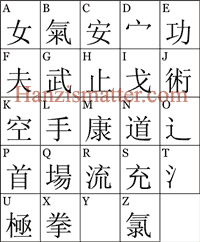
chlorinated alphabet

images of Chinese characters and 'radicals' produced when typing various letters in a fontTian at Hanzismatter always manages to find good stuff. But this time, with the help of Alan Siegrist, he’s outdone himself. I’ve got tears streaming down my face because I’ve been laughing so hard at the font of random characters and so-called radicals that some people have apparently been mistaking for a phonetic guide to Chinese characters.

My title for this entry is in reference to the character given when the letter Z is typed: 氯. This is lǜ, which means “chlorine.”

Festschrift for John DeFrancis now available for free

Most readers of Pinyin News will already know of John DeFrancis, editor of the ABC Chinese-English Comprehensive Dictionary and author of The Chinese Language: Fact and Fantasy and many other important works. (If you haven’t read The Chinese Language: Fact and Fantasy yet, order it now.)

In recognition of the 95th(!) birthday today of Professor DeFrancis, Sino-Platonic Papers is rereleasing Schriftfestschrift: Essays in Honor of John DeFrancis on His Eightieth Birthday. Previously, this important compilation, which runs more than 250 pages, was available only in a printed edition priced at US$35. The fifteenth-anniversary edition, however, is being released for free as a PDF (15 MB — so have a fast Internet connection, or a lot of patience).

I’d like to draw special attention to an article written in Pinyin: “Hanzi Bu Tebie Biaoyi,” by Zhang Liqing. (Zhang’s work also appears here on Pinyin Info, in her translations of The Historical Evolution of Chinese Languages and Scripts and of the amazing Comparing Chinese Characters and a Chinese Spelling Script — an evening conversation on the reform of Chinese characters.)

Feel free to print out a copy of the Schriftfestschrift for your own use or for inclusion in a library. Just don’t sell it.

The original publication contained several color photos. I’ll add those later. Also, the English tex is searchable to some degree, as I used OCR after scanning these pages; but the results weren’t perfect.

Here are the contents:

  • Tabula Gratulatoria
  • Introduction, by Victor H. Mair
  • Publications of John DeFrancis
  • Hanzi Bu Tebie Biaoyi, by Zhang Liqing
  • Typology of Writing Systems, by Zhou Youguang
  • Dui Hanzi de Jizhong Wujie, by Yin Binyong
  • The Information Society and Terminology, by Liu Yongquan
  • A Bilingual Mosaic, by Einar Haugen
  • The Polysemy of the Term Kokugo, by S. Robert Ramsey
  • Memorizing Kanji: Lessons from a Pro, by J. Marshall Unger
  • Why Chinese Is So Damn Hard, by David Moser
  • Ethnolinguistic Notes on the Dungan, by Lisa E. Husmann and William S-Y. Wang
  • Korean Views on Writing Reform, by Wm. C. Hannas
  • Language Policies and Linguistic Divergence in the Two Koreas, by Ho-min Sohn
  • Okinawan Writing Systems, Past, Present, and Future, by Leon A. Serafim
  • Proposal of a Comparative Study of Language Policies and Their Implementation in Singapore, Taiwan, and China (PRC), by Robert L. Cheng
  • The Topical Function of Preverbal Locatives and Temporals in Chinese, by Feng-fu Tsao
  • Yes-No Questions in Taipei and Peking Mandarin, by Robert M. Sanders
  • Patronizing Uses of the Particle ma: Bureaucratic Chinese Bids for Dominance in Personal Interactions, by Beverly Hong Fincher
  • Gender and Sexism in Chinese Language and Literature, by Angela Jung-Palandri
  • A zhezi Anagram Poem of the Song Dynasty, by John Marney
  • Some Remarks on Differing Correspondences in Old Chinese Assumed to Represent Different Chinese Dialects, by Nicholas C. Bodman
  • Can Taiwanese Recognize Simplified Characters?, by John S. Rohsenow
  • Simplified Characters and Their (Un)relatedness, by Chauncey C. Chu
  • The Teaching of Culture and the Culture of Teaching: Problems, Challenges, and Opportunities in Language Instruction, by Eugene Eoyang
  • The Culture Component of Language Teaching, by Kyoko Hijirida
  • Thinking About Prof. John DeFrancis, by Apollo Wu
  • Wo suo Renshi de De Xiansheng, by Chih-yu Ho
  • Two Poems for Professor John DeFrancis, by Richard F. S. Yang
  • Announcement, by Stephen Fleming

Happy birthday, John! And many happy returns!

Aborigines: tuzhu vs. yuanzhumin

In May, a delegation of Aborigines from Taiwan attended the Fifth U.N. Permanent Forum on Indigenous Issues. (Of course, since the United Nations shuns Taiwan, the delegates were able to attend only by registering with a U.S. NGO.) The delegates raised objections to the U.N.’s Mandarin translation of “original inhabitants”/”indigenous peoples” as tuzhu.

The UN’s translation calls Aborigines tu chu [tǔzhù] (土著), which has negative and barbaric implications, the representatives said. They requested the UN instead use yuan chu min [yuánzhùmín] (原住民), which is the term used in this country. Although both terms are translated into English as “original inhabitants,” tu chu [tǔzhù] was too derogatory, they said.

(I’ve added correct Pinyin above in red between square brackets.)

This is not the first time groups have voiced this complaint to the United Nations. (See the sources below.)

Here are some comparative frequencies of use:

total within .tw domains within .cn domains
土著
(tuzhu)
1,130,000 59,500 283,000
原住民
(yuanzhumin)
2,520,000 1,210,00 112,000
土著+原住民
(both tuzhu and yuanzhumin)
49,300 12,000 6,140

Although tuzhu gets used much less of the time in Taiwan than yuanzhumin, it still shows up in significant numbers. So, what’s so bad about tuzhu? Do Taiwan’s aborigines use that word to refer to other people, just not themselves? If so, why? Which word is older? Why the difference between usage in Taiwan and China, and when did it arise?

I don’t have answers here, just questions.

sources: