Questions on the origin of writing: SPP 26

卍 a cross potent, which looks like a plus sign with perpendicular stems on the end of each of the four lines, but not so long as to make a cross in a square; image copied from Wikipedia

Sino-Platonic Papers has rereleased another issue related to the history of writing: Questions on the Origins of Writing Raised by the Silk Road (1.0 MB PDF), by Jao Tsung-i (Ráo Zōngyí, 饒宗頤) of the Chinese University of Hong Kong.

This work focuses especially on the use of two symbols, shown at right, in China and elsewhere.

This is issue no. 26 of Sino-Platonic Papers. It was first published in September 1991.

additional reading:

The Tao of semiotics. Zen and etymology.

Sino-Platonic Papers has rereleased for free Tracks of the Tao, Semantics of Zen (950 KB PDF), by Victor H. Mair.

After a brief introduction, Mair, who has translated more than one classic Taoist text, asks, “How did Tao and Zen enter our vocabulary? And what do these two extraordinarily powerful words really mean?”

He then enters into a “somewhat lengthy excursion into the neglected realm of philology” but keeps to his word to “try to make it as painless and entertaining as possible.”

It’s a fascinating and wide-ranging essay, especially for those interested in historical linguistics.

This is issue no. 17 of Sino-Platonic Papers. It was originally released in April 1990.

An apology

Sorry for the horrible state of the coding in my blog recently. WordPress has not acted well since the last upgrade. So far my attempts to fix the situation have been ineffective and, worse still, have made me even slower than usual to respond to e-mail.

I’m working to resolve this.

Street names in English translation: trend or error?

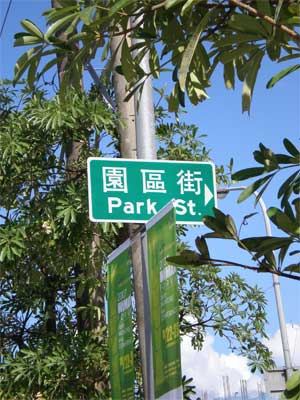
Taipei street sign reading '園區街 Park St.'Ah, Park Street: Taipei’s lovely tree-lined boulevard next to a wonderful oasis of well-manicured nature.

Nope.

Here, “park” refers to Nangang Software Park (Nángǎng Ruǎntǐ Yuánqū, 南港軟體園區), an area in eastern Taipei of new buildings housing mainly software-development and biomedical companies. The software park itself is a pretty nice place and looks fine; its surrounding area, however, is anything but green and leafy, comprising mainly dreary brick buildings and vacant lots.

But what’s odder than the name itself is that it appears in English rather than in the mix of Hanyu Pinyin (with StuPid, StuPid InTerCapITaLiZaTion) and English (e.g., St., Rd.) that has become standard in Taipei. Also odd is that at one end of the street the signs read “Park St,” but at the other end “YuanQu St.” This is a fairly new street name, as the software park is only a few years old.
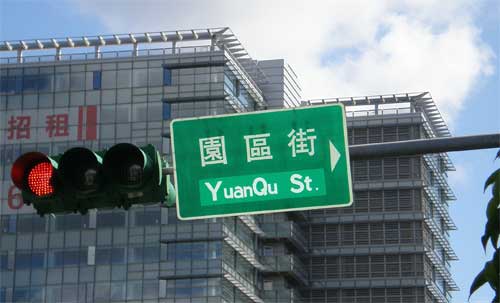
Taipei street sign reading '園區街 YuanQu St.'

The flash on my camera helps reveal that the part of the sign reading “YuanQu St.” is pasted on top of something else — quite possibly “Park St.”

I spent about 15 minutes today getting my phone call to the Taipei City Government transferred from one desk to another before I was able to speak with someone who knew what she was doing. She stated that the Park Street version is in error and would be corrected to Yuanqu Street.

I really wish I’d asked for her extension number, because I’m certain to be making similar calls in the future.


Tailingua.com: an introduction to Taiwanese

My friend Michael Cannings has just unveiled his new Web site on the Taiwanese language, Tailingua. Here is how he introduces it:

Taiwanese is a Chinese language spoken by two-thirds of the population of Taiwan. It forms one dialect of the group known as Southern Min, which has a total of around forty-nine million native speakers, making it the twenty-first most widely-spoken language in the world.

However, there is very little information in English available on the internet (or in print, for that matter) about Southern Min in general, and Taiwanese in particular – a lack that Tailingua is designed to remedy, at least in part.

The site provides concise summaries of romanization and other methods for writing Taiwanese. It also offers fonts, input methods, a list of useful books, and more.

A very promising beginning!

‘Indo-European Vocabulary in Old Chinese’

Sino-Platonic Papers has rereleased for free Indo-European Vocabulary in Old Chinese. A New Thesis on the Emergence of Chinese Language and Civilization in the Late Neolithic Age (2.9 MB PDF), by Tsung-tung Chang of Goethe-Universität.

Here’s the table of contents:

  1. Recent developments in the field of historical linguistics
  2. Monosyllabic structure of Chinese words and Indo-European stems
  3. Tonal accents of Middle Chinese
  4. Preliminaries on the comparison of consonants and vowels
  5. Some IE stems corresponding to Chinese words of entering tone
  6. Middle Chinese tones and final consonants of IE stems
  7. Some IE stems corresponding to Chinese words of rising tone
  8. Some IE stems corresponding to Chinese words of vanishing tone
  9. Some IE stems corresponding to Chinese words of level tone
  10. Reconstruction of Middle Chinese vocalism according to Yün-ching
  11. Old Chinese vocalism
  12. Vocalic correspondences between Chinese and IE
  13. Initials of Old Chinese
  14. Initial consonant clusters in Old Chinese as seen from IE-stems
  15. Proximity of Chinese to Germanic
  16. Relation of Old Chinese to neighboring languages
  17. Emergence of Chinese Empire and language in the middle of the third millennium B.C.

Appendix

  • Abbrevations
  • Bibliography
  • Rhyme Tables of Early Middle Chinese (600)
  • Rhyme Tables of Early Mandarin (1300)
  • Word Index
    • English
    • Pinyin

This was first published in January 1988 as issue no. 7 of the journal.

New story in Pinyin: ‘Dashui Guohuo’ (‘After the Flood’)

I’m very pleased to announce that Pinyin Info has a new story in Hanyu Pinyin: “Dàshuǐ Guòhòu,” by Zhang Liqing. It’s available here in two versions: Pinyin alone and Pinyin with English translation (as “After the Flood”), so one doesn’t even have to know Mandarin or Pinyin to read this.

The story recalls a girlhood friend in China, not long after the end of the Second World War.

Zhang is an associate editor of the ABC Chinese-English Comprehensive Dictionary and has translated a number of important works into English, including Zhou Youguang’s The Historical Evolution of Chinese Languages and Scripts and Lü Shuxiang’s Comparing Chinese Characters and a Chinese Spelling Script — an evening conversation on the reform of Chinese characters.

Indian influence on Chinese popular literature: a bibliography

Sino-Platonic Papers has rereleased for free another book-length back issue: A Partial Bibliography for the Study of Indian Influence on Chinese Popular Literature (10.8 MB PDF), by Victor H. Mair.

Here are the contents:

  • Journals and Works Referred to in Abbreviated Fashion
  • Catalogs of Tun-huang Manuscripts and Bibliographies of Studies on Them
  • Chinese Studies, Texts, Translations, and Dictionaries
  • Japanese and Korean Studies, Texts, Translations, and Dictionaries; Southeast Asian Sinitic Dictionaries
  • South and Southeast Asian and Buddhicized Central Asian Texts, Translations, and Dictionaries (Includes Indic, Tibetan, Uighur, Indonesian, etc.)
  • Near and Middle Eastern Texts, Translations, and Dictionaries
  • Studies and Texts in European Languages (Other than Translations from the Above Groups)
  • Films, Performances, Lectures, Unpublished Manuscripts, and Personal Communications
  • Articles and Books Not Seen

The introduction is also online in quick-loading HTML format.

This was first published in March 1987 as issue no. 3 of Sino-Platonic Papers.