reviews of books related to China and linguistics (2)

Sino-Platonic Papers has just released online its second compilation of book reviews. Here are the books discussed. (Note: The links below do not lead to the reviews but to other material. Use the link above.)

Invited Reviews

  • William A. Boltz, “The Typological Analysis of the Chinese Script.” A review article of John DeFrancis, Visible Speech, the Diverse Oneness of Writing Systems.
  • Paul Varley and Kumakura Isao, eds., Tea in Japan: Essays on the History of Chanoyu. Reviewed by William R. LaFleur .
  • Vladimir N. Basilov, ed., Nomads of Eurasia. Reviewed by David A. Utz.

Reviews by the Editor

  • “Philosophy and Language.” A review article of Françcois Jullien, Procès ou Création: Une introduction a la pensée des lettrés chinois.

Language and Linguistics

  • W. South Coblin, A Handbook of Eastern Han Sound Glosses.
  • Weldon South Coblin. A Sinologist’s Handlist of Sino-Tibetan Lexical Comparisons.
  • ZHOU Zhenhe and YOU Rujie. Fangyan yu Zhongguo Wenhua [Topolects and Chinese Culture].
  • CHOU Fa-kao. Papers in Chinese Linguistics and Epigraphy.
  • ZENG Zifan. Guangzhouhua Putonghua Duibi Qutan [Interesting Parallels between Cantonese and Mandarin].
  • Luciana Bressan. La Determinazione delle Norme Ortografiche del Pinyin.
  • JIANG Shaoyu and XU Changhua, tr. Zhongguoyu Lishi Wenfa [A Historical Grammar of Modern Chinese] by OTA Tatsuo.
  • McMahon, et al. Expository Writing in Chinese.
  • P. C. T’ung and D. E. Pollard. Colloquial Chinese.
  • Li Sijing, Hanyu “er” Yin Shih Yanjiu [Studies on the History of the “er” Sound in Sinitic].
  • Maurice Coyaud, Les langues dans le monde chinois.
  • Patricia Herbert and Anthony Milner, eds., South-East Asia: Languages and Literatures; A Select Guide.
  • Andrew Large, The Artificial Language Movement.
  • Wilhelm von Humboldt, On Language: The Diversity of Hunan Language-Structure and Its Influence on the Mental Development of Mankind.
  • Vitaly Shevoroshkin, ed., Reconstructing Languages and Cultures.
  • Jan Wind, et al., eds., Studies in Language Origins.

Short Notices

  • A. Kondratov, Sounds and Signs.
  • Jeremy Campbell, Grammatical Man: Information, Entropy, Language, and Life.
  • Pitfalls of the Tetragraphic Script.

Lexicography and Lexicology

  • MIN Jiaji, et al., comp., Hanyu Xinci Cidian [A Dictionary of New Sinitic Terms]
  • LYU Caizhen, et al., comp., Xiandai Hanyu Nanci Cidian [A Dictionary of Difficult Terms in Modern Sinitic].
  • Tom McArthur, Worlds of Reference: Lexicography, learning and language from the clay tablet to the computer.

A Bouquet of Pekingese Lexicons

  • JIN Shoushen, comp., Beijinghua Yuhui [Pekingese Vocabulary].
  • SONG Xiaocai and MA Xinhua, comp., Beijinghua Ciyu Lishi [Pekingese Expressions with Examples and Explanations] .
  • SONG Xiaocai and MA Xinhua, comp., Beijinghua Yuci Huishi [Pekingese Words and Phrases with Explanations] .
  • FU Min and GAO Aijun, comp., Beijinghua Ciyu (Dialectical Words and Phrases in Beijing).

A Bibliographical Trilogy

  • Paul Fu-mien Yang, comp., Chinese Linguistics: A Selected and Classified Bibliography.
  • Paul Fu-mien Yang, comp., Chinese Dialectology: A Selected and Classified Bibliography.
  • Paul Fu-mien Yang, comp., Chinese Lexicology and Lexicography: A Selected and Classified Bibliography.

Orality and Literacy

  • Jack Goody. The interface between the written and the oral.
  • Jack Goody. The logic of writing and the organization of society.
  • Deborah Tannen, ed., Spoken and Written Language: Exploring Orality and Literacy.

Society and Culture

  • Scott Simmie and Bob Nixon, Tiananmen Square.
  • Thomas H. C. Lee, Government Education and Examinations in Sung China.
  • ZHANG Zhishan, tr. and ed., Zhongguo zhi Xing [Record of a Journey to China].
  • LIN Wushu, Monijiao ji Qi Dongjian [Manichaeism and Its Eastward Expansion].
  • E. N. Anderson, The Food of China.
  • K. C. Chang, ed., Food in Chinese Culture: Anthropological and Historical Perspectives.
  • Jacques Gemet, China and the Christian Impact: A Conflict of Cultures.
  • D. E. Mungello, Curious Land: Jesuit Accommodation and the Origins of Sinology.

Short Notice

  • Roben Jastrow, The Enchanted Loom: Mind in the Universe.

In Memoriam
Chang-chen HSU
August 6, 1957 – June 27, 1989

  • Hsu Chang-chen, ed., and tr., Yin-tu hsien-tai hsiao-shuo hsüan [A Selection of Contemporary Indian Fiction].
  • Hsu Chang-chen, T’o-fu tzu-huiyen-chiu (Mastering TOEFL Vocabulary).
  • Hsu Chang-chen, Tsui-chung-yao-te i pai ke Ying-wen tzu-shou tzu-ken (100 English Prefixes and Word Roots).
  • Hsu Chang-chen, Fa-wen tzu-hui chieh-koufen-hsi — tzu-shou yü tzu-ken (Les préfixes et les racines de la langue française).
  • Hsu Chang-chen, comp. and tr., Hsi-yü yü Fo-chiao wen-shih lun-chi (Collection of Articles on Studies of Central Asia, India, and Buddhism).

This is SPP no. 14, from December 1989. The entire text is now online as a 7.3 MB PDF.

See my earlier post for the contents of the first SPP volume of reviews and a link to the full volume.
Banqiao’s orificial signage

David, who for just a little while longer lives in the same Banqiao neighborhood as I, sent me a photo of a street sign in our highly populated but little-discussed city.

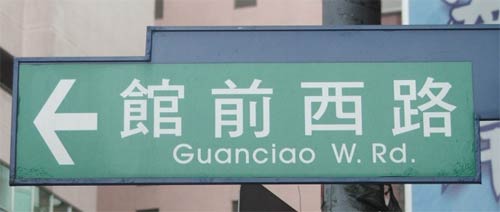
'Guanciao W. Rd.': streetsign in Banqiao, Taiwan, labeled in misspelled Tongyong Pinyin and English

The sign tells us this is “Guanciao” West Road. In Hanyu Pinyin this would be “Guanqiao.” Guanqiao? The only word in my biggest Mandarin-English dictionary under that spelling is guānqiào (關竅/关窍), which is defined as “orifices on the human body.” Hmm. Taiwan might have the questionable taste of having many a road still named after a dead dictator, but orifices?

This oddity is explained by the fact that Banqiao is simply continuing its tradition of typos — even on relatively new signs. (The style of the sign and the choice of Tongyong Pinyin both indicate this went up within the past few years.)

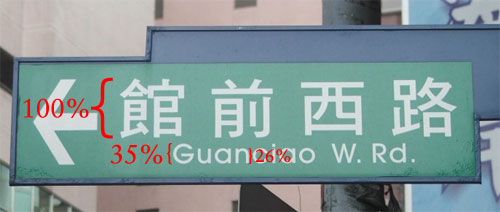
Guanciao (Guanqiao) should be Guancian. (In Hanyu Pinyin, 館前西路 is written Guǎnqián Xīlù.) It’s worth noting this is not a tiny lane but a road in a well-traveled part of town.

As long as I’m putting up yet another post with photos and doing further damage to my reputation of having one of the Taiwan blogosphere’s fastest-loading, least Turtonesque sites*, I might as well go ahead and add one more so I can mention something else about this sign.

Let’s look at the relative size of the Chinese characters and the alphabetic text. The majority of the letters are but one quarter of the height of the Chinese characters.

sign showing the relative percentages of the height of the letters/Hanzi on the sign

Although in this particular case the lettering might not be too small, this style often leads to nearly illegible romanization, especially on signs posted high above streets.

* Just in terms of the average number photos per post, that is. (But that’s in part because I’m a lousy photographer.) Congratulations, Michael, on reaching two thousand posts!

reviews of books related to China and linguistics

Sino-Platonic Papers has just released online its first compilation of book reviews. Here is a list of the books discussed. (Note: The links below do not lead to the reviews but to other material.)

Invited Reviews

  • J. Marshall Unger, The Fifth Generation Fallacy. Reviewed by Wm. C. Hannas
  • Rejoinder by J. Marshall Unger
  • Hashimoto Mantaro, Suzuki Takao, and Yamada Hisao. A Decision for the Chinese NationsToward the Future of Kanji (Kanji minzoku no ketsudanKanji no mirai ni mukete). Reviewed by Wm. C. Hannas
  • S. Robert Ramsey. The Languages of China. Reviewed by Wm. C. Hannas
  • James H. Cole, Shaohsing. Reviewed by Mark A. Allee
  • Henry Hung-Yeh Tiee, A Reference Grammar of Chinese Sentences. Reviewed by Jerome L. Packard

Reviews by the Editor

  • David Pollack, The Fracture of Meaning
  • Jerry Norman, Chinese
  • N. H. Leon, Character Indexes of Modern Chinese
  • Shiu-ying Hu, comp., An Enumeration of Chinese Materia Medico
  • Donald M. Ayers, English Words from Latin and Greek Elements
  • Chen Gang, comp., A Dictionary of Peking Colloquialisms (Beijing Fangyan Cidian)
  • Dominic Cheung, ed. and tr., The Isle Full of Noises
  • Jonathan Chaves, ed. and tr., The Columbia Book of Later Chinese Poetry
  • Philip R. Bilancia, Dictionary of Chinese Law and Government
  • Charles O. Hucker, A Dictionary of Official Titles in Imperial China
  • Robert K. Logan, The Alphabet Effect
  • Liu Zhengtan, Gao Mingkai, et al., comp., A Dictionary of Loan Words and Hybrid Words in Chinese (Hanyu Wailai Cidian)
  • The Mandarin Daily Dictionary of Loan Words (Guoyu Ribao Wailaiyu Cidian)
  • Shao Xiantu, Zhou Dingguo, et al., comp., A Dictionary of the Origins of Foreign Place Names (Waiguo Diming Yuyuan Cidian)
  • Tsung-tung Chang, Metaphysik, Erkenntnis und Praktische Philosophie um Chuang-Tzu
  • Irene Bloom, trans, ed., and intro., Knowledge Painfully Acquired: The K’un-chih chi of Lo Ch’in-shun
  • Research Institute for Language Pedagogy of the Peking College of Languages, comp., Frequency Dictionary of Words in Modern Chinese (Xiandai Hanyu Pinlyu Cidian)
  • Liu Yuan, chief compiler, Word List of Modern Mandarin (Xianhi Hanyu Cibiao)
  • The Editing Group of A New English-Chinese Dictionary, comp., A New English-Chinese Dictionary
  • BBC External Business and Development Group, Everyday Mandarin

This is SPP no. 8, from February 1988. The entire text is now online as a 4.2 MB PDF.

Banqiao signage SNAFU

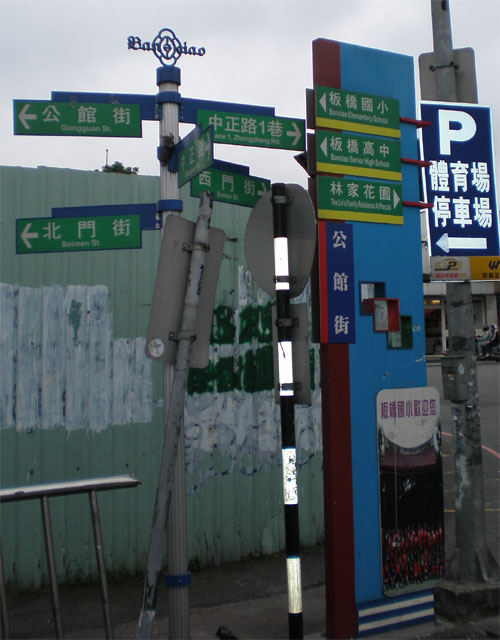
Here’s an example of the mixing of romanization systems and addition of errors that used to be common in Taipei before the city switched to Hanyu Pinyin. These signs are on a corner in Banqiao, Taipei County, not far from Banqiao City Hall.

First, let’s set the scene. We have two types of signs, both with a mix of romanization and English. One set of signs gives street names; the other points toward places of possible interest.
establishing shot of signage (at one corner) discussed in this post

The blue-panel signage on the right represents something introduced during the term of the previous mayor, a member of the Democratic Progressive Party. And since the DPP backs Tongyong Pinyin for Mandarin, that’s the romanization system used most of the time on such signs. A number of the photos on these signs feature the previous mayor, who had relatively little recognition among the public since he had succeeded someone else’s term rather than being elected to his own. He put his photo on all sorts of things. But he failed to be elected to the city’s top spot. His challenger, the current mayor of Banqiao, spreads her name recognition by having her recycling speech broadcast from the city’s trash trucks.

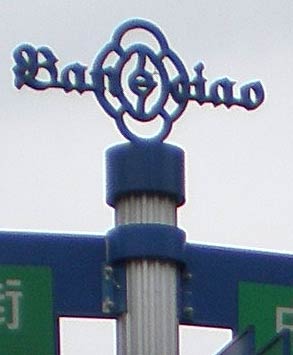
photo of the top piece on a streetsign pole in Banqiao. It reads OK, now note the cap on the signpost. It reads “Ban ciao” in black letter. Although I spotted several of these today, I’d never seen any before, which would mean it’s very likely that a KMT-led city administration under a KMT-led county government is putting up new signs in Tongyong Pinyin, a romanization system the Kuomintang (Guomindang) opposes. (The KMT used to oppose Hanyu Pinyin as well, which is how Taiwan ended up with MPS2, the Tongyong Pinyin of the 1980s.) Similarly, Banqiao has relatively new signs in prominent places around the city that read (in a particularly clumsy script face) “Bravo Banciao.” (What exactly about Banqiao is worthy of such a cheer is not stated.) Even though the city administration is under the mistaken impression that it must use Tongyong (and it does suffer from this idea), that doesn’t mean it has to go around putting up new signage in this.

To get back to the cap, the likely story is that the transportation department had some leftover money in its budget which had to be spent lest the following year’s budget be cut; but rather than spend it on fixing errors, which would involve study and actual work, people decided to make something that the boss thinks would look cool.

I wonder, though, how many Taiwanese would even recognize this reads “Banciao” unless they had it specifically pointed out to them. A few months ago I spotted an innocent-looking teenager shopping with her mother. The girl was wearing a shirt with the following text:

'f uck you' written in black letter

Although it’s almost certain she would know both English words and understand their meaning together, I think it extremely unlikely she knew what words were on her shirt.

OK, let’s have a closer look at the signs themselves.
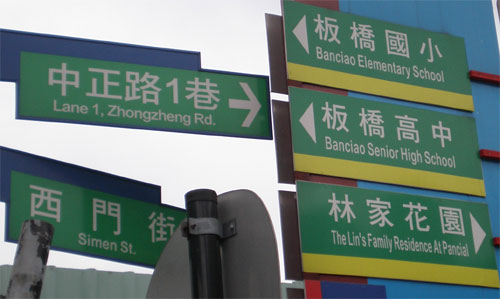
detail of signs discussed in this post

Here we have

  • “Zhongzheng” (Hanyu Pinyin)
  • “Simen” and “Banciao” (Tongyong Pinyin for what would be “Ximen” and “Banqiao” in Hanyu Pinyin)
  • “Panchial” (bastardized Wade-Giles of “Panchiao” plus a typo, for what would be “Banqiao” in Hanyu Pinyin)

And then there’s the matter of “The Lin’s Family Residence At Panchail,” which would be much better written simply “Lin Family Residence” or by the most commonly used English name “Lin Family Gardens.”

So that’s three romanization systems, a typo, and clumsy English on official signage at just one corner — to say nothing of how relatively small the alphabetic text is. And there’s no solution in sight.

And they called for macaronic — groups seek new national anthem for Taiwan

The Taiwan Peace Foundation and the Taiwan Society, which are both non-governmental organizations, are holding a competition for a new national anthem for Taiwan. In the first stage, they are looking just for lyrics. They recommend the use of multiple languages of Taiwan in this and thus also recommend that the submission contain some romanization (“yǐ běnguó yǔyán wéizhǔ, fùzhù pīnyīn wéi jiā, kě jiāohù shǐyòng bùtóng yǔyán”). Given Taiwan’s linguistic situation, I think this is a reasonable approach. Of course, whether it has any chance of becoming officially enacted in the near future is another matter.

Táiwān Hépíng Jījīnhuì hé Táiwān Shè tuīdòng “xīn guógē yùndòng”, jīntiān gōng bù “xīn guógē” zhēng xuǎn bànfǎ, xīwàng jièyóu gōngkāi zhēngqiú hé shèhuì cānyù, xuǎnchū fúhé Táiwān mínzhòng qīpàn, néng gǎndòng mínzhòng de xīn guógē.

Táiwān Hépíng Jījīnhuì biǎoshì, “xīn guógē” yùndòng dì-yī jiēduàn jiāng jìnxíng gēcí zhēng xuǎn, Liùyuè shí’èr rì jiézhǐ shōujiàn, zìshù yǐ wǔshí dào yībǎi zì wéiyí, yǐ běnguó yǔyán wéizhǔ, fùzhù pīnyīn wéi jiā, kě jiāohù shǐyòng bùtóng yǔyán. Jiāng píngxuǎn yōushèng yīzhì wǔ míng, jiǎngjīn xīn tái bì shíwàn yuán, jiāzuò ruògān míng, jiǎngjīn yīwàn yuán.

Dì-èr jiēduàn wéi gēqǔ zhēng xuǎn, bìxū cóng dì-yī jiēduàn yōushèng gēcí zhōng, xuǎnzé yīzhì liǎng shǒu pǔqǔ, chángdù liǎng zhì sān fēnzhōng wéiyí, wǔ fēnzhōng wéixiàn, Bāyuè sānshíyī rì jiézhǐ shōujiàn. Dì-yī míng jiǎngjīn èrshí wàn yuán, dì-èr míng jiǎngjīn shíwàn yuán, dì-sān míng jiǎngjīn wǔwàn yuán, jiāzuò ruògān míng, jiǎngjīn gè yīwàn yuán.

Táiwān Hépíng Jījīnhuì dìzhǐ wéi Táiběi Shì Sōngjiāng Lù yībǎi liùshíbā hào sì lóu, wǎngzhǐ www.twpeace.org.tw.

source: Táiwān Hépíng Jījīnhuì hé Táiwān Shè zhēngqiú xīn guógē (台灣和平基金會和台灣社徵求新國歌), CNA, April 20, 2007

further reading: ROC National Anthem, Wikipedia

Why ‘Beijing’ was spelled ‘Peking’

Sino-Platonic Papers has just released one of its popular back issues as a free PDF. This one, no. 19 (June 1990), deals with the common question of What’s up with that “Peking” spelling, anyway?

As Bosat Man explains in “Backhill / Peking / Beijing”:

The three main contributing factors to the discrepancy between Peking and Beijing are:

  1. a plethora of romanizations
  2. a welter of local pronunciations, and
  3. phonological change over time.

He then goes into detail, especially about the third point. The whole work is just six pages, single spaced. Here it is: “Backhill / Peking / Beijing” (1 MB PDF).

Alice and Humpty Dumpty — in Hanyu Pinyin

Humpty Dumpty and AliceO frabjous day! Finally, I have up on my site a Hanyu Pinyin version of a long section of Y.R. Chao’s delightful Mandarin translation of Through the Looking-Glass.

I’m certain that many will find this easier going than working through the original version in the Gwoyeu Romatzyh romanization system, though I hope that at least some site visitors will use this parallel text (English, Hanyu Pinyin, and Gwoyeu Romatzyh) to better learn that fascinating if somewhat baroque system.

Many thanks to Zhang Liqing for providing me with her carefully prepared Hanyu Pinyin version.

Here’s an excerpt containing most of the famous “glory” exchange between Alice and Humpty Dumpty:

Ālìsī shuō, “Wǒ bù dǒng nǐ zěnme jiào ‘róngyào.'”

Hūndì Dūndì lěngxiàozhe shuō, “Zìrán nǐ bù dǒng a — děi yào děng wǒ lái gàosong nǐ a. Wǒ de yìsi shì shuō, ‘Nǐ zhè jiù bèi rénjia bōdǎo le!'”

Ālìsī shuō, “Kěshi ‘róngyào’ yě bù néng dàng ‘bèi rénjia bōdǎo le’ jiǎng a.”

Hūndì Dūndì shuō, “Hng! yào yòng yī ge zìyǎnr a, wǒ yào tā dàng shénme jiǎng jiù dàng shénme jiǎng — yě bù duō yě bù shǎo.”

Ālìsī shuō, “Zánmen yào wèn de shì, nǐ néng bu neng ná zìyǎnr yīhuǐr dàng zhège, yīhuǐr dàng nàge jiǎng.”

Hūndì Dūndì shuō, “Zánmen yào wèn de shì, dàodǐ shéi zuòzhǔ — jiùshi zhè diǎnr.”

See the more complete version in English, Hanyu Pinyin, and Gwoyeu Romatzyh: Humpty Dumpty in Mandarin Chinese.

Mandarin teaching in Thailand: Taiwanese teachers choosing Hanyu Pinyin

The following quote sums up a recent article on Taiwanese who are teaching Mandarin at universities in Thailand:

jiùsuàn yǒu lǎoshī cǎiyòng ㄅㄆㄇ jiāoxué, zuìzhōng háishi huíguī dào Hànyǔ Pīnyīn, zhìyú Tōngyòng Pīnyīn, gēnběn méiyǒu rén shǐyòng.

(Even if some teachers employ bopo mofo in [the early stages of] their teaching, they still ultimately revert to Hanyu Pinyin. As for Tongyong Pinyin, essentially no one uses it.)

In the penultimate paragraph, a teacher takes what for traditional Chinese education is often seen as a radical position: content over form.

“Wǒmen kěyǐ yòng Hànyǔ Pīnyīn, yòng fántǐzì qù tuīxíng Táiwān wénhuà, zhè shì bu chōngtū de. Wǒ yòng jiǎntǐzì jiǎng Táiwān, dàjiā dōu rènshi Táiwān le, wǒmen yòng Hànyǔ Pīnyīn jièshào Táiwān, dàjiā dōu rènshi Táiwān le.”

(”We can use Hanyu Pinyin and traditional Chinese characters to promote Taiwan culture; these are not conflicting. I use simplified Chinese characters to talk about Taiwan; everyone learned about Taiwan. We use Hanyu Pinyin to introduce Taiwan; everyone learned about Taiwan.”)

In the final paragraph, the reporter editorializes along the same lines. (Editorializing in news articles is a common practice here.) It’s perhaps worthy of note that this comes from what was until recently a KMT-run television network — one that remains very “blue.”

Here’s the whole article:

Táiwān nèibù, jīhū měigé yīzhènzi, jiùyào chūxiàn guānyú “wénzì” de yìshi xíng tài zhēngzhí, bāokuò jiǎntǐzì fántǐzì, bāokuò Tōngyòng Pīnyīn yǔ Hànyǔ Pīnyīn. Hǎoxiàng yòng hé dàlù bù yīyàng de xìtǒng, jiùshì ài Táiwān, jiùshì tūxiǎn Táiwān zhǔtǐ yìshi.

Rán’ér, zhè duì ài Táiwān zhēn de yǒu bāngzhù ma? Duì qiánghuà Táiwān zhǔtǐ yìshi zhēn de yǒu bāngzhù ma?

Zhè shì zài Tàiguó dàxué lǐ, xuéshengmen shàng Zhōngwén kè de qíngkuàng. Suīrán méiyǒu tǒngyī de jiàocái, dàn dàduōshù de lǎoshī shǐyòng de háishi jiǎntǐ Zhōngwén bǎnběn, jiāo de yěshì Hànyǔ Pīnyīn.

Rajamangala Kējì Dàxué Zhōngwén kèchéng zhǔrèn Fú Cuì-lán lǎoshī jiù zhíyán, wèile zài Tàiguó tuīdòng Huáyǔ kèchéng, tā duì Huáyǔ lǎoshī de yāoqiú zhǐyǒu yī ge, jiùshì shǐyòng jiǎntǐ Zhōngwén: “Xiànzài wǒmen yī shuōdào Hànyǔ, tāmen jiù shuō bù xué, juéde Hànyǔ hěn nán, wǒ yào jiéshù zhèige gàiniàn, bāng tā mànmàn de xuéxí, ràng tā zhīdao Hànyǔ bù shì hěn nán de, kěyǐ xué de.”

Shìshíshàng duì dàduōshù de Tàiguó xuésheng láishuō, xuéxí Zhōngwén de dònglì shì yīnwèi Zhōngwén zhújiàn biànchéng qiángshì yǔyán, gōutōng duì tāmen ér yán zuì zhòngyào. Xiàofāng de kǎoliáng bù nán lǐjiě.

Zhìyú pīnyīn fāngshì jiù gèng bùyòng shuō le, jiùsuàn yǒu lǎoshī cǎiyòng ㄅㄆㄇ jiāoxué, zuìzhōng háishi huíguī dào Hànyǔ Pīnyīn, zhìyú Tōngyòng Pīnyīn, gēnběn méiyǒu rén shǐyòng.

Wālái’ālōnggōng huángjiā dàxué (ed.: Walailak University) de Zhōngwén lǎoshī Liú Yǎ-píng shuōchū tā de kǎoliáng: “Zhīqián méiyǒu xiān jiāo ㄅㄆㄇ, tāmen zhíjiē jiēchù Hànyǔ Pīnyīn, jiù huì bèi Yīngwén de niàn fǎ wùdǎo, suǒyǐ hòulái zhǐyào líng chéngdu, wǒ jiù huì xiān jiāo ㄅㄆㄇ, bǎ fāyīn wěnzhù, wěnzhù zhīhòu jiù zhuǎn guòlai jiāo Hànyǔ Pīnyīn, bìjìng Hàn pīn zhēn de shì xiànzài Ōu-Měi guójiā, bǐjiào pǔbiàn de gōngjù.”

Lìngyī wèi yóu Tái-Shī-Dà péixùn qiánwǎng Tàiguó jiāo Zhōngwén de lǎoshī Lín Hóng-zhèng yě zhǐchū, gāng dào Tàiguó shí, yǒu xǔduō Zhōngwén lǎoshī duìyú gāi shǐyòng Hànyǔ Pīnyīn háishi Tōngyòng Pīnyīn ér zhēngzhá, dàjiā zuìhòu dōu xuǎnzé le Hànyǔ Pīnyīn. Bìjìng guójì dà huánjìng shǐyòng de shì Hànyǔ Pīnyīn, tāmen bùnéng ràng Tàiguó xuésheng xuéxí yī tào bùnéng yòng de pīnyīn xìtǒng. Lín Hóng-zhèng yě rènwéi, shǐyòng nǎ yī tào xìtǒng, qíshí gēnběn bìngbù zhòngyào: “Yòng Hànyǔ Pīnyīn jiùshì hóngmàozi jiùshì róng gòng, zhè gēnběn méiyǒu guānxi. Wǒmen kěyǐ yòng Hànyǔ Pīnyīn, yòng fántǐzì qù tuīxíng Táiwān wénhuà, zhè shìbu chōngtū de. Wǒ yòng jiǎntǐzì jiǎng Táiwān, dàjiā dōu rènshi Táiwān le, wǒmen yòng Hànyǔ Pīnyīn jièshào Táiwān, dàjiā dōu rènshi Táiwān le.”

Cóng Tàiguó tuīdòng Huáyǔ kèchéng de jīngyàn lái kàn, guónèi jìnxíng Hànyǔ Pīnyīn Tōngyòng Pīnyīn zhīlèi de zhēngbiàn, qíshí xiāngdāng kěxiào. Yóuqí xiàng Táiwān zhèyàng yī ge xiǎo dǎoguó, zhèngfǔ lǎoshi xiǎngzhe zhèngmíng, xiǎngzhe yào yǔ Zhōngguó dàlù qūgé de xìtǒng, bùguò ràng zìjǐ de guójì kōngjiān gèngwéi xiá’ài. Zěnyàng cáinéng ràng Táiwān zǒu chūqu, nándào zhèxiē yǔ qítā guójiā hùdòng de jīngyàn, hái bù zúyǐ gěi diǎn jǐngxùn ma?

source: Cóng Tàiguó tuīdòng Huáyǔ kèchéng kàn guónèi Huáyǔ yìshi xíng tài zhī zhēng (從泰國推動華語課程看國內華語意識型態之爭), 中廣新聞網 (BCC), March 3, 2007