more Dungan

Since earlier this month when I wrote a post on Dungan-language radio, I’ve discovered that Olli Salmi has some great Dungan material on his website, including a paper he wrote and a couple of stories in Dungan, including one he has translated into English.

And for lagniappe he offers “An Unofficial Practical Orthography for the Kiowa Language.”

Assimilation of Roman letters into the Chinese writing system: 1994 study

The latest rerelease from Sino-Platonic Papers is The Sino-Alphabet: The Assimilation of Roman Letters into the Chinese Writing System (2.3 MB PDF), by Mark Hansell. This was first published in May 1994. Since then, of course, Roman letters have come to be used even more widely in texts written otherwise in Chinese characters.

Here is the introduction:

One of the most striking changes in written Chinese in recent years is the increasingly common use of the Roman alphabet in both loanwords and native coinages. To modern urbanites, vocabulary such as MTV, PVC, kǎlā OK, and B xíng gānyán are not exotica, but are the stuff of everyday life. The explosion of alphabetically-written lexical items is made possible by the systematic assimilation of the Roman alphabet into the standard repertoire of Chinese reader/writers, to create what I have called the “Sino-alphabet”. This paper explores both the formal structure and the function of the Sino-alphabet. Structurally, the Sino-alphabet represents the adaptation of the English alphabet to the Chinese system in terms of 1) discreteness and 2) directionality. Chinese characters (henceforth “Sinograms”) are “discrete” in that each graph represents an independent chunk of phonological material, influenced very little by its neighbors. Roman letters, in contrast, are non-discrete because only in combination with other letters can they form meaningful units of speech. The use of Roman letters as fully discrete entities sets the Sino-alphabet apart from the Roman alphabet as used in other languages, and makes possible its assimilation into the Chinese writing system. In terms of directionality, the Sino-alphabet exhibits the full range of options that are present in Chinese: left-to-right, top-to-bottom, and right-to-left; while the traditional Roman alphabet as used in the West never allows the right-to-left direction.

The main function of the Sino-alphabet has been the adaptation of graphic loans from English. Graphic borrowing has a long tradition in Chinese; for example, graphic loans from Japanese have contributed a great deal to the modern Chinese lexicon (e.g. 科學, 經濟, 幹部 and hundreds of others). The emergence of English as the main source of loan vocabulary, as well as schooling that has exposed the mass of the population to the Roman alphabet, laid the groundwork for graphic borrowing of English vocabulary .Increasing graphic borrowing solidified the position of the Sino-alphabet, which in turn made possible more borrowing. Now firmly established, the Sino-alphabet is available for other functions such as transliteration of foreign or dialectal sounds.

The adaptation of Roman letters into the Chinese system would seem to highlight the difference between alphabetic and morpho-syllabic types of writing systems. Yet it also shows that Roman letters are not inherently alphabetic, and can quite easily change type when borrowed. Throughout the history of writing, the creativity and flexibility of writers and readers have overcome radical structural differences between writing systems and between languages. The development of the Sino-alphabet is proof that the peculiar structure of the Chinese writing system presents no impediment to the internationalization of the Chinese language.

This is issue no. 45 of Sino-Platonic Papers.

Kazakhstan backtracks on move from Cyrillic to Roman alphabet?

The president of Kazakhstan has announced that his country won’t “advance the transformation of the Kazakh alphabet from the Cyrillic to Latin one.”

That he did so in a meeting with the president of Turkey is puzzling, as this is not something likely to please the Turks.

On the other hand, not advancing is not necessarily the same thing as cancelling.

Here’s the full release from Kazakhstan’s news agency:

Kazakhstan’s President Nursultan Nazarbayev offered not to advance the transformation of the Kazakh alphabet from the Cyrillic to Latin one. The Head of the State announced about it upon the results of his talks with President of Turkey Abdullah Gul.

“For 70 years the Kazakhstanis read and wrote in Cyrillic. More than 100 nationalities live in our state. Thus we need stability and peace. We should be in no hurry in the issue of alphabet transformation”, Mr. Nazarbayev noted.

source: Kazakhstan should be in no hurry in Kazakh alphabet transformation to Latin: Nazarbayev, Kazinform, December 13, 2007

See earlier: Kazakhstan plans switch to Latin alphabet, Pinyin News, November 18, 2007

Panama moves toward compulsory Mandarin in schools

A bill that would make the teaching of Mandarin compulsory in all schools in Panama has passed the first of three readings in the Panamanian National Assembly.

In looking for details on this, I found a document on the Panamanian National Assembly’s Web site from September 5, 2005: Que Establece la Enseñanza Obligatoria del Idioma Mandarín, en los Centros Educativos Oficiales y Particulares del Primer y Segundo Nivel de Enseñanza y Se Dictan Otras Disposiciones (PDF).

If that represents the draft that was passed yesterday, here is a quote that may provide important information:

El Ministerio de Educación establecerá la carga horaria necesaria, que garantice el aprendizaje efectivo del idioma desde los primeros niveles de enseñanza, lo cual implica que el estudiante que culmina el bachillerato pueda comunicarse verbalmente y por escrito en mandarín. (emphasis added)

So this isn’t just for spoken Mandarin. Students who gain a bachillerato would be expected to be able to not only speak but also write Mandarin. (Can someone help clarify just what level a bachillerato represents?)

As much as I would like for more people around the world to learn Mandarin, it’s necessary to be blunt here: If the legislators and educators of Panama expect all of that country’s students to achieve literacy in Mandarin through Chinese characters, they are not only living in a fantasy world but also setting up what will certainly be a monumental and expensive failure. If this means, as it probably does, literacy in Chinese characters, the students of Panama have a whole world of frustration waiting for them.

Certainly some students will succeed. But the percent who do will never make it into double digits. Moreover, requiring Mandarin for everyone is not practical but a massive overestimation of the need for Panamanians to be able to communicate in Mandarin. I do not say that is how things ought to be, just that that is how they are … and how they will remain for many years to come. From a practical point of view, which is what legislators ought to be taking when imposing universal requirements, having a high level of English matters much, much more than having a high level of Mandarin, though certainly programs need to be widely available to provide students with the choice to learn Mandarin.

For another approach to the question of achieving literacy in Mandarin, let’s look at the case of Singapore. The majority of those in the city-state are ethnic Chinese, many of whom are native speakers of various Sinitic languages. There’s no shortage of money for education; and there’s no shortage of Mandarin classes or teachers. Official statistics there state that in the year 2000:

  • 82.2 percent of the literate ethnic Chinese population was literate in at least Mandarin
  • 0.7 percent of the literate ethnic Indian population was literate in at least Mandarin
  • 0.3 percent of the literate ethnic Malay population was literate in at least Mandarin

If nearly 20 percent of Singapore’s literate ethnic Chinese population is not literate in Mandarin, and less than 1 percent of the literate ethnic Malay and Indian populations is literate in Mandarin, what chance does Panama think it has of having this succeed with its own decidedly non-Chinese population?

Note: It’s going to be a little tricky to figure out the details of some of Panama’s plan because references to “China” may well be to Taiwan, which Panama recognizes as the Republic of China. So sometimes “China” will mean China (PRC), and sometimes “China” will mean Taiwan (ROC). Expect confusion in news stories about this.

additional sources:

interviews with Y.R. Chao

I’ve just stumbled across a book-length series of interviews with Y.R. Chao (Zhao Yuanren / Zhào Yuánrèn / 趙元任 / 赵元任). Even better: The complete text is available for free on the Web!

China Scholars Series: Chinese linguist, phonologist, composer and author, Yuen Ren Chao. An Interview Conducted by Rosemany Levenson, with an introduction by Mary Haas.

Wow. This is absolutely fabulous. The Bancroft Library of the University of California, Berkeley, deserves praise for this. Other works of interest to readers of Pinyin News are also available; but more about those later, in separate posts.

In case any readers are not familiar with Chao (1892-1982), he was the finest linguist ever to come out of China. He was also a supporter of romanization; he was even the lead creator of an ingenious if somewhat complicated romanization system for Mandarin: Gwoyeu Romatzyh. But there’s no way a few short sentences could do justice to the depth and breadth of Chao’s learning. To get a better idea of the man, read the introduction to the work linked to above — and then read the rest!

Enjoy!

Further reading: Y.R. Chao’s translation into Gwoyeu Romatzyh of the Humpty Dumpty section of Through the Looking-Glass, with Hanyu Pinyin and English

Kazakhstan plans switch to Latin alphabet

Kazakhstan’s Ministry of Education and Science has followed up on suggestions from President Nursultan Nazarbayev by proposing a six-step plan to switch the country from the Cyrillic alphabet to the Latin one. The plan is based on a similar one used in Uzbekistan.

The plan for switching to Latin will have a five-year preparatory stage, during which the practicalities will be worked out. The next step will see publications being printed using the new alphabet, alongside the existing one for the initial changeover period, and the working-age population will be trained in using the new script. Teaching materials using Latin will be introduced into the country’s school system. The final phase will be the consolidation of Latin as the Kazakh language in Cyrillic fades from public use.

The switch is projected to cost US$300 million, though some expect the cost to be higher.

With the country awash with petrodollars from its booming energy sector, financing the switch should not be a problem. It remains to be seen, however, whether officials will retain the political will to press ahead, given that the measure could cause disruption at home, and seems likely to vex one of Kazakhstan’s key allies, Russia.

Along with the usual arguments for alphabet change, in particular promoting the country’s integration into the global economy, officials have argued that a Latin alphabet could help Kazakhstan forge a more cohesive national identity, moving it out from under Russia’s shadow.

“Switching the Kazakh alphabet to Latin means for Kazakhs changing the Soviet (colonial) identity, which still largely dominates the national consciousness, to a sovereign (Kazakh) identity,” the report stated. “Among the many arguments in favor of switching the Kazakh alphabet to Latin, boosting the national identity of the Kazakh people is the main and decisive one.”

This explicit statement marks a break with Kazakhstan’s earlier, low-key approach to discussing the switch to Latin. While Azerbaijan, Turkmenistan and Uzbekistan acted quickly after the 1991 Soviet collapse to embrace Latin script, Kazakhstan took a more cautious route: it did not want to alienate its large Russian-speaking population. In addition, officials felt that with the country in the grip of economic crisis in the early 1990s, changing the alphabet at that time was not a fiscally justifiable move.

The report pulls no punches in identifying the Cyrillic alphabet as being a major barrier to developing a Kazakh national identity: “It [Cyrillic] facilitated and facilitates the orientation of the Kazakh national consciousness towards the Russian language and Russian culture. As a result, Kazakh identity as such remains largely undefined. On this level, moving to Latin will make it possible to form a clearer national identity for Kazakhs.”

Another reason for the switch is linked to the representation of the sounds of the Kazakh language. “In many cases the phonetic nature of Kazakh is not shown according to Cyrillic script,” Professor Kobey Khusayn, director of the Academy of Sciences’ Institute of Linguistics, told EurasiaNet in an interview. As a result, he said, certain Kazakh sounds are not properly represented and this leads to difficulties with correct pronunciation. The introduction of Cyrillic in 1940 was “imposed from above” for ideological reasons, he added, with no consideration of how this alphabet suited the Kazakh language.

Kazinform, the state news agency, already issues news in both the Cyrillic and Latin scripts.

sources:

Taipei to stick with Hanyu Pinyin, despite pressure from central gov’t: mayor

Taipei Mayor Hau Lung-bin (Hǎo Lóngbīn / 郝龍斌) said on Sunday that Taipei will not switch from Hanyu Pinyin to Tongyong Pinyin, despite pressure from the Ministry of the Interior to do so.

Questioned by reporters at the wedding of Taiwan’s top “Go” player, Hau stressed that the Taipei City Government would continue to use Hanyu Pinyin despite the Interior Ministry’s push as it’s the most commonly used pinyin system in the international community.

“Taipei City has decided to continue using Hanyu Pinyin to connect with other countries in the world,” Hau said.

He suggested that the Interior Ministry consult with linguistic scholars and learn to respect their expertise when standardizing the romanization of Taiwan’s place and street names.

Yes, the MOI would do well to follow this advice — as would the Taipei City Government itself. Taipei’s stupid @#$%! InTerCaPiTaLiZaTion and lack of apostrophes are significant errors. And sometimes the lack of tone marks is a problem. And don’t get me started about Taipei’s “nicknumbering” system.

Taipei City is the only city in Taiwan that has adopted Hanyu Pinyin.

This is incorrect. Several cities around Taiwan use Hanyu Pinyin, such as Xinzhu and Taizhong, though none as consistently as Taipei.

TVBS is reporting that Taipei will be forced to switch, which I very much doubt will happen — certainly not before the presidential election in March 2008.

Nèizhèngbù de xíngzhèng mìnglìng yīdàn bānbù, bùyòng sòngjiāo Lìyuàn tóngyì, Táiběi shìzhèngfǔ zhǐyǒu zhàobàn de fèn, 5 nián qián, Mǎ Yīngjiǔ qiángshì zhǔdǎo Hànyǔ Pīnyīn, ràng Táiběi Shì chéngwéi tā yǎnzhōng, gēn guójì jiēguǐ de dūshì, 5 nián hòu, Nèizhèngbù dìngdìng fǎlìng qiǎngpò zhíxíng, gěi le yī jì huímǎqiāng.

TVBS also gives the cost for changing Taipei’s signs at NT$8 million (US$250,000).

The TVBS video gives lots of pictures of signs.

sources:

Taipei City Government screws the English language again

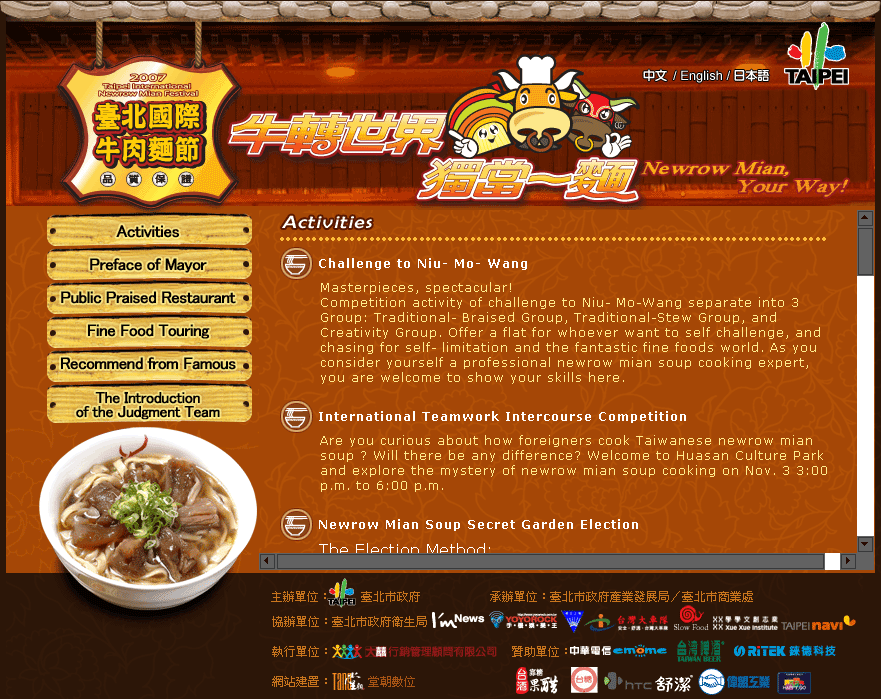
In addition to skewering Tongyong Pinyin in his latest column, Johnny Neihu reports on a new Web site from the Taipei City Government with bizarre romanization and completely crappy English.

However, it hasn’t taken long for things [in Taipei’s English-language environment] to start deteriorating — 11 months to be precise. Mayor Hau Lung-bin (郝龍斌) has already begun to make his mark, if the English moniker of the metropolis’ most recent culinary fiesta is anything to go by.

I am talking about Taipei’s “Newrow Mian” Festival, which, for those ignorant of Mayor Hau’s personal Romanization system, means beef noodles. “Newrow”? It sounds more like the sort of French-accented Mandarin you would expect from a badly congested Inspector Clouseau if they ever made The Pink Panther in Beijing. But then what can you expect from a mayor with a master’s degree in food science?

Any laowai getting into a cab and asking for a lift to the nearest “newrow” store will no doubt be greeted with a look more vacant than that of Hau at a council meeting.

My guess is that the city government brokered some sort of deal on purchasing livestock for the festival with “La New” of shoes fame. The city got the right to use La New’s dodgy transliteration of the Mandarin word for cow, and so the carcasses were split, with the shoe company getting the leather and the noodle festival getting the beef, so to speak.

But the title of the noodle extravaganza was not the only questionable translation circulating last week. One of the festival’s contests was named the “International Teamwork Intercourse Competition.” What that has to do with beef noodles is anyone’s guess, but I bet the tickets sold pretty fast.

The Web site was set up to promote a “festival” for one of Taipei’s standard foods: niúròumiàn (beef noodle soup / 牛肉麵).

This is yet another example of Taiwan trying to promote its English-language environment by using machine-generated Chinglish, and by coming up with Anglicizations that don’t work as romanizations of Mandarin and mean nothing to local Mandarin speakers. Although the sound of the English word “row” is not too far from that of the Mandarin ròu, “new” for niú is a much bigger stretch. In fact, “new” is probably closer to (女), meaning female, which would give us a female flesh festival (nǚ ròu jié). Maybe the organizers could work in that International Teamwork Intercourse Competition after all. Now that would likely be a successful tourist draw, albeit the wrong sort.

This gives me an excuse to toss in something for lagniappe: niúròu chǎng (牛肉場), which literally means “beef area” but which is actually a slang term for a place with strippers — a place to see “meat” on display. (Compare this with English, in which “beefcake” refers to men, not women.) Even within the not-so-high-class world of strip joints, niurou chang are relatively low class.

According to the 2005 Mandarin-language article linked to below, niurou chang began in Taiwan in 1984. The article also provides an etymolgy, though perhaps an invented one.

Biǎoyǎn de nèiróng dōu gēn niúròu wúguān, wèihé jiào niúròu chǎng?

Yuánlái niúròu de Táiyǔ jiù zuò “yǒu ròu,” suǒyǐ lù “ròu,” mài ròu de suǒzài jiù jiào “niúròu chǎng.” Zhèige bù mài ròu què jiào “niúròu chǎng de sèqíng chǎngsuǒ.”

This states that such places were originally called in Taiwanese “have meat,” which sounds like “reveal flesh.” Perhaps Taffy, A-giâu, or someone else who knows Taiwanese can comment.

Just in case the Taipei City Government should develop a sense of shame and fix the English on this Web site (ha!), click on the image for a screen shot of the first page of the English site.
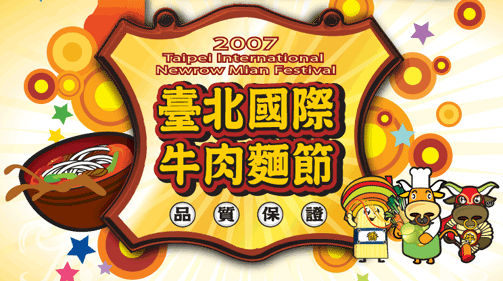
website image reading '2007 Taipei International Newrow Mian Festival' and '臺北國際牛肉麵節' (i.e., Taibei guoji niuroumian jie)

sources: