some common character slips

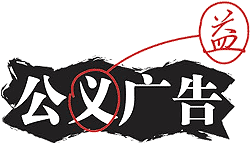
image of '公义广告' with an editor's red pen correcting 义 to 益; the 'correction' is in the originalJoel of Danwei posts on a “public-service announcement” (gongyi guanggao), of sorts, that tells people “Every Chinese person should respect Chinese characters and use Chinese characters properly.” The problem, as the ad puts it, is that “there are a multitude of non-standard uses of Chinese characters in society; mistaken and variant characters are relatively common, harming the elegance and purity of Chinese characters.”

References, especially when written in so-called simplified characters, to the “elegance and purity” of Chinese characters might strike some as lacking in historical perspective if not as downright ironic. Compare, for example, the following:

(traditional) and (simplified)

(traditional) and 广 (simplified)

But, that aside, the ad contains an interesting list of 100 instances of commonly miswritten characters. (Whether all of these are really wrong would make a good subject for another post.)

This ad is, as Joel notes, a roundabout way of touting the Xiandai Hanyu cidian (现代汉语词典), which is one of if not the most popular dictionary in China. The fifth edition was issued last year.

Lü Shuxiang (呂叔湘 / 吕叔湘) (1904-1998), the editor in chief of the first edition of this dictionary, was a strong advocate of romanization, as can be seen in his excellent essay Comparing Chinese Characters and a Chinese Spelling Script — an evening conversation on the reform of Chinese characters (漢字和拼音字的 比較 —-漢字改革一 夕談 / 汉字和拼音字的 比较 —-汉字改革一 夕谈). (The English translation of this was made especially for Pinyin Info by Zhang Liqing, one of the associate editors of the ABC Chinese-English Comprehensive Dictionary.)

source: Characters in the public interest, Danwei, December 13, 2006

Simplified characters inside and outside of the People’s Republic of China

The following is a guest post by Professor Victor H. Mair. All of the Chinese characters other than those in the scanned image are my own addition.

———–

A friend of ours from Taiwan who keeps a sharp eye out for new cancer medicine for my wife recently sent us the announcement of a new drug, and added the following handwritten note at the end:
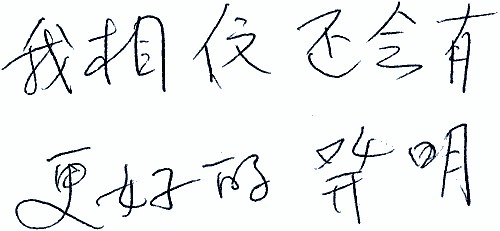
scanned note of Chinese characters. description follows below

xiāngxìn hái huì yǒu
I believe still can there is/are
         
gèng hǎod fāmíng    
more good invention    

“I believe that there will be even better inventions.”

Of the eleven Chinese characters in her note, four were simplified: xìn (亻 rén [“man”] on the left and 文 wén [“civil, writing”] on the right), hái (as on the mainland), huì (as on the mainland), and (癶 Kangxi radical 105 [] on the top as with the original graph, mainland 开 kāi [“open”] on the bottom]).

Here is the text as it would appear in traditional Chinese characters.

我相信還會有
更好的發明.

The text as it would appear in the PRC’s “simplified” Chinese characters, with the different characters in yellow

我相信还会
更好的明.

Note that, of the four simplified characters in this short note, two are nonstandard according to PRC orthography, which has rén (亻 “man”) on the left and yán (言 “speech”) on the right for xìn (信 “trust; letter”), i.e., the graph is unsimplified on the mainland, and a completely different form for (發/发 “emit, occur”). One might have expected that these nonstandard simplified forms would have derived from Japanese forms, since Taiwan has had close cultural ties with Japan during the past century. Yet Japanese orthography does not call for the simplification of xìn at all, and the Japanese simplification of , while similar to the simplified form in our friend’s note, has the bottommost strokes curving toward the left and right, whereas our friend has them going straight down. Our friend’s xìn is not an ad hoc invention by her, because I have often seen it used in informal writing, and it is fairly easy to understand how someone might want to substitute the four-stroke component wén (文 “writing”) for the seven-stroke component yán (言 “speech”) when thinking of the meaning “letter, missive” for this character. Our friend’s , on the other hand, probably is related to the Japanese form, but further simplified so that the effort to curve the last two strokes left and right is eliminated. In addition, the idea of “open, begin” for the bottom component (开 kāi) was undoubtedly in the mind of the person who devised this simplified form, since it comports well with the fundamental meanings of .

What is particularly interesting is that our friend is vocally opposed to the simplification of characters, decrying the mainland communist bandits as destroyers of Chinese civilization, yet she herself uses them regularly and casually, and in her own writing! Indeed, she uses more simplified characters in her writing than are called for by the PRC authorities. The same is true of Chinese writers the world over when they let their hair down and do what comes naturally. The simplification of Chinese characters has been going on for more than two thousand years (see, for example, the many simplified forms in the stele inscriptions of the Six Dynasties period and the profusion of simplified characters in the pinghua [“expository tales”] of the Song period).

I should not neglect to observe that there are also numerous unofficial simplified characters in widespread use on the mainland. For example 午 (“noon” – four strokes) is a common substitute for 舞 (“dance” – 14 strokes [!]), 江 jiāng (“[Yangtze] river” – six strokes) frequently replaces 疆 jiāng (“border” – nineteen strokes [!!]) in Xinjiang (the name of the Uyghur region in the far west), and so forth.

What does all of this boil down to? In a nutshell, people are not fools. They do not want to waste their lives writing a dozen* or more strokes for a single syllable when they can convey the same amount of information in four or five strokes. I contend that the natural process of simplification – without artificial (e.g., heavy-handed government) intervention – inevitably results in the development of a syllabary or an alphabet. In fact, this is what happened with Japanese hiragana and katakana, as well as with the nüshu (“women’s script”) of southwestern Hunan. Absent strong government controls and/or elitist models, the same would happen with mainstream hanzi (“sinographs”) in China, and we even see a tendency toward greater emphasis on phoneticization and de-emphasis on semanticization in the official writing system of the PRC. For instance, 云 yún is used both for “cloud” and “say” (ironically, the graph for “cloud” on the oracle bones started out with the simple form, and the “rain” radical 雨 was only added about a thousand years later with the seal form of the graph), while (“emit, occur”) and (“hair”) share the same graph. This is not, of course, to mention the hundreds of so-called “letter words” (zimuci) that are creeping into Chinese dictionaries, nor the thousands of English words that are invading Chinese speech and writing. But that is a matter for another essay.

==
*The average number of strokes per character is over a dozen for traditional forms and just under a dozen for the complete set of characters that incorporates the official simplified forms. The main reasons why there is not much difference between the two averages are: 1. the vast numbers of characters overall, 2. the relatively few characters that have been officially simplified.

Victor H. Mair
University of Pennsylvania
December 6, 2006

———–

see also Mystery of old simplified Chinese characters?, Pinyin News, October 7, 2005

85 percent of Japanese report weakening of ability to write kanji: poll

I may have understated the headline by using “weakening.” Regardless, though, the figures are dramatic.

People are becoming accustomed to computer-aided input of kanji and thus forgetting how to be able to write them by hand. This is only going to get worse, not better.

For a brief English article on this, see the link below.

「パソコンを始めて漢字が書けなくなった70%、読める漢字が増えた15%」。
6月に行った調査 ではこんな結果が出ているが、最新の調査はどうだろうか。「漢字の日」である12月12日、ニンテンドー DS 用ソフト「 漢検DS 」が、漢字に関する意識調査の結果を発表した。

同調査は10~15歳の“こども”400名、35~40歳の“大人”400名を対象としている。

調査によれば、「漢字を書く機会が減ったと感じている」大人が93%、「ここ何年かで自分の漢字力が低下したと感じている」大人が85%にものぼり、多くの大人が漢字を書く機会が減り、漢字が書けなくなったと感じていることがわかった。

このような結果にもかかわらず、こども世代の過半数以上は「分からない漢字は両親に聞く」と考えている。一方の大人世代では、4人に1人が「漢字を書けなくて恥を書いたシチュエーション」として、「こどもなど、人に聞かれてわからなかった時」と答えた。「親は漢字が分かるもの」というこどもの期待と、親の能力には大きな乖離があるようだ。

漢字力が低下した原因について尋ねるたところ(複数回答)、最も多かった回答は「PC をよく使うから」で87.4%。続いて「携帯電話(携帯メール)をよく使うから」(43.8%)、「年齢をおうことによる記憶力の低下」(41.8%)の順となった。

早稲田大学笹原宏之助教授はこう分析する。「漢字教育が漢字についての応用力を育てるような体系的なものとして行われておらず、また日常生活でも本や新聞などの紙面よりも、テレビやパソコンなど画面の上で漢字を書いたり見たりする機会が増えたためだ」

自分の漢字力を知る方法としては、大人、こどもともに、1位「漢字検定」、2位「漢字勉強用ゲームソフト」、3位「漢字問題集」という結果となった。また、こどもが漢字勉強用ゲームソフトで漢字を勉強することについては、大人の48%が賛成と回答している。

笹原助教授は漢字力低下の要因を、PC などの普及による漢字を書く行為のデジタル化に見出したが、その低下した漢字力を向上させるための学習方法にもデジタル化の波が及んでいるのかもしれない。

ちなみになぜ12月12日が「漢字の日」かといえば、1995年に財団法人日本漢字能力検定協会が「いい(1)じ(2)いち(1)じ(2)」(いい字1字)の語呂合わせで設定したからだという。

sources:

Japan’s kanji of the year: ?

I can’t seem to manage the enthusiasm to talk about the selection now, so maybe commenters can handle this one. (Pretty please!) But at least 命 is more interesting than the kanji of the year for 2005: 愛.

source: 2006年「今年の漢字」応募集計結果発表, December 13, 2006

other reading: Taiwan’s Chinese character of the year, Pinyin News, January 22, 2006

mother-bleeping X’s

Click to enlarge. Taiwanese movie poster for the Western film 'Severance' (斷頭氣). It contains the line '員工旅遊變生死遊戲 真他X的煩 Orz'

Language Log has had quite a few posts in recent months on the bleeping out of letters from obscenities. I’d like to add here an example of something bleeped out of a string of Chinese characters.

The other day I noticed an ad on the side of a bus for the forthcoming British slasher film Severance. (I didn’t get a good photo of this ad, so here I’m using an image of the poster for this movie.) In Mandarin this has the rather uninspired title of Duàntóu qì (斷頭氣: “Severed Head Qi“).

What really caught my eye, however, was the tag line in Chinese characters:

員工旅遊變生死遊戲 真他X的煩 Orz

This is interesting not just for the use of Orz, which is Net slang, but also for the bleeping out of the middle character of the obscenity tāmā de (他媽的, sometimes seen as “tamade“), rendering it 他X的. (Note too that a Roman letter rather than a Chinese character was used for this.)

There’s nothing obscene about the middle character by itself (媽). It’s used in writing words related to (“mother”). For that matter, there’s nothing in the least impolite about any of the characters by themselves or the individual morphemes they represent. The phrase as a whole literally means simply “his mother’s.” But as a whole the phrase works as something that youngsters would get into trouble for saying around their parents or elders and that would probably not be used on television (not without bleeping the subtitles, at least).

Lu Xun (Lǔ Xùn/鲁迅/魯迅) wrote a brief essay about the expression tama de. (For an English translation and notes of Lu Xun’s tama de essay, see Lu Xun on the Chinese “national swear”, an excellent post by Huichieh Loy of From a Singapore Angle.)

Back to the bleeping. As the results of Google searches show, 他媽的 and 他X的 are both common, though the original form is much more so.

  total of all domains within .cn domains within .tw domains
他X的 98,100 22,700 6,960
他媽的 1,910,000 173,000 903,000

Note that .cn (PRC) domains have 23.14% of the total 他X的s but only 9.06% of the total 他媽的s. This difference is probably a result of China’s Net nanny culture. On the other hand, specifically PRC domains still have a lot of 他媽的s. (Or rather 他妈的s, using the so-called simplified form of 媽.) Taiwan domains, however, have more than five times as many, which in the spirit of this post I should probably call a fucking lot of 他媽的s.

Out of curiousity I also ran searches for the other letters of the alphabet and found a spike for the 他M的. The letter M serves here as an abbreviation for the ma of tama de. Accordingly, it’s no surprise to see that 他ma的 is also found and that both 他M的 and 他ma的 are relatively rare in .tw domains (since people in Taiwan aren’t taught romanization).

  total of all domains within .cn domains within .tw domains
他M的 21,200 4,220 128
他ma的 12,400 2,620 168

To my surprise, I also came across a lesser spike for the use of the letter Y: 他Y的

  total of all domains within .cn domains within .tw domains
他Y的 8,450 1,520 14

The 他Y的s are mainly referring to a sadistic Flash game Pìpì chōu tā Y de (屁屁抽他Y的).

But it appears this isn’t really intended to be the letter Y from the Roman alphabet. Instead, Y appears to be used in place of zhuyin fuhao’s similar-looking ㄚ, which represents the sound that Hanyu Pinyin assigns to the Roman letter A. Thus, 他Y的 is not read “ta Y de” but more like “taaa de.” (See Some Things Chinese Characters Can’t Do-Be-Do-Be-Do.) Oddly enough, there are thousands of pages with 他Y的 (Roman letter Y) but just a handful with 他ㄚ的 (bopo mofo ㄚ). This may be from the relative ease of typing the letter Y instead of zhuyin’s ㄚ. Another odd result is that many of the 他ㄚ的s are within .cn domains but in traditional Chinese characters. [Later addition: See the comments for clarification on this.]

Since the subject of zhuyin fuhao came up, I made some additional searches:

  total of all domains within .cn domains within .tw domains
ㄊㄚㄇㄚㄉㄜ 0 0 0
他ㄇㄚ的 142 0 55
他ㄇ的 3,820 16 1,410
ㄊㄇㄉ 408 0 2

“TMD” is another extremely common way to indicate tama de. But too many unrelated results turn up in searches for me to give useful numbers for this.

OK, I’m finally finished with this tama de post.

Zhejiang orders Pinyin, numerals removed from business names

Xinhua is reporting that beginning in March 2007 the names of businesses in China’s Zhejiang Province must use no Hanyu Pinyin or numerals (Arabic numerals, most likely) and must have at least two Chinese characters.

This is reportedly the first time a local Chinese government has made this regulation. (But see also 911 restaurant?!.) Since this is a new regulation, it seems likely that it was created to counter an emerging practice. I expect we’ll hear soon of a crackdown against English in names, too.

Míngnián 3 yuè qǐ, fánshì zài Zhèjiāng de qǐyè jiù bùnéng zài shǐyòng yóu Hànyǔ Pīnyīn Zìmǔ huò shùzì zǔchéng de shānghào le, ér bìxū gǎiyòng yóu liǎng ge yǐshàng Hànzì zǔchéng de shānghào míngchēng.

Jù liǎojiě, zhè shì guónèi shǒu bù guānyú qǐyè shānghào guǎnlǐ hé bǎohù de dìfāngxìng fǎguī.

source: Shānghào yòng Hànzì bù shǎoyú liǎng ge (商号用汉字不少于两个), Xinhua, via Héběi qīngnián bào (河北青年报), December 2, 2006

related reading: Chinese man forbidden to use letter ‘D’ for son’s name, Pinyin News, November 5, 2005

Gaoxiong (Kaohsiung) MRT

Looking through Hao’s photos (linked to in his comment on yesterday’s post) reminded me that the MRT system in Gaoxiong is at least partially open. Since Gaoxiong is in Tongyong land, and since the signage there mixes romanization and English, and since no tone marks are given, I thought I’d share with everyone these Hanyu Pinyin guides I just made.

Here are the stations of the Gaoxiong subway system as given in Hanyu Pinyin (with tone marks), Hanyu Pinyin and English, Chinese characters, and Tongyong Pinyin and English:

See also Hao’s photos of the KMRT.

I don’t know Gaoxiong well, having been there only once, so if I got the word parsing for any of the stations wrong, please let me know.

signage snafus in Taizhong/Taichung/Taijung…

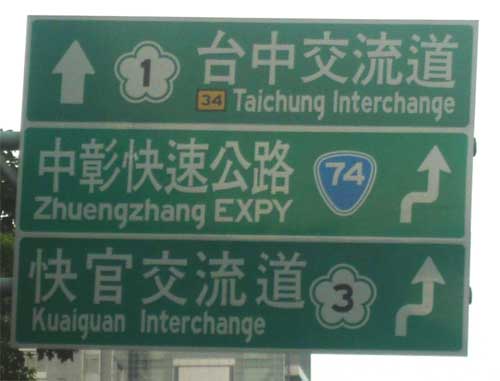
An observant reader, Sonarchic, sent in the top two photos below, both of which were taken in Taizhong (Taichung), Taiwan. The first one is especially interesting in that what would be written zhong in Hanyu Pinyin is here written two different ways: chung and zhueng.

sign with what is written Z-H-O-N-G in Hanyu Pinyin spelled here both C-H-U-N-G and Z-H-U-E-N-G

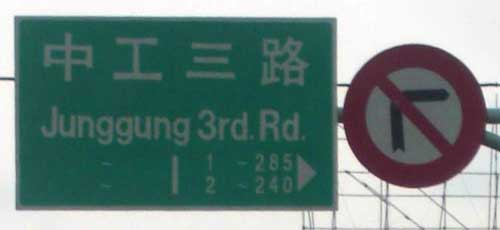
Here’s an older street sign.

sign with what is written Z-H-O-N-G in Hanyu Pinyin spelled here J-U-N-G (MPS2)

I’ve appended two photos I took myself in Taizhong about two years ago.

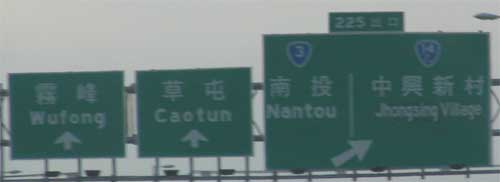
The first was taken on a highway near Taizhong. Since highways are under the central government’s jurisdiction, these signs are in Tongyong Pinyin.

sign with what is written Z-H-O-N-G in Hanyu Pinyin spelled here J-H-O-N-G (Tongyong Pinyin)

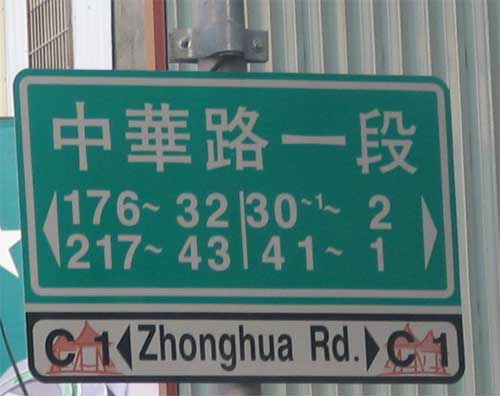
And here is a relatively new street sign with Taizhong itself. Note the use of Hanyu Pinyin, which, despite reports to the contrary, is not limited in Taiwan to Taipei City. I don’t know what “C1” refers to; I certainly hope it’s not a variant of Taipei’s idiotic nicknumbering system. Note also how any mention of the road’s sections (duan) are omitted from the romanization — very bad. Moreover, it has always seemed to me that Taizhong’s street signs suffer from too much information: just look at all those numbers. That can’t be good for readability.

sign with what is written Z-H-O-N-G in Hanyu Pinyin actually spelled Z-H-O-N-G

So, to wrap up, these signs in and near Taizhong, give us:

All that for a simple zhong (中).