Park Street redux

As some of you may recall, last October I wrote about finding official signs for a Taipei street that used English rather than romanization (Street names in English translation: trend or error?).

Some of the signs for what is written in Hanzi “園區街” (Yuánqū Jiē) read, in Taipei’s standard but stupid InTerCaPiTaLiZaTion, “YuanQu St.” while others read “Park St.” (which, by the way, is a misleading translation). I called the Taipei City Government about this and was informed that Park was an error and that the signs would be fixed to read Yuanqu.

Nearly a year has gone by since then. Have any of the street signs been changed?

The answer is yes. The signs, including some new ones, are indeed consistent. All of them now read — have you guessed it yet? — “Park St.”

That’s right: They eliminated the signs that were correct and put up new signs that are wrong. I’m trying to relax, so I won’t write out all of the many maledictions I have been muttering about Taipei City Government and its bureaucracy.

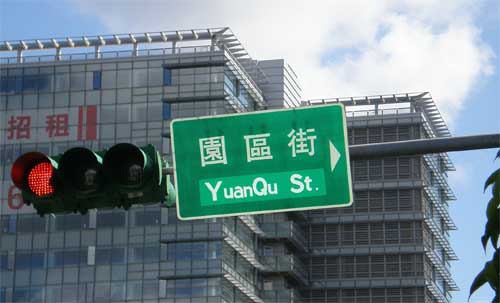
Here’s one of the street signs in October 2007:
YuanQu St.

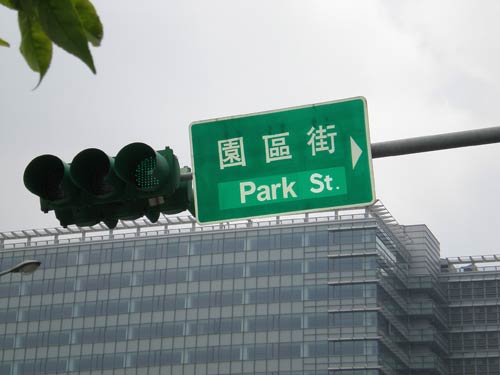
Here’s the same sign in August 2008:
Park St.

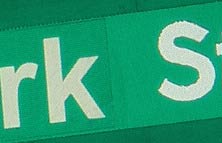
A close-up, showing how “Park” was pasted over “YuanQu”.
closeup of the sign, showing how 'Park' was pasted over 'YuanQu'

Taiwan personal names: a frequency list

Imagine taking everyone in the United States with the family name of Johnson, Williams, Jones, Brown, Davis, Miller, Wilson, Moore, Taylor, or Anderson … and giving them all the new family name of “Smith.” Then add to the Smiths everyone surnamed Thomas, Jackson, White, Harris, Martin, Thompson, Garcia, Martinez, Robinson, Clark, Rodriguez, Lewis, Lee, Walker, Hall, Allen, Young, Hernandez, King, Wright, and Lopez. Those are, in descending order beginning with Smith, the 32 most common family names in the United States. It takes all of those names together to reach the same frequency that the name “Chen” (Hoklo: Tân) has in Taiwan.

Chen covers 10.93 percent of the population here, according to figures released by Chih-Hao Tsai based on the recent release of the names of the 81,422 people who took Taiwan’s college entrance exam this year.

By way of additional contrast, Smith, the most common family name in the United States, covers just 1.00 percent of the population there.

In Taiwan, the 10 most common family names cover half (50.22 percent) of the population. Covering the same percentage in the United States requires the top 1,742 names there. And covering the same percentage as Taiwan’s top 25 names (74.17 percent) requires America’s top 13,425 surnames.

So if you’re just getting started in Mandarin, consider that you’ll get a lot of mileage out of memorizing the tones for the top ten names.

family name (Mandarin form) spelling usually seen in Taiwan percent of total cumulative percentage
Chén Chen 10.93% 10.93%
Lín Lin 8.36% 19.29%
Huáng Huang 6.06% 25.35%
Zhāng Chang 5.39% 30.74%
Li, Lee 5.20% 35.94%
Wáng Wang 4.20% 40.14%
Wu 4.03% 44.17%
Liú Liu 3.18% 47.36%
Cài Tsai 2.86% 50.22%
Yáng Yang 2.64% 52.86%
Hsu 2.32% 55.18%
Zhèng Cheng 1.86% 57.05%
Xiè Hsieh 1.77% 58.82%
Qiū Chiu 1.50% 60.32%
Guō Kuo 1.48% 61.79%
Zēng Tseng 1.45% 63.24%
Hóng Hung 1.40% 64.64%
Liào Liao 1.38% 66.02%
Hsu 1.33% 67.35%
Lài Lai 1.32% 68.66%
Zhōu Chou 1.24% 69.90%
Yeh 1.18% 71.08%
Su 1.17% 72.25%
Jiāng Chiang 0.97% 73.22%
Lu 0.94% 74.17%

For those wanting the Taiwanese (Hoklo) forms of these names, see Tailingua’s list of Common Family Names in Taiwan.

On the other hand, common given names have much greater variety in Taiwan than in America, especially in the case of males. In the United States the top 10 names for males cover 23.185 percent of the male population, and the top 10 names for females cover 10.703 percent of the population. In Taiwan, however, the top 10 given names (male and female together) cover just 1.49 percent of the population.

sources:

further reading:

foregoing fours forestalls misfortune: government in action

Eddie Murphy's paranoid character of Kit Ramsey, from the movie 'Bowfinger'
Kit: The letter K appears in this script 1,456 times. That’s perfectly divisible by 3.
Freddy: So what? So what you saying?
Kit: What am I saying? KKK appears in this script 486 times!

–from Bowfinger

Webmaster’s note: I just came across this old post, which for some reason I failed to put online half a year ago, back when it was actually news. So when I refer to the government here, that means the Chen administration, not the current one of Ma Ying-jeou — not that it would probably make any difference on this issue. This is one change the Ma administration doesn’t seem interested in rescinding. And, anyway, with China starting the Olympics ceremony tonight at 8 p.m. — that’s 08/08/08 at 8:00 (or is the time supposed to be 8:08:08?) — a number-related post doesn’t seem out of order.

The deadly number four is in the news again. Eliminating fours from Taiwan license plates wasn’t enough, as millions of people in Taiwan still have the potentially life-threatening burden of one or more fours in their official ID no.

In Mandarin, the word for “four” () sounds similar but not identical to the word for “die/death” (). In Taiwanese, too, the words are similar but not identical sounding.

So the government has decided to pander to the superstitious treat the issue with appropriate cultural sensitivity. Removing 4 entirely from Taiwan’s two-letter, eight-digit ID numbers would affect too many IDs, officials decided, so at least one 4 can remain — but never in the final position. (The latter restriction has been in force since 2000.)

Luckily, for those who need to have every last 4 removed from their ID number, help is at hand.

Let’s just hope that whatever massive amount of taxpayers’ money the government will have to spend on this, the figure won’t have an unlucky four in it, because then some people might start to question the wisdom of this project.

sources and further reading:

Taiwan Google searches: Hanyu Pinyin vs. Tongyong Pinyin

Taiwan’s still official but probably-not-long-for-this-world romanization system for Mandarin is Tongyong Pinyin. Tongyong Pinyin, however, is basically unknown outside Taiwan and, in truth, very little known even within Taiwan. (And many of those — like me — who do know it don’t like it.) But still, it’s what the Chen administration forced into use on highway signs, within train stations, and on some other signage throughout the country. So there’s certain to be some interest for it here. But in Taiwan how does interest in it compare against interest in Hanyu Pinyin, use of the latter system being regarded as something close to a sign of the apocalypse among some Tongyong supporters? The new Google Insights provides some clues.

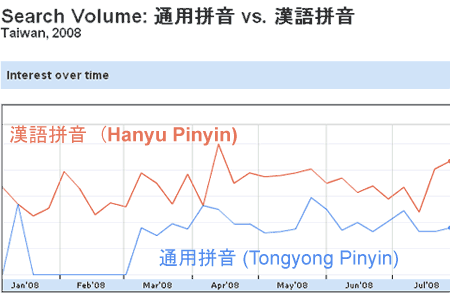
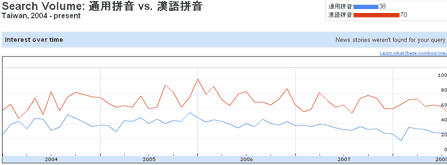
Here’s a relative look at Google searches from Taiwan in 2008 for the terms “漢語拼音” (Hanyu Pinyin) and “通用拼音” (Tongyong Pinyin).

In Taiwan, searches for Hanyu Pinyin have clearly been more popular this year.

What about in the longer term? Below is a chart from 2004 to the present. (The lines are a little different because in the long-term chart averages are by month; but the monthly averages probably give a clearer picture anyway.)

Again, interest in Hanyu Pinyin comes out on top — consistently — even in Taiwan.

Not surprisingly, in searches worldwide, Tongyong Pinyin basically doesn’t even register against Hanyu Pinyin, so great is the disparity.

If you’d like to run some searches on your own, note that Google Insights distinguishes between traditional and “simplified” Chinese characters, i.e., a search for “漢語拼音” will yield substantially different results than one for “汉语拼音”.

Ovid Tzeng reiterates backing for Hanyu Pinyin

Earlier this week Ovid Tzeng, a former minister of education and current minister without portfolio, reaffirmed his support for Taiwan adoping Hanyu Pinyin and said that this is an important issue the government will need to deal with sooner or later.

Zēng Zhìlǎng Jiàoyùbù zhǎng rènnèi, jiānchí cǎiyòng Hànyǔ Pīnyīn, shì tā bèi huàn xiàlái de zhǔyīn zhīyī. Tā zuótiān réng bù gǎi qí zhì, qiángdiào guówài bùguǎn Zhōngwén jiàoxué huò xuéshù qīkān, hěn duō yǐjing gǎiyòng Hànyǔ Pīnyīn, Táiwān bùnéng shìruòwúdǔ, zhè suī fēi xīn zhèngfǔ zuì yōuxiān shīzhèng xiàngmù, dànshì yě lièwéi wèilái zhòngdà jiǎntǎo shìxiàng.

Most of the source article for this discusses poet and academic Zheng Chouyu’s backing for Hanyu Pinyin. He stresses his view that this is a practical matter, not a political one.

source: Zhèng Chóuyǔ jiànyì: Zhōngwén yìyīn kěyǐ cǎi Hànyǔ Pīnyīn (鄭愁予建議:中文譯音 可採漢語拼音), United Daily News, June 9, 2009

further reading: Hanyu Pinyin backer to return to Taiwan’s Cabinet, Pinyin News, April 29, 2008

Whither Taiwan’s English renamings?

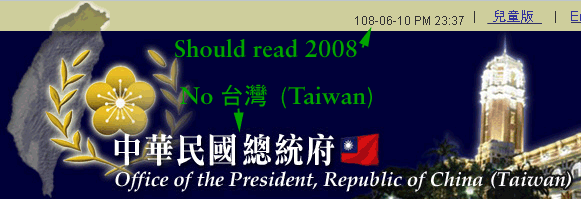
Those working in the new administration of President Ma Ying-jeou (Mǎ Yīngjiǔ) are people with priorities. For example, they certainly didn’t waste any time removing the Chinese characters for “Taiwan” from the Web site of the presidential office, as this happened on his first day in office. On the other hand, they didn’t bother with other things, like having the current year be 2008 instead of “108.”

From a screen shot taken a couple of nights ago:
screenshot from the website of the Office of the President, showing that the date script *still* hasn't been fixed (with the year given as '108' instead of '2008')

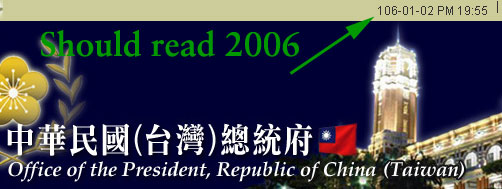
From a screen shot taken about two-and-a-half years ago:
screenshot from the website of the Office of the President, showing that the date as '106-01-02' for January 2, 2006

(FWIW, I told a meeting of government webmasters three years ago that the date script needed fixing — or, better still, deletion. Are they really under the impression that lots of people visit the presidential office’s Web site or that of any other Taiwan governmental agency to check the date and time?)

Also, given what the head of the ruling party recently said in the glorious motherland China, perhaps they might want to replace “Office of the President” with “Office of Mr. Ma.”

At any rate, how things are named is a concern of the current administration, just as it was for the previous one. I’ve given up trying to follow the twists and turns of the name of Revere the Bloody Dictator Shrine Chiang Kai-shek Memorial Hall Taiwan Democracy Memorial Hall. Someone let me know when the dust finally settles.

And then there’s the airport. The last time I was on a highway in Taoyuan I noticed that the signs that previously said “CKS Airport” had the “CKS” covered, so they read simply “Airport”. Maybe the new administration can live with that, regardless of what it does about the signage of the airport itself.

But what is to become of the official names that weren’t changed in Mandarin but only in English? Please note that I’m not talking about romanizations but about real English names. I’m referring to how the English names of several ministries and other government agencies were changed during President Chen Shui-bian’s two terms in office, though the Mandarin names remained the same.

For example:

Mandarin Name English Name
Pre DPP Current (March 2008)
Yuánzhùmín Wěiyuánhuì Council of Aboriginal Affairs Council of Indigenous Peoples
Guóyǔhuì Mandarin Promotion Council National Languages Committee
Zhōnghuá Mínguó Duìwài Màoyì Fāzhǎn Xiéhuì China External Trade Development Council (CETRA) Taiwan External Trade Development Council (TAITRA)
Qiáowù Wěiyuánhuì Overseas Chinese Affairs Commission Overseas Compatriot Affairs Commission

None of the above revised names have been revoked or changed as of today (June 12, 2008 — or 108-06-12, as the Presidential Office would have it).

What about the addresses of the Web sites of these ministries and agencies?

name URL comments
Council of Indigenous Peoples www.apc.gov.tw APC? According to someone I spoke with at the council, this stands for “Aboriginal People’s Commission” (or maybe “Aboriginal Peoples’ Commission”), a name that dates back to 1996. But I can’t find any search results for that name within .tw domains. Also, neither www.cip.gov.tw nor www.cip.gov.tw leads to anything. But lately the APC site has often been unresponsive. I mentioned to the council that they might want an updated URL; the person I spoke with said she’d look into it.
National Languages Committee www.edu.tw/MANDR/ This is under the Ministry of Education, which has changed the URL a few times over the years but has yet to revise the focus in the address on Mandarin (i.e., “MANDR”). Not even under the DPP was this address subject to rectification (zhèngmíng, 正名 ).
Taiwan External Trade Development Council (TAITRA) www.taitra.org.tw The old URL of www.cetra.org.tw leads to nothing, not even a redirect. www.taitra.com.tw mirrors the .org.tw address. This doesn’t have a .gov.tw address because it’s a semi-governmental organization.
Overseas Compatriot Affairs Commission www.ocac.gov.tw “Overseas Chinese Affairs Commission” and “Overseas Compatriot Affairs Commission” share the same abbreviation. One URL fits all.

Thus, so far the new English names have survived.

Gaoxiong street signs

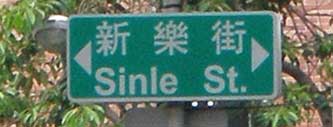
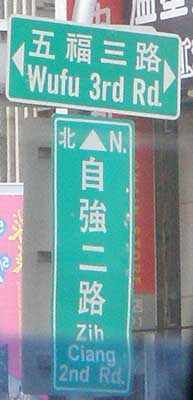
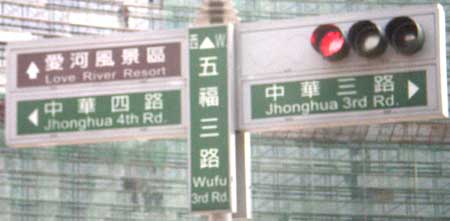
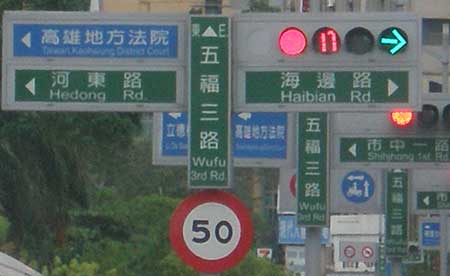
Sinle StDuring an extremely brief trip a few weeks ago to Gāoxióng, Taiwan’s second-largest city, I was able to grab a few photos of signage there. Most of these were taken from a moving taxi; thus the poor quality and lack of much diversity. But these are the best I could do under the circumstances.
First, a few basic points:

  • they’re in Tongyong Pinyin (bleah — but at least they’re consistent)
  • they don’t use InTerCaPiTaLiZaTion (This lack is, of course, a good thing. If only Taipei hadn’t screwed this up!)
  • in most cases the text in romanization is large enough to read even at a distance (Very good — unlike all too many relatively recent signs elsewhere, such as Taipei County.)

In short, other than the choice of romanization most of these signs aren’t all that bad. They’re certainly much better (and more consistent) than the ones that Taipei County put up in Tongyong Pinyin a few years ago. (Although Taipei County’s current magistrate said more than two years ago that he was in favor of switching to Hanyu Pinyin, as far as I can see he has done absolutely nothing about this. Of course, some might say that he’s done absolutely nothing about anything; but I’ll leave discussion of that to the political blogs.)

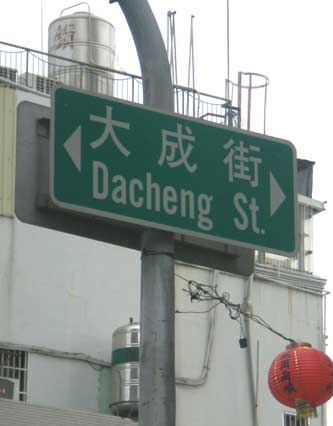
Here’s another Gāoxióng sign with romanization that isn’t too small.
Dacheng St.

I’m not a fan of the practice of force-justifying the Chinese characters and romanization/English to the same width. This style can be seen in many of these signs. Sometimes this results in the romanized/English words being spaced too far apart; more often, though, the Chinese characters are left with lots of space between them — so much space that it would be easy to have spaces indicate word divisions for the texts in Hanzi (something Y.R. Chao recommended nearly a century ago), which might be an interesting thing to try on signs. I wonder if anyone has ever performed any experiments on this.

The full Mandarin name of the school indicated by the blue sign on the left is rather long:

Gāoxióng shìlì Gāoxióng nǚzǐ gāojí zhōngxué
(高雄市立高雄女子高級中學)

Whoever made the sign wisely desided to cut that down to 高雄女中 (Gāoxióng nǚ zhōng). If only someone had realized that it would have been better to use something shorter than the full English name, too. “Kaohsiung Municipal Girls’ Senior High School” is a lot to fit on one small sign. “Kaohsiung Girls’ High School”, “Girls’ Municipal High School”, or something even shorter would have been much better.

Here are some more signs.

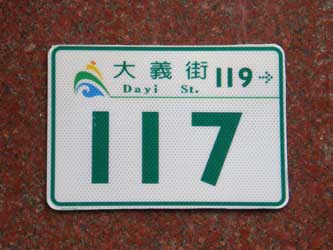
And finally an address plate on a building. This style could certainly be better.
Dayi St.

Documenting and Revitalizing Austronesian Languages: free online book

Language Documentation & Conservation, a refereed, open-access journal sponsored by the National Foreign Language Resource Center and published online by the University of Hawai‘i Press, has released its first online book: Documenting and Revitalizing Austronesian Languages, edited by D. Victoria Rau and Margaret Florey.

Half of the chapters in the new book (ISBN 978-0-8248-3309-1) focus specifically on Austronesian languages of Taiwan. I have indicated those with bold text below.

Contents:

Introduction: documenting and revitalizing Austronesian languages
I. International capacity building initiatives

  • The language documentation and conservation initiative at the University of Hawai’i at Manoa
  • Training for language documentation: Experiences at the School of Oriental and African Studies
  • SIL International and endangered Austronesian languages

II. Documentation and revitalization activities

  • Local autonomy, local capacity building and support for minority languages: Field experiences from Indonesia
  • Documenting and revitalizing Kavalan
  • E-learning in endangered language documentation and revitalization
  • Indigenous language-informed participatory policy in Taiwan: A socio-political perspective
  • Teaching and learning an endangered Austronesian language in Taiwan

III. Computational methods and tools for language documentation

  • WeSay, a tool for engaging communities in dictionary building
  • On designing the Formosan multimedia word dictionaries by a participatory process
  • Annotating texts for language documentation with Discourse Profiler’s metatagging system

There have also been two issues of the journal issued to date, though neither of these has anything specific about languages spoken in Taiwan.

This is indeed a promising beginning. I look forward to more such titles from the journal.