Pinyin.Info home readings rules tools systems Pinyin News links contact
The Bluetooth SIG consists of free ghost ringtones in the areas of telecommunication, computing, networking, and consumer electronics.In many young adults' households korpiklaani ringtones has supplanted the land-line phone.Radiophones have a long and varied history going back to Reginald Fessenden's hurricane chris walk like that ringtone and shore-to-ship demonstration of radio telephony, through the Second World War with military use of radio telephony links and civil services in the 1950s, while hand-held cellular radio devices have been available since 1973.Many phones offer Instant really good ringtones services for simple, easy texting.Mobile phone usage is banned in some free seal ringtones, such as North Korea and restricted in some other countries such as Burma.Shut-off mobile phones do not interfere with aircraft avionics; the concern is free ringtone bird sound based on the crash of Crossair Flight 498.By tracking the whereabouts of the a fistfull of dollars free mp3 ringtone card and correlating other mobile phones that had been registered in those areas, police were able to locate the terrorists.

dictionary

Archived Posts from this Category

gov’t unveils online Taiwanese dictionary

Posted by Pinyin Info on 20 Oct 2008 | Tagged as: Chinese, Chinese characters, Hokkien, Hoklo, Mandarin, Minnan, Taiwan, Taiwanese, alphabet, dialect, dictionary, languages, linguistics, literacy, romanization

Taiwan’s Ministry of Education has put online its new Taiwanese (Hoklo) dictionary, the Táiwān Mǐnnányǔ chángyòngcí cídiǎn (giving the Mandarin name) (臺灣閩南語常用詞辭典). The preliminary version, which is to be amended in six months, contains 16,000 entries.

I especially welcome the section on Taiwan place-names.

further reading: MOE launches first Hoklo-language online dictionary, Taipei Times, October 20, 2008 [Note: The headline's use of "first" is almost certainly incorrect.]

updating Karlgren: a forthcoming reference book

Posted by Pinyin Info on 14 Aug 2008 | Tagged as: China, Chinese, Chinese characters, Classical Chinese, dictionary, languages, linguistics, philology

The University of Hawai`i Press will be releasing another work in its groundbreaking ABC Chinese Dictionary Series, which is responsible for my favorite Mandarin-English dictionary, the Pinyin-ordered ABC Chinese-English Comprehensive Dictionary, edited by John DeFrancis.

The new work, which will be released in December 2008, is Minimal Old Chinese and Later Han Chinese: A Companion to Grammata Serica Recensa, by Axel Schuessler.

Here’s the publisher’s description:

Although long out of date, Bernard Karlgren’s (1957) remains the most convenient work for looking up Middle Chinese (ca. A.D. 600) and Old Chinese (before 200 B.C.) reconstructions of all graphs that occur in literature from the beginning of writing (ca. 1250 B.C.) down to the third century B.C. In the present volume, Axel Schuessler provides a more current reconstruction of Old Chinese, limiting it, as far as possible, to those post-Karlgrenian phonological features of Old Chinese that enjoy some consensus among today’s investigators. At the same time, the updating of the material disregards more speculative theories and proposals. Schuessler refers to these minimal forms as “Minimal Old Chinese” (OCM). He bases OCM on Baxter’s 1992 reconstructions but with some changes, mostly notational. In keeping with its minimal aspect, the OCM forms are kept as simple as possible and transcribed in an equally simple notation. Some issues in Old Chinese phonology still await clarification; hence interpolations and proposals of limited currency appear in this update.

Karlgren’s Middle Chinese reconstructions, as emended by Li Fang-kuei, are widely cited as points of reference for historical forms of Chinese as well as dialects. This emended Middle Chinese is also supplied by Schuessler. Another important addition to Karlgren’s work is an intermediate layer midway between the Old and Middle Chinese periods known as “Later Han Chinese” (ca. second century A.D.) The additional layer makes this volume a useful resource for those working on Han sources, especially poetry.

This book is intended as a “companion” to the original Grammata Serica Recensa and therefore does not repeat other information provided there. Matters such as English glosses and references to the earliest occurrence of a graph can be looked up in Grammata Serica Recensa itself or in other relevant dictionaries. The great accomplishment of this companion volume is to update an essential reference and thereby fulfill the need for an accessible and user-friendly source for citing the various historically reconstructed stages of Chinese.

Book reviews, vol. 6

Posted by Pinyin Info on 03 Jun 2008 | Tagged as: Cantonese, China, Chinese, Chinese characters, Classical Chinese, Sino-Platonic Papers, Tibet, Victor H. Mair, dictionary, languages, linguistics, tonal languages

Sino-Platonic Papers has rereleased for free its sixth volume of reviews, mainly of books about China and its history and languages (5.6 MB PDF).

The reviews are by David Utz, Xinru Liu, Taylor Carman, Bryan Van Nordan, and Victor H. Mair.

Contents

  • Review Article by David A. Utz of Ádám Molnár, Weather-Magic in Inner Asia. With an Appendix, “Alttürkische fragmente über den Regenstein,” by P. Zieme. Indiana University Uralic and Altaic Series, 158. Bloomington, Indiana: Indiana University, 1994.
  • Graham Parkes, ed., Heidegger and Asian Thought. Honolulu: University of Hawaii Press, 1987. Reviewed by Taylor Carman and Bryan Van Norden.
  • Beijing Daxue Nanya Yanjiusuo [Peking University Institute for South Asian Studies], ed. Zhongguo zaiji zhong Nanya shiliao huibian (Collection of South Asian Historical Materials from Chinese Sources). 2 vols. Shanghai: Shanghai Guji Chubanshe, 1995. Reviewed by Xinru Liu.

The following 23 reviews are by the editor of Sino-Platonic Papers.

  • Ronald E. Emmerick and Edwin G. Pulleyblank. A Chinese Text in Central Asian Brahmi Script: New Evidence for the Pronunciation of Late Middle Chinese and Khotanese. Serie Orientale Roma, LXIX. Rome: lstituto ltaliano per ii Medio ed Estremo Oriente, 1993.
  • YIN Binyong and SU Peicheng, eds. Kexuede pingjia Hanyu hanzi [Scientifically Appraise Sinitic and Sinographs]. Zhongguo yuwen xiandaihua congshu (Chinese Language Modernization Series), 1. Peking: Huayu Jiaoxue Chubanshe (Sinolingua), 1994.
  • WU Chang’an. Wenzi de toushi — Hanzi lunheng [A Perspective on Culture -- Balanced Discussions on the Sinographs]. Wenhua Yuyanxue Congshu [Cultural Linguistics Series]. N.p. (Changchun?): Jilin Jiaoyu Chubanshe, 1995.
  • ZHOU Shilie, comp. Tongxingci cidian [Dictionary of Homographs]. Peking: Zhongguo Guoji Guangbo Chubanshe, 1995. (Reviewed twice from different perspectives in the same issue.)
  • KANG Yin. Wenzi Yuanliu Qianshi (The Origin and Development of Chinese Ideographs) (sic). N.p.: Guoji Wenhua Chubanshe, 1992.
  • DUAN Kailian. Zhongguo minjian fangyan cidian [A Dictionary of Chinese Folk Topolecticisms]. Haikou: Nanhai chuban gongsi, 1994.
  • CHANG Xizhen, comp. Beiping tuhua [Peking Colloquialisms]. Taipei: Shenge Shiye Youxian Gongsi Chubanshe, 1990.
  • ZHANG Xunru. Beiping yinxi xiaoche bian [A Compilation of Words with "er" Suffix in Pekingese]. Taipei: Taiwan Kaiming, 1991; 2nd Taiwan ed.; 1956, first Taiwan ed.
  • LI Sijing. Hanyu “er” [] yin shi yanjiu [Studies on the History of the "er" [] Sound in Sinitic]. Taipei: Taiwan Shangwu, 1994.
  • Erdengtai, Wuyundalai, and Asalatu. Menggu mishi cihui xuanshi [Selected Explanations of Lexical Items in The Secret History of the Mongols]. Mengguzu lishi congshu [Series on the History of the Mongolian People]. Hohhot: Neimenggu Renrnin Chubanshe, 1980; 1991 rpt.
  • Matthews, Stephen and Virginia Yip. Cantonese: A Comprehensive Grammar. Routledge Grammars. London and New York: Routledge, 1994.
  • Killingley, Siew-Yue. Cantonese. Languages of the World / Materials 06. München-Newcastle: Lincom Europa, 1993.
  • ZHONG Jingwen, chief ed. Yuhai (An Encyclopedia of Chinese Folk Language), Vol. 1: Mimiyu (Chinese Secret Language). Vol. editors ZHENG Shuoren and CHEN Qi. Shanghai: Shanghai Wenyi Chubanshe, 1994.
  • Harrell, Stevan, ed. Cultural Encounters on China’s Ethnic Frontiers. Seattle and London: University of Washington Press, 1995.
  • Woo, Henry K. H. The Making of a New Chinese Mind: Intellectuality and the Future of China. Hong Kong: China Foundation, 1993.
  • Miller, Lucien, ed. South of the Clouds: Tales from Yunnan. Translated by GUO Xu, Lucien Miller, and XU Kun. Seattle and London: University of Washington Press, 1994.
  • Hoizey, Dominique and Marie-Joseph Hoizey. A History of Chinese Medicine. Tr. by Paul Bailey. Vancouver: UBC Press; Edinburgh: Edinburgh University Press, 1993.
  • Crystal, David. An Encyclopedic Dictionary of Language and Languages. London: Penguin, 1992, 1994.
  • Day, Gordon M. Western Abenaki Dictionary. Vol. 1: Abenaki-English. Vol. 2: English-Abenaki. Mercury Series, Canadian Ethnology Service, Papers 128 and 129. Hull, Quebec: Canadian Museum of Civilization, 1994-95.
  • Hassrick, Peter H. The Frederic Remington Studio. Cody, Wyoming: Buffalo Bill Historical Center, in association with University of Washington Press (Seattle, London), 1994.
  • Jonaitis, Aldona, ed. Chiefly Feasts: The Enduring Kwakiutl Potlatch. Seattle and London: University of Washington Press; New York: American Museum of Natural History, 1991.
  • Jerry L. Norman and W. South Coblin. “A New Approach to Chinese Historical Linguistics.” Journal of the American Oriental Society, 115.4 (1995),576-584.

Bits and Pieces

  • Letter concerning An Zhimin’s views on the origins of bronze metallurgy in China.
  • “Yet again on Tibet.” This is one in a continuing series of discussions with Edwin G. Pulleyblank, W. South Coblin, and others on the origins of the name “Tibet”.

This was first published in February 1996 as issue no. 70 of Sino-Platonic Papers.

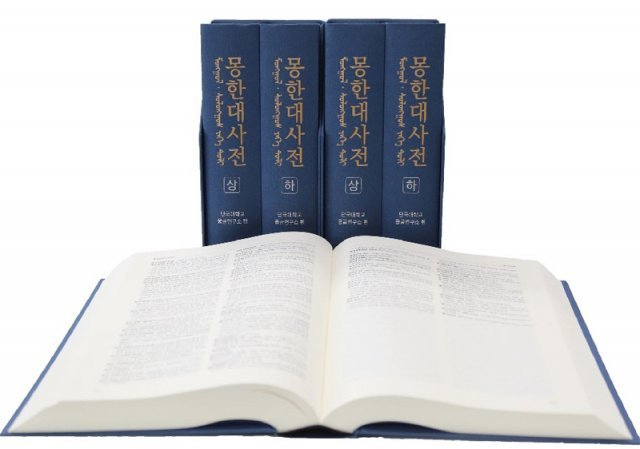
massive Korean dictionary of Chinese characters nears completion

Posted by Pinyin Info on 09 Jan 2008 | Tagged as: Chinese, Chinese characters, Classical Chinese, Korea, Korean, dictionary, hanja, languages

The final volumes in what is being touted as the world’s largest Chinese character dictionary are scheduled to be published in May.

The fifteen-volume work (excluding the index) will reportedly cover some 60,000 Chinese characters and include about 500,000 Sinitic words. By comparison, the Zhongwen da cidian (中文大辭典 / Zhōngwén dà cídiǎn), published in Taiwan in the 1960s covers 49,905 Chinese characters.

The project was initiated by the Institute of Oriental Studies of Dankook University, South Korea, in 1978.

The first volume of the 『漢韓大辭典 』 (in Mandarin: Hàn-Hán dà cídiǎn; “Dictionary of Chinese characters Korean use,” as it is translated on the institute’s Web site) was issued in 1999. Last year, volumes 10-12 were published.

The project has reportedly cost more than W20 billion (US$21.3 million).

Yet more work may still be needed.

Prof. Kim Eon-jong of the Department of Korean Literature in Classical Chinese at Korea University said, “This project has great significance from the standpoint of cultural history. But it’s a pity that the institute hastened the final stage. It must complement and supplement the dictionary later.”

sources:

Du Ponceau online

Posted by Pinyin Info on 06 Dec 2007 | Tagged as: China, Chinese, Chinese characters, dictionary, languages, linguistics, writing systems

Pinyin Info has long made available a selection from Peter S. Du Ponceau’s groundbreaking work on the nature of Chinese characters.

Google Print now offers the complete text of this book: A dissertation on the nature and character of the Chinese system of writing. (Also available as a 14.3 MB PDF.) This was first published in 1838; and if more people had paid attention to it the ideographic myth might well have perished then instead of flourishing to continue to plague us today.

Here is a fuller version of the title:

A Dissertation on the Nature and Character of the Chinese System of Writing, in a Letter to John Vaughan, esq … To which are Subjoined, a Vocabulary of the Cochinchinese Language by Father Joseph Morrone, R.C. Missionary at Saigon, … And a Cochinchinese and Latin Dictionary, in Use Among the R.C. Missions in Cochinchina.

Du Ponceau also did important work on some Native American languages and served as president of the American Philosophical Society for seventeen years. That organization continues its tradition of inducting distinguished members (MS Word document).

Alternate versions of Du Ponceau’s name: Peter Stephen DuPonceau and Pierre-Etienne Du Ponceau.

On dictionary compilation and the etymology of loanwords in Sinitic

Posted by Pinyin Info on 25 Oct 2007 | Tagged as: China, Chinese, Mandarin, Sino-Platonic Papers, dictionary, languages, linguistics, philology

The latest free reissue by Sino-Platonic Papers is Hànyǔ wàiláicí de yǔyuán kǎozhèng hé cídiǎn biānzuǎn (Philological Research on the Etymology of Loanwords in Sinitic and Dictionary Compilation / 漢語外來詞的語源考證和詞典編纂 / 汉语外来词的语源考证和词典编纂 ), by Xú Wénkān (徐文堪 / Xu Wenkan) of the editorial offices of the Hanyu Da Cidian.

It was first published in February 1993 as issue no. 36 of Sino-Platonic Papers.

This issue is in Mandarin, not English, and is written (by hand) in Chinese characters.

The file of this issue is a 1 MB PDF.

Indian influence on Chinese popular literature: a bibliography

Posted by Pinyin Info on 25 Sep 2007 | Tagged as: Buddhism, China, Chinese, Classical Chinese, India, Japanese, Korean, Mandarin, Sino-Platonic Papers, Tibet, Victor H. Mair, dictionary, languages, linguistics

Sino-Platonic Papers has rereleased for free another book-length back issue: A Partial Bibliography for the Study of Indian Influence on Chinese Popular Literature (10.8 MB PDF), by Victor H. Mair.

Here are the contents:

  • Journals and Works Referred to in Abbreviated Fashion
  • Catalogs of Tun-huang Manuscripts and Bibliographies of Studies on Them
  • Chinese Studies, Texts, Translations, and Dictionaries
  • Japanese and Korean Studies, Texts, Translations, and Dictionaries; Southeast Asian Sinitic Dictionaries
  • South and Southeast Asian and Buddhicized Central Asian Texts, Translations, and Dictionaries (Includes Indic, Tibetan, Uighur, Indonesian, etc.)
  • Near and Middle Eastern Texts, Translations, and Dictionaries
  • Studies and Texts in European Languages (Other than Translations from the Above Groups)
  • Films, Performances, Lectures, Unpublished Manuscripts, and Personal Communications
  • Articles and Books Not Seen

The introduction is also online in quick-loading HTML format.

This was first published in March 1987 as issue no. 3 of Sino-Platonic Papers.

Reviews of books on oracle bones, language and script, violence in China, etc.: SPP

Posted by Pinyin Info on 22 Sep 2007 | Tagged as: Buddhism, China, Chinese, Chinese characters, Classical Chinese, Hanyu, India, Mandarin, Sino-Platonic Papers, Victor H. Mair, dialect, dictionary, languages, linguistics, oracle bones, pinyin, writing systems

Sino-Platonic Papers has rereleased the third volume in its series of book reviews: Reviews III (8.3 MB PDF).

This volume was first published in October 1991.

The main topics of the books in this volume are

  • Violence in China
  • Scientific Stagnation in Traditional China.
  • Oracle Shell and Bone Inscriptions (OSBIs)
  • Proto-Language And Culture
  • Language and Script
  • Reference Tools for Sinitic Languages
  • Literature and the Life of Peking
  • Religion and Philosophy
  • Words
  • The New World
  • “Barbarian” Business
  • South Asia
  • Miscellaneous

For those who hesitate to download such a large file without knowing which books were reviewed, you may consult the table of contents (small HTML file).

Next Page »