Pinyin.Info home readings rules tools systems Pinyin News links contact

September 2007

Monthly Archive

New story in Pinyin: ‘Dashui Guohuo’ (’After the Flood’)

Posted by site admin on 29 Sep 2007 | Tagged as: China, Chinese, English, Hanyu, Mandarin, pinyin, tone marks

I’m very pleased to announce that Pinyin Info has a new story in Hanyu Pinyin: “Dàshuǐ Guòhòu,” by Zhang Liqing. It’s available here in two versions: Pinyin alone and Pinyin with English translation (as “After the Flood”), so one doesn’t even have to know Mandarin or Pinyin to read this.

The story recalls a girlhood friend in China, not long after the end of the Second World War.

Zhang is an associate editor of the ABC Chinese-English Comprehensive Dictionary and has translated a number of important works into English, including Zhou Youguang’s The Historical Evolution of Chinese Languages and Scripts and Lü Shuxiang’s Comparing Chinese Characters and a Chinese Spelling Script — an evening conversation on the reform of Chinese characters.

Indian influence on Chinese popular literature: a bibliography

Posted by site admin on 25 Sep 2007 | Tagged as: Buddhism, China, Chinese, Classical Chinese, India, Japanese, Korean, Mandarin, Sino-Platonic Papers, Tibet, Victor H. Mair, dictionary, languages, linguistics

Sino-Platonic Papers has rereleased for free another book-length back issue: A Partial Bibliography for the Study of Indian Influence on Chinese Popular Literature (10.8 MB PDF), by Victor H. Mair.

Here are the contents:

  • Journals and Works Referred to in Abbreviated Fashion
  • Catalogs of Tun-huang Manuscripts and Bibliographies of Studies on Them
  • Chinese Studies, Texts, Translations, and Dictionaries
  • Japanese and Korean Studies, Texts, Translations, and Dictionaries; Southeast Asian Sinitic Dictionaries
  • South and Southeast Asian and Buddhicized Central Asian Texts, Translations, and Dictionaries (Includes Indic, Tibetan, Uighur, Indonesian, etc.)
  • Near and Middle Eastern Texts, Translations, and Dictionaries
  • Studies and Texts in European Languages (Other than Translations from the Above Groups)
  • Films, Performances, Lectures, Unpublished Manuscripts, and Personal Communications
  • Articles and Books Not Seen

The introduction is also online in quick-loading HTML format.

This was first published in March 1987 as issue no. 3 of Sino-Platonic Papers.

A nose for foreign food?

Posted by site admin on 25 Sep 2007 | Tagged as: Banqiao, Chinese, Chinese characters, Hokkien, Hoklo, Minnan, Taiwan, Taiwanese, bopomofo, literacy, writing systems, zhuyin

Imagine some white guys in a fairly large U.S. city open a restaurant named “Mr. Taiwan Slant-Eyes Asian Cuisine.” And imagine that this restaurant specializes in distinctly Americanized dishes such as egg foo yong, fortune cookies, and California wraps. Now imagine the response. Isn’t this fun?

OK, now imagine a different situation: In Taiwan’s fifth-largest city some locals open a place specializing in Taiwanized Western food and dub their restaurant “Miss UK Cafe Pointy-Nose Foreign Food.”

As you’ve probably guessed, the second scenario is real. The “Miss UK Cafe ㄚ度仔 異國美食” (Miss UK Cafe a-tok-a yìguó měishí) recently opened not far from my apartment in Banqiao.

A-tok-a (ㄚ度仔) is Taiwanese for “pointy nose” (i.e., Westerner), though perhaps the common translation of “big nose” conveys the spirit a little better. As Tempo Gain explains in the Forumosa thread on this word, “the initial ‘a’ often preceds names, and the final ‘a’ often is attached to nouns like the Mandarin ‘zi’ haizi, chezi, etc.”

Although most foreigners I know in Taiwan find the use of a-tok-a offensive to some degree, reactions are usually tempered by the knowledge that the word is very seldom used intentionally as a pejorative. It’s just the word most Hoklo speakers would use for “Westerner,” and they mean nothing bad by this and perhaps even see it as “cute” in a favorable way. So since I’m certain the restaurateurs didn’t intend any insult in choosing this name, I’m not going to carp about this any more than I already have — which is not to say that I will ever buy anything from that restaurant.

It’s still an interesting name, though. (Actually, this is probably two names: the standard one (ㄚ度仔 異國美食), which is for most people, and the English one (Miss UK Cafe), which is probably there in an attempt to look modern/foreign/cool.)

For those keeping count, that’s three scripts and as many languages on just one sign.

  • Miss UK Cafe: English, in the Roman alphabet
  • ㄚ度仔: Taiwanese, in a mixed script of zhuyin (ㄚ) and Chinese characters
  • 異國美食: Mandarin, in Chinese characters

The mixing of scripts in “ㄚ度仔” is representative of the sad fact that most people in Taiwan are unsure how to write Taiwanese. Here are some of the ways this word gets written, along with the number of Google results and Baidu results for that exact phrase.

  • ㄚ度仔 Google 555 / Baidu doesn’t recognize the ㄚ
  • 阿凸仔 3,440 / Baidu 1,320
  • 阿多仔 6,730/ Baidu 13,400
  • 阿卓仔 11,300 / Baidu 2,810
  • 阿荳仔 12,500 / Baidu 24,700
  • 阿豆仔 12,500 / Baidu 24,700 (Google and Baidu apparently refuse to differentiate 荳 and 豆)

Also interesting is the use of yìguó (異國) instead of the more common wàiguó (外國), for “foreign.”

  • “異國” Google 1,510,000 / Baidu 14,700,000
  • “外國” Google 6,420,000 / Baidu 46,500,000

Yìguó měishí, however, is more common than wàiguó měishí.

  • “外國美食” Google 41,100 / Baidu 26,400
  • “異國美食” Google 114,000 / Baidu 152,000

This, I suspect, is because yìguó měishí “sounds fancier” because of how relatively common the word waiguo is.
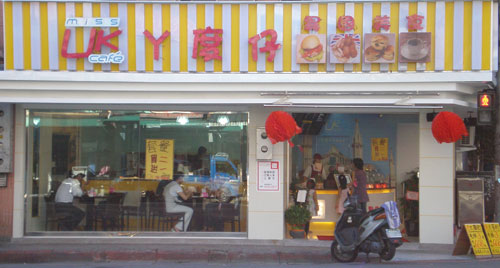
photo of the storefront of the restaurant discussed in this post

further reading:

Reviews of books on oracle bones, language and script, violence in China, etc.: SPP

Posted by site admin on 22 Sep 2007 | Tagged as: Buddhism, China, Chinese, Chinese characters, Classical Chinese, Hanyu, India, Mandarin, Sino-Platonic Papers, Victor H. Mair, dialect, dictionary, languages, linguistics, oracle bones, pinyin, writing systems

Sino-Platonic Papers has rereleased the third volume in its series of book reviews: Reviews III (8.3 MB PDF).

This volume was first published in October 1991.

The main topics of the books in this volume are

  • Violence in China
  • Scientific Stagnation in Traditional China.
  • Oracle Shell and Bone Inscriptions (OSBIs)
  • Proto-Language And Culture
  • Language and Script
  • Reference Tools for Sinitic Languages
  • Literature and the Life of Peking
  • Religion and Philosophy
  • Words
  • The New World
  • “Barbarian” Business
  • South Asia
  • Miscellaneous

For those who hesitate to download such a large file without knowing which books were reviewed, you may consult the table of contents (small HTML file).

‘Slips of the Tongue and Pen in Chinese’

Posted by site admin on 12 Sep 2007 | Tagged as: China, Chinese, Chinese characters, Hanyu, Mandarin, Sino-Platonic Papers, languages, linguistics, literacy, psycholinguistics, tonal languages, writing systems

David Moser wrote his highly popular work Why Chinese Is So Damn Hard (found right here on Pinyin Info) in the early 1990s. Around the same time he contributed another more academic but still highly readable essay to Sino-Platonic Papers, this one on the topic of “Slips of the Tongue and Pen in Chinese.”

This work has just been reissued for free (2.9 MB PDF).

International Literacy Day

Posted by site admin on 07 Sep 2007 | Tagged as: literacy

The International Taiwan-Denial Association United Nations has declared September 8 International Literacy Day.

blog: Talking Taiwanese

Posted by site admin on 07 Sep 2007 | Tagged as: Hokkien, Hoklo, Minnan, Taiwanese, languages, linguistics

Talking Taiwanese is a great new blog featuring long, detailed posts that often compare and contrast Taiwan’s linguistic situation with that of other places (e.g., Catalonia, Friesland, Galicia). Taiwan’s failure to institute meaningful language programs in Taiwanese is another frequent topic.

Talking Taiwanese started so strong, with a torrent of posts, that I more than half expected the author, Johan, to burn out. But although the rate of new posts there has slowed a little, Talking Taiwanese is still going strong. Check it out.

My only excuse for not mentioning this earlier is that I’m behind on everything lately. I first heard about this blog from David of David on Formosa, who often puts up great links.

Unusual Venezuelan names and the law

Posted by site admin on 05 Sep 2007 | Tagged as: general

China has attempted to block personal and now place names with unusual Chinese characters and even prevent names using a perfectly usual Roman letter and numbers, but authorities in Venezuela are trying to limit personal names themselves to just 100(!), with exemptions for Indians and foreigners, according to an article in the New York Times.

Goodbye, Tutankamen del Sol.

So long, Hengelberth, Maolenin, Kerbert Krishnamerk, Githanjaly, Yornaichel, Nixon and Yurbiladyberth. The prolifically inventive world of Venezuelan baby names may be coming to an end.

If electoral officials here get their way, a bill introduced last week would prohibit Venezuelan parents from bestowing those names — and many, many others — on their children.

The measure would not be retroactive. But it would limit parents of newborns to a list of 100 names established by the government, with exemptions for Indians and foreigners, and it is already facing skepticism in the halls of the National Assembly….

The bill’s ambition, according to a draft submitted to municipal offices here for review, is to “preserve the equilibrium and integral development of the child” by preventing parents from giving newborns names that expose them to ridicule or are “extravagant or hard to pronounce in the official language,” Spanish.

The bill also aims to prevent names that “generate doubts” about the bearer’s gender….

Not everyone denounces the bill. Temutchin del Espíritu Santo Rojas Fernández, 25, a computer programmer, explained that his first name was inspired by the birth name of Genghis Khan, often spelled Temujin in English. He said he frequently had to correct the spelling of his name on official documents.

And in Venezuela, where the tax authorities require name and national identity number for every purchase needing a receipt, pronouncing and spelling out Temutchin del Espíritu Santo can get tiring, Mr. Rojas Fernández said. “With a name this complicated, you lose time,” he said.

“It also creates social problems,” he continued. “When interacting with others, not everyone can pronounce your name. I have to pronounce my name five times and spell it twice.”

source: A Culture of Naming That Even a Law May Not Tame, New York Times, September 4, 2007

Next Page »