story in Pinyin

Zhang Liqing has submitted another item written in Hanyu Pinyin. This time it’s a story, “Lā Tuǐ,”, by Táo Dàzú (Christopher L. Potter).

Here’s the opening:

Wǒ xiǎng gěi nǐ jiǎng yī ge zhēnshí d gùshi. Wǒ shíjiǔ suì d shíhou, Yuènán Zhànzhēng jiéshù bù jiǔ. Wǒ juédìng bù huí dàxué niànshū, yīnwei wǒ bù zhīdao wèishénme yào niànshū. Dìqiú hěn dà, měi gè rén dōu huì yǒu hǎo duō jīhuì. Qíshí shì wǒ bù zhīdao wǒ yào xué shénme zhuānyè huòzhě jiānglái zhǎo shénme gōngzuò. Zǒng’éryánzhī, wǒ bù zhīdao wǒ zhè yī bèizi yào zuò shénme. Nà gè shíhou wǒ xiǎng “bù zhīdao” shì hěn yánzhòng d wèntí. Yúshì wǒ juédìng táobì wǒ èr-niánjí d qiūjì xuéqī.

You can read the entire story on this site. Enjoy!

make romanizations, not war

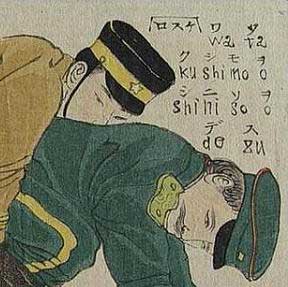
closeup of the romanization discussed in this postWhile a lot of things might be unusual about this old print of a Japanese soldier having sex with or simply raping a Western soldier, what particularly startled me is the use of romanization. Given that much of the text in the full image (note: definitely not safe for work) isn’t accompanied by romanization, it appears the intent is to help indicate which lines are being said by the Westerner. (But I can’t read Japanese, so I don’t know for sure.)

Has anyone noticed this practice — the romanization, y’all — in other Japanese prints?

Commenters on Eros Blog (again, not safe for work) translate the text and place the cartoon from the time of the Russo-Japanese War of 1904–05.

Taiwan’s MPS2 romanization system is not the same as Yale

Taiwan does not now nor has it ever officially used the Yale romanization system. But that hasn’t stopped the relatively common belief that the Yale romanization system for Mandarin can be found on some official signage here.

What most people take as Yale is in fact MPS2, a Taiwan-devised romanization system that dates from the mid 1980s. MPS2 was developed Taiwan in a vain attempt to counter the growing popularity around the world of Hanyu Pinyin. In other words, it was basically the Tongyong Pinyin of the 1980s, though its supporters (there must have been some) never embraced it with the same level of nationalistic fervor as Tongyong Pinyin has received from some quarters. Little wonder, then, that most people — including many who really should know better — don’t seem to have noticed that MPS2 even exits, much less that a great deal of the island’s signage remains in this system.

To some degree the confusion of MPS2 for Yale is understandable, given that the two systems have many points in common on which they differ with Hanyu Pinyin. Here are some examples.

-au rather than -ao

MPS II and Yale Hanyu
au ao
bau bao
chau chao
dau dao
gau gao
hau hao

-ung rather than -ong

MPS II and Yale Hanyu
chung chong
dung dong
gung gong
hung hong

chr, jr, r, shr

MPS II and Yale Hanyu
chr chi
jr zhi
r ri
shr shi

ts- instead of c-

MPS II and Yale Hanyu
tsai cai
tsan can
tsau cao
tseng ceng
tsou cou
tsu cu
tsung cong
tsz ci

And neither uses Hanyu Pinyin’s abbreviated vowel forms (such as -ui for -uei, -iu for -iou, and -un for -uen). But here we can begin to see some of the differences between MPS2 and Yale.

MPS II Yale Hanyu
chuei chwei chui
duei dwei dui
tzuei dzwei zui

Yale often uses w as a medial where other systems would use u.

MPS II Yale Hanyu
shuei shwei shui
suan swan suan
guang gwang guang

Yale often uses y as a medial where other systems would use i

MPS II Yale Hanyu
jia jya jia
niau nyau niao
chiung chyung qiong

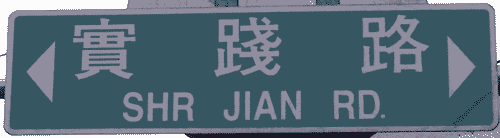
This sign, in Banqiao, would read Shrjyan in Yale, not Shrjian, which is MPS2.
street sign reading 'SHR JIAN RD'

To review all of the similarities and differences among these and other systems, see my comparison chart of romanization systems.

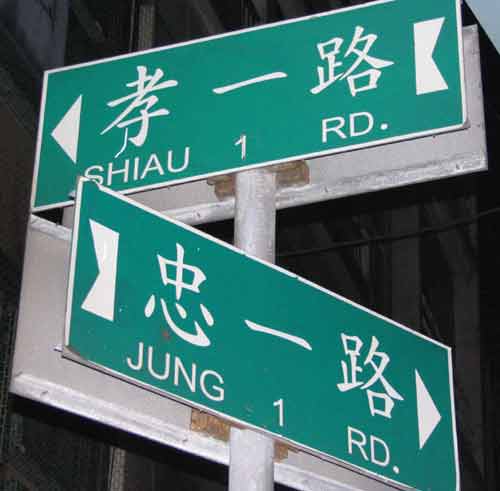
To close, here are some more signs in MPS2. What in Hanyu Pinyin is written zhong is jung in both MPS2 and Yale. What in Hanyu Pinyin is xiao, however, is written differently in MPS2 and Yale: shiau and syau, respectively.

photo of street signs in Jilong. One sign reads 'JUNG 1 RD', the other 'SHIAU 1 RD'
This photo was taken in Jilong.

Guangzhou subway to switch from Pinyin to English-Pinyin mix

Guangzhou’s Metro will be reportedly be changing from Hanyu Pinyin to a mix of English and Pinyin in the naming of its stations. Thus, for example, “Guangzhou Huochezhan” will become “Guangzhou Train Station” (or something like that) and Tiyu Xilu will become Tiyu West Road.

If the official website of the Guangzhou Metro is anything to go by, the Pinyin presently used there is terrible. The official website is infected with the Pinyin-crippling diseases of InTerCaPiTaLiZaTion and FailUreToSePaRateWords. 体育西路, for example, is given not as Tǐyù Xīlù but as TiYuXiLu. Horrible! And, of course, there are some typos too, which make matters even worse, such as TiYuZhongZin for what should be Tǐyù Zhōngxīn.

The last time I was in Guangzhou the subway didn’t exist, so I haven’t seen this signage for myself. Can anyone supply photos of station signage in Guangzhou? I’d also appreciate receiving photos of official Pinyin signage from elsewhere in China. (Photos can be sent to the address on my contact info page.)

And, of course, there’s no word on supplying what ought to be a basic: additional signage in romanized Cantonese.

I have written the authorities there seeking details about the conversion but have not received a reply.

source and resources:

typo of the day

Ain’t it the truth.

sign in Guangzhou Province with 'ticketing hell' rather than 'ticketing hall'

Jìzhě zuórì (5 rì) qiánwǎng Dōngguǎn shìqū mǒu qìchē zǒngzhàn bànshì, zài zhàn qián guǎngchǎng xià le gōngjiāochē biàn xúnzhǎo shòupiàotīng wèizhi. Zǒuláng shàng xuángguà zhe yīkuài jùdà de zhǐshì pái, zhǐmíng chángtú shòupiàotīng de wèizhi, dàn Hànzì xiàmian pèishàng de Yīngwén ràngrén dàchī-yījīng, hèrán xiě zhe: Ticketing Hell (Zhōngwén zhíyì wéi “shòupiào dìyù”). Yuánlái shì dàtīng de Yīngwén “Hall” bèi wùxiě wéi “Hell” (dìyù).

Zhè kuài zhǐshì pái de bèimiàn xiě zhe bùtóng de nèiróng, Zhōngwén shì “xíngrén tōngdào”, Yīngwén xiězuò “Pedestrain chenneling”. Zhuānyè rénshì gàosu jìzhě, “chenneling” bùzhī hé yì, shì zìjǐ shēngzào de cíhuì, kěnéng shì xiǎng xiě “channeling” ér chūxiàn le pīnxiě cuòwù, dàn “channeling” shì “gōuqú” de yìsi, “tōngdào” yībān xiězuò “channels”.

Zài guǎngchǎng de lìngyī cè, gōngjiāo zhàn de zhǐshì pái shàng bùzài xiě Yīngwén, érshì gǎiyòng Pīnyīn, dànshì xiězuò “gongjiaozan”, “zhàn” zì de pīnyīn yěshì cuòwù de.

Yǒu chéngkè gàosu jìzhě, zhèxiē zhǐshì pái yǐjing guà le hǎojǐ nián le, yīzhí méiyǒu huàn xiàlái. Rúguǒ wàibīn kànjian, bùzhī zuò hé gǎnxiǎng.

source: Yīngwén pīnxiě cuòwù: yīzìzhīchā shòupiàotīng biàn “dìyù” (英文拼写错误 一字之差售票厅变“地狱”), Guǎngzhōu Rìbào, November 4, 2006

Banqiao street names

Although Banqiao — spelled “Panchiao” in bastardized Wade-Giles and “Banciao” in Tongyong Pinyin — is one of Taiwan’s most populous cities, it doesn’t get much attention, overshadowed as it is by its neighbor Taipei.

To a certain degree that’s deserved: With a population of some 542,000 (which, if it were transplanted to the United States, would make it that nation’s 26th largest city), Banqiao really ought to have more of interest. But, still, it has been my home for about nine years and it isn’t completely awful. (How’s that for a recommendation?) And the city has been improving, especially with the development around the enormous new train station and the equally enormous Taipei County Government Hall. (David has a few additional photos of Banqiao. I’m amazed I have yet to run into him on the street, especially since foreigners tend to stick out here.)

Until a few years ago, street signs in Banqiao were relatively uniformly in MPS2 (often confused with the Yale romanization system), along with the usual assortment of mistakes and smatterings of other systems. Then signs in Tongyong Pinyin began to replace some but not all of those in MPS2. Last year’s elections, however, saw the DPP lose power in both Taipei County (Banqiao is the county’s largest city) and Banqiao itself. So a move toward Hanyu Pinyin can be expected — eventually. As far as I know, though, the city’s department of transportation, which is in charge of such signage, is still under the erroneous belief that the city must follow the central government’s guidelines and thus use Tongyong. Jilong (Keelung) is another example of a city under a pan-blue administration that thinks it has to use Tongyong.

For people’s reference, I have compiled a list of Banqiao street names in Chinese characters, Hanyu Pinyin (with tone marks), and the mix of romanization and English generally seen in Taiwan.

resource:

ensure zhuyin is taught thoroughly: education official

Taiwan’s Ministry of Education is worried that with so many students entering first grade already knowing zhuyin fuhao, having learned it from their parents or at a buxiban (cram school) or preschool, some teachers are neglecting to ensure that all their students have a thorough grounding in this script. Since zhuyin is used to help teach students Chinese characters, a lack of proficiency in reading zhuyin could severely hamper a child’s ability to perform well in school.

I’ve seen reports from China of related worries there — but regarding Pinyin, not zhuyin, of course.

The original article in Chinese characters is no longer online, so I’m supplying the full text in Pinyin (which is all I have now).

Kāixué le, duì xiǎo yī xīnshēng láishuō, zhùyīn fúhào shì yǔwén lǐngyù de zhòngdiǎn, yuē xū shàngkè 10 zhōu, què yīn bùshǎo yòuzhìyuán yǐ tíqián jiāo guò, bùfen xiǎo yī lǎoshī yǐ duōshù xuésheng yǐ xuéhuì, lüèguò bù jiāo. Jiàoyùbù zuótiān zhǐchū, rúguǒ yǒu zhèizhǒng qíngxing, jiāzhǎng yīnggāi xiàng lǎoshī hé xuéxiào fǎnyìng.

Jiǔ nián yīguàn kèchéng guīdìng, xiǎo yī shàng xuéqī jiùyào shúxí, rèn dú, zhèngquè shūxiě zhùyīn fúhào yǐjí pīnyīn fāngfǎ, Jiàoyùbù guójiào sī guānyuán biǎoshì, wǎngnián dōu yǒu bùshǎo jiāzhǎng tóusù, bàoyuàn xiǎo yī de lǎoshī yīnwèi bān shàng duōshù xuésheng yǐjing xuéhuì zhùyīn fúhào, shěnglüè bù jiāo, yǐngxiǎng qítā xuésheng de shòujiào quán.

Jiàoyùbù zhōngyāng kèchéng yǔ jiāoxué yǔwén kē fǔdǎo zīxún lǎoshī Wú Huì-huā zhǐchū, shàngxué qīyuē yǒu 21 dào 22 zhōu, gēnjù kèchéng ānpái, xiǎo yī zhùyīn fúhào yào shàng 10 zhōu, zhīhòu lǎoshī huì kāishǐ jiāo guózì.

Wú Huì-huā shuō, gè bǎnběn kèběn yǒuguān zhùyīn fúhào jiàofǎ bùtóng, xiànzài yǐ hěn shǎo ànzhào zìmǔ shùnxù, yǒude zhào mǔyīn, yǒude zé ànzhào kèběn nèiróng, rú “xiǎo bái’é, ài chànggē” zhōng, huì xiān jiāo bǐjiào jiǎndān de “ㄅ” “ㄍ” děng, bùshǎo lǎoshī dàgài lìyòng 8, 9 zhōu shàng wán, jiēzhe tì xuésheng fùxí.

Wú Huì-huā shuō, bùshǎo jiāzhǎng pà lǎoshī bù jiāo zhùyīn fúhào, háizi shū zài qǐpǎoxiàn shàng, yīncǐ shàng yòuzhìyuán shí, huò xiǎo yī rùxué qián, jiùràng háizi xiān xué, huò qù bǔxí.

Gēnjù guānchá, xiǎo yīshēng yuē yǒu 6, 7 chéng yǐ huì zhùyīn fúhào, dàn chéngdu luòchā hěn dà, bùshǎo xuésheng kàn le huì niàn, dàn pīnxiě bù chūlai.

Wú Huì-huā biǎoshì, jíshǐ bān shàng yībàn yǐshàng xuésheng dōu yǐ xuéhuì zhùyīn fúhào, lǎoshī háishi yīnggāi ànzhào kèbiǎo shàngkè, yóuqí bùnéng fàngqì hái bù huì de xuésheng, gèng yào zhùyì chéngdu shàng de luòchā.

Zhùyīn fúhào jí pīnzì shì guówén zhòngyào jīchǔ, Wú Huì-huā shuō, jiāzhǎng měitiān kě huā yīdiǎn shíjiān, yào háizi lǎngdú shàngkè de nèiróng, tì háizi fùxí, duì háizi xuéxíhuì yǒu bāngzhù, dàn bùbì tài jiāolǜ, bùxū wéixué zhùyīn fúhào qù bǔxí.

source: Xiǎo yī bù jiāo zhùyīn — jiāzhǎng kě fǎnyìng (小一不教注音 家長可反映), September 1, 2006

Tao (Yami) language materials

Providence University of Taizhong County, Taiwan, has put online a site about the language of the Tao (Yami) people of Taiwan’s Orchid Island (Lanyu). It contains complete the text of a 690-page book on the language. It offers readings in Tao (romanized) with not only interlinear English and Chinese characters but also audio files.

The sample sentences range from the mundane to the unexpected, such as Ji na ni’oya o nitomolok sia ori, ta isáray na jia. (“He wasn’t angry at the person who poked his buttocks, but instead he thanked him.”)

This site, which has interfaces in both English and Mandarin, is a terrific resource. Check it out.

source: Women compile dictionary and grammar text for Yami language, Taipei Times, October 23, 2006