Taiwan premier calls for support for romanization of Taiwanese

Taiwan’s premier, Su Tseng-chang (Sū Zhēn-chāng / 蘇貞昌), has instructed the Ministry of Education to back the Tái-Luó romanization system for Taiwanese.

Unless I’ve been misled by the local media, which has been known to confuse various romanization systems, this romanization system is simply what the Ministry of Education approved back in October 2006. (Tai-Luo means “Taiwan Romanization,” which is not a particularly specific name.) So the statement is likely simply as speculated in the media: that Su is seeking to bolster his “green” and “localization” credentials ahead of the ruling Democratic Progressive Party’s choice of a candidate for the 2008 presidential election. It’s hard to know if this is simply lip service or something that will lead to increased support for the romanization of Hoklo (Taiwanese), probably the former.

Su made the statement during a meeting last week with the head of the Taiwan Society, Chet Yang (Yáng Wén-jiā / 楊文嘉 / Yang Wen-chia). The Taiwan Society, an umbrella organization for pro-Taiwan groups, backs the same romanization system.

sources and further reading:

Pinyin Info 1, Condoleezza Rice 0

U.S. Secretary of State Condoleezza Rice has joined Al Gore, John F. Kennedy, and other prominent U.S. politicians in spreading the crisis/opportunity myth. Fortunately, though, Glenn Kessler of the Washington Post found Victor H. Mair’s essay danger + opportunity ≠ crisis here on Pinyin Info:

At one point, Rice said that the difficult circumstances in the Middle East could represent opportunity. “I don’t read Chinese but I am told that the Chinese character for crisis is wei-ji, which means both danger and opportunity,” she said in Riyadh. “And I think that states it very well. We’ll try to maximize the opportunity.”

But Victor H. Mair, a professor of Chinese at the University of Pennsylvania, has written on the Web site https://pinyin.info, a guide to the Chinese language, that “a whole industry of pundits and therapists has grown up around this one grossly inaccurate formulation.” He said the character “ji” actually means “incipient moment” or a “crucial point.” Thus, he said, a wei-ji “is indeed a genuine crisis, a dangerous moment, a time when things start to go awry.”

sources and further readings:

language reformer Qian Xuantong remembered

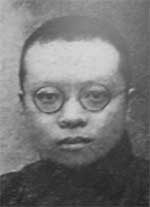
photo of Qian Xuantong (Ch'ien Hsuan-t'ung)Two days ago was the 68th anniversary of the death of Qian Xuantong (Qián Xuántóng / 錢玄同 / 钱玄同 / Ch’ien Hsüan-t’ung) (1887–1939), a phonetician, philologist, and professor of literature at Peking University. Although he isn’t well known today, Qian was an important contributor to the reforms associated with the May 4 movement. He also helped renew debate about script reform in China.
Just about the time that the National Phonetic Alphabet succeeded in gaining ascendancy over the Mandarin Alphabet and other schemes, the evolution of literary and political movements into a new stage gave rise to renewed consideration of the roman alphabet as the basis for reform of the Chinese written language.

What seems to have initiated the new stage of discussion was a letter written in March 1918 by Ch`ien Hsüan-t`ung, a well-known philologist and professor of literature at National Peking University, to Ch`en Tu-hsiu, who at the time was editor of La Jeunesse, the leading organ of young Chinese intellectuals, and who soon afterward became one of the founders of the Chinese Communist Party. In his letter Ch`ien Hsüan-t`ung expressed approval of Ch`en Tu-hsiu’s demand for a break with the Confucian ideology which had dominated Chinese life for more than two thousand years, and also offered his idea as to how this was to be carried out. “If you want to abolish Confucianism,” he said, “you must first abolish the Chinese script.” To his mind there was little of value in Chinese literature, 99.9 per cent of which he dismissed as merely transmitting Confucian ideology and Taoist mythology.

It seemed to Ch`ien that the ideographic [sic] script could not be adapted to the needs of modern China. He also saw no solution in the attempts which had thus far been made to apply a phonetic system of writing to Chinese. Indeed, it appeared to him that it would be impossible to apply a phonetic system of writing to Chinese at all. These views also led him to the conclusion, reached earlier by Wu Chih-hui and others, that Chinese writing itself would have to be abandoned and replaced by Esperanto.

I seem to remember that someone in Japan was driven to distraction about that country’s orthography and making a similar proposal about switching from Japanese to Esperanto. Or am I imagining that?

At any rate, others soon convinced Qian of the error of his ways, and before long he was a strong supporter of romanization, as were many others of his generation, including Lu Xun. By the way, Qian was the one who convinced Lu Xun to start writing stories. That alone should be enough to make the world forever grateful to him.

I strongly recommend the first of the readings below, from which the above quote was taken. It’s interesting reading.

sources:

Gaoxiong receives funding to upgrade the city’s English

The government of Gaoxiong (Kaohsiung) has recently secured funding from the Executive Yuan to

  • waste on so-called translation agencies that wouldn’t know real English if it bit them on the ass,
  • print up some signs on which the English is so small as to be almost unusable,
  • put up even more signs in a romanization system few people know but many think is ridiculous at best,
  • um, create an “English-friendly environment” in advance of the World Games, which will be held in the city in 2009.

The stories didn’t mention how much money will be involved in this. The project will be headed by the recently promoted Xǔ Lì-míng (許立明 / Xu Liming / Hsu Li-ming).

Let’s all hope the city does a much better job than is to be expected from past experience throughout Taiwan.

sources:

Taiwan license plates and English

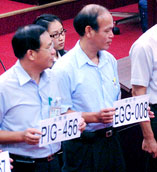
Taipei City councilors holding up signs resembling license plates with funny English: PIG-456 and EGG-008It seems that ridding Taiwan license plates of the dreaded number 4 wasn’t enough. A Taipei city councilor, Tim Chang (Cháng Zhōngtiān / 常中天) of the New Party, suggested last year that “drivers are making an ass of themselves” if they drive around with license plates that spell out something that is insulting, ill-omened, or funny in English. He called for such unfortunate combinations to be filtered out in advance and for motorists to be allowed to change their plate numbers.

As the Taipei Times article on this notes, “License plates in Taiwan are made up of two alphabetic letters and four digits for cars, while license plates on scooters have three letters and three digits.”

People in Taiwan can change to another random plate number for NT$1,250 (approx. US$38), while personalized license plates cost at least NT$3,000.

source: Lucky number plate? Not for this ASS, Taipei Times, August 23, 2006

Y.R. Chao works being reissued

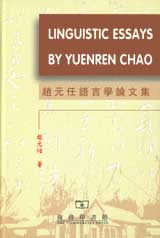
cover of the book 'Linguistic Essays, by Yuenren Chao'The Commercial Press has begun issuing a set of the complete works of Y.R. Chao (Zhao Yuanren / 趙元任 / 赵元任). This project, which will comprise some twenty volumes, will contain works in both English and Mandarin Chinese. All of the many fields Chao wrote about will be covered. Letters and journals will also be included, as will sound recordings. Wonderful!

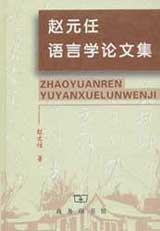
For those who don’t want to wait for the whole series or don’t feel the need to buy all of them, the Commercial Press has also two volumes of Chao’s selected essays on linguistics: one in English and one in Mandarin. These are, respectively, Linguistic Essays by Yuenren Chao (ISBN: 7-100-03385-3/H·860) and Zhào Yuánrèn yǔyánxué lùnwénjí (赵元任语言学论文集) (ISBN: 7-100-03127-3/H·789).

cover of the book '赵元任语言学论文集 Zhao Yuanren Yuyanxue Lunwenji'Note how the cover of Linguistic Essays, a book printed just last year in China, uses “Yuenren Chao,” the traditional spelling and Western order of his name, rather than “Zhao Yuanren,” the spelling used in Hanyu Pinyin. Also note how the Mandarin title is given in traditional, not simplified, characters: 趙元任語言學論文集, not 赵元任语言学论文集. A nice surprise, on both counts. On the other hand, the botched romanization on the cover of the Mandarin-language collection, which gives “ZHAOYUANREN YUYANXUELUNWENJI” instead of “Zhào Yuánrèn yǔyánxué lùnwénjí,” is particularly inappropriate and painful to look at on a collection of the works of this brilliant linguist. But don’t judge this book by its cover.
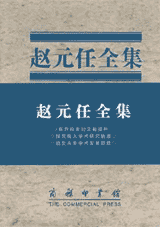
Here are links to all the volumes in the complete works that I’ve been able to locate information on:

cover of the first volume of Y.R. Chao's collected works

IPA for Mandarin Chinese

Another back issue of Sino-Platonic Papers has been released as a free PDF: Chinese Romanization Systems: IPA Transliteration (1.34 MB), by Warren A. Shibles. This was first published in November 1994 as SPP No. 52.

This work, whose rather dim view of romanization I do not share, is primarily a useful compilation of various published forms of IPA transcriptions for all the syllables of Mandarin. To these the author adds his own stab at applying the International Phonetic Alphabet to Mandarin. Moreover, a variety of romanization systems are shown, including that from Werner Rüdenberg’s Chinesisch-deutsches worterbuch.

Elsewhere, Pat Moran recently posted an HTML version of his own IPA chart for Mandarin.

I hope that the variety of approaches will provide a useful reminder that standard Mandarin is represented by a range, not a fixed point. And also that standard Mandarin is not the same thing as a caricature of a Beijing accent. Too often, in their quest for “correctness,” students of Mandarin end up with so many ers that they sound like they’re part circus seal. Emulating the sounds of the Beijing dialect of Mandarin is fine (though generally unnecessary); just don’t go overboard.

registration of aborigine names fails to reach target

Taiwan’s Cabinet-level Council of Indigenous Peoples (formerly the Council of Aboriginal Affairs) has been encouraging members of Taiwan’s tribes to officially register themselves under their “original names,” which are recorded in romanization. But the total of such registrations reached only about half of this year’s goal of 10,000, with the majority of those having been registered in earlier years.

source: