New story in Pinyin: ‘Dashui Guohuo’ (‘After the Flood’)

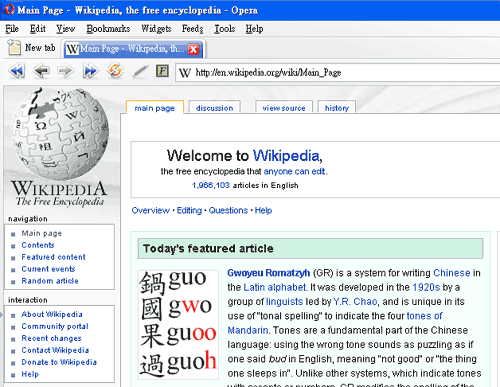
I’m very pleased to announce that Pinyin Info has a new story in Hanyu Pinyin: “Dàshuǐ Guòhòu,” by Zhang Liqing. It’s available here in two versions: Pinyin alone and Pinyin with English translation (as “After the Flood”), so one doesn’t even have to know Mandarin or Pinyin to read this.

The story recalls a girlhood friend in China, not long after the end of the Second World War.

Zhang is an associate editor of the ABC Chinese-English Comprehensive Dictionary and has translated a number of important works into English, including Zhou Youguang’s The Historical Evolution of Chinese Languages and Scripts and Lü Shuxiang’s Comparing Chinese Characters and a Chinese Spelling Script — an evening conversation on the reform of Chinese characters.

A nose for foreign food?

Imagine some white guys in a fairly large U.S. city open a restaurant named “Mr. Taiwan Slant-Eyes Asian Cuisine.” And imagine that this restaurant specializes in distinctly Americanized dishes such as egg foo yong, fortune cookies, and California wraps. Now imagine the response. Isn’t this fun?

OK, now imagine a different situation: In Taiwan’s fifth-largest city some locals open a place specializing in Taiwanized Western food and dub their restaurant “Miss UK Cafe Pointy-Nose Foreign Food.”

As you’ve probably guessed, the second scenario is real. The “Miss UK Cafe ㄚ度仔 異國美食” (Miss UK Cafe a-tok-a yìguó měishí) recently opened not far from my apartment in Banqiao.

A-tok-a (ㄚ度仔) is Taiwanese for “pointy nose” (i.e., Westerner), though perhaps the common translation of “big nose” conveys the spirit a little better. As Tempo Gain explains in the Forumosa thread on this word, “the initial ‘a’ often preceds names, and the final ‘a’ often is attached to nouns like the Mandarin ‘zi’ haizi, chezi, etc.”

Although most foreigners I know in Taiwan find the use of a-tok-a offensive to some degree, reactions are usually tempered by the knowledge that the word is very seldom used intentionally as a pejorative. It’s just the word most Hoklo speakers would use for “Westerner,” and they mean nothing bad by this and perhaps even see it as “cute” in a favorable way. So since I’m certain the restaurateurs didn’t intend any insult in choosing this name, I’m not going to carp about this any more than I already have — which is not to say that I will ever buy anything from that restaurant.

It’s still an interesting name, though. (Actually, this is probably two names: the standard one (ㄚ度仔 異國美食), which is for most people, and the English one (Miss UK Cafe), which is probably there in an attempt to look modern/foreign/cool.)

For those keeping count, that’s three scripts and as many languages on just one sign.

  • Miss UK Cafe: English, in the Roman alphabet
  • ㄚ度仔: Taiwanese, in a mixed script of zhuyin (ㄚ) and Chinese characters
  • 異國美食: Mandarin, in Chinese characters

The mixing of scripts in “ㄚ度仔” is representative of the sad fact that most people in Taiwan are unsure how to write Taiwanese. Here are some of the ways this word gets written, along with the number of Google results and Baidu results for that exact phrase.

  • ㄚ度仔 Google 555 / Baidu doesn’t recognize the ㄚ
  • 阿凸仔 3,440 / Baidu 1,320
  • 阿多仔 6,730/ Baidu 13,400
  • 阿卓仔 11,300 / Baidu 2,810
  • 阿荳仔 12,500 / Baidu 24,700
  • 阿豆仔 12,500 / Baidu 24,700 (Google and Baidu apparently refuse to differentiate 荳 and 豆)

Also interesting is the use of yìguó (異國) instead of the more common wàiguó (外國), for “foreign.”

  • “異國” Google 1,510,000 / Baidu 14,700,000
  • “外國” Google 6,420,000 / Baidu 46,500,000

Yìguó měishí, however, is more common than wàiguó měishí.

  • “外國美食” Google 41,100 / Baidu 26,400
  • “異國美食” Google 114,000 / Baidu 152,000

This, I suspect, is because yìguó měishí “sounds fancier” because of how relatively common the word waiguo is.
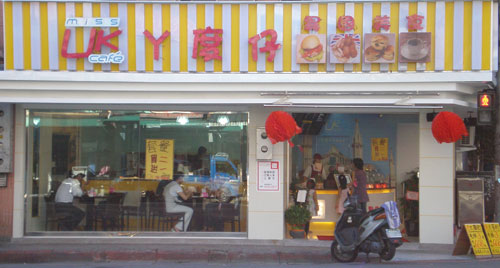
photo of the storefront of the restaurant discussed in this post

further reading:

Reviews of books on oracle bones, language and script, violence in China, etc.: SPP

Sino-Platonic Papers has rereleased the third volume in its series of book reviews: Reviews III (8.3 MB PDF).

This volume was first published in October 1991.

The main topics of the books in this volume are

  • Violence in China
  • Scientific Stagnation in Traditional China.
  • Oracle Shell and Bone Inscriptions (OSBIs)
  • Proto-Language And Culture
  • Language and Script
  • Reference Tools for Sinitic Languages
  • Literature and the Life of Peking
  • Religion and Philosophy
  • Words
  • The New World
  • “Barbarian” Business
  • South Asia
  • Miscellaneous

For those who hesitate to download such a large file without knowing which books were reviewed, you may consult the table of contents (small HTML file).

‘Slips of the Tongue and Pen in Chinese’

David Moser wrote his highly popular work Why Chinese Is So Damn Hard (found right here on Pinyin Info) in the early 1990s. Around the same time he contributed another more academic but still highly readable essay to Sino-Platonic Papers, this one on the topic of “Slips of the Tongue and Pen in Chinese.”

This work has just been reissued for free (2.9 MB PDF).

Chinese Philology and the Scripts of Central Asia

Sino-Platonic Papers has rereleased for free issue no. 30 from October 1991: Chinese Philology and the Scripts of Central Asia (742 KB PDF), by M.V. Sofronov of the Institute of Far Eastern Studies, Academy of Sciences, Moscow.

It begins:

The period of the tenth to fourteenth centuries was a time when the peoples who conquered Northern China established their own states and proceeded to create their own written culture. They rightly saw the basis of a new state culture in their own script. The Kidan state of Liao was established in 916 in the northeastern part of China. It was conquered by the Jucen state Jin in 1126. The Tangut state of Hsi Hsia was established on the northwestern frontiers of China in 1032. All of these states created their cultures in accordance with historical circumstances and taking into consideration the achievements of older cultural centers of East and South Asia.

The oldest and most powerful philological tradition which exerted an influence on the scripts of Central Asia was that of the Chinese. This tradition developed under the specific conditions of the Chinese character script. Primarily, it elaborated the problem of the explanation of the meanings of the characters and the establishment of their correct readings.

One of the important achievements of the traditional Chinese philology was the method of fanqie (“cut and splice”) according to which the unknown reading of a character is described by means of two other characters with known readings. Originally fanqie was designed, presumably under the tutelage of Indian phoneticians, to indicate the readings of characters in the philological works. With the development of Tantric Buddhism in China it was extended to the transcription of Sanskrit dharanis and related texts. In these transcriptions, Sanskrit syllables with phonemic components distributively incompatible in Chinese were constructed. In these cases the Sanskrit syllable was rendered by two Chinese ones. This pair of Chinese syllables formed the fanqie binom provided with appropriate diacritics. For rendering initial consonant clusters, two or three Chinese syllables were used respectively for clusters of two or three Sanskrit consonants. These binoms or trinoms were provided with diacritics, respectively erhe (“two together”) or sanhe (“three together”). This method of transcription constituted the counterpart to the orthographic techniques of the rendering of consonant clusters in Sanskrit and Tibetan syllabic scripts….

linguistic nationalism and Hoklo (Taiwanese, Minnan)

Sino-Platonic Papers has rereleased its August 1991 issue: Linguistic Nationalism: The Case of Southern Min.

An excerpt from the introduction:

In this paper, I will explore aspects of the social value of Southern Min. I draw on data collected in three Southern Min-speaking communities in which I have done participant-observation fieldwork: Penang, Malaysia; Tainan, Taiwan, and Xiamen (Amoy), the People’s Republic of China, focusing in particular on the political importance of Southern Min in Tainan. I take as one goal that of drawing attention to the importance of regional identities and differences in Chinese society, differences all too often disregarded by those who seek to reify ‘Chinese culture’ as a monolithic entity.

Also, the color scheme of the online catalog for Sino-Platonic Papers has been adjusted a little in order to make clearer which issues are presently available for free download.

names of love hotels in macho kanji and other scripts

Donald Ritchie’s recent review of Japanese Love Hotels: A Cultural History, by Sarah Chaplin, has the following interesting section:

The contemporary love hotel is now much more kawaii (cute) than kinky.

Among the the reasons offered for this is that there has been something of a power shift in love-hotel choice. It used to be the male half that decided. Back then the places had hopeful macho monikers — Empire, Rex, King. Then the female half began to choose. Love hotels started calling themselves “fashion hotels” or “boutique hotels,” and began to have lavish lobbies with theme-shops, colors like beige and lavender, and decor like Laura Ashley.

This change can be documented in the Meguro Emperor (still in Meguro), which began in 1973 as a he-man fort before it slowly metamorphosed into a romantic Disneyland castle. The interior has been several times revised to segue from male- to female-friendly. Even the name has changed. It is now Gallery Hotel.

In most love hotels “macho” kanji has been replaced by “feminine” hiragana, trendy katakana or, more often, romaji, that romanized script that carries no male/female associations at all.

source: It’s ladies first now in Japanese love hotels, Japan Times, August 26, 2007