new name policy for naturalized ROC citizens

Since July 9, naturalized citizens of Taiwan have been permitted to have a romanized form of their original name included along with their adopted “Chinese name” on their household-registration certificate (hùkǒu). (This is an important government document that states your official residence.)

For example, my original name is Mark Swofford. My Mandarin name is Shǐ Wěifán (史偉凡). If I were to take ROC citizenship (which I’d like but am unlikely to try to gain until Taiwan drops its insistence that I first renounce my U.S. citizenship), my household-registration certificate would have “史偉凡” and could now also have some romanization. But … the romanization would have to be along the lines of Make Siwafo’erde.

What I could not have, according to the new regulations, would be either my original name or a romanization of my Mandarin name (i.e., neither “Mark Swofford” nor “Shi Weifan” would be permitted). Instead, I’d have to use a romanization of a Sinicized form of my original name (Make Siwafo’erde).

This is, well, rather odd. But I called the Ministry of the Interior and received confirmation. Apparently it’s part of the Legislative Yuan’s idea of helping Taiwan’s internationalization. I suppose this is a half step forward. Before the change, the only thing allowed would have been a name in Chinese characters and only Chinese characters.

source: Ministry changes name regulations for naturalization, Taipei Times, July 9, 2009

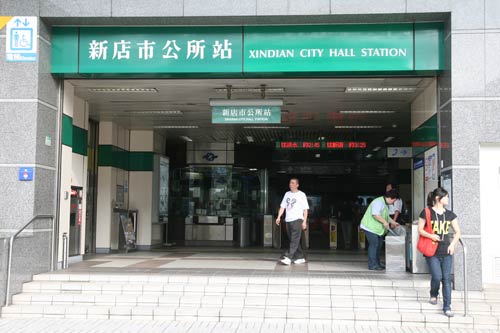
photos of and around Xindian City Hall MRT station

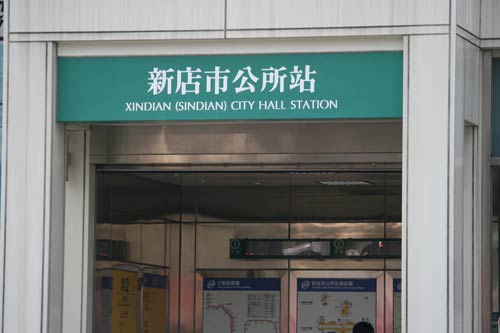
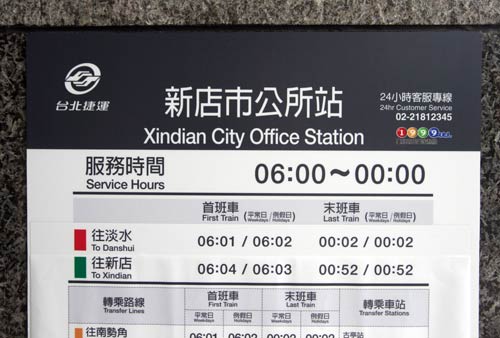
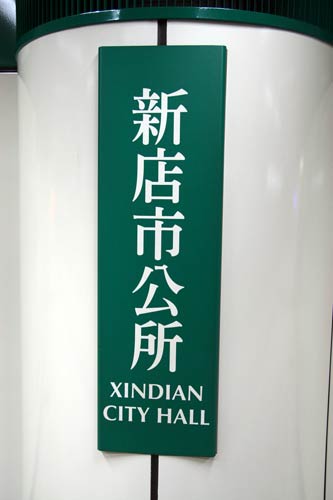
My friend David of David on Formosa kindly sent me lots of photos of the current signage at Xindian City Something-or-other Station. Here they are.

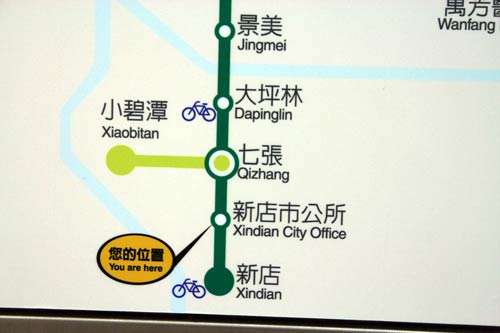
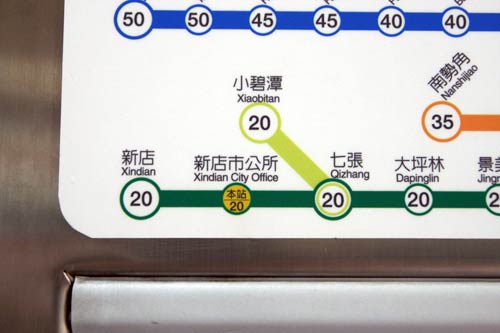
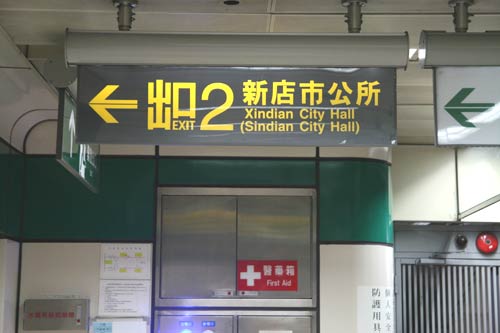
Note that some of the signage at the station itself gives the Tongyong Pinyin form (Sindian) as well as the Hanyu Pinyin form; but other signage does not. And the newest signs give Xindian City Office rather than Xindian City Hall.

MRT station main entrance, marked 'Xindian City Hall Station'

MRT station side entrance, marked 'Xindian (Sindian) City Hall Station'

Sign of things to come?
photo of station operation hours, with station name marked 'Xindian City Office Station'

sign on a pillar on the MRT platform reading 'Xindian City Hall'

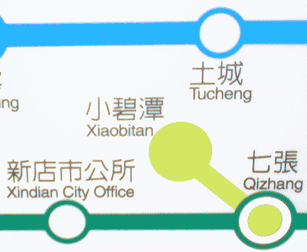
closeup of a new map on a station wall, with the station called 'Xindian City Office'

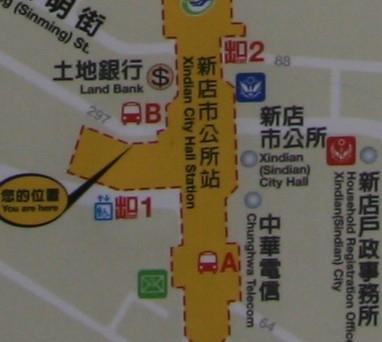
map_detail

exit2

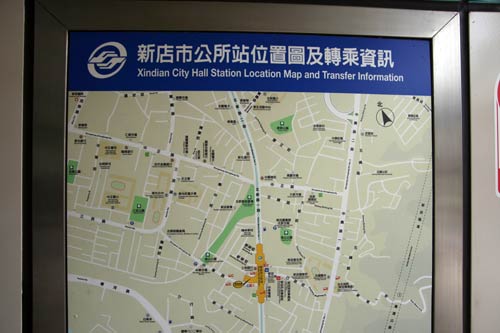
area_map

This closeup from the map above reveals that even city hall itself (not the MRT station) is labeled “City Hall.”

closeup from the photo above, as described

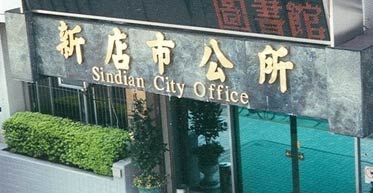
More than three years ago Taipei County Magistrate Zhōu Xīwěi (Chou Hsi-wei / 周錫瑋 / Zhou Xiwei) said that Taipei County should use the same romanization system as the city of Taipei (i.e., Hanyu Pinyin). But nothing has happened yet — not unlike his administration in general. So here we still see the Tongyong Pinyin form of “Sindian” rather than the Hanyu Pinyin form (now official at the national level) of “Xindian.”
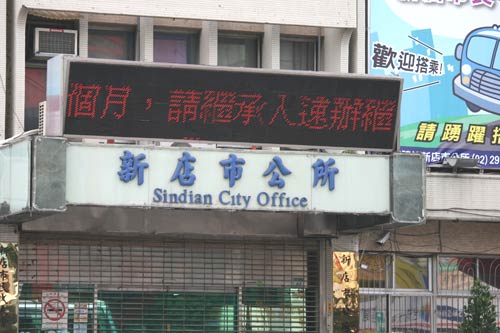
photo of Xindian City Hall (the actual building, not the MRT station). It's labeled 'Sindian City Office'

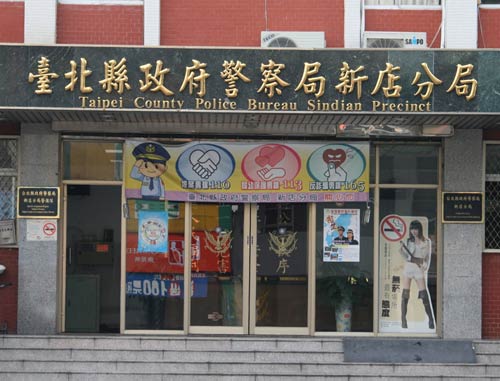
Taipei County Police Bureau Sindian Precinct

You can’t fight city hall, er, office

This follows up my previous post: new Taipei MRT stations and wordy names.

Although the MRT system resists fixing the mistakes in its station names — such as in wordy, unnatural English names or misuse of Hanyu Pinyin — that doesn’t mean it never changes a name. It does — and here I’m referring to things beyond the usual matter of romanization systems. In recent weeks a long-established MRT station name has been undergoing a quiet change. As this case reveals, however, it appears that the authorities have a rule that opposes change unless they want to take a perfectly good name and make it worse.

I recently complained about the needless and indeed counterproductive insertion of Taipei and Nangang into station names, such as in the case of adding “Taipei” to the English name of what in Mandarin is only “Nángǎng Zhǎnlǎnguǎn” (南港展覽館). But that’s not the only case of “Taipei” given in an English name that doesn’t have the city name included in Mandarin. Two more instances of this are “Taipei Zoo,” which in Mandarin is simply Dòngwùyuán (動物園), and “Taipei City Hall,” which in Mandarin is Shìzhèngfǔ (市政府).

First let’s examine the case of “Taipei Zoo.” The Mandarin name for this is simply the word for zoo: dòngwùyuán. So in English why not call this stop simply Zoo instead of Taipei Zoo? (There’s certainly no Xindian Zoo, Banqiao Zoo, Xinzhuang Zoo, Sanchong Zoo, etc., anywhere on the MRT system.)

There’s no clear answer. Although Hanziphiles love to proclaim “Just one Chinese character is enough,” the Mandarin language is most definitely not a monosyllabic one, especially when it comes to place names. (See, for example, Taipei street names and the monosyllabic myth.) So it’s possible that what’s happening here is the habits of Mandarin are being overwritten upon English.

Interestingly, in metropolitan Taipei most native Mandarin speakers, if they had to add a geographical distinction, would probably call this the Mùzhà Dòngwùyuán (木柵動物園) rather than the Táiběi Dòngwùyuán (台北動物園).

I’m more interested, however, in the case of “Taipei City Hall,” which in which in Mandarin is Shìzhèngfǔ (市政府) — again, no Táiběi. In this case adding “Taipei” makes sense because there really is another city hall stop on the MRT system: Xindian City Hall, which in Mandarin is Xīndiàn Shìgōngsuǒ (新店市公所).

Translated literally, shìzhèngfǔ is city government and shìgōngsuǒ is city administrative office. They have different names in Mandarin because of Taiwan’s somewhat convoluted governmental structure, a shìzhèngfǔ having somewhat greater autonomy than a shìgōngsuǒ. Nevertheless, in English both would usually be called simply city hall. Although New York City has hundreds of times more people than, say, Hays, Kansas (population 20,000), both places have a city hall … because usually that’s what cities have, regardless of their size or importance.

And for years the Taipei MRT has had a station named “Taipei City Hall” and another named “Xindian City Hall,” which is of course as it should be.

Unfortunately, however, Taiwan’s bureaucracy does not agree. The RDEC, keeper of the government’s bilingual stylebook for organizations, says that a shìgōngsuǒ is a city office, not a city hall, which is perhaps what has prompted the authorities with the MRT to change the perfectly good English name of “Xindian City Hall Station” to the distinctly worse “Xindian City Office Station.”

Basically, if there’s a discrepancy between how something is usually said in English and how some government official in Taiwan thinks it’s supposed to be said in English, real English loses. The same applies to Pinyin, whose clear and simple rules continue to be ignored here.

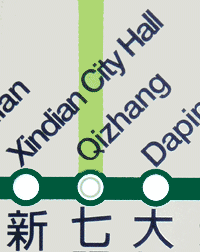
Both names — Xindian City Hall and Xindian City Office — can currently be seen on signage in the MRT system. The system maps next to MRT car doors have Xindian City Hall (see image at the left below). But the new long strips above the MRT doors (right) have Xindian City Office.

I expect Xindian City Hall to disappear soon.

Can anyone tell me what’s currently on that station itself?

xindian_city_hall xindian_city_office

photo of the front of Xindian City Hall, across the street from the MRT station. The sign reads 'Sindian City Office'

new Taipei MRT stations and wordy names

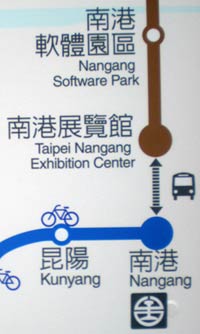
detail of a map of the Taipei MRT system, showing 'Nangang Software Park' and 'Taipei Nangang Exhibition Center' on the brown line, connected by bus to 'Nangang' on the blue lineTaipei will soon open a dozen new stations on its mass-transit system, the MRT. Most of the stations will be in the relatively newly developed district of Neihu, with a couple in the Nangang district. It’s the latter two stations I want to focus on:

  • Nangang Software Park
  • Taipei Nangang Exhibition Center

Basically, these names suck.

The most obvious problem is that they both are unnecessarily long, which is not a negligible consideration for not only signage but also the MRT’s announcement system, which is in four languages: Mandarin, Hoklo, Hakka, and English. (It takes a while to get through all of those.)

Also, “Nangang Software Park” (Nángǎng Ruǎntǐ Yuánqū 南港軟體園區)? There is no other software park around the MRT system. Just “Software Park” would work better as a name for the station. Accurate, but also short, simple, and distinctive — just what such a name should be.

BTW, this software park is the source of the name for Taipei’s still-not-corrected Park Street signs.

Worse still is “Taipei Nangang Exhibition Center”. First, calling it even “Nangang Exhibition Center” would be bad enough for the same reason that “Nangang Software Park” is unnecessarily wordy: there’s no “exhibition center” anywhere else on the system.

But “Taipei Nangang”? Ugh. That may work in Mandarin, but it’s lousy English. It follows the same unnaturally inverted pattern and redundancy that gave us “Taiwan Taoyuan International Airport,” or, as I like to call it, Chinglish International Airport. (But I do like it better than “Revere the Dictator Chiang Kai-shek International Airport.”)

Here’s a photo of the exhibition building itself (not the MRT station — though those are the MRT tracks behind the barrier in the foreground).

taipei_nangang_exhibition_center

So “Taipei Nangang Exhibition Center” probably is the official name of the complex. But that really doesn’t matter because (1) the MRT station certainly does not have to have the exact same name and (2) the name is just plain stupid.

Above, I mentioned that names for MRT stations should be “accurate, but also short, simple, and distinctive.” Sticking “Taipei Nangang” in front of “Exhibition Center” makes the name clumsy and less distinctive, especially since the two MRT stations closest to “Taipei Nangang Exhibition Center” are called “Nangang” and “Nangang Software Park”.

Nangang, Nangang, Nangang — yeah, we get it: They’re in Nangang.

Perhaps the MRT would like to change other names to be similarly useful. For example, instead of “Chiang Kai-shek Memorial Hall” we could have “Taipei Zhongzheng Chiang Kai-shek Memorial Hall;” and in place of, say, “Xindian City Hall” we could have “Taipei County Xindian Xindian City Hall.” (More about the Xindian City Hall station in another post.)

But perhaps those names aren’t nearly informative enough. According to the MRT’s way of thinking, people might still be confused about the location. How about, say, “Planet Earth Northern Hemisphere Asia East Asia Taiwan Taipei Zhongzheng Chiang Kai-shek Memorial Hall” and “Planet Earth Northern Hemisphere Asia East Asia Taiwan Taipei County Xindian Xindian City Hall,” etc.?

I’m happy to report that even the MRT seems to have some reservations about ridiculously long names — at least when those names are in Mandarin. Note the photo of part of the route map (top right of this post). The Mandarin name for “Taipei Nangang Exhibition Center” is Nángǎng Zhǎnlǎnguǎn (南港展覽館), not Táiběi Nángǎng Zhǎnlǎnguǎn (台北南港展覽館). (I didn’t crop any characters from the left of the station name.) So why is “Taipei” in the English version but not in the Mandarin one? Does the city government believe that foreigners are so stupid that they fail to comprehend that the Taipei MRT system is indeed in the Taipei metropolitan area? If so, then maybe they should be giving consideration to my idea of putting at least “Planet Earth Northern Hemisphere Asia East Asia Taiwan Taipei” in front of all the names in the city of Taipei. This could come in in several versions:

  • “Planet Earth Northern Hemisphere Asia East Asia Taiwan, Republic of China, Taipei” — for pan-blue traditionalists
  • “Planet Earth Northern Hemisphere Asia East Asia Taiwan, which is really a country and not a part of China, Taipei” — for the pan-green crowd, and
  • “Planet Earth Northern Hemisphere Asia East Asia China Chinese Taipei Taipei” — for the unificationists and those who like to “q?n Zh?ngguó

Then administrations could have fun changing from one system to another, depending on who was in power.

There’s more to say about this topic (e.g., how the names of stations such as Taipei Zoo, Taipei City Hall, and Xindian City Hall Office do or don’t fit into this pattern). But I’ve already written enough for one post.

And in case anyone is wondering: Yes, I have brought my concerns to the attention of the officials of the MRT. They don’t care. Does anyone have contacts in the media or with politicians?
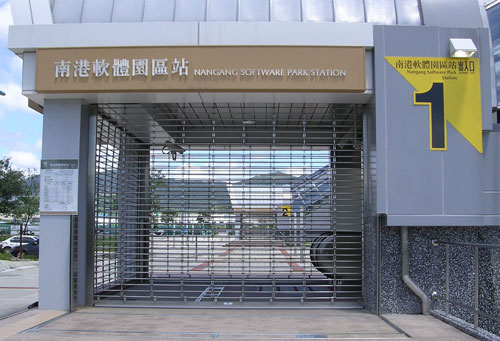

photo of an entrance to the 'Nangang Software Park Station'

common newbie errors in Pinyin: YAN

Today’s post is something for those who are relatively new to Pinyin and Mandarin. It covers something I’ve received more than one query about.

Hanyu Pinyin is quite simple. But it still has a few points — beyond the usual caveats about x, q, c, and zh — that sometimes trip up introductory students of Mandarin. One of the most common of these is the syllable yan.

Lots of Mandarin learners tend to pronounce this as if it were yang — but with an n on the end instead of an ng. But it’s properly pronounced much like the English pronunciation of the name of the Japanese currency: yen. Thus, yen for yan is a common misspelling.

Yet yan is a perfectly regular spelling within the Pinyin system. What’s more: Pinyin doesn’t have anything spelled yen.

Remember that when an i comes at the beginning of a syllable, it is written y (or yi, if there is no vowel immediately following). Thus,

yan = ian

I stress this because relatively few people get any of the following related syllables wrong:

  • bian (as in former Taiwan president Chen Shui-bian)
  • pian (as in pianyi / cheap)
  • mian (as in chaomian / fried noodles)
  • dian (as in dianhua / telephone)
  • tian (as in tianqi / weather)
  • nian (as in nian / year)
  • lian (as in buyao lian / shameless)
  • jian (as in zaijian / good-bye)
  • qian (as in qian / money)
  • xian (as in xiansheng / mister)

Now try reading these:

  • yanjing / eye
  • yanjing / glasses
  • chouyan / smoke (verb)
  • yuyan / language
  • yanse / color
  • keyan / scientific research
  • It’s easy!

    further reading:
    combinations of initials and finals in Hanyu Pinyin/span

    Tainan County signage

    I recently spent a few days in Tainan County and, as is my habit, paid special attention to the signage.

    Although the signage in the city of Tainan is primarily — or perhaps now exclusively — in Tongyong Pinyin (which is now supposed to be changed to Hanyu Pinyin), the situation in the remainder of Tainan County is not so clear-cut. Basically, from what I saw most Tainan County towns do not have street signs in Tongyong. Indeed, many of them don’t have street signs in any romanization system whatsoever.

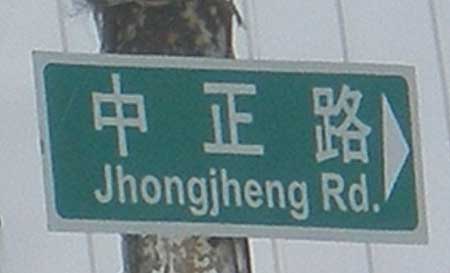
    In some small towns there are some local signs in Tongyong. For example, the following three:

    jhongjheng

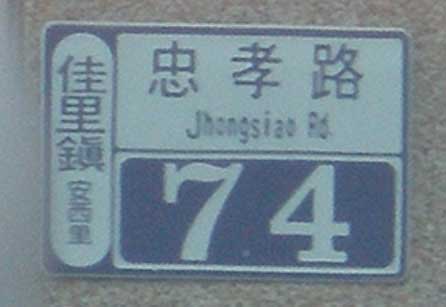
    That one’s OK, as Tongyong goes. But as for the next two address plates, is it really too much to ask that the people who make signs learn what a baseline is and what it’s for, that sizes of letters should not be altered on a whim, and that amateurish font faces are not to be used?

    Jhongsiao Rd.

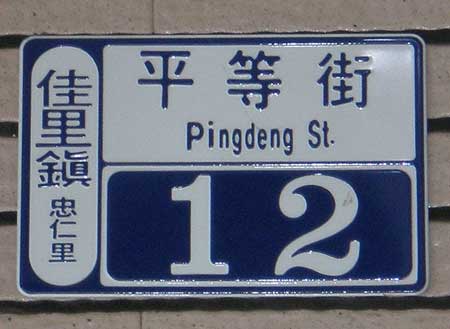
    Pingdeng St.

    (Note the “Pingdeng” spelling above. It’s relevant to the next example.)

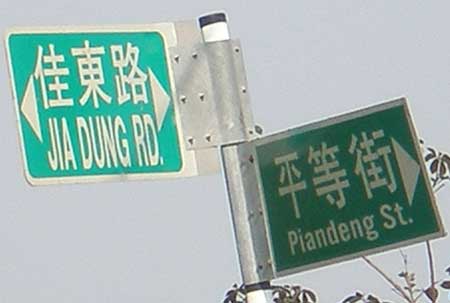
    OK, so those were in Tongyong Pinyin. But two signs about one block from where the previous shot was taken reveal more of the picture of local signage in Tainan County.

    Tongyong most certainly is not the only romanization found in Tainan County.
    described below

    Together on one pole we have “JIA DUNG RD. / 佳東路” and “Piandeng St. / 平等街”. “Jiadung” is MPS2 for what in Hanyu Pinyin would be Jiādōng (Jiadong), while “Piandeng” is a typo (presumably from Tongong, as this is a newer sign that doesn’t match the style used on other MPS2-era signs in the area) for what in Hanyu Pinyin would be Píngděng (Pingdeng). It would be spelled Pingdeng in Tongyong Pinyin as well, as can be seen above.

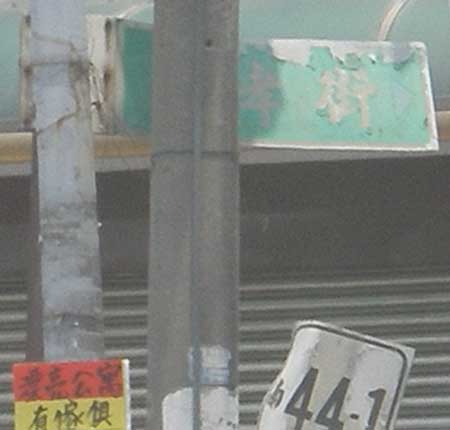
    And some signs have no romanization whatsoever and should have been put out of their misery a long time ago.
    peeling_sign

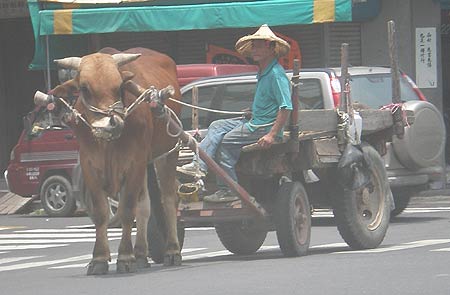
    But all sorts of old things can occasionally be found on the streets of Tainan County.
    photo of man riding in a cart pulled down a Tainan County city street by a cow

    Guangzhou opts for Pinyin ‘Lu’ over English ‘Road’

    In the push for Guangzhou to revamp its street signs, it appears the initial move for all general terms to be translated into English — e.g., as road — has been overturned. I’m pleased. Thus, Guangzhou’s street signs will be written differently than those in Beijing and many other cities in China.

    Of course, I’d be more pleased if, say, 白云路 were rendered as Baahk-wahn Louh (or however that should be spelled in Cantonese) instead of or in addition to Báiyún Lù. Fat chance of that happening, though. And, anyway, the ratio for stories that please me vs. those that really piss me off is not nearly what I’d like it to be, so at least today I’ll take what I can get.

    Some excerpts from stories on this topic:

    No, it is not “street,” nor “road”. It is simply lu.

    The English translation for signs in Guangzhou will be based on Mandarin pronunciation with pinyin spelling and come into effect from May 1, the city government said.

    This means busy Beijing Road will be translated as Beijinglu and east Dongfeng Road will be known as Dongfeng Donglu. Lu means road or street in English.

    I really hope that “Beijinglu” is just a typo. It should be Beijing Lu / Běijīng Lù.

    From a Mandarin-language story:

    Zài “gōnggòng biāozhì Yīngwén yì fǎguī fàn” zuìchū de cǎogǎo xiàng shèhuì zhēngqiú yìjiàn shí, jiāng “lù” hé “dàdào” fānyì chéng Yīngyǔ dāncí Road, Avenue. Zuórì gōngbù de “gōnggòng biāozhì Yīngwén yì fǎguī fàn” dìnggǎo zhōng, cóng “dàdào” dào “lù” dào “xiàng”, “lǐ”, “jiē” děng, yīlǜ zhíjiē yòng Hànyǔ Pīnyīn jìnxíng biāozhù. Dànshì xiāngyìng de, “qiáo”, “lìjiāoqiáo”, “gōnglù”, “suìdào” děng jiāotōng shèshī, “guīfàn” zé míngquè guīdìng shǐyòng yìyì, rú “Guǎngzhōu Dà Qiáo” yì wéi Guangzhou Bridge, “Guǎngshàn Gōnglù” yìchéng Guangshan Highway.

    Note the translation (which, however, won’t be used) of dàdào as “avenue.” In Taiwan, this is rendered as “boulevard.”

    OK, being pleased was nice while it lasted. Now, unfortunately, it’s time to go back to being pissed off. It takes real chutzpah to bring up a U.N. resolution that backs native languages in support of putting Mandarin on signs in a Cantonese-speaking region.

    A resolution made by the UN in 1967 stipulated all the English translations of place names in each country and region should be based on its mother language. The State Council issued a plan to standardize place names in 1986, stipulating all public names should be based in pinyin.

    Or, as a Mandarin-language article puts it in greater detail:

    Zhōng yāoqiú duì shìzhèng dàolù de fānyì cǎiqǔ pīnyīn zhíyì de fāngshì, shì yǒu jù kěchá de. 1967 nián dì-èr jiè Liánhéguó dìmíng biāozhǔnhuà huìyì zuòchū juéyì, yāoqiú gèguó guójì jiāowǎng zhōng dōu shǐyòng Luómǎ (Lādīng) zìmǔ pīnxiě, měi ge dìmíng zhǐyǒu yī zhǒng Luómǎ zìmǔ de pīnxiě xíngshì, jí “dānyī Luómǎhuà”. Yīncǐ, “báiyún lù” jiùyào yì wéi Baiyun Lu, ér bù shì Baiyun Road, yīnwèi hòuzhě shì liǎng zhǒng bùtóng de Luómǎ zìmǔ pīnxiě xíngshì, bùfú “dānyī huà”. 1977 nián, dì-sān jiè Liánhéguó dìmíng biāozhǔnhuà huìyì shàng, tōngguòle Zhōngguó tíchū de cǎiyòng Hànyǔ Pīnyīn Fāng’àn zuòwéi Zhōngguó dìmíng Luómǎ zìmǔ pīnxiěfǎ de guójì biāozhǔn. 1986 nián Guówùyuàn bānbù “dìmíng guǎnlǐ tiáolì”, guīdìng Zhōngguó dìmíng de Luómǎ zìmǔ pīnxiě, yī “Hànyǔ Pīnyīn Fāng’àn” zuò tǒngyī guīfàn. Yīncǐ “báiyún lù” yě bùnéng yì wéi White Cloud Road, yīnwèi bù fúhé “Hànyǔ Pīnyīn Fāng’àn”. Suǒyǐ, shǐyòng Hànyǔ Pīnyīn zuòwéi Zhōngguó dìmíng pīnxiě guīfàn, bùjǐn wèi wǒmen fǎlǜ fǎguī suǒ guīdìng, yěděi dàoliǎo guójì shàng de rènkě.

    Well, I suppose those could be separate instances of subversive irony; but my money is still on deeply offensive and clueless chutzpah. Or doublespeak. Take your pick.

    sources:

    related entries

    ‘dialects’ wasting ‘important neurons’ needed for Mandarin, English: Lee Kuan Yew

    In 1979 Singapore launched its campaign for people there to “Strike Hard Against Hoklo, Cantonese, and Other Languages that Your Government Says Are Puny and Insignificant Because They Have Only Tens of Millions of Speakers Apiece,” er, “Speak Mandarin” (Jiǎng Huáyǔ Yùndòng / 讲华语运动). The city-state has been marking the the 30th anniversary of this with some speeches, such as one a couple of weeks ago by former prime minister Lee Kuan Yew (Lǐ Guāngyào), now “minister mentor.”

    Lee described the situation:

    Thirty years ago I launched the Speak Mandarin campaign. [Singaporean] Chinese students learned Mandarin at school. Unfortunately, they used to speak dialects amongst themselves, at home, and with their friends — a variety of dialects.

    Here, “dialects” is of course the standard misnomer for Sinitic languages other than Mandarin.

    Lee said that he himself was setting a bad example during the 1960s and 1970s by doing such highly irresponsible things as giving speeches in the native language of the majority of Singapore’s citizens. So he stopped all that. And he had the government shut down almost all broadcasts in Hokkien (Hoklo) and other such languages.

    Lee said that although he understands “the strong emotional ties to one’s mother tongue … the trend is clear. In two generations, Mandarin will become our mother tongue.”

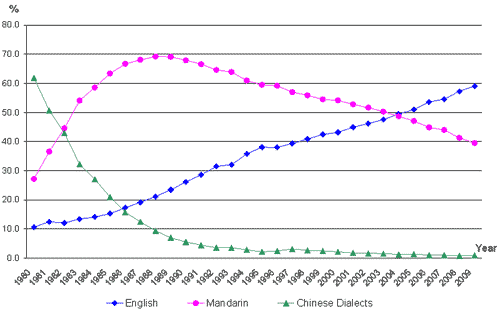
    Actually, no, that’s not clear at all. Rather, a very different trend is apparent. During his speech Lee displayed the graph below, with data taken from surveys conducted by Singapore’s Ministry of Education.

    Dominant Home Language of Singaporean Chinese Primary-1 Students (1980 to 2009)
    graph showing English in a steady climb from 10% -- all numbers are approximate -- (1980) to 60% (2009); 'Chinese dialects' in steep decline from 1980 (62%) to 1988 (9%) and continuing to decline to only 1% or 2% in 2009; and Mandarin, which begins in 1980 at 28% and quickly tops 60% in 1985, with slower growth until 1988 (69%), after which it enters a steady decline to 39% (2009)

    As the primary language of the home for young students, Mandarin has dropped steadily since the late 1980s, while English has risen steadily since 1980, with English surpassing Mandarin in 2004. (Language data for the whole population is more complicated. See, for example, the 2005 General Household Survey.)

    Of course the government and Lee recognize this. But they don’t want to fight against English, which is crucial to Singapore’s success. So what Lee is proposing is that parents — both parents — speak Mandarin, not English, to their children.

    (I see from my stats that this site gets lots of visitors from Singapore. Can any of you comment on how well you think the public will respond to Lee’s proposal.)

    Lee explained in his speech that people have only so many “gigabytes” in their brains to devote to languages.

    Though stating that speaking “dialects” in some situations can provide “extra warmth,” he warns that by using such languages: “You are losing important neurons with data which should not be there. And like the computer, when you delete it, it doesn’t really go away. It’s there at the back, and you’ve got to go to the rubbish channel and say ‘destroy.’ And it’s still disturbing your hard disk.”

    Thus, those rubbish languages must be destroyed “dialects” must be let go, he said.

    On March 8 a linguist at Nanyang Technological University (NTU) in Singapore was quoted in the newspaper as saying, “Although Singaporeans are still multilingual, 40 years ago, we were even more multilingual. Young children are not speaking some of these languages at all any more…. All it takes is one generation for a language to die.” But even after all these years, with Sinitic languages other than Mandarin fading fast there, this is apparently still no time to be slacking off, as Lee’s principal private secretary, Chee Hong Tat, promptly responded, “It would be stupid for any Singapore agency or NTU to advocate the learning of dialects, which must be at the expense of English and Mandarin.”

    Part of the reason behind Lee’s call, however, is a basic misunderstanding. Setting aside the matters of educating children in a language not native to them and how many languages most people are capable of speaking effectively, the main difficulty with learning Mandarin is not the language itself (especially for those who speak other Sinitic languages) but Chinese characters as its near-exclusive script.

    If Singapore is smart about promoting Mandarin, sooner rather than later it will develop a two-track system, with most students studying how to read and write Mandarin exclusively in Hanyu Pinyin, while those who wish become more specialized can go on to study Chinese characters as well. For this to work, Singapore will need to produce plenty of material to read in Pinyin. (A newspaper, for example, would be a must — and one with real news, not just cute stories for kids.) The city-state certainly has the means and motive for this. But does it have the imagination? If it does, most students could save their precious neurons and gigabytes for other things — perhaps even their families’ traditional native languages.

    SOURCES:
    Lee Kuan Yew speech:

    Some Singapore blog posts:

    newspaper stories:

    letter to the editor:

    additional: