August 2008
Monthly Archive
news and discussions related to romanization
Monthly Archive
Posted by site admin on 23 Aug 2008 | Tagged as: Japan, Japanese, kana, languages
The Yomiuri Shimbun reports, “A series of classic works by renowned novelists is proving popular due to innovative designs and the fact the text is printed using lateral text rather than the vertical columns usually used for Japanese novels.”
The first two books in the Meisaku Bungaku (Masterpiece Literature) series are single volume editions of Soseki Natsume’s “Kokoro” (Heart) and Osamu Dazai’s “Ningen Shikkaku” (No Longer Human), both published on Aug. 1.
The venture by the publisher, Goma Books, is aimed at getting young people to read classic fiction in a similar manner to the way they read novels on mobile phones.
The two books feature photographs of actresses on their front covers, and the type is not the usual black, but features colors such as orange and bright green to give the books a casual feel. Such designs, coupled with the horizontal text, have helped the publisher sell more than 50,000 copies of the novels since they were put on sale.
The two books were among 60 novels made available on the Goma Books mobile phone Web site in April last year. They were selected due to their great popularity.
Copyright on all the site’s books has expired because at least 50 years have passed since the death of their authors.
Some site users said they found it easy to read the masterpieces when they were written horizontally rather than vertically. The site attracts about 100 million hits a month, prompting the publisher to put out printed forms of the works.
As well as the switch from vertical to horizontal text, other ideas also were adopted.
Reading ease was taken into account, with the publisher using fewer words per page and more space between lines. Kana syllables are also frequently printed alongside kanji to aid readers.
My favorite bit, in part because I wonder if the first sentence had ever been uttered before, comes next. Or is this a topic that has been hotly debated among the Japanese literati?
“The emotions [of the work] are not lost with lateral writing,” said Yutaka Akiyama–a former editor at publisher Iwanami Shoten–who was responsible for compiling the complete works of Soseki. “Soseki himself wrote his notes horizontally.”
The second batch of three works, which include Ryunosuke Akutagawa’s “Kumo no Ito” (The Spider’s Thread), came out Friday.
source: Laterally printed classics prove hit, Daily Yomiuri Online, August 23, 2008
Posted by site admin on 22 Aug 2008 | Tagged as: Chinese, English, Mandarin, Taipei, Taiwan, romanization, signage
As some of you may recall, last October I wrote about finding official signs for a Taipei street that used English rather than romanization (Street names in English translation: trend or error?).
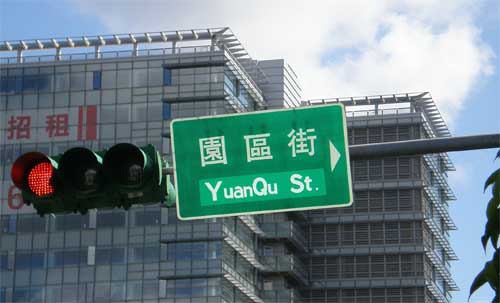
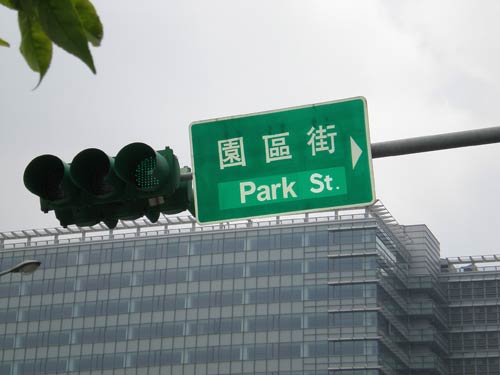
Some of the signs for what is written in Hanzi “園區街” (Yuánqū Jiē) read, in Taipei’s standard but stupid InTerCaPiTaLiZaTion, “YuanQu St.” while others read “Park St.” (which, by the way, is a misleading translation). I called the Taipei City Government about this and was informed that Park was an error and that the signs would be fixed to read Yuanqu.
Nearly a year has gone by since then. Have any of the street signs been changed?
The answer is yes. The signs, including some new ones, are indeed consistent. All of them now read — have you guessed it yet? — “Park St.”
That’s right: They eliminated the signs that were correct and put up new signs that are wrong. I’m trying to relax, so I won’t write out all of the many maledictions I have been muttering about Taipei City Government and its bureaucracy.
Here’s one of the street signs in October 2007:

Here’s the same sign in August 2008:

A close-up, showing how “Park” was pasted over “YuanQu”.

Posted by site admin on 21 Aug 2008 | Tagged as: Cantonese, Chinese, Mandarin, languages, teach Chinese
Ozaru’s link in a comment on my previous post led me eventually to a report on “community languages” in higher education in Britain. The report provides numbers for those in degree programs for various foreign languages.
| Language | 1996 | 2001 | 2005 | 2007 | % change 1996-2007 | % of total in 1996 | % of total in 2007 |
|---|---|---|---|---|---|---|---|
| French | 5655 | 4077 | 3964 | 3700 | -34.57 | 33.02 | 28.83 |
| Italian | 837 | 786 | 639 | 2461 | 194.03 | 4.89 | 19.18 |
| Spanish | 2155 | 2331 | 2547 | 1401 | -34.99 | 12.58 | 10.92 |
| German | 2288 | 1736 | 1503 | 610 | -73.34 | 13.36 | 4.75 |
| Russian and Eastern European | 418 | 380 | 425 | 409 | -2.15 | 2.44 | 3.19 |
| Mandarin | 165 | 165 | 352 | 392 | 137.58 | 0.96 | 3.05 |
| Modern Middle Eastern | 214 | 260 | 362 | 378 | 76.64 | 1.25 | 2.95 |
| Japanese | 272 | 249 | 331 | 306 | 12.50 | 1.59 | 2.38 |
| Portuguese | 128 | 117 | 118 | 141 | 10.16 | 0.75 | 1.10 |
| Other Asian | 161 | 171 | 142 | 118 | -26.71 | 0.94 | 0.92 |
| African | 54 | 57 | 57 | 67 | 24.07 | 0.32 | 0.52 |
| Scandinavian | 65 | 36 | 57 | 19 | -70.77 | 0.38 | 0.15 |
| Other European | 2200 | 1507 | 1667 | 1647 | -25.14 | 12.85 | 12.83 |
| Other non-European | 2514 | 1900 | 1248 | 1185 | -52.86 | 14.68 | 9.23 |
| ALL | 17126 | 13772 | 13412 | 12834 | -25.06 | 100 | 100 |
(Adapted from Table 3.3 in the report)
If I understand the report correctly, the figures are not for total enrollments, just for students majoring or minoring in the languages in question. Thus, the actual enrollment numbers are likely much higher, though certainly not distributed evenly across the languages.
I’m pleased to note that the number of students in Mandarin programs has more than doubled in the last dozen years, though this doesn’t match the even more impressive growth rate for Italian. (I have no idea why Italian received such a boost, especially during a period in which most other European languages were shedding students.)
Mandarin now ranks sixth (or perhaps fifth, depending on how many Polish majors there are) among foreign language majors, with 3 percent of foreign language majors concentrating on this.
On the other hand, because native English speakers must devote a great deal more time and effort to learning Mandarin than most other languages, the levels of learning and achievement aren’t the same. Simply put, for most native English speakers Mandarin is damn hard, and students won’t gain nearly the same level of fluency in four years as they would studying most other languages.
For example, in 2002 Goldsmiths, University of London, which is the “largest provider of community languages in a PGCE,” set up its Postgraduate Certificate in Education in community languages, starting with Arabic, Mandarin, and Punjabi, and adding Urdu in 2004. So far all of the students enrolled in the Mandarin program have had “some knowledge of the language as a community/family/heritage language.” In other words, most — perhaps all — students have been ethnic Chinese and have a background in the language beyond the classroom.
Although the College does not especially seek to attract students who have some knowledge of the language as a community/family/heritage language, all the students accepted so far do have this background. This may change in the next five to ten years, as more non-native speaker students graduate with UK degrees in Mandarin, and some may wish to go on to teach it. However, this will only take place if there is good progression in the language from school to university level so that graduates can reach a high enough level in the language to teach up to A level. Currently, this is not the case, and those who have applied so far do not have this level of expertise.
Ouch. So it’s not that non-Chinese didn’t apply to the program, it’s that none of them were judged up to the requisite level of fluency to teach the language, despite having attained unversity degrees in Mandarin. (This only reinforces my worry about the drop in graduate enrollments in Mandarin in the United States.)
The report also notes, “There are no degree courses in the four most widely used community languages in England: Urdu, Cantonese, Punjabi and Bengali, although SOAS will offer a degree course in Bengali from autumn 2008.”
The situation is more promising for those taking A-levels in “Chinese.” (NB: The chart does not distinguish between Cantonese and Mandarin — even though these have separate oral exams — but lumps them together as “Chinese.” The majority will be Cantonese.)

(The figures for Spanish have not been included in the chart because it seems likely that most pupils study this as a foreign language rather than a community language: in 2007, 63,978 candidates sat GCSE and 7,152 A-level Spanish. Hindi is not included in this chart as it is not available at GCSE or A-Level.)
The total number of A-Level presentations in these languages in 2007 is 5347, indicating potential numbers in a good position to continue their studies in these languages in higher education. The ‘retention rate’ for most of languages listed above is high. This is a percentage calculated by comparing the numbers sitting a GCSE examination in a given year compared with those sitting an A-level in the same language two years later. It has to be regarded as a proxy measure, however, as not all those sitting A-levels took the relevant examination two years earlier. The retention rate over all languages (i.e. including French, German and Spanish), between GCSEs sat in 2005 and A-levels in 2007, is 7.5%. Most of the languages likely to be studied as community languages have a retention rate considerably higher than those typically studied as ‘foreign’ languages. Chinese is the most spectacular, with a retention rate of 78%, followed by Polish (51%) and Russian (42%). Only Bengali (3%) and Punjabi (4%) have retention rates below the overall figure. The high retention rate for the majority indicates that community language learners can, generally speaking, be regarded as committed students, and potentially good candidates for continued study of these languages in higher education.
source:
further reading:
Posted by site admin on 18 Aug 2008 | Tagged as: Cantonese, Chinese, Classical Chinese, Hanyu, Hokkien, Hoklo, Japanese, Mandarin, Taiwanese, languages
From the way the U.S. media talk about the boom in Mandarin classes, it’s easy to get the impression that Mandarin is about to become the most studied language in the United States. So I offer the following overdue reality check.
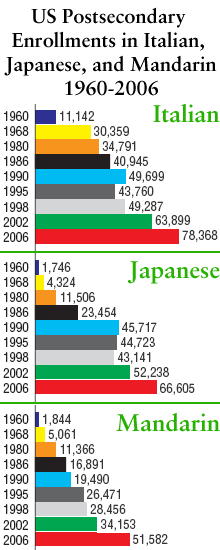
The data come from the results of a large survey of foreign-language enrollments in U.S. post-secondary schools. The survey was conducted by the Modern Language Association. I started work on this post when the results were released in November 2007; but, well, I got distracted.
This post has lots of tables and figures, so for those who don’t want to scan through everything I offer some basic points up front.
A few summary remarks of my own:
OK, now on to some details.
Look below at the growth for American Sign Language since 1990. If Mandarin had had that sort of growth (4,820 percent!) the pundits would no doubt be telling us that the Chinese had already taken over the planet and were going to rule the entire galaxy within the next decade. (And don’t get me started about the supposed Mandarin in Serenity/Firefly.) But American Sign Language just doesn’t seem to get the same sort of respect, despite the fact that it still has more than 50 percent more enrollments than Mandarin. Arabic, which has also had a much faster growth rate than that of Mandarin, hasn’t received the same level of hype either.
| Enrollments | 1990 | 2006 | % Growth 2002-06 | % Growth 1990-2006 |
|---|---|---|---|---|
| American Sign Language | 1,602 | 78,829 | 29.7 | 4820.7 |
| Arabic | 3,475 | 23,974 | 126.5 | 589.9 |
| Korean | 2,286 | 7,145 | 37.1 | 212.6 |
| Mandarin | 19,490 | 51,582 | 51.0 | 164.7 |
| Hebrew | 12,995 | 23,752 | 4.2 | 82.8 |
| Portuguese | 6,211 | 10,267 | 22.4 | 65.3 |
| Italian | 49,699 | 78,368 | 22.6 | 57.7 |
| Spanish | 533,944 | 822,985 | 10.3 | 54.1 |
| Japanese | 45,717 | 66,605 | 27.5 | 45.7 |
| French | 272,472 | 206,426 | 2.2 | -24.2 |
| German | 133,348 | 94,264 | 3.5 | -29.3 |
| Russian | 44,626 | 24,845 | 3.9 | -44.3 |
| Total | 1,125,865 | 1,489,042 | 12.7 | 32.3 |
| Change between Surveys | 1995-98 | 1998-2002 | 2002-06 |
|---|---|---|---|
| Spanish | 8.3% | 13.7% | 10.3% |
| French | -3.1% | 1.5% | 2.2% |
| German | -7.5% | 2.3% | 3.5% |
| American Sign Language | 165.3% | 432.2% | 29.7% |
| Italian | 12.6% | 29.6% | 22.6% |
| Japanese | -3.5% | 21.1% | 27.5% |
| Mandarin | 7.5% | 20.0% | 51.0% |
| Russian | -3.8% | 0.5% | 3.9% |
| Arabic | 23.9% | 92.3% | 126.5% |
| Hebrew * | 20.6% | 44.0% | 4.2% |
| Portuguese | 6.0% | 21.1% | 22.4% |
| Korean | 34.0% | 16.3% | 37.1% |
| Total | 5.0% | 16.6% | 12.7% |
* Modern and Biblical Hebrew combined
Below: Russian may not have the top number of enrollments, but it certainly has some motivated students, given the high numbers of them in advanced courses.
| Intro Enr. | Advanced Enr. | Total Enrollment | Ratio of Intro Enr. to Advanced Enr. | |
|---|---|---|---|---|
| Russian | 17,527 | 6,569 | 24,096 | 2.67:1 |
| Portuguese | 7,387 | 2,422 | 9,809 | 3.05:1 |
| German | 72,434 | 18,758 | 91,192 | 3.86:1 |
| French | 160,736 | 40,927 | 201,663 | 3.93:1 |
| Korean | 5,511 | 1,397 | 6,908 | 3.94:1 |
| Greek, Ancient | 13,250 | 3,176 | 16,426 | 4.17:1 |
| Mandarin | 41,193 | 9,262 | 50,455 | 4.45:1 |
| Spanish | 669,432 | 142,602 | 812,034 | 4.69:1 |
| Japanese | 55,161 | 10,585 | 65,746 | 5.21:1 |
| Latin | 26,787 | 4,383 | 31,170 | 6.11:1 |
| Hebrew, Modern | 7,665 | 1,250 | 8,915 | 6.13:1 |
| Arabic | 20,571 | 2,463 | 23,034 | 8.35:1 |
| Italian | 69,757 | 7,593 | 77,350 | 9.19:1 |
| Hebrew, Biblical | 7,854 | 705 | 8,559 | 11.14:1 |
| American Sign Language | 72,694 | 5,249 | 77,943 | 13.85:1 |
| Other languages | 27,836 | 3,478 | 31,314 | 8.00:1 |
| Total | 1,275,795 | 260,819 | 1,536,614 | 4.89:1 |
One thing I find particularly troubling is that the number of graduate students studying Mandarin has fallen. (Please click on the link in the previous sentence, since the relevant table is too wide to fit on this page.) The much-ballyhooed but also much-deserved increase in students studying Mandarin has all been at the undergraduate level. Given that the grad enrollment as a percentage of total enrollment for Mandarin is about the same as that for French (2.63 percent and 2.73 percent, respectively) it might appear that Mandarin has simply reached a “normal” ratio in this regard. But native speakers of English generally need much more time to master Mandarin than to master French. Simply put, four years, say, of post-secondary study of French provides students with a much greater level of fluency than four years of post-secondary study of Mandarin.
Also, there is a great deal more work that needs to be done in terms of translations from Mandarin. I do not at all mean to belittle the work being done in French — or in any other language. In fact it pains me that the MLA’s list of languages being studied included neither Old French nor Provençal, both of which I have studied and love dearly. I just mean that Mandarin has historically been underrepresented in U.S. universities given the number of speakers it has and its body of texts that have not yet been translated into English. U.S. universities need to be producing many more qualified grad students who can handle this specialized work. And right now, unfortunately, that’s not happening.
| Two-Year Colleges | Undergrad Programs | Grad Programs | Total | |||||
|---|---|---|---|---|---|---|---|---|
| Language | 2002 | 2006 | 2002 | 2006 | 2002 | 2006 | 2002 | 2006 |
| Cantonese | 47 | 96 | 128 | 82 | 5 | 0 | 180 | 178 |
| Literary Sinitic | 0 | 0 | 56 | 101 | 18 | 12 | 74 | 113 |
| Japanese, Classical | 0 | 0 | 8 | 23 | 11 | 7 | 19 | 30 |
| Taiwanese | 0 | 0 | 34 | 21 | 13 | 0 | 47 | 21 |
| Tibetan | 0 | 0 | 43 | 56 | 35 | 64 | 78 | 120 |
| Tibetan, Classical | 0 | 0 | 8 | 11 | 20 | 33 | 28 | 44 |
The figures in the table above are probably too low. Literary Sinitic (”classical Chinese”) is probably especially underrepresented because often too little differentiation is given between it and modern standard Mandarin. But at least the numbers can provide minimum figures.
| Language | Ratio of Intro Enr. in 2-Year Schools to Intro Enr. in 4-Year Schools |
|---|---|
| Greek, Ancient | 0.00:1 |
| Hebrew, Biblical | 0.01:1 |
| Latin | 0.04:1 |
| Hebrew, Modern | 0.07:1 |
| Portuguese | 0.11:1 |
| Russian | 0.15:1 |
| German | 0.20:1 |
| Italian | 0.23:1 |
| French | 0.24:1 |
| Arabic | 0.26:1 |
| Mandarin | 0.26:1 |
| Korean | 0.28:1 |
| Japanese | 0.39:1 |
| Spanish | 0.49:1 |
| American Sign Language | 1.47:1 |
| Other languages | 0.24:1 |
American Sign Language sticks out here as the only language that more people take at the introductory level at junior colleges than at universities. Roughly twice as many people take introductory Spanish in universities as at junior colleges. Introductory Japanese classes are surprisingly popular at the two-year college level, well above the level for introductory Mandarin, though Mandarin is not unpopular itself.
| Language | 1998 | 2002 | 2006 | % Change 2002–06 |
|---|---|---|---|---|
| Hindi/Urdu | 1314 | 2009 | 2683 | 33.55 |
| Vietnamese | 899 | 2236 | 2485 | 11.14 |
| Tagalog/Filipino | 794 | 1142 | 1569 | 37.39 |
| Sanskrit | 363 | 487 | 607 | 24.64 |
| Hmong | 15 | 283 | 402 | 42.05 |
| Thai | 272 | 330 | 307 | -6.97 |
| Indonesian | 223 | 225 | 301 | 33.78 |
| Samoan | 207 | 201 | 280 | 39.30 |
| Cantonese | 39 | 180 | 178 | -1.11 |
| Tibetan | 80 | 78 | 120 | 53.85 |
| Literary Sinitic | 32 | 74 | 113 | 52.70 |
| Pashto | – | 14 | 103 | 635.71 |
| Punjabi | 32 | 99 | 103 | 4.04 |
| Total | 4270 | 7358 | 9251 | 25.73 |
Although more U.S. postsecondary students are studying languages other than English than ever before, that’s unfortunately not because U.S. students as a whole have finally embraced the study of languages. Rather, there are simply more students now. Relatively speaking, enrollments in foreign languages are much lower than they were 30 years ago.
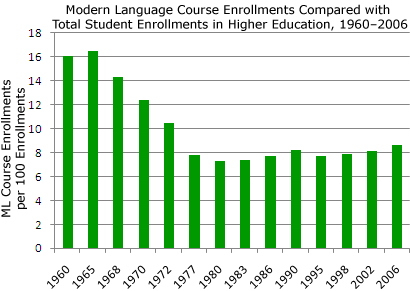
If “ancient” foreign languages such as Latin and Ancient Greek were included in the graph, the imbalance between the 1960s and the present in foreign-language enrollments would be even greater.
source: Enrollments in Languages Other Than English in United States Institutions of Higher Education, Fall 2006 (PDF), MLA, November 13, 2007

Posted by site admin on 14 Aug 2008 | Tagged as: China, Chinese, Chinese characters, Classical Chinese, dictionary, languages, linguistics, philology
The University of Hawai`i Press will be releasing another work in its groundbreaking ABC Chinese Dictionary Series, which is responsible for my favorite Mandarin-English dictionary, the Pinyin-ordered ABC Chinese-English Comprehensive Dictionary, edited by John DeFrancis.
The new work, which will be released in December 2008, is Minimal Old Chinese and Later Han Chinese: A Companion to Grammata Serica Recensa, by Alex Schuessler.
Here’s the publisher’s description:
Although long out of date, Bernard Karlgren’s (1957) remains the most convenient work for looking up Middle Chinese (ca. A.D. 600) and Old Chinese (before 200 B.C.) reconstructions of all graphs that occur in literature from the beginning of writing (ca. 1250 B.C.) down to the third century B.C. In the present volume, Axel Schuessler provides a more current reconstruction of Old Chinese, limiting it, as far as possible, to those post-Karlgrenian phonological features of Old Chinese that enjoy some consensus among today’s investigators. At the same time, the updating of the material disregards more speculative theories and proposals. Schuessler refers to these minimal forms as “Minimal Old Chinese” (OCM). He bases OCM on Baxter’s 1992 reconstructions but with some changes, mostly notational. In keeping with its minimal aspect, the OCM forms are kept as simple as possible and transcribed in an equally simple notation. Some issues in Old Chinese phonology still await clarification; hence interpolations and proposals of limited currency appear in this update.
Karlgren’s Middle Chinese reconstructions, as emended by Li Fang-kuei, are widely cited as points of reference for historical forms of Chinese as well as dialects. This emended Middle Chinese is also supplied by Schuessler. Another important addition to Karlgren’s work is an intermediate layer midway between the Old and Middle Chinese periods known as “Later Han Chinese” (ca. second century A.D.) The additional layer makes this volume a useful resource for those working on Han sources, especially poetry.
This book is intended as a “companion” to the original Grammata Serica Recensa and therefore does not repeat other information provided there. Matters such as English glosses and references to the earliest occurrence of a graph can be looked up in Grammata Serica Recensa itself or in other relevant dictionaries. The great accomplishment of this companion volume is to update an essential reference and thereby fulfill the need for an accessible and user-friendly source for citing the various historically reconstructed stages of Chinese.
Posted by site admin on 10 Aug 2008 | Tagged as: China, Chinese, Chinese characters, Mandarin, Xinjiang, linguistics, pinyin
Just how common are monosyllabic given names in China? I’ve seen lots of wild guesses, which generally range from about one-quarter to one-half (?!) of the population. Zhang et al., however, give the following figures:
91.06% Chinese have three-character names and only 8.34% have two-character names. People with four characters or more only constitute 0.6% of the population.
This was based on a database of 1,644,911 names in China.
According to a larger survey last year in the PRC, however, 14.22 percent of Han people in China have given names that are monosyllabic … and thus are written with a single Chinese character. On the other hand, 85.61 percent of Han people in China have full names written with exactly three Chinese characters, according to the report released by the National Citizen Identity Information Center, an organization with ties to China’s Ministry of Public Security. (It thus seems likely they have access to especially good data.)
Since the source material is unclear on what is meant by names written with three Chinese characters, it’s possible that some people in the second group have disyllabic family names and monosyllabic given names; but that number is likely to be close to statistically insignificant, given the relative paucity of monosyllabic given names and the outright rarity of disyllabic family names. (Only 0.02 percent of those in Zhang et al.’s name list had disyllabic family names.)
The sum of 14.22 and 85.61 is 99.83, which leaves 0.17 percent of those in China classified as Han having names that are at least four syllables long and so take at least four Chinese characters to write.
According to a report published last December but which I’m just now getting around to writing about, nearly one thousand names in China are written with at least ten Chinese characters. The news story, alas, does not give any of these names; but it does provide a breakdown of the numbers:
10 characters: 594 names
11 characters: 272 names
12 characters: 94 names
13 characters: 33 names
14 characters: 5 names
15 characters: 1 name
A total of 97 percent of those 999 people live in the predominantly non-Han Chinese region of Xinjiang, which likely indicates that they have non-Han names that are being forced into forms that fit procrustean Mandarinized syllables.
A report from Nanjing states that 309 of the city’s 6 million people have names that take more than four Chinese characters to write.
PRC authorities have proposed limiting given names to two syllables and family names to four syllables (for rare cases in which a child receives a disyllabic family name from both parents).
As for Taiwan, monosyllabic given names are much rarer here than in China. My guess would be about 2 percent. This could probably be worked out from Chih-Hao Tsai’s list of Chinese names; but right now I don’t have the time.
On the other hand, China’s public is being urged to embrace new disyllabic family names, largely because the relative paucity of surnames ensures many, many people in China share common names.
Recent demographic surveys indicate there are about 1,600 surnames, with only 100 or so being frequently used, among Chinese nationals, which means many people share a name. For example, nearly 300,000 people, male and female, use the same common name of Zhang Wei, the statistics show.
The top 1,600 U.S. surnames don’t even cover half of the population, according to the U.S. Census Bureau, whose list of surnames found in the United States contains more than 88,000 entries.
sources:
Further reading:
Posted by site admin on 09 Aug 2008 | Tagged as: Chinese, Hanyu, Hokkien, Hoklo, Mandarin, Taiwan, Taiwanese, tone marks
Imagine taking everyone in the United States named Johnson, Williams, Jones, Brown, Davis, Miller, Wilson, Moore, Taylor, and Anderson … and giving them all the new family name of “Smith.” Then add to the Smiths everyone surnamed Thomas, Jackson, White, Harris, Martin, Thompson, Garcia, Martinez, Robinson, Clark, Rodriguez, Lewis, Lee, Walker, Hall, Allen, Young, Hernandez, King, Wright, and Lopez. Those are, in descending order beginning with Smith, the 32 most common family names in the United States. It takes all of those names together to reach the same frequency that the name “Chen” (Hoklo: Tân) has in Taiwan.
Chen covers 10.93 percent of the population here, according to figures released by Chih-Hao Tsai based on the recent release of the names of the 81,422 people who took Taiwan’s college entrance exam this year.
By way of additional contrast, Smith, the most common family name in the United States, covers just 1.00 percent of the population there.
In Taiwan, the 10 most common family names cover half (50.22 percent) of the population. Covering the same percentage in the United States requires the top 1,742 names there. And covering the same percentage as Taiwan’s top 25 names (74.17 percent) requires America’s top 13,425 surnames.
So if you’re just getting started in Mandarin, consider that you’ll get a lot of mileage out of memorizing the tones for the top ten names.
| family name (Mandarin form) | spelling usually seen in Taiwan | percent of total | cumulative percentage |
|---|---|---|---|
| Chén | Chen | 10.93% | 10.93% |
| Lín | Lin | 8.36% | 19.29% |
| Huáng | Huang | 6.06% | 25.35% |
| Zhāng | Chang | 5.39% | 30.74% |
| Lǐ | Li, Lee | 5.20% | 35.94% |
| Wáng | Wang | 4.20% | 40.14% |
| Wú | Wu | 4.03% | 44.17% |
| Liú | Liu | 3.18% | 47.36% |
| Cài | Tsai | 2.86% | 50.22% |
| Yáng | Yang | 2.64% | 52.86% |
| Xǔ | Hsu | 2.32% | 55.18% |
| Zhèng | Cheng | 1.86% | 57.05% |
| Xiè | Hsieh | 1.77% | 58.82% |
| Qiū | Chiu | 1.50% | 60.32% |
| Guō | Kuo | 1.48% | 61.79% |
| Zēng | Tseng | 1.45% | 63.24% |
| Hóng | Hung | 1.40% | 64.64% |
| Liào | Liao | 1.38% | 66.02% |
| Xú | Hsu | 1.33% | 67.35% |
| Lài | Lai | 1.32% | 68.66% |
| Zhōu | Chou | 1.24% | 69.90% |
| Yè | Yeh | 1.18% | 71.08% |
| Sū | Su | 1.17% | 72.25% |
| Jiāng | Chiang | 0.97% | 73.22% |
| Lǚ | Lu | 0.94% | 74.17% |
For those wanting the Taiwanese (Hoklo) forms of these names, see Tailingua’s list of Common Family Names in Taiwan.
On the other hand, common given names have much greater variety in Taiwan than in America, especially in the case of males. In the United States the top 10 names for males cover 23.185 percent of the male population, and the top 10 names for females cover 10.703 percent of the population. In Taiwan, however, the top 10 given names (male and female together) cover just 1.49 percent of the population.
sources:
further reading:
Posted by site admin on 08 Aug 2008 | Tagged as: Chinese, Mandarin, Taiwan, languages
Kit: The letter K appears in this script 1,456 times. That’s perfectly divisible by 3.
Freddy: So what? So what you saying?
Kit: What am I saying? KKK appears in this script 486 times!–from Bowfinger
Webmaster’s note: I just came across this old post, which for some reason I failed to put online half a year ago, back when it was actually news. So when I refer to the government here, that means the Chen administration, not the current one of Ma Ying-jeou — not that it would probably make any difference on this issue. This is one change the Ma administration doesn’t seem interested in rescinding. And, anyway, with China starting the Olympics ceremony tonight at 8 p.m. — that’s 08/08/08 at 8:00 (or is the time supposed to be 8:08:08?) — a number-related post doesn’t seem out of order.
The deadly number four is in the news again. Eliminating fours from Taiwan license plates wasn’t enough, as millions of people in Taiwan still have the potentially life-threatening burden of one or more fours in their official ID no.
In Mandarin, the word for “four” (sì) sounds similar but not identical to the word for “die/death” (sǐ). In Taiwanese, too, the words are similar but not identical sounding.
So the government has decided to pander to the superstitious treat the issue with appropriate cultural sensitivity. Removing 4 entirely from Taiwan’s two-letter, eight-digit ID numbers would affect too many IDs, officials decided, so at least one 4 can remain — but never in the final position. (The latter restriction has been in force since 2000.)
Luckily, for those who need to have every last 4 removed from their ID number, help is at hand.
Let’s just hope that whatever massive amount of taxpayers’ money the government will have to spend on this, the figure won’t have an unlucky four in it, because then some people might start to question the wisdom of this project.
sources and further reading: