March 2008
Monthly Archive
news and discussions related to romanization
Monthly Archive
Posted by site admin on 29 Mar 2008 | Tagged as: Chinese, Chinese characters, Sino-Platonic Papers, languages, linguistics, writing systems
This week’s rerelease from Sino-Platonic Papers is The Prestige of Writing: 文, Letter, Picture, Image, Ideography, by Haun Saussy, who is currently a professor of Chinese and comparative literature at Yale.
This work contains a memorable, wry disclaimer:
WARNING. The following section contains passages from the writings of Ernest Fenollosa which may be objectionable to some readers. The reproduction of these statements does not indicate endorsement or approval of their content by the author or editors, who decline all responsibility for any damages, direct or incidental, that may be attributed to the reading of them.
The author explains: “The need for such a disclaimer was brought home to me by the reactions of two sinological colleagues who refereed an earlier version of this paper.” Just in case anyone’s wondering why that might be the case, see Fennolosa, Pound and the Chinese Character, by George A. Kennedy, and The Ideographic Myth, by John DeFrancis.
Here is the introduction:
The disparagement of writing is a motif common, I suppose, to all traditions that have writing. Writing is often seen as inadequate to represent speech or thought. But another response to the inadequacy of writing has been to exalt some other kind of writing — occasionally a language reformer’s pet project, but more frequently the writing of the angels, the writing of the citizens of some utopia, of the scholars of some faraway kingdom, or of the forces of nature itself. Imagined writings of this sort telescope critique and critique’s wishful compensation. They attribute wonders — praestigia — to a medium most often noticed in its falterings.
Since Chinese writing became known in Europe, it has often been pressed into service as the model of this perfected writing. This enthusiasm must appear outlandish to those whose ‘native’ writing-system is Chinese. But it is not enough to show that the indigenous and foreign perceptions of Chinese writing are at variance, or even that the tales told of Chinese script do not stand up to linguistic scrutiny: there is an inventive element to all intercultural interpretation, a fit between its observations and the intellectual needs of its proponents, that expert testimony simply shoves aside. The proper way to analyze an intellectual tangle of this sort, it seems to me, is not to hold it to the standard of specialist univocity, but to situate it ethnographically among the conceptions it echoes or answers. Which aspects of which utopias still beckon, and which have definitely gone on to feed intellectual history, is another question deserving patient consideration.
This is issue no. 75 of Sino-Platonic Papers. It was originally published in February 1997.
Posted by site admin on 20 Mar 2008 | Tagged as: English, Sino-Platonic Papers, Tibet, Tibetan, languages, romanization
It seems like a good time for something related to Tibet.
The newest rerelease from Sino-Platonic Papers comprises 900 sample sentences in romanized Tibetan and English, the Tibetan being specifically Kham Tibetan.
From the introduction:
The reader is undoubtedly aware that written Tibetan radically differs from what is spoken and that there are also many differences in, for example, written Tibetan in Amdo regions and that of Lhasa. The value of this material is that it presents one of the most widely used Tibetan dialects as it is actually spoken.
Renchin-Jashe, a native of Yulshul (Yushu) Tibetan Autonomous Prefecture in Qinghai Province where Kham is spoken, wrote these sentences using a system that he devised. I then edited the sentences…. We have tried throughout to present sentences that reflect Tibetan culture.
This issue is Kham Tibetan Language Materials (2.7 MB PDF), by Renchin-Jashe and Kevin Stuart.
Here are the first 15 of the 900 sentences.
The work also contains a guide to pronunciation and sentences for learners at the intermediate level.
It was first published in November 1993 as issue no. 42 of Sino-Platonic Papers.
Posted by site admin on 16 Mar 2008 | Tagged as: Beijing, Chinese, Sino-Platonic Papers, languages, linguistics, romanization, writing systems
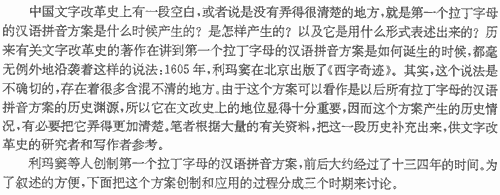
The most recent rerelease from Sino-Platonic Papers is Dì-yī ge Lādīng zìmǔ de Hànyǔ Pīnyīn Fāng’àn shì zěnyàng chǎnshēng de? (How Was the First Romanized Spelling System for Sinitic Produced? / 第一个拉丁字母的汉语拼音方案是怎样产生的), by YIN Binyong (尹斌庸).
The author should be familiar to regular readers of this site, as he wrote the standard works on Hanyu Pinyin orthography — Chinese Romanization: Pronunciation and Orthography and the Xinhua Pinxie Cidian — as well as Pinyin-to-Chinese Character Computer Conversion Systems and the Realization of Digraphia in China.
The text is in Mandarin in Chinese characters. Here is the introduction.

This is issue no. 50 of Sino-Platonic Papers. It was first published in November 1994.
Posted by site admin on 12 Mar 2008 | Tagged as: Chinese, Chinese characters, Hanyu, Mandarin, Tongyong, pinyin, teach Chinese, zhuyin
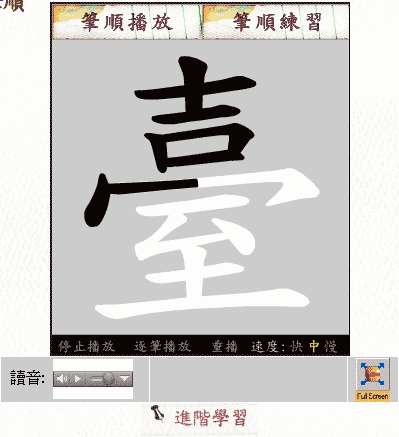
Taiwan’s Ministry of Education has put online new a Web site devoted to stroke order for Chinese characters.
Unlike the older MOE stroke-order online handbook, this new site provides animations of the stroke order for 4,808 of the most frequently used traditional Chinese characters. And they really are traditional, too. For example, a Pinyin search for tai (it doesn’t accept tone marks or numbers) doesn’t return 台, even though it is more commonly seen in Taiwan than the full form of 臺. But perhaps that’s a glitch, since 台 is within the system, as a search for that particular character reveals.
Users can also test their knowledge of official stroke order, since each character’s animation also comes with an interactive feature in which users trace the strokes with their mouse. (Click on the button to the top right of the character.) It can be a little picky, as I suppose befits the prescriptive nature of the site. (In the real world, people write many characters using orders other than what Taiwan’s Ministry of Education and your Mandarin teacher might tell you is the One True Way. But that’s another matter.)
Although there’s no English interface at present, the files are labeled in English, so positioning your mouse over the navigation elements will usually reveal enough for non-Hanzi readers to make their way around.
Unfortunately, the site doesn’t appear to work with anything other than @#$%! Internet Explorer. Also, at first the search feature allowed the entry of no more than four letters, making it impossible to use Pinyin (Hanyu Pinyin is offered along with Taiwan’s official Tongyong Pinyin) to look up characters for, say, zhong and guang, or for the Pinyin syllables with the most letters: chuang, shuang, and zhuang (not counting -r forms); but someone there is on the ball, since that was fixed after I wrote the ministry about it yesterday.
site and further reading:
Posted by site admin on 01 Mar 2008 | Tagged as: Cantonese, China, Chinese, Guangzhou, Hokkien, Hoklo, Hong Kong, Minnan, Shanghainese, Sino-Platonic Papers, Taiwanese, dialect, languages, linguistics
The latest new release from Sino-Platonic Papers is one that I think will be of particular interest to readers of Pinyin News. It’s an extensive study of not only the attitudes of speakers of Cantonese and Mandarin toward the status of Cantonese but also their beliefs about its future, especially in Hong Kong: Language or Dialect–or Topolect? A Comparison of the Attitudes of Hong Kongers and Mainland Chinese towards the Status of Cantonese (650 KB PDF), by Julie M. Groves.
This study reports on a comparative survey of three groups of Chinese: 53 Hong Kong Cantonese speakers, 18 Mainland Chinese Cantonese speakers, and 72 Mainland Chinese Putonghua speakers. It was found that the Putonghua speakers held more ‘classic’ views, the majority seeing Cantonese as a dialect. In contrast, only just over half the Hong Kongers and two-fifths the Mainland Cantonese speakers considered it clearly a dialect, while one-third of all respondents favoured a mid-point classification. The differing perspectives held by the groups can be traced to their different political and linguistic situations, which touch issues of identity.
The author notes, “The uncertainties in classification also reflect a problem with terminology. The Chinese word usually translated dialect, fangyan (方言), does not accurately match the English word dialect.” Groves recommends the adoption of Victor Mair’s proposed English word for fangyan: topolect.
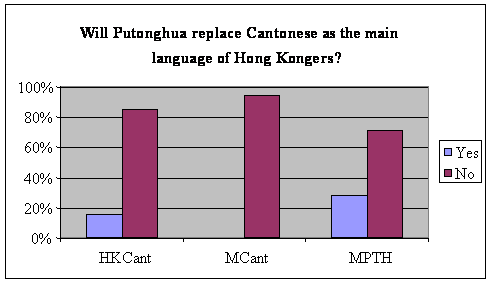
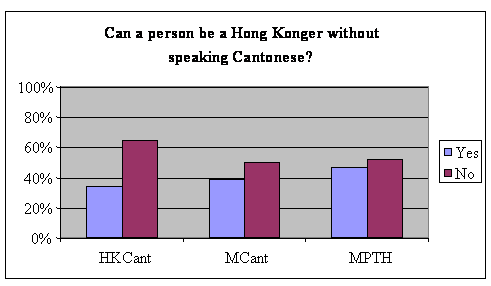
Although this focuses on the dialect vs. language debate, it covers much more than that. Those being surveyed were also asked questions such as:
The results of the study may also prove useful for those interested in the future of other languages of China and Taiwan, such as Taiwanese and Shanghainese.
Here are a couple of the many graphs found in the study.
HK Cant = Hong Kong Cantonese speakers
MCant = mainland Cantonese speakers
MPTH = mainland speakers of Mandarin (”Pǔtōnghuà“)