Y.R. Chao works being reissued

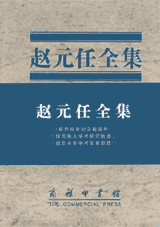
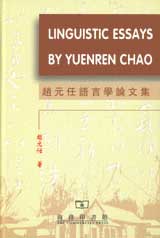
cover of the book 'Linguistic Essays, by Yuenren Chao'The Commercial Press has begun issuing a set of the complete works of Y.R. Chao (Zhao Yuanren / 趙元任 / 赵元任). This project, which will comprise some twenty volumes, will contain works in both English and Mandarin Chinese. All of the many fields Chao wrote about will be covered. Letters and journals will also be included, as will sound recordings. Wonderful!

For those who don’t want to wait for the whole series or don’t feel the need to buy all of them, the Commercial Press has also two volumes of Chao’s selected essays on linguistics: one in English and one in Mandarin. These are, respectively, Linguistic Essays by Yuenren Chao (ISBN: 7-100-03385-3/H·860) and Zhào Yuánrèn yǔyánxué lùnwénjí (赵元任语言学论文集) (ISBN: 7-100-03127-3/H·789).
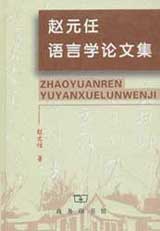
cover of the book '赵元任语言学论文集 Zhao Yuanren Yuyanxue Lunwenji'Note how the cover of Linguistic Essays, a book printed just last year in China, uses “Yuenren Chao,” the traditional spelling and Western order of his name, rather than “Zhao Yuanren,” the spelling used in Hanyu Pinyin. Also note how the Mandarin title is given in traditional, not simplified, characters: 趙元任語言學論文集, not 赵元任语言学论文集. A nice surprise, on both counts. On the other hand, the botched romanization on the cover of the Mandarin-language collection, which gives “ZHAOYUANREN YUYANXUELUNWENJI” instead of “Zhào Yuánrèn yǔyánxué lùnwénjí,” is particularly inappropriate and painful to look at on a collection of the works of this brilliant linguist. But don’t judge this book by its cover.

Here are links to all the volumes in the complete works that I’ve been able to locate information on:

cover of the first volume of Y.R. Chao's collected works

IPA for Mandarin Chinese

Another back issue of Sino-Platonic Papers has been released as a free PDF: Chinese Romanization Systems: IPA Transliteration (1.34 MB), by Warren A. Shibles. This was first published in November 1994 as SPP No. 52.

This work, whose rather dim view of romanization I do not share, is primarily a useful compilation of various published forms of IPA transcriptions for all the syllables of Mandarin. To these the author adds his own stab at applying the International Phonetic Alphabet to Mandarin. Moreover, a variety of romanization systems are shown, including that from Werner Rüdenberg’s Chinesisch-deutsches worterbuch.

Elsewhere, Pat Moran recently posted an HTML version of his own IPA chart for Mandarin.

I hope that the variety of approaches will provide a useful reminder that standard Mandarin is represented by a range, not a fixed point. And also that standard Mandarin is not the same thing as a caricature of a Beijing accent. Too often, in their quest for “correctness,” students of Mandarin end up with so many ers that they sound like they’re part circus seal. Emulating the sounds of the Beijing dialect of Mandarin is fine (though generally unnecessary); just don’t go overboard.

Grace Lee — the name, the movie

Korean-American filmmaker Grace Lee has made a movie about her own very common name, those who share it with her, and what cultural implications it may have, both in the West and Asia.

Here is the opening of one reviewer’s description of the film:

Smartly counterprogrammed opposite the orientalized depictions of Asian femininity in Memoirs of a Geisha, The Grace Lee Project is a breezy first-person video essay that goes in search of the average Asian American woman, all the while wondering if there is in fact such a thing. Early in her documentary, filmmaker Grace Lee points out that almost everyone knows a Grace Lee, and what’s more, is inclined to describe her the same way: nice, intelligent, quiet, sweet, studious, sort of forgettable. (Oh, and plays the violin.) Even G.L.’s often think of other G.L.’s—and of themselves—in those non- descript terms. Intrigued and disconcerted by the oppressive commonness of her name—and even more so by the perceived attributes that cling to it—Lee sets out to humanize the sociocultural abstraction and statistical mean that is “Grace Lee.”

Although the film premiered in late 2005 and received good reviews, it is not yet commercially available on DVD.

Taiwan aboriginal students can gain extra school-entrance points through language exam

To help ward off the extinction of the languages of Taiwan’s tribes, the Council of Indigenous Peoples is establishing examinations in these languages. Those young people who pass will be given a 10 percent increase on their exam scores toward entry into high schools and universities. This would be on top of the 25 percent increase aboriginal students already receive automatically.

The first of the examinations will be held in March. Each test will have two parts: listening and speaking.

The council hopes this will encourage young people to retain the languages of their ancestors.

Students can prepare for the tests by studying books issued by the Ministry of Education. Although the ministry’s books have nine levels, tests will be based on only the first three levels.

sources:

registration of aborigine names fails to reach target

Taiwan’s Cabinet-level Council of Indigenous Peoples (formerly the Council of Aboriginal Affairs) has been encouraging members of Taiwan’s tribes to officially register themselves under their “original names,” which are recorded in romanization. But the total of such registrations reached only about half of this year’s goal of 10,000, with the majority of those having been registered in earlier years.

source:

Shanxi / Shaanxi

road sign that gives SHANXI LU for 山西路 and SHANXI LU for 陕西路
A sign in Tianjin, China, points toward two roads, which, although they have different names, are both labeled “SHANXI LU”.

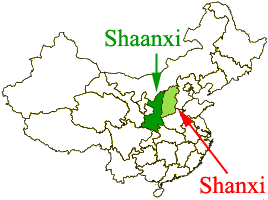
The two roads are named after adjacent Chinese provinces: Shānxī (山西), whose largest city is Taiyuan, and Shǎnxī ( 陝西 / 陕西), which contains Xi’an. So “Shanxi” would appear to be appropriate for both if tone marks are omitted, which is, obviously, sometimes definitely a bad idea.

But because these names are both often used and leaving off the tone mark in their romanized forms could lead to confusion, the PRC authorities long ago decided to alter the romanization of Shǎnxī by borrowing a trick from Y.R. Chao’s tonal spelling system; in this exceptional case, a doubled a is used to represent the third-tone a in Shǎnxī, rendering the province’s name as “Shaanxi”. (This is not intended to change the pronunciation in the slightest, which is still Shǎnxī in modern standard Mandarin. Pronouncing “Shaanxi” with a drawn-out a — Shaaaaaaaaaaaaaaaaaaanxi — is incorrect.)

In Gwoyeu Romatzyh, a first-tone a is spelled simply a, so “Shanxi” could be said to use this as well. And in the old postal system romanizations that predated Hanyu Pinyin for the names, the provinces were “Shensi” and “Shansi”.

So the signs in the photo should read “SHANXI LU” for 山西路 (Shānxī Lù) and “SHAANXI LU” for 陕西路 (Shǎnxī Lù). The local authorities, however, say they can’t do anything to change this:

Tiānjīn Shì Dìmíng Bàngōngshì de gōngzuò rényuán biǎoshì, ànzhào “Tiānjīn Shì dìmíng guǎnlǐ tiáolì” de guīdìng, dìmíng de Hànyǔ Pīnyīn Fāng’àn yào yǐ Hànyǔ Pīnyīn hé pīnxiě guīzé wéi biāozhǔn, bùdé shǐyòng wàiwén pīnxiě. Tóngyàng, Tiānjīn Shì yǔyán wénzì péixùn cèshì zhōngxīn de gōngzuò rényuán yě biǎoshì, xiàng Shānxī Lù hé Shǎnxī Lù de Hànyǔ Pīnyīn pīnxiě fāngshì quèshí wúfǎ gēnggǎi.

(天津市地名办的工作人员表示,按照《天津市地名管理条例》的规定,地名的汉语拼音方案要以汉语拼音和拼写规则为标准,不得使用外文拼写。同样,天津市语言文字培训测试中心的工作人员也表示,像山西路和陕西路的汉语拼音拼写方式确实无法更改。)

This is absurd. “Shaanxi” is not a “foreign-language spelling” (wàiwén pīnxiě). The name is in Mandarin, China’s official language, and Shaanxi is China’s own spelling for this, as should be no mystery to anyone who has access to a map of China published in the last few decades. Also, Hanyu Pinyin’s rules — which are based on words, not syllables, and most definitely not on Chinese characters taken in isolation — take this exception into account. Using “Shaanxi” to refer to 陕西 Province is perfectly acceptable in Hanyu Pinyin.

map of China, showing the locations of Shaanxi and Shanxi

source: ‘SHANXI LU’: Nín cāi shì nǎ tiáo lù? (SHANXI LU 您猜是哪条路?), Měirì xīn bào (每日新报), December 29, 2006

Beijing subway signage — some photos

Sonarchic sent in photos of some signs in the Beijing subway system.

The typography for English and Pinyin is generally poor, as is common in China.

There are several things in general I’d like to draw attention to:

  • Everything is in a boring sans-serif.
  • The letters are often set too close together and occasionally too far apart.
  • EVERYTHING IS IN CAPITAL LETTERS.
  • The size of the English/romanization relative to the Chinese characters varies, with the English text often too small. (The latter is increasingly a problem in Taiwan.)

OK, now to the photos.

column-mounted list of station names along one particular Beijing subway line
Above:

  • very tight tracking between most of the Roman letters, except around the letter I
  • enormous (and incorrect) space after the apostrophes in “Tian’anmen” (which is, correctly, written with an apostrophe, BTW) and “Yong’anli” (which should perhaps be written “Yong’an Li”)
  • yet the apostrophes in the time-to-station markings are not followed by enormous spaces
  • failure to parse many words correctly, e.g., “Lù” (“Road” / ?) should be written apart from the name of the road: G?chéng Lù (???), not GUCHENGLU, etc.

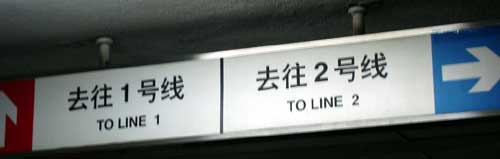
sign hanging from the ceiling of a Beijing subway station, with arrows showing which way to different lines
Above:

  • note different word spacing between “TO” and “LINE” than between “LINE” and the number

click for larger image
Above:

  • This should almost certainly be “Changchun Jie” (jie means “street”), not “CHANGCHUNJIE”.

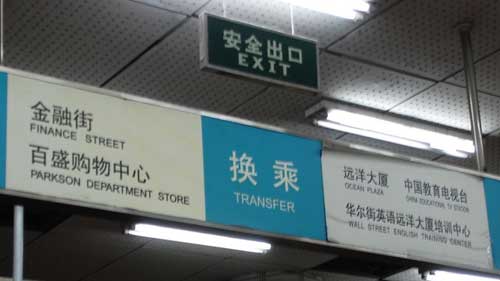
click for larger image
Above:

  • only Chinese characters identify this as the northeast exit (??? D?ngb?i k?u)
  • uneven left margin for the English/romanization
  • very small English in relation to the Chinese characters
  • clumsy letterspacing around capital I’s
  • too much space after the period in JRJ.COM
  • uneven spacing, as can be seen in the two uses of the word “insurance” comparison of the sizes of the word 'insurance' on the same sign

stylized image of a person sitting on a stair, with the caption 'no loitering' in English and Mandarin

further reading: