
lane – 4 = street + $

A neighborhood along a small lane in Taipei has found a change in the name of their street highly profitable. What was once Jilong Road Section 3 Lane 4 is now Dunnan Street. The area’s lǐzhǎng (neighborhood head) worked for three years to get the change approved.

Although the story below doesn’t mention this, the television report I saw on this had several people in the neighborhood stating that a prime consideration for them was the elimination of the dreaded number four from their address.

Another factor in the boost in the price of real estate there is the new name, Dunnan Street (Dūnnán Jiē / 敦南街), which (intentionally) closely resembles the name of one of one of Taipei’s priciest roads: the nearby Dunhua South Road (Dūnhuà Nánlù / 敦化南路).

Qiángbì shàng xiě zhe Jīlóng Lù 3 duàn 4 xiàng, dàn pángbiān de lùpái quèshì dàdà de “Dūnnán Jiē” 3 ge zì, méicuò zhè tiáo xiàngzi bànnián qián zhèngshì gǎimíng jiào Dūnnán Jiē. Dūnnán Jiē zhùhù: “yěyǒu gǎi Jīlóng Lù, yěyǒu gǎi Hépíng Dōnglù, xiànzài gǎi.. ‘Dūnnán Jiē,’ luànqībāzāo.”

Bùguǎn zhīqián shì jǐ xiàng jǐ hào, zài lǐzhǎng 3 nián de bēnzǒu xià, xiànzài quánbù gǎimíng jiào Dūnnán Jiē, ménpái yī huàn, shēnjià mǎshàng bù yīyàng, fáng zhòng yèzhě yùgū měi píng 30 wàn de hángqíng, tiào dào 40 wàn, huànsuàn yī hù 30 píng de fángzi, xiàn zhǎng 300 wàn. Fáng zhòng yèzhě Yáng Kūn-zhōng: “Yībān rén de kèbǎn yìnxiàng, yǒu gēn Dūnhuà Nánlù yǒuguān de, fángjià kěnéng huì bǐjiào hǎo yīdiǎn.” TVBS jìzhě Gǔ Cǎi-yàn: “Zhèlǐ jiùshì Dūnnán Jiē le, hòumian zhèige háo zhái, píngjūn yī píng yào 5-60 wàn, kējì shǒufù Guō Tái-míng, yīkǒuqì, céngjīng zài zhèbiān mǎi le 4 hù fángzi.” Jiù lián guō tái míng yě céngjīng shì Dūnnán Jiē de wūzhǔ, dēngjì zài tā hé qīzi de míngxià. Dūnnán Jiē zhùhù: “(shénme) Guō Tái-míng, (zěnyàng) màidiào le ba.” Bùguò gǎimíng jiào Dūnnán Jiē zhīhòu, bùyòng dǎzháo diànzǐ dàhēng línjū de zhāopai, fángjià yǐjing yǒu lā tái de xiàoguǒ, zhǐnéng shuō jiào shénme lù míng, zhēn de yǒu chà.

source: Jīlóng Lù xiǎoxiàng gǎimíng “Dūnnán Jiē” — fángjià dà zhǎng (基隆路小巷改名「敦南街」 房價大漲), TVBS, January 20, 2007
Pinyin Info 1, Condoleezza Rice 0

U.S. Secretary of State Condoleezza Rice has joined Al Gore, John F. Kennedy, and other prominent U.S. politicians in spreading the crisis/opportunity myth. Fortunately, though, Glenn Kessler of the Washington Post found Victor H. Mair’s essay danger + opportunity ≠ crisis here on Pinyin Info:

At one point, Rice said that the difficult circumstances in the Middle East could represent opportunity. “I don’t read Chinese but I am told that the Chinese character for crisis is wei-ji, which means both danger and opportunity,” she said in Riyadh. “And I think that states it very well. We’ll try to maximize the opportunity.”

But Victor H. Mair, a professor of Chinese at the University of Pennsylvania, has written on the Web site https://pinyin.info, a guide to the Chinese language, that “a whole industry of pundits and therapists has grown up around this one grossly inaccurate formulation.” He said the character “ji” actually means “incipient moment” or a “crucial point.” Thus, he said, a wei-ji “is indeed a genuine crisis, a dangerous moment, a time when things start to go awry.”

sources and further readings:

language reformer Qian Xuantong remembered

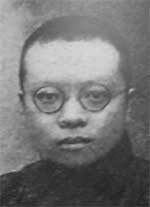
photo of Qian Xuantong (Ch'ien Hsuan-t'ung)Two days ago was the 68th anniversary of the death of Qian Xuantong (Qián Xuántóng / 錢玄同 / 钱玄同 / Ch’ien Hsüan-t’ung) (1887–1939), a phonetician, philologist, and professor of literature at Peking University. Although he isn’t well known today, Qian was an important contributor to the reforms associated with the May 4 movement. He also helped renew debate about script reform in China.
Just about the time that the National Phonetic Alphabet succeeded in gaining ascendancy over the Mandarin Alphabet and other schemes, the evolution of literary and political movements into a new stage gave rise to renewed consideration of the roman alphabet as the basis for reform of the Chinese written language.

What seems to have initiated the new stage of discussion was a letter written in March 1918 by Ch`ien Hsüan-t`ung, a well-known philologist and professor of literature at National Peking University, to Ch`en Tu-hsiu, who at the time was editor of La Jeunesse, the leading organ of young Chinese intellectuals, and who soon afterward became one of the founders of the Chinese Communist Party. In his letter Ch`ien Hsüan-t`ung expressed approval of Ch`en Tu-hsiu’s demand for a break with the Confucian ideology which had dominated Chinese life for more than two thousand years, and also offered his idea as to how this was to be carried out. “If you want to abolish Confucianism,” he said, “you must first abolish the Chinese script.” To his mind there was little of value in Chinese literature, 99.9 per cent of which he dismissed as merely transmitting Confucian ideology and Taoist mythology.

It seemed to Ch`ien that the ideographic [sic] script could not be adapted to the needs of modern China. He also saw no solution in the attempts which had thus far been made to apply a phonetic system of writing to Chinese. Indeed, it appeared to him that it would be impossible to apply a phonetic system of writing to Chinese at all. These views also led him to the conclusion, reached earlier by Wu Chih-hui and others, that Chinese writing itself would have to be abandoned and replaced by Esperanto.

I seem to remember that someone in Japan was driven to distraction about that country’s orthography and making a similar proposal about switching from Japanese to Esperanto. Or am I imagining that?

At any rate, others soon convinced Qian of the error of his ways, and before long he was a strong supporter of romanization, as were many others of his generation, including Lu Xun. By the way, Qian was the one who convinced Lu Xun to start writing stories. That alone should be enough to make the world forever grateful to him.

I strongly recommend the first of the readings below, from which the above quote was taken. It’s interesting reading.

sources:

Beijing to turn some textbook readings into cartoons

Portions of some textbooks in the PRC are being turned into animated cartoons for primary- and secondary-school students.

Wang Ying, the general manager of the Children’s Art and Play Theater Co. and chief organizer of the activity, described this as “an innovative move to further develop cultural products for 367 million people in China aged under 18.”

The scripts for the screenplays are being selected through a nationwide competition.

The cartoons will cover such subjects as ancient poems, fairy tales, and foreign novels.

For more information, see the official website.

source: Chinese youngsters to enjoy cartoon plays based on textbooks, Xinhua, October 13, 2005

Gaoxiong receives funding to upgrade the city’s English

The government of Gaoxiong (Kaohsiung) has recently secured funding from the Executive Yuan to

  • waste on so-called translation agencies that wouldn’t know real English if it bit them on the ass,
  • print up some signs on which the English is so small as to be almost unusable,
  • put up even more signs in a romanization system few people know but many think is ridiculous at best,
  • um, create an “English-friendly environment” in advance of the World Games, which will be held in the city in 2009.

The stories didn’t mention how much money will be involved in this. The project will be headed by the recently promoted Xǔ Lì-míng (許立明 / Xu Liming / Hsu Li-ming).

Let’s all hope the city does a much better job than is to be expected from past experience throughout Taiwan.

sources:

Taiwan officially recognizes the Sakizaya as a tribe

Taiwan’s Executive Yuan will ratify the Sakizaya (撒奇萊雅 / Sāqíláiyǎ) as an indigenous tribe on January 17, raising the number of officially recognized tribes here to thirteen.

During Japan’s rule over Taiwan (1895-1945), Japanese ethnologists classified the Sakizaya as members of the Ami. Later scholars, however, have distinguished the two groups as a separate because of linguistic differences and the Sakizaya’s sense of their own identity.

Representatives of the Sakizaya applied in 2004 with the Council of Indigenous Peoples for official recognition.

The Sakizaya live mainly in Hualian City and Hualian County’s townships of Shoufeng, Ruisui, and Fengbin.

I hope to find more information about the tribe’s language, as well as the origins of the tribe’s name.

sources:

Shanghainese are overusing English, says PRC academic

From the China Daily a few months ago.

A linguistics expert has claimed Shanghainese are overusing the English language.

“It’s a blind worship of the English language,”said Pan Wenguo, dean of Chinese as a Foreign Language School at East China Normal University, at a conference held Monday to commemorate the 20th anniversary of promoting Putonghua, or Mandarin.

He added the business sector was particularly responsible for the trend, claiming many people used English “more for following others blindly than for practical needs.”

Pan said up to one-third of Chinese are studying or have studied English, while the number of English learners in Shanghai is even higher.

“English is not bad in itself, but the present mania of learning English is really too much,”said Pan.

Last Sunday, more than 50,000 Shanghai locals sat the English Interpreter Test of middle to high levels, an increase of 20 per cent on last year.

The time set a side for English learning has been on the rise for students at various levels….

In the increasingly competitive job market, the English Certificate has become one of the most important qualifications employees look for, ranking only behind diplomas.

Many employers, especially in the business sector, tend to hire only people with good English communication abilities….

source: Linguist criticizes ‘blind worship’ of English, China Daily, September 23, 2006

Taiwan license plates and English

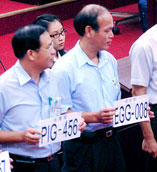
Taipei City councilors holding up signs resembling license plates with funny English: PIG-456 and EGG-008It seems that ridding Taiwan license plates of the dreaded number 4 wasn’t enough. A Taipei city councilor, Tim Chang (Cháng Zhōngtiān / 常中天) of the New Party, suggested last year that “drivers are making an ass of themselves” if they drive around with license plates that spell out something that is insulting, ill-omened, or funny in English. He called for such unfortunate combinations to be filtered out in advance and for motorists to be allowed to change their plate numbers.

As the Taipei Times article on this notes, “License plates in Taiwan are made up of two alphabetic letters and four digits for cars, while license plates on scooters have three letters and three digits.”

People in Taiwan can change to another random plate number for NT$1,250 (approx. US$38), while personalized license plates cost at least NT$3,000.

source: Lucky number plate? Not for this ASS, Taipei Times, August 23, 2006