
for the record: remarks by the premier of the PRC State Council

Here’s the official word by PRC Premier Wēn Jiābǎo (温家宝/溫家寶) on what the PRC will do regarding education. I’m putting this here mainly for later reference.

We put education high on the development agenda. A total of 184 billion yuan was allocated by both central and local governments to fund rural compulsory education, enabling us to pay tuition and miscellaneous fees for the 52 million rural students receiving compulsory education throughout the western region and in some areas in the central region, provide free textbooks to 37.3 million students from poor families and grant living allowances to 7.8 million students staying in dormitories. Of the 410 targeted counties, 317 reached the goals of making nine-year compulsory education generally available and basically eliminating illiteracy among young and middle-aged adults. The proportion of the target population attaining these two goals in the western region increased to 96% from the 77% of 2003. The central government spent 9 billion yuan over the past three years building facilities for 7,651 rural boarding schools. Eight billion yuan was spent to develop modern primary and middle school distance education for rural areas. The project covers over 80% of the rural primary and middle schools in the central and western regions and enables over 100 million students to have access to high-quality education resources. New enrollment at secondary vocational schools totaled 7.41 million and total attendance reached 18.09 million. Total attendance at institutions of higher education reached 25 million and the gross enrollment ratio rose to 22%….

Education is the bedrock of China’s development, and fairness in education is an important form of social fairness. We need to make education a strategic priority and accelerate the development of all types of education at all levels. The overall goal is to expand the availability of compulsory education and consolidate progress already made, accelerate the development of vocational education and strive to improve the quality of higher education. This year, we will completely stop collecting tuition and miscellaneous fees from all rural students receiving compulsory education. This will ease the financial burden of 150 million rural households with children attending primary and middle schools. We will continue to provide free textbooks for poor rural students receiving compulsory education and living allowances for those staying in dormitories. We will improve the mechanism for ensuring continuing funding for rural compulsory education. This year’s government allocations for rural compulsory education total 223.5 billion yuan, up 39.5 billion yuan from last year. During implementation of the Eleventh Five-Year Plan, 10 billion yuan will be allocated from the central government budget to upgrade rural junior middle school facilities. Local governments should also make corresponding increases in funding in this area. In addition, we will continue working to solve the problems that students from poor urban families and children of rural migrant workers in cities have in receiving compulsory education. This year, we will ensure that the plan to make nine-year compulsory education generally available and basically eliminate illiteracy among young and middle-aged adults in the western region and the modern rural primary and middle school distance education project achieve their final objectives. We will work to ensure that all children are able to afford and attend school. We are definitely capable of reaching this goal. We need to attach more importance to developing vocational education, which is a major reform and historic task to truly make education available to all members of society. The focus of this effort will be on developing secondary vocational education and strengthening the vocational education and training network for urban and rural areas. We will deepen reform of the management of vocational education by setting up a mechanism that combines the participation of industry, enterprises and schools and promoting models of school operation that integrate work and study and enhance cooperation between schools and enterprises. We will accelerate reform of education and teaching in higher education with the focus on improving quality, keep the scale of enrollment relatively stable, increase efforts to develop leading disciplines and universities, make innovations in the model for producing capable personnel and improve the mix of capable personnel being produced in order to produce large numbers of outstanding personnel. We will support and standardize the development of non-publicly funded schools and improve conditions for non-government entities to run schools.

Source: Report on the Work of the Government delivered by Premier Wen Jiabao at the Fifth Session of the Tenth National People’s Congress on March 5, 2007, via Xinhua, March 16, 2007
Truku dictionary released

What is reportedly Taiwan’s first dictionary of language of the Truku (Tàilǔgé 太魯閣) tribe was released yesterday. The Truku are also known as the Sediq. They live mainly in Xiulin, Hualian County, site of the Taroko Gorge, one of Taiwan’s most scenic areas, which takes its name from the tribe (or perhaps vice versa).

The work is based in part on a lexicon compiled in the 1950s, when a pastor at a local church began to translate the Bible into Truku. Six pastors at a local church have been working on the dictionary since 1999.

Words in Truku are created by adding prefix, postfix and midfix to root words. A root word can develop into as many as 40 words, Jiru [Haruq, one of the authors of the dictionary,] explained.

Midfix is added into the middle of a root word by separating the root word.

Taking an example from the dictionary, hakawis a root word meaning “bridge” in Truku, hmhakaw becomes “bridge-building”, mhakaw is a bridge builder, shakaw is the reason to build a bridge and hkagan is the location where the bridge is built.

“Verb tenses and different parts of speech are also constructed by adding prefixes, postfixes or midfixes to a rood word,” Iyuq [Ciyang, another of the authors of the dictionary,] said.

Until recently, the Truku were seen as being part of the Atayal tribe.

sources:

‘dialect’ and ‘Chinese’ from a linguistic point of view

Another back issue of Sino-Platonic Papers has been released, this one of particular relevance to the themes of this site: What Is a Chinese “Dialect/Topolect”? Reflections on Some Key Sino-English Linguistic Terms (1991), by Professor Victor H. Mair of the University of Pennsylvania’s Department of East Asian Languages and Civilizations.

Here is the abstract:

Words like fangyan, putonghua, Hanyu, Guoyu, and Zhongwen have been the source of considerable perplexity and dissension among students of Chinese language(s) in recent years. The controversies they engender are compounded enormously when attempts are made to render these terms into English and other Western languages. Unfortunate arguments have erupted, for example, over whether Taiwanese is a Chinese language or a Chinese dialect. In an attempt to bring some degree of clarity and harmony to the demonstrably international fields of Sino-Tibetan and Chinese linguistics, this article examines these and related terms from both historical and semantic perspectives. By being careful to understand precisely what these words have meant to whom and during which period of time, needlessly explosive situations may be defused and, an added benefit, perhaps the beginnings of a new classification scheme for Chinese language(s) may be achieved. As an initial step in the right direction, the author proposes the adoption of “topolect” as an exact, neutral translation of fangyan.

The entire text is now online as a 2.2 MB PDF: What Is a Chinese “Dialect/Topolect”? Reflections on Some Key Sino-English Linguistic Terms.

Strongly recommended.

Google releases Pinyin input method for Windows, IE

Google has released a Pinyin-based character-input method for Windows systems. It offers a number of special features … which I don’t have time to detail right now, sorry. Read about them here: Google Gǔgē pīnyīn shūrùfǎ gōngnéng jièshào. And download the program from this page.

Taiwanese couplet

a chunlian written in Taiwanese, as described in this post

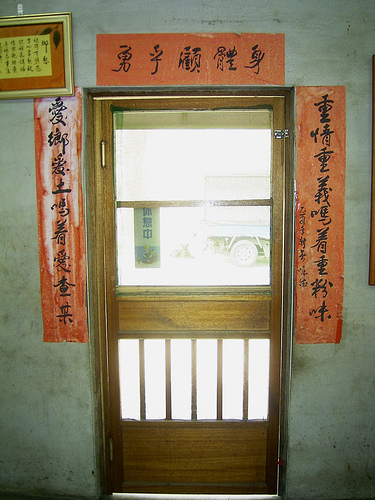
This photo of a chūnlián (春聯 / 春联) — couplet for Chinese New Year — has been making the e-mail rounds. (I don’t know the original source.) What’s interesting about this set is that they’re written in Taiwanese, not Mandarin.

I’ve written these left to right. But the orders in the original are

  1. to the right of the doorway, top to bottom
  2. to the left of the doorway, top to bottom

The writing above the doorway can be seen as separate from the other two or together with them. In the latter case it would be read first, from right to left. It reads 身體顧乎勇, which means “take care of health.”)

The one on the right reads 重情重義嗎著重粉味, which means “attach importance to relationships and brotherhood, but [people] also need to attach importance to powder’s smell” (i.e., to those who wear scented face power: women).

The second one, the one on the left, reads 愛鄉愛土嗎著愛查某, which means “love your home town, love your motherland; but also love women.”

The language of the first half of each of the two vertical strips is formal and traditional. But the style of both second halves is more akin to a sales pitch for a Viagra-like patent medicine.

Bichhin, which looks like a promising blog on Taiwanese (and written in Taiwanese, too), has helpfully rendered this in both the Tai-Luo and church romanization systems. It’s easier to see the rhymes that way.

further reading:

Holy hippos, Batman! — Taiwan expands its list of English words for students

Taiwan’s Ministry of Education has dipped into pop culture for some of its additions to the list of English words that elementary and junior high students are expected to learn. Among the new additions are “Batman” and “Spiderman.”

Yes, students will be tested on these — but not until 2011.

Three professors and three junior high English teachers compiled the new list of two hundred basic words; this will be added to the existing list of one thousand words.

Here are some of the other new additions:

  • bat
  • bug (computer)
  • Easter
  • French fries
  • gate (airport)
  • guy
  • Halloween
  • hippo
  • kangaroo
  • koala
  • marker
  • MRT (the mass rapid transit systems of Taipei and Gaoxiong)
  • PIN (personal identification number)
  • scooter
  • slim
  • spider
  • surf
  • temple
  • T-shirt
  • yummy
  • zebra

sources:

illiteracy in China on the rise: PRC illiteracy eradication office head

Gāo Xuéguì (高学贵 / 高學貴), the director of the illiteracy eradication office of the basic education department of China’s Ministry of Education, has acknowledged that illiteracy in China increased between 2000 and 2005, in large part because people are losing the literacy they were said to have acquired. Although the figures for literacy are still inflated, the admission is a refreshing bit of directness from a government not known for its willingness to release bad news about itself.

Here’s the full article:

The number of illiterates in China grew by more than 30 million between 2000 and 2005 despite its efforts to eradicate illiteracy, a senior official has said.

Though over 9.75 million adults learnt to read and write during this period, the number of illiterates in the country rose to 116 million, said Gao Xuegui, director of the illiteracy eradication office of the basic education department of the Ministry of Education.

The number of illiterates in China accounted for 11.3 percent of the world’s total in 2000, right after India, and 15.01 percent in 2005. That means many people who had come out of the illiteracy trap forgot what they learnt.

“The situation is worrying,” Gao said. “Illiteracy is not only a matter of education, but also has a great social impact.”

China defines literacy as the ability to read and write at least 1,500 Chinese characters.

“Given the increase in the number of illiterates, the country may not be able to meet its target of a 50-percent reduction in its illiterate population by 2015 as projected by UNESCO,” said China National Institute for Educational Research scholar Guo Hongxia.

A worrying factor, as Gao said, is the changing demography of illiterates in the country.

For instance, the western regions now have only about 40 million illiterates. In contrast, the central and eastern parts, which have a high population density, account for two-thirds of them, with 9.63 million being in Shandong alone.

A major reason for the rebound in the illiterate population is the changing perception of knowledge in the market economy. Farmers today can earn money by working as laborers, too. So they tend to ignore the nine-year compulsory education despite having access to it, Gao said.

Another factor that ironically contributed to the increase in the illiteracy rate is the success of the illiteracy eradication campaign of the previous years because that led many local governments to “eradicate” the departments in charge of the program itself, Gao said.

But despite the setback, the illiteracy eradication office is determined to fulfill its mission, for which it’s seeking 100 million-yuan ($12.9 million) this year.

The existing budget of 8 million yuan ($1.03 million), it says, is not enough because it allots a paltry 0.07 yuan (or less than 1 cent) to each illiterate person.

The extra money, the office says, will be used to build a team of illiteracy eradication professionals on government payroll and to offer subsidy to volunteers.

Projects to eradicate illiteracy among 80 million women and the ethnic minorities are already under way.

But some local governments haven’t shown a long-term commitment to the program, with a few even trying to bend the rules, said Wu Qing, honorary councilor of Beijing Cultural Development Centre for Rural Women, an NGO that helps with the literacy campaign.

source: Ghost of illiteracy returns to haunt country, China Daily, April 2, 2007

Cris-atunity revisited

Benjamin Zimmer of Language Log has had a couple of recent posts on the crisis = danger + opportunity myth. First, in Stop him before he tropes again, he takes Al Gore to task for repeating the myth (again).

Then Zimmer posted his findings that the myth “was in use among Christian missionaries in China as early as 1938 and creeping into American public discourse by 1940.” (See Crisis = danger + opportunity: The plot thickens.) Nice work!

Meanwhile, Gary Feng of Shadow has voiced a dissenting position that “the urban myth has some kernel of truth in it.”