Banqiao’s orificial signage

David, who for just a little while longer lives in the same Banqiao neighborhood as I, sent me a photo of a street sign in our highly populated but little-discussed city.

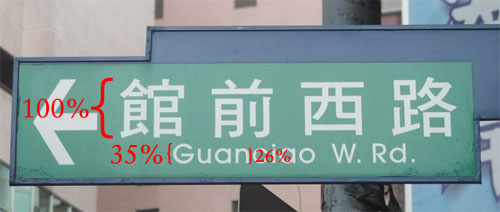
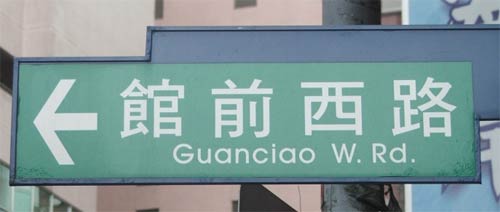
'Guanciao W. Rd.': streetsign in Banqiao, Taiwan, labeled in misspelled Tongyong Pinyin and English

The sign tells us this is “Guanciao” West Road. In Hanyu Pinyin this would be “Guanqiao.” Guanqiao? The only word in my biggest Mandarin-English dictionary under that spelling is guānqiào (關竅/关窍), which is defined as “orifices on the human body.” Hmm. Taiwan might have the questionable taste of having many a road still named after a dead dictator, but orifices?

This oddity is explained by the fact that Banqiao is simply continuing its tradition of typos — even on relatively new signs. (The style of the sign and the choice of Tongyong Pinyin both indicate this went up within the past few years.)

Guanciao (Guanqiao) should be Guancian. (In Hanyu Pinyin, 館前西路 is written Guǎnqián Xīlù.) It’s worth noting this is not a tiny lane but a road in a well-traveled part of town.

As long as I’m putting up yet another post with photos and doing further damage to my reputation of having one of the Taiwan blogosphere’s fastest-loading, least Turtonesque sites*, I might as well go ahead and add one more so I can mention something else about this sign.

Let’s look at the relative size of the Chinese characters and the alphabetic text. The majority of the letters are but one quarter of the height of the Chinese characters.

sign showing the relative percentages of the height of the letters/Hanzi on the sign

Although in this particular case the lettering might not be too small, this style often leads to nearly illegible romanization, especially on signs posted high above streets.

* Just in terms of the average number photos per post, that is. (But that’s in part because I’m a lousy photographer.) Congratulations, Michael, on reaching two thousand posts!

Taipei’s new busstop signs

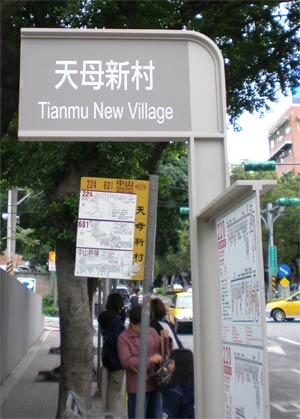
white on gray busstop sign reading 'Tianmu New Village', with Chinese charactersThe Taipei City Government has begun to replace busstop signs throughout the city.

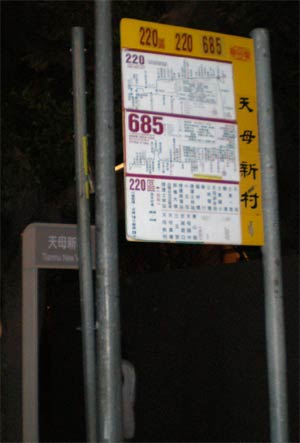
The color scheme of the new signs, however, is a poor choice because white letters against a gray background offer little contrast, especially at night.

Here, for example, is are daytime and nighttime shots of the same stop, taken from different angles.

shot of the busstop signs during the day nighttime shot of the busstop sign, showing the low level of contrast at night

The stop is not lit well, so the nighttime photo had to be taken with a flash. So this photo, though the focus came out a little fuzzy, represents an improvement over what people would normally see at night.

Two weeks ago I wrote the Taipei City Government’s Department of Transportation for clarification about the policies associated with this signage but have not received an answer. Everyone I have spoken with in that office has been friendly; but the system is unfortunately still stuck in its ways.

At least InTerCaPiTaLiZaTion doesn’t seem to be in effect. And the new style for displaying bus routes does provide more information to those who cannot read Chinese characters.

List of busstops for the Taipei 220 bus, as given on the new style (spring 2007) of busstop signage. Click for larger image.
(click for larger image)

reviews of books related to China and linguistics

Sino-Platonic Papers has just released online its first compilation of book reviews. Here is a list of the books discussed. (Note: The links below do not lead to the reviews but to other material.)

Invited Reviews

  • J. Marshall Unger, The Fifth Generation Fallacy. Reviewed by Wm. C. Hannas
  • Rejoinder by J. Marshall Unger
  • Hashimoto Mantaro, Suzuki Takao, and Yamada Hisao. A Decision for the Chinese Nations — Toward the Future of Kanji (Kanji minzoku no ketsudan — Kanji no mirai ni mukete). Reviewed by Wm. C. Hannas
  • S. Robert Ramsey. The Languages of China. Reviewed by Wm. C. Hannas
  • James H. Cole, Shaohsing. Reviewed by Mark A. Allee
  • Henry Hung-Yeh Tiee, A Reference Grammar of Chinese Sentences. Reviewed by Jerome L. Packard

Reviews by the Editor

  • David Pollack, The Fracture of Meaning
  • Jerry Norman, Chinese
  • N. H. Leon, Character Indexes of Modern Chinese
  • Shiu-ying Hu, comp., An Enumeration of Chinese Materia Medico
  • Donald M. Ayers, English Words from Latin and Greek Elements
  • Chen Gang, comp., A Dictionary of Peking Colloquialisms (Beijing Fangyan Cidian)
  • Dominic Cheung, ed. and tr., The Isle Full of Noises
  • Jonathan Chaves, ed. and tr., The Columbia Book of Later Chinese Poetry
  • Philip R. Bilancia, Dictionary of Chinese Law and Government
  • Charles O. Hucker, A Dictionary of Official Titles in Imperial China
  • Robert K. Logan, The Alphabet Effect
  • Liu Zhengtan, Gao Mingkai, et al., comp., A Dictionary of Loan Words and Hybrid Words in Chinese (Hanyu Wailai Cidian)
  • The Mandarin Daily Dictionary of Loan Words (Guoyu Ribao Wailaiyu Cidian)
  • Shao Xiantu, Zhou Dingguo, et al., comp., A Dictionary of the Origins of Foreign Place Names (Waiguo Diming Yuyuan Cidian)
  • Tsung-tung Chang, Metaphysik, Erkenntnis und Praktische Philosophie um Chuang-Tzu
  • Irene Bloom, trans, ed., and intro., Knowledge Painfully Acquired: The K’un-chih chi of Lo Ch’in-shun
  • Research Institute for Language Pedagogy of the Peking College of Languages, comp., Frequency Dictionary of Words in Modern Chinese (Xiandai Hanyu Pinlyu Cidian)
  • Liu Yuan, chief compiler, Word List of Modern Mandarin (Xianhi Hanyu Cibiao)
  • The Editing Group of A New English-Chinese Dictionary, comp., A New English-Chinese Dictionary
  • BBC External Business and Development Group, Everyday Mandarin

This is SPP no. 8, from February 1988. The entire text is now online as a 4.2 MB PDF.

Banqiao signage SNAFU

Here’s an example of the mixing of romanization systems and addition of errors that used to be common in Taipei before the city switched to Hanyu Pinyin. These signs are on a corner in Banqiao, Taipei County, not far from Banqiao City Hall.

First, let’s set the scene. We have two types of signs, both with a mix of romanization and English. One set of signs gives street names; the other points toward places of possible interest.
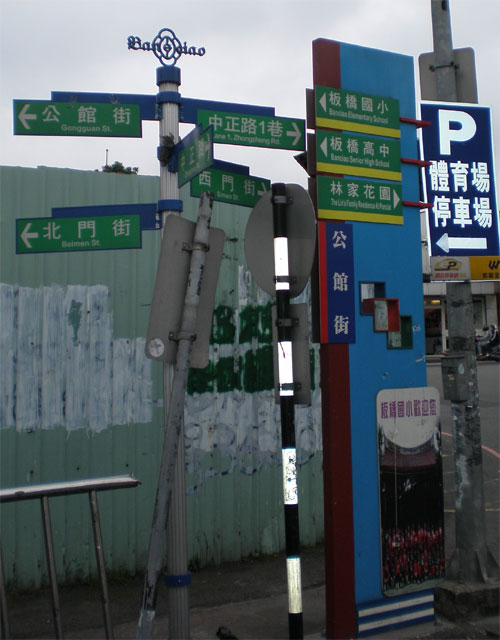
establishing shot of signage (at one corner) discussed in this post

The blue-panel signage on the right represents something introduced during the term of the previous mayor, a member of the Democratic Progressive Party. And since the DPP backs Tongyong Pinyin for Mandarin, that’s the romanization system used most of the time on such signs. A number of the photos on these signs feature the previous mayor, who had relatively little recognition among the public since he had succeeded someone else’s term rather than being elected to his own. He put his photo on all sorts of things. But he failed to be elected to the city’s top spot. His challenger, the current mayor of Banqiao, spreads her name recognition by having her recycling speech broadcast from the city’s trash trucks.
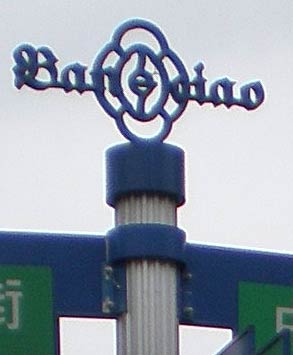
photo of the top piece on a streetsign pole in Banqiao. It reads OK, now note the cap on the signpost. It reads “Ban ciao” in black letter. Although I spotted several of these today, I’d never seen any before, which would mean it’s very likely that a KMT-led city administration under a KMT-led county government is putting up new signs in Tongyong Pinyin, a romanization system the Kuomintang (Guomindang) opposes. (The KMT used to oppose Hanyu Pinyin as well, which is how Taiwan ended up with MPS2, the Tongyong Pinyin of the 1980s.) Similarly, Banqiao has relatively new signs in prominent places around the city that read (in a particularly clumsy script face) “Bravo Banciao.” (What exactly about Banqiao is worthy of such a cheer is not stated.) Even though the city administration is under the mistaken impression that it must use Tongyong (and it does suffer from this idea), that doesn’t mean it has to go around putting up new signage in this.

To get back to the cap, the likely story is that the transportation department had some leftover money in its budget which had to be spent lest the following year’s budget be cut; but rather than spend it on fixing errors, which would involve study and actual work, people decided to make something that the boss thinks would look cool.

I wonder, though, how many Taiwanese would even recognize this reads “Banciao” unless they had it specifically pointed out to them. A few months ago I spotted an innocent-looking teenager shopping with her mother. The girl was wearing a shirt with the following text:

'f uck you' written in black letter

Although it’s almost certain she would know both English words and understand their meaning together, I think it extremely unlikely she knew what words were on her shirt.

OK, let’s have a closer look at the signs themselves.
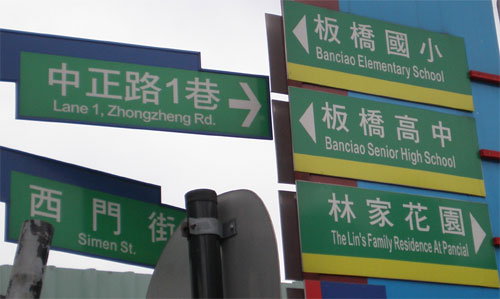
detail of signs discussed in this post

Here we have

  • “Zhongzheng” (Hanyu Pinyin)
  • “Simen” and “Banciao” (Tongyong Pinyin for what would be “Ximen” and “Banqiao” in Hanyu Pinyin)
  • “Panchial” (bastardized Wade-Giles of “Panchiao” plus a typo, for what would be “Banqiao” in Hanyu Pinyin)

And then there’s the matter of “The Lin’s Family Residence At Panchail,” which would be much better written simply “Lin Family Residence” or by the most commonly used English name “Lin Family Gardens.”

So that’s three romanization systems, a typo, and clumsy English on official signage at just one corner — to say nothing of how relatively small the alphabetic text is. And there’s no solution in sight.

Mandarin’s ‘four languages’

Another back issue of Sino-Platonic Papers has been released: The Four Languages of “Mandarin”, by Robert M. Sanders of the University of Hawaii.

Here’s how it begins:

Many hours have been spent at scholarly meetings and many pages of academic writing have been expended discussing what is to be considered acceptable Mandarin. Very often these discussions degenerate into simplistic and narrow-minded statements such as “That’s not the way we say it in …!” or “We had better ask someone from Peking.” Objectively speaking, these disagreements on style reflect a less-than-rigorous definition of which type of Mandarin each party is referring to. Because there has been a failure by all concerned to define fully the linguistic and socio-linguistic parameters of their assumed language(s), Mandarin oranges are often unwittingly being compared with Mandarin apples. This paper is a preliminary attempt to articulate the fundamental differences distinguishing four major language types subsumed under the single English heading ‘Mandarin’. Though the Chinese terms putonghua/guoyu, guanhua, and difanghua help to accentuate the conceptual distinctions distinguishing our four types of Mandarin, it is arguable that even Chinese scholars are not immune from confusing one language with another.

Sanders goes on to indentify and discuss what he calls

  1. Idealized Mandarin
  2. Imperial Mandarin
  3. Geographical Mandarin
  4. Local Mandarin

The entire text is now online for free in both HTML and PDF (875 KB) formats.

Professor Sanders is also one of the associate editors of the excellent ABC Chinese-English Comprehensive Dictionary.

And they called for macaronic — groups seek new national anthem for Taiwan

The Taiwan Peace Foundation and the Taiwan Society, which are both non-governmental organizations, are holding a competition for a new national anthem for Taiwan. In the first stage, they are looking just for lyrics. They recommend the use of multiple languages of Taiwan in this and thus also recommend that the submission contain some romanization (“yǐ běnguó yǔyán wéizhǔ, fùzhù pīnyīn wéi jiā, kě jiāohù shǐyòng bùtóng yǔyán”). Given Taiwan’s linguistic situation, I think this is a reasonable approach. Of course, whether it has any chance of becoming officially enacted in the near future is another matter.

Táiwān Hépíng Jījīnhuì hé Táiwān Shè tuīdòng “xīn guógē yùndòng”, jīntiān gōng bù “xīn guógē” zhēng xuǎn bànfǎ, xīwàng jièyóu gōngkāi zhēngqiú hé shèhuì cānyù, xuǎnchū fúhé Táiwān mínzhòng qīpàn, néng gǎndòng mínzhòng de xīn guógē.

Táiwān Hépíng Jījīnhuì biǎoshì, “xīn guógē” yùndòng dì-yī jiēduàn jiāng jìnxíng gēcí zhēng xuǎn, Liùyuè shí’èr rì jiézhǐ shōujiàn, zìshù yǐ wǔshí dào yībǎi zì wéiyí, yǐ běnguó yǔyán wéizhǔ, fùzhù pīnyīn wéi jiā, kě jiāohù shǐyòng bùtóng yǔyán. Jiāng píngxuǎn yōushèng yīzhì wǔ míng, jiǎngjīn xīn tái bì shíwàn yuán, jiāzuò ruògān míng, jiǎngjīn yīwàn yuán.

Dì-èr jiēduàn wéi gēqǔ zhēng xuǎn, bìxū cóng dì-yī jiēduàn yōushèng gēcí zhōng, xuǎnzé yīzhì liǎng shǒu pǔqǔ, chángdù liǎng zhì sān fēnzhōng wéiyí, wǔ fēnzhōng wéixiàn, Bāyuè sānshíyī rì jiézhǐ shōujiàn. Dì-yī míng jiǎngjīn èrshí wàn yuán, dì-èr míng jiǎngjīn shíwàn yuán, dì-sān míng jiǎngjīn wǔwàn yuán, jiāzuò ruògān míng, jiǎngjīn gè yīwàn yuán.

Táiwān Hépíng Jījīnhuì dìzhǐ wéi Táiběi Shì Sōngjiāng Lù yībǎi liùshíbā hào sì lóu, wǎngzhǐ www.twpeace.org.tw.

source: Táiwān Hépíng Jījīnhuì hé Táiwān Shè zhēngqiú xīn guógē (台灣和平基金會和台灣社徵求新國歌), CNA, April 20, 2007

further reading: ROC National Anthem, Wikipedia

possible Western cultural innovations in early China

Here’s another just-released issue from the archives of Sino-Platonic Papers: Western Cultural Innovations in China, 1200 B.C. (July 1989), by Edward L. Shaughnessy of the University of Chicago.

It begins:

In a recent article on the history of the chariot in China, I attempted to show that a West Asian prototype was introduced to the Bronze Age Shang culture of the north China plain at about 1200 B.C. I used archaeological evidence, both artifactual and figured, to suggest that the route of transmission lay across the broad plains of Central Asia and the south Siberian steppe, passing finally through the grasslands and loess plateau of Mongolia, Ningxia and northern Shaanxi and Shanxi provinces, the area traditionally referred to as the Ordos. In the course of tracing this transmission of the chariot, I discovered several other innovations in the Shang culture of this time that seemed to be introduced from the same general direction. In this brief note I will simply mention, without attempting to provide complete substantiation, the most notable of these innovations, in the hope that this may stimulate consideration of the possibility that even in antiquity Chinese culture was greatly enriched through its contacts with the West.

The entire text is now online for free as a 790 KB PDF.

early recording of mock Cantonese

Last month a recording of Cal Stewart’s 1904 comic monologue “Uncle Josh and the Insurance Agent” was added to the Library of Congress’s National Recording Registry of 2006.

Here’s the LC’s description:

Cal Stewart was among the most prolific and popular recording artists of the first 20 years of commercial recording. His “Uncle Josh” monologues offer humorous commentary on American life at the turn of the 20th century, reflecting major themes and fashions of the time. His “rural comedy” describes life in the imaginary New England village of Pumpkin Center, painting humorous pictures of Uncle Josh’s encounters with new technologies, and comic contrasts between agrarian and urban life in America. Stewart’s influence can be heard in the comedy of Will Rogers, in Fred Allen’s character, Titus Moody, and in Garrison Keillor’s stories about Lake Wobegon.

Comedies of the time often featured “ethnic humor.” Whether anyone still finds such things funny or even bearable without wincing is of course another matter.

Stewart has an example of this in his Uncle Josh in a Chinese Laundry (audio), found in a slightly different version in Uncle Josh’s Punkin Centre Stories (text). This is the tale of Uncle Josh, told in the first person, getting into a fight with someone working in a Chinese laundry — though this is because Uncle Josh is cheated by a presumably white man, not by anyone in the laundry. “Uncle Josh in a Chinese Laundry” also contains what might be one of the first recorded snippets of mock Cantonese, which would probably have been the Sinitic language most heard in the United States then.

further reading: