Introduction and notes for the Tao Te Ching

Victor Mair’s translation of the Tao Te Ching has certainly more than earned its place in a crowded field. Mair’s introduction and notes to the Tao Te Ching (Dàodéjīng, to give the Pinyin form) are now available for free as part of the rereleases of the journal he edits, Sino-Platonic Papers.

Here’s the link: [The] File [on the Cosmic] Track [and Individual] Dough[tiness]: Introduction and Notes for a Translation of the Ma-wang-tui Manuscripts of the Lao Tzu [Old Master] (6.4 MB PDF). The work explains the reasons for this odd title, and in the process provides all sorts of linguistic and other goodness. This is well worth reading.

Here is how it begins:

Next to the Bible and the Bhagavad Gītā (BG), the Tao Te Ching is the most translated book in the world. Well over a hundred different renditions of the Taoist classic have been made into English alone, not to mention the dozens in German, French, Italian, Dutch, Latin, and other European languages. There are several reasons for the superabundance of translations. The first is that the Tao Te Ching is considered to be the fundamental text of both philosophical and religious Taoism. Indeed, the Tao or Way, which is at the heart of the Tao Te Ching, is also the centerpiece of all Chinese religion and thought. Naturally, the different schools and sects each bring a somewhat different slant to the Tao, but all subscribe to the notion that there is a single, overarching Way that encompasses everything in the universe. As such, the Tao Te Ching shares crucial points of similarity with other major religious scriptures the world over.

The second reason for the popularity of the Tao Te Ching is its brevity. There are few bona fide classics that are so short, yet so packed with food for thought. One can read and reread the Tao Te Ching over and over scores of times without exhausting the insights it offers.

The third aspect which accounts for the wide repute of the Tao Te Ching is the fact that it is supposedly “very easy to understand” (LXX.2 and see the note thereto) when actually it is exceedingly impenetrable. Paradox is the essence of the Tao Te Ching, so much so that even scholars with a solid grounding in Classical Chinese cannot be sure they have grasped what the Old Master is really saying in his pithy maxims. This deceptive ease which masks tortuous difficulty is both a challenge and an invitation, a challenge to the honest scholar and an invitation to the charlatan. Since no one can fully plumb the profundity of the Tao Te Ching, even the amateur cannot be held responsible for misrepresenting it. Hence the plethora of translations, many by individuals who command not one iota of any Chinese language. In the words of the eminent Dutch Sinologist, J.J.L. Duyvendak:

Not only do translations made by competent Sinologues vary considerably, but there also exists a multitude of so-called translations made by people who try to make up for their entirely imaginary or extremely elementary knowledge of classical Chinese by philosophical speculations which often are completely foreign to the Chinese spirit. With due acknowledgement of the interest which this Chinese classic has been able to arouse in a large circle, one cannot help regretting that the Tao-tê-ching has thus become the object of the worst dilettantism.

It is precisely because of my annoyance at the sheer presumptuousness of those who pretended to convey the words of the Old Master to others, when they themselves had not the slightest idea how to read them, that I vowed two decades ago I would never be so bold as to add my own voice to the cacophonous chorus of Tao Te Ching paraphrasts. Two unexpected and celebrated events, however, conspired to make me recant. One was the egregiously large advance and effusive national publicity awarded to an absolute tyro a couple of years ago who dared to dabble with the daunting Tao Te Ching. Although the individual concerned will remain mercifully unnamed, I felt duty bound to reclaim translation of the Tao Te Ching as the proper province of the conscientious Sinologist.

The other prod was the recent discovery of two ancient manuscripts in China which made it possible to produce a totally new translation of the Tao Te Ching far more accurate and reliable than any that has hitherto been published. This is the first translation of the Tao Te Ching based from its very inception wholly on these newly found manuscripts. The manuscripts came from a place in central China called Ma-wang-tui, not far south of the Yangtze River….

Above I expanded Mair’s acronym of TTC for Tao Te Ching.

This was first published in October 1990 as issue no. 20 of Sino-Platonic Papers.
Pinyin-related plugin for WordPress

Adsotrans — which offers the best free, online Pinyin transcription tool — has just released a plugin for WordPress, the most popular software for blogging. This will annotate Chinese characters with all-important word parsing. Trevelyan’s post provides a download link and directions.

Check it out.

ChinesePod is helping sponsor this project, so they deserve thanks.

source: Our Adsotrans WordPress Plugin, Adsotrans blog, February 14, 2008

Kyrgyzstan may join trend, adopt the Roman alphabet

Asel translates and summarizes remarks by Tashboo Jumagulov (Ташбоо Жумагулов), chairman of Kyrgyzstan’s state language commission, and Kyrgyz legislator Zainidin Kurmanov (Зайнидин Курманов) on the possibility of Kyrgyzstan switching from the Cyrillic to the Roman alphabet, which was recently discussed in the Kyrgyz parliament.

Both Jumagulov and Kurmanov seem to regard the switch as inevitable, though the latter voiced concern that the switch is done carefully and not rushed.

Kyrgyzstan is not to be confused with its neighbor, Kazakhstan, which has been seesawing on its own proposed switch to the Roman alphabet.

sources:

On Kazakhstan’s proposed switch:

Results of US AP exams: first year for Mandarin, Japanese

2007 was the first year that the U.S. College Board offered an Advanced Placement (AP) exam for “Chinese Language and Culture.” It was also the first year students could take an AP exam in “Japanese Language and Culture.”

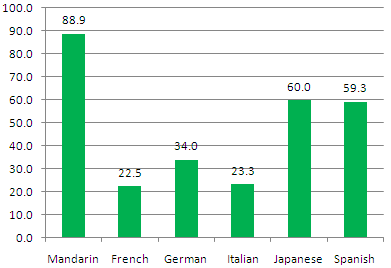
Data for the results as a whole have just been released. The figures for Mandarin are remarkably lopsided.

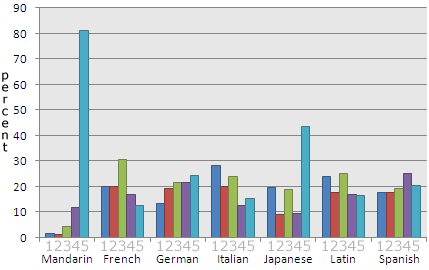
A total of 81.1 percent of those taking the exam for Mandarin and Chinese culture achieved the top score of 5, a much higher percentage than with any other test. The subject with the second highest percentage of 5’s was Japanese (43.4 percent), followed by Electricity and Magnetism (33.8 percent), Mechanics (26.1 percent), and German (24.4 percent). In most other subjects a score of 5 was achieved by only about 10 percent to 20 percent of test takers.

Let’s look at those who achieved only the lowest score (1). Here, too, Mandarin stands out, with by far the lowest percentage of test takers with this score (1.5 percent). Next are Drawing, 2-D Design, and 3-D Design (5.8 percent); English Language and Composition (10.9 percent); and Calculus BC (13.5 percent). Most subjects have “1” rates in the 20s.

Comparison of Scores Across Language Exams
chart comparing how well test takers did in various language exams, with scores for 'Chinese' being far higher than all others; languages listed: Mandarin, French, German, Italian, Japanese, Latin, and Spanish

Comparison of Lowest Scores Across Language Exams
comparing percentages of test takers receiving the low score of '1', with all languages other than Mandarin falling above 13% -- Mandarin at a mere 1.5%

So, does this indicate Mandarin isn’t damn hard for students after all or that the perfect pedagogy for this subject has been reached? Of course not.

Only 11.1 percent of the 3,260 people taking the Mandarin exam did not indicate on their test that they “regularly speak or hear the foreign language of the examination at home, or that they have lived for one month or more in a country where the language is spoken.”

Percent of test takers who “regularly speak or hear the foreign language of the examination at home” or “have lived for one month or more in a country where the language is spoken”
chart showing that far more students taking the Mandarin AP exam are already speakers of that langauge

Thus, it’s no surprise to see that 89.4 percent of those taking the Mandarin exam identified themselves as “Asian, Asian American, or Pacific Islander.” Of all those across the entire United States who took the Mandarin exam last year, only 363 people did not identify themselves as falling within that category. This certainly does not match the hype about Mandarin as the foreign language being studied.

While I congratulate those who scored well on the exam (Chinese characters can certainly be a pain to learn regardless of your background), the test — and perhaps the curriculum, too — evidently needs considerable revision, which isn’t too surprising considering this was its first appearance. I’m a bit saddened, though, to see that more students from a wider variety of backgrounds aren’t taking up the challenge of Mandarin.

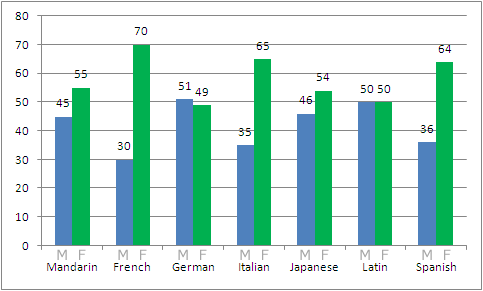
There doesn’t appear to be much of a gender imbalance, however, in AP Mandarin classes.

Percentages of students in AP language exams, by sex
chart showing the percentages of students in various AP language exams, by sex

Within a week or two I’ll be posting some interesting figures about U.S. post-secondary enrollments in Mandarin and other languages.

source: The 4th Annual AP Report to the Nation, College Board, February 13, 2008

Zhou Youguang awarded

Zhou Youguang, often called the father of Hanyu Pinyin, has received another award.

Dì-wǔ jiè Wú Yùzhāng Jiǎng 31 rì zài Zhōngguó Rénmín Dàxué bānfā, céng cānyù “Hànyǔ Pīnyīn Fāng’àn” zhìdìng de “Hànyǔ Pīnyīn zhī fù” Zhōu Yǒuguāng huòdé Wú Yùzhāng rénwén shèhuì kēxué jiǎng tè děng jiǎng.

Zhè wèi 102 suì gāolíng de yǔyánxuéjiā yǐ qí sì juǎn běn “Zhōu Yǒuguāng yǔwén lùn jí” huòjiǎng. Tā zǎonián xuéxí jīngjì xué, yè yú cóngshì yǔyán wénzì yánjiū. 1955 nián chūrèn Zhōngguó wénzì gǎigé wěiyuánhuì dì-yī yánjiūshì zhǔrèn, yánjiū wénzì gǎigé hé Hànyǔ Pīnyīn, bìng yú liù nián hòu chūbǎn “Hànzì gǎigé gàilùn,” quánmiàn xì tǒng de lùnshù le Zhōngguó de wénzì gǎigé wèntí. Tā hái cānyù zhìdìng “Hànyǔ Pīnyīn Fāng’àn,” cùchéng “Hànyǔ Pīnyīn Fāng’àn” chéngwéi yòng Luómǎ zìmǔ pīnxiě Hànyǔ de guójì biāozhǔn, bèi yùwéi “Hànyǔ Pīnyīn zhī fù.” Rújīn, zài Měiguó Guóhuì Túshūguǎn lǐ, jì cáng yǒu jīngjìxuéjiā Zhōu Yǒuguāng de zhùzuò, yòu yǒu zuòwéi yǔyán wénzìxué jiā Zhōu Yǒuguāng de zhùzuò.

Zhōu Yǒuguāng zài huòjiǎng gǎnyán zhōng chēng: “Wǒ de sūnnǚ zài xiǎoxué shí duì wǒ shuō, yéye nín kuī le, nín gǎo jīngjì bàntú ér fèi, gǎo yǔwén bànlùchūjiā, liǎng ge bànyuán hé qǐlai shì yī ge líng. Wǒ jīnhòu yào zàicì cóng líng zuòqǐ, hǎohāo xuéxí, lǎodāngyìzhuàng, gǎnshàng shídài. “Yōumò de fāyán yíngdé quánchǎng chíjiǔ de zhǎngshēng.

Jùxī, Zhōu Yǒuguāng 83 suì shí “huàn bǐ” yòng diànnǎo gōngzuò, 98 suì kāishǐ chàngdǎo “jīchǔ Huáwén” yùndòng, 100 suì, 101 suì, 102 suì shí jūn yǒu zhùzuò chūbǎn.

Tóngshí huòdé tèděng jiǎng de háiyǒu Zhōngguó Rénmín Dàxué jiàoshòu, zhùmíng fǎxuéjiā Xǔ Chóngdé. Xǔ Chóngdé céng cānyù qǐcǎo 1954 nián xiànfǎ, 1982 nián xiànfǎ, “Xiāng Gǎng tèqū jīběnfǎ” hé “Àomén tèqū jīběnfǎ” sìbù fǎ lǜ, jiànzhèng le Zhōngguó xiànzhèng fāzhǎn jìnchéng. Tā de huòjiǎng zhùzuò wèi “Zhōnghuá Rénmín Gònghéguó xiànfǎ shǐ.”

Cǐwài, běn cì Wú Yùzhāng rénwén shèhuì kēxué jiǎng hái bānfā yīděng jiǎng 12 xiàng, yōuxiù jiǎng 25 xiàng.

Wú Yùzhāng rénwén shèhuì kēxué jiǎng yóu Wú Yùzhāng jījīn shèlì, miànxiàng quánguó jiǎnglì guónèi yǒu zhòngdà yǐngxiǎng de yōuxiù zhé xué shèhuì kēxué lùnzhù. Jù Wú Yùzhāng jījīn wěiyuánhuì zhǔrèn wěiyuán, Zhōngguó Rénmín Dàxué yuán xiàozhǎng Yuán Bǎohuà jièshào, zhèige jiǎng xiàng měi wǔ nián píngxuǎn yīcì, xiàn píngjiǎng xuékē wèi Mǎkèsīzhǔyì lǐlùn, zhéxué, jiàoyùxué, lì shǐxué, Zhōngguó chuántǒng wénhuà yǔ yǔyán wénzìxué, xīnwénxué, jīngjìxué hé fǎxué děng bā ge xuékē, měi ge xuékē shè tèděng jiǎng, yīděng jiǎng jí yōuxiù jiǎng. Zì 1987 nián zhìjīn, zhèige jiǎng yǐ bānfā wǔ jiè, Guō Mòruò, Lǚ Shūxiāng, Hú Shéng, Wáng Lì děng xiān-hòu huòjiǎng, yǐ chéngwéi quánguóxìng zhéxué shèhuì kēxué yánjiū guīgé jiào gāo de jiǎnglì.

Wú Yùzhāng jījīn yóu Zhōngguó Rénmín Dàxué shèlì, yǐ jìniàn wúchǎn jiējí gémìngjiā, jiàoyùjiā, lìshǐxuéjiā, yǔ yán wénzìxué jiā, Rénmín Dàxué dì-yī rèn xiàozhǎng Wú Yùzhāng.

source: ‘Hànyǔ Pīnyīn zhī fù’ huò Wú Yùzhāng rénwén shèhuì kēxué jiǎng (“漢語拼音之父”獲吳玉章人文社會科學獎), Xinhua, November 1, 2007

further reading:

Pioneer Mandarin ‘immersion’ program sinking?

Some eleven years after it began, what is touted as the first U.S. elementary school Mandarin immersion program is reportedly in trouble.

In September 1996, Montgomery County [Maryland] started what it promoted as the first Mandarin Chinese immersion program for elementary students in the country. The program at Potomac Elementary School became a national model, and acclaim and fame followed.

Today, the original class of first-graders are seniors preparing for college. Many continued to study Chinese in middle and high school, but most dropped out in recent years — a handful as late as this fall — citing confusion in the curriculum and difficulties with the instructor. Now, just three of the first 22 students continue to study Chinese at the cluster’s high school….

Critics say there is a lack of resources and appropriate materials, poor coordination among grade levels and inadequate teacher development. There’s even disagreement among educators on what immersion is.

“Immersion can mean many things to different people in the field,” said Elena Izquierdo, vice president of the District-based nonprofit National Association for Bilingual Education and a professor at the University of Texas at El Paso. “For some, immersion is total immersion, for others it is partial, and some people call one class in foreign language an immersion class.”

It is also important to define the goal of each program; all are not the same, Izquierdo said. Some aim for complete reading, writing and oral proficiency in a foreign language; others might be geared to gaining conversational skills.

At first, the Chinese immersion students at Potomac were “a school within a school,” sticking together from kindergarten through fifth grade. Principal Linda Goldberg changed the format when she arrived in 2002, believing that students learning Chinese needed more interaction with the other students.

Today, 137 students at Potomac, from kindergarten to fifth grade, take math and science in Chinese and other subjects in English, she said.

Judith Klimpl, supervisor of foreign languages for Montgomery public schools, said math and science were chosen because the subjects are taught with many hands-on activities and have concrete vocabulary. There is no intensive grammar or writing instruction in Chinese at this level.

Once students move to Hoover Middle School, lessons in language acquisition intensify, Principal Billie-Jean Bensen said. The students, who used to have two periods in Chinese, now have one, including an “immersion class” in the sixth grade. But, Bensen conceded, the title of the class is probably “not correct.” A single class shouldn’t be labeled immersion, she said.

.

Children at Potomac Elementary who enroll in the Chinese partial immersion program are taught mathematics and science in the Chinese language, but not the language itself. The result, parents say, is a familiarity with the language and enhanced listening skills when they reach middle school and a more formal language program begins….

The transition to middle school, and then from middle school to high school, lies at the heart of the program’s problems.

“There’s definitely issues with transitioning from Potomac Elementary to Hoover and from Hoover to Churchill,” said Sees. “If you look at the dropout rate in the high school itself, it’s abysmal.”

Immersion students take an immersion class in sixth grade and then are filtered into the standard one-period-per-day Chinese language classes with students who were not in an immersion program in seventh grade, said Hoover Principal Billie-Jean Bensen. They then continue in that traditional language course structure in high school. Schick said that the transition process at Hoover has improved in the last two years.

The first three levels of Chinese language instruction in the county’s schools are generally completed in middle school and the first year of high school, said Duffield….

sources and further reading:

Taiwanese, eh?

I’m so far behind on posts that when Taffy of Tailingua sent this to me people in Taipei probably really were wearing short sleeves. They’re certainly not wearing so little now, with the cold, damp, miserable weather we’ve been having lately. Oh well, at least it’s better than what so many people have been having to endure in China. I hope Pinyin News readers there are keeping warm and didn’t get stuck in some transportation-related hell.
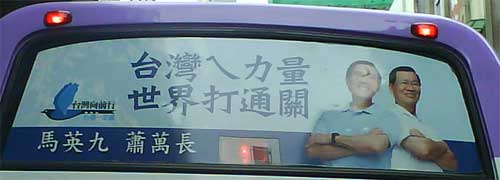
photo discussed in this post -- large blue text against a white background, Ma and Siew shown from the waist up with their arms crossed; a blue bird on the left
This poster on the back of a bus is for Taiwan’s presidential campaign.

It reads:

Táiwān ei lìliang
Shìjiè dǎ tōngguān

Mǎ Yīngjiǔ — Xiāo Wàncháng

.

台灣ㄟ力量
世界打通關

馬英九 蕭萬長

It’s hard to put this into English that makes sense. Perhaps “Taiwan shows its power to the world.” The idea is something like “Taiwan can overcome all obstacles.” It doesn’t strike me as a good slogan. But maybe I’m missing something.

The interesting part is that it has Taiwanese written with zhuyin (bopomofo): ㄟ (ei). But the ㄟ is basically just for show, since it doesn’t serve any linguistic purpose that the expected Chinese character — 的 (de), indicating the possessive — wouldn’t provide. The sign is still in Mandarin. (Dǎ tōngguān, for example, is not a Taiwanese expression, according to several native speakers I questioned about this.)

For those who don’t know, Mǎ Yīngjiǔ and Xiāo Wàncháng comprise the KMT’s ticket for next month’s presidential election.

Both Ma and Xiao use unusual spellings for the way they write their names in the Roman alphabet: Ma Ying-jeou and Vincent Siew, respectively.

The “Ying-jeou” of Ma’s name gives the appearance of Gwoyeu Romatzyh. But in that system his name would be “Maa Ing-jeou.”

“Siew” for Hanyu Pinyin’s Xiāo indicates that the source is likely a language other than Mandarin. But Taiwanese isn’t it, though Siew, unlike Ma, was born here. Because of that spelling, many foreigners in Taiwan pronounce his family name like the English word “shoe.” “Vincent” is of course an “English name” rather than a romanization of his birth name.

As I’m fond of pointing out, perhaps the only prominent Taiwan politician whose name is recognizably Hanyu Pinyin and only Hanyu Pinyin is President Chen Shui-bian, the man most responsible for seeing that Taiwan did not adopt Hanyu Pinyin during his tenure.