
The Art of War: a companion volume

Sonshi, the largest website dedicated to Sun Zi’s (Sun Tzu’s) Art of War, recently selected Victor H. Mair’s new translation as “the #1 Art of War edition.”

In announcing its judgment, the site stated, “how rare a book that courageously stands up to centuries of established thought, proceeds to knock it down with sound logic and proof, and succeeds in convincing even the Old Guard to change their views.”

Professor Mair has just published a free, book-length companion to his translation: Soldierly Methods: Vade Mecum for an Iconoclastic Translation of Sun Zi bingfa, with a complete transcription and word-for-word glosses of the Manchu translation by H. T. Toh (1 MB PDF).

Yes, all that and Manchu too. The appendixes might well supply the longest text in romanized Manchu available online — not to mention the longest one with English translation. (Perhaps someone from Echoes of Manchu can comment.)

And I’d like to note the introduction to the transcription offers a cool word I hadn’t come across before: Mandjurist, which is German for “Manchu philologist.”

Here’s the table of contents:

  • Preface
  • Principles of Translation
  • Guide to Pronunciation
  • Key Terms
  • Abbreviations
  • Discussion
    • The Book and Its Title
    • Authorship
    • Historical Background
    • Dating
    • Stylistics and Statistics
    • Techniques and Technology
    • Taoistic Aspects
    • Eurasian Parallels
    • On the World Stage
    • Notes
  • Appendix I: The Pseudo-Biography of Sun Wu
  • Appendix II: Further Notes on Selected Key Terms
  • Appendix III: Transcription of the Manchu Translation of the Sun Zi with Word-for-Word English Glosses by Hoong Teik Toh
  • Appendix IV: Transcription of the Manchu Translation of the Sun Zi by Hoong Teik Toh
  • Bibliography

This is issue no. 178 of Sino-Platonic Papers.
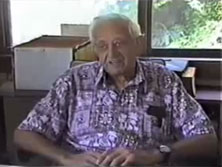
John DeFrancis video

John DeFrancisTen years ago John DeFrancis was awarded the Chinese Language Teachers Association’s first lifetime achievement award. Since he could not be present at the association’s annual conference to receive the award, he sent a videotape of a 12-minute acceptance speech. The video was recently edited down to 6:27 and uploaded to YouTube: John DeFrancis remarks.

Here’s my summary of the main points:

0:00 — While working on what he intended to be a largely political study of Chinese nationalism, DeFrancis encountered references to people who wanted China to adopt an alphabetic writing system, an idea which he initially dismissed. But discovering Lu Xun’s interest in romanization led him to investigate the matter further. [I’m frustrated by the cut away from this discussion. Perhaps a fuller version of the video will be posted later.]
1:30 — Emphasizes he’s not in favor of completely abandoning Chinese characters. Rather, he favors digraphia.
2:30 — “I’d like to mention three aspects of the Chinese field which have interested me.”

  1. pedagogy (2:50) — lots of advancements
  2. linguistic aspect (3:20) — that’s also progressing well
  3. socio-linguistics (3:52) — the field isn’t doing as well as it should be

5:00 — computers and Chinese characters. DeFrancis tears into the Chinese government for its emphasis on shape-based character-input methods rather than Pinyin.

Taiwan to adopt Hanyu Pinyin!

I don’t have time to write a proper post on this now. But the big news is that Taiwan will adopt Hanyu Pinyin, with Tongyong Pinyin left to wither away.

Here’s the story: Zhōngwén yìyīn cǎi Hànyǔ Pīnyīn — bù bǔzhù Tōngyòng Pīnyīn (中文譯音採漢語 不補助通用), United Daily News, September 17, 2008.

The Forumosa thread on this topic supplies some information for those of you who want to read something on this in English: MOE Approves Hanyu Pinyin as Taiwan Transliteration Policy?

(Thanks, Jidanni, for the heads up.)

letters with diacritics: a roughly alphabetical chart

þ

For those who don’t know an ogonek from a retroflex hook — and sometimes for those who do — finding a needed letter with a diacritical mark can be a time-consuming process. (I look forward to the days when combining marks are much better supported.)

So I made a chart with lots of — but certainly not all — diacritics, sorted alphabetically by appearance as well as name and sound. That means, for example, that a thorn (þ) can be found under p as well as under t (as in th), even though — I know, I know — p and þ are unrelated.

Perhaps some people will find it quicker to use than going through the various Unicode charts or searching through various other charts in which the letters are grouped by sound rather than appearance. Someone has probably already made one of these, and done a better job. But I didn’t have any luck finding it before hacking out my own.

Here it is, for what it’s worth: letters with diacritical marks, grouped alphabetically.

I hope some people find it useful.

foreign languages in NZ secondary schools

New Zealand’s Ministry of Education has released figures on secondary school enrollments in foreign languages in 2007, according to a newspaper report.

Education Ministry figures show nearly 70,000 pupils studied foreign languages at secondary schools last year, with 27,284 learning French.

Japanese was also popular (18,440), followed by Spanish (9531) and German (6623).

Chinese… attracted just 1687 pupils.

The total of those figures (63,565) seems considerably shy of “nearly 70,000.” So I suspect some languages more popular than Mandarin have been left off the list. Either way, Mandarin takes only about 2.5 percent of the total. And no indication is given of what percentage of those are “heritage” students.

That’s a lot of kids taking Japanese, though. Can anyone familiar with the situation in New Zealand comment on that?

I wasn’t able to locate the source of these figures. I did, however, find some figures from ten years ago, though they don’t include Mandarin. Also, I don’t understand the categories. But, FWIW:

Numbers of students studying second languages, July 1998

language secondary learners primary & intermediate learners
Japanese 21,701 13,625
French 20,990 8,413
German 7,377 3,877
Spanish 2,247 5,172

A few more lines from the 2008 report:

Under the new curriculum, schools must be “working toward” offering pupils in years 7 to 10 the option of learning a second language from 2011, in a push to make more Kiwis bilingual.

However, the ministry says it is up to schools and their communities to choose which languages are offered – meaning French is likely to remain popular.

A ministry spokesman said measures were underway to boost teachers’ ability to teach a variety of foreign languages in schools.

They included Maori medium scholarship and overseas exchange programmes.

sources:

further reading:

Ma administration still undecided on how to teach Taiwanese

Under the new administration of President Ma Ying-jeou, Taiwan’s Ministry of Education has worked out its plan for teaching pretty much everything … except for Hoklo (the language better known in these parts as “Taiwanese”). There have been a lot of arguments. How early to start teaching the language? How much should be taught? Use romanization? Use zhuyin? May teachers use any kind of soap or only special kinds when washing out the mouths of students speaking the language? (OK, they don’t do that last one anymore.)

So the ministry has decided to appoint a new committee to review such questions. Decisions on these issues are expected in six months or so.

My guess would be that the ministry is going to pack the new committee with conservatives who will see to it that romanization is avoided or at least belittled, that little of the language will actually be taught, and that students will not be tested seriously on the subject. But I’ll be happy if I’m wrong.

sources:

that horizontal feeling

The Yomiuri Shimbun reports, “A series of classic works by renowned novelists is proving popular due to innovative designs and the fact the text is printed using lateral text rather than the vertical columns usually used for Japanese novels.”

The first two books in the Meisaku Bungaku (Masterpiece Literature) series are single volume editions of Soseki Natsume’s “Kokoro” (Heart) and Osamu Dazai’s “Ningen Shikkaku” (No Longer Human), both published on Aug. 1.

The venture by the publisher, Goma Books, is aimed at getting young people to read classic fiction in a similar manner to the way they read novels on mobile phones.

The two books feature photographs of actresses on their front covers, and the type is not the usual black, but features colors such as orange and bright green to give the books a casual feel. Such designs, coupled with the horizontal text, have helped the publisher sell more than 50,000 copies of the novels since they were put on sale.

The two books were among 60 novels made available on the Goma Books mobile phone Web site in April last year. They were selected due to their great popularity.

Copyright on all the site’s books has expired because at least 50 years have passed since the death of their authors.

Some site users said they found it easy to read the masterpieces when they were written horizontally rather than vertically. The site attracts about 100 million hits a month, prompting the publisher to put out printed forms of the works.

As well as the switch from vertical to horizontal text, other ideas also were adopted.

Reading ease was taken into account, with the publisher using fewer words per page and more space between lines. Kana syllables are also frequently printed alongside kanji to aid readers.

My favorite bit, in part because I wonder if the first sentence had ever been uttered before, comes next. Or is this a topic that has been hotly debated among the Japanese literati?

“The emotions [of the work] are not lost with lateral writing,” said Yutaka Akiyama–a former editor at publisher Iwanami Shoten–who was responsible for compiling the complete works of Soseki. “Soseki himself wrote his notes horizontally.”

The second batch of three works, which include Ryunosuke Akutagawa’s “Kumo no Ito” (The Spider’s Thread), came out Friday.

source: Laterally printed classics prove hit, Daily Yomiuri Online, August 23, 2008