signage snafus in Taizhong/Taichung/Taijung…

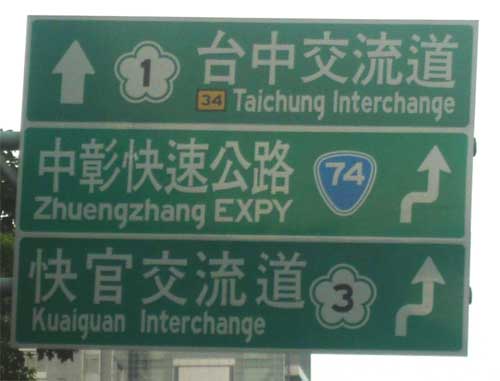
An observant reader, Sonarchic, sent in the top two photos below, both of which were taken in Taizhong (Taichung), Taiwan. The first one is especially interesting in that what would be written zhong in Hanyu Pinyin is here written two different ways: chung and zhueng.

sign with what is written Z-H-O-N-G in Hanyu Pinyin spelled here both C-H-U-N-G and Z-H-U-E-N-G

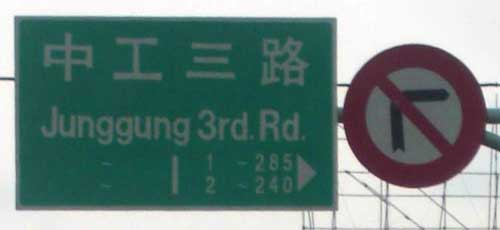
Here’s an older street sign.

sign with what is written Z-H-O-N-G in Hanyu Pinyin spelled here J-U-N-G (MPS2)

I’ve appended two photos I took myself in Taizhong about two years ago.

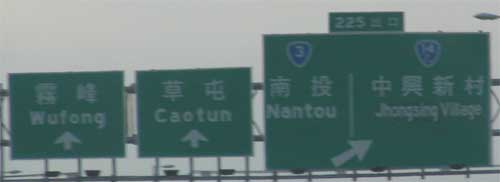
The first was taken on a highway near Taizhong. Since highways are under the central government’s jurisdiction, these signs are in Tongyong Pinyin.

sign with what is written Z-H-O-N-G in Hanyu Pinyin spelled here J-H-O-N-G (Tongyong Pinyin)

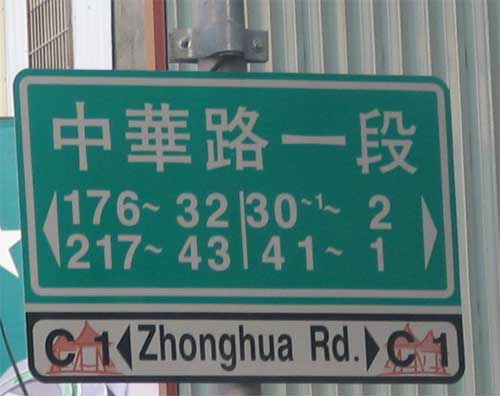
And here is a relatively new street sign with Taizhong itself. Note the use of Hanyu Pinyin, which, despite reports to the contrary, is not limited in Taiwan to Taipei City. I don’t know what “C1” refers to; I certainly hope it’s not a variant of Taipei’s idiotic nicknumbering system. Note also how any mention of the road’s sections (duan) are omitted from the romanization — very bad. Moreover, it has always seemed to me that Taizhong’s street signs suffer from too much information: just look at all those numbers. That can’t be good for readability.

sign with what is written Z-H-O-N-G in Hanyu Pinyin actually spelled Z-H-O-N-G

So, to wrap up, these signs in and near Taizhong, give us:

All that for a simple zhong (中).

Taiwan’s MPS2 romanization system is not the same as Yale

Taiwan does not now nor has it ever officially used the Yale romanization system. But that hasn’t stopped the relatively common belief that the Yale romanization system for Mandarin can be found on some official signage here.

What most people take as Yale is in fact MPS2, a Taiwan-devised romanization system that dates from the mid 1980s. MPS2 was developed Taiwan in a vain attempt to counter the growing popularity around the world of Hanyu Pinyin. In other words, it was basically the Tongyong Pinyin of the 1980s, though its supporters (there must have been some) never embraced it with the same level of nationalistic fervor as Tongyong Pinyin has received from some quarters. Little wonder, then, that most people — including many who really should know better — don’t seem to have noticed that MPS2 even exits, much less that a great deal of the island’s signage remains in this system.

To some degree the confusion of MPS2 for Yale is understandable, given that the two systems have many points in common on which they differ with Hanyu Pinyin. Here are some examples.

-au rather than -ao

MPS II and Yale Hanyu
au ao
bau bao
chau chao
dau dao
gau gao
hau hao

-ung rather than -ong

MPS II and Yale Hanyu
chung chong
dung dong
gung gong
hung hong

chr, jr, r, shr

MPS II and Yale Hanyu
chr chi
jr zhi
r ri
shr shi

ts- instead of c-

MPS II and Yale Hanyu
tsai cai
tsan can
tsau cao
tseng ceng
tsou cou
tsu cu
tsung cong
tsz ci

And neither uses Hanyu Pinyin’s abbreviated vowel forms (such as -ui for -uei, -iu for -iou, and -un for -uen). But here we can begin to see some of the differences between MPS2 and Yale.

MPS II Yale Hanyu
chuei chwei chui
duei dwei dui
tzuei dzwei zui

Yale often uses w as a medial where other systems would use u.

MPS II Yale Hanyu
shuei shwei shui
suan swan suan
guang gwang guang

Yale often uses y as a medial where other systems would use i

MPS II Yale Hanyu
jia jya jia
niau nyau niao
chiung chyung qiong

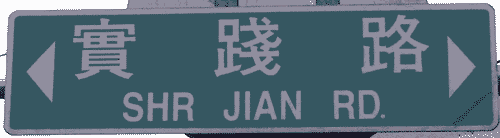
This sign, in Banqiao, would read Shrjyan in Yale, not Shrjian, which is MPS2.
street sign reading 'SHR JIAN RD'

To review all of the similarities and differences among these and other systems, see my comparison chart of romanization systems.

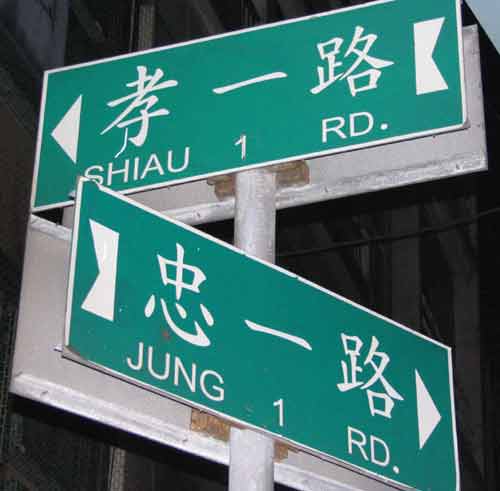
To close, here are some more signs in MPS2. What in Hanyu Pinyin is written zhong is jung in both MPS2 and Yale. What in Hanyu Pinyin is xiao, however, is written differently in MPS2 and Yale: shiau and syau, respectively.

photo of street signs in Jilong. One sign reads 'JUNG 1 RD', the other 'SHIAU 1 RD'
This photo was taken in Jilong.

Banqiao street names

Although Banqiao — spelled “Panchiao” in bastardized Wade-Giles and “Banciao” in Tongyong Pinyin — is one of Taiwan’s most populous cities, it doesn’t get much attention, overshadowed as it is by its neighbor Taipei.

To a certain degree that’s deserved: With a population of some 542,000 (which, if it were transplanted to the United States, would make it that nation’s 26th largest city), Banqiao really ought to have more of interest. But, still, it has been my home for about nine years and it isn’t completely awful. (How’s that for a recommendation?) And the city has been improving, especially with the development around the enormous new train station and the equally enormous Taipei County Government Hall. (David has a few additional photos of Banqiao. I’m amazed I have yet to run into him on the street, especially since foreigners tend to stick out here.)

Until a few years ago, street signs in Banqiao were relatively uniformly in MPS2 (often confused with the Yale romanization system), along with the usual assortment of mistakes and smatterings of other systems. Then signs in Tongyong Pinyin began to replace some but not all of those in MPS2. Last year’s elections, however, saw the DPP lose power in both Taipei County (Banqiao is the county’s largest city) and Banqiao itself. So a move toward Hanyu Pinyin can be expected — eventually. As far as I know, though, the city’s department of transportation, which is in charge of such signage, is still under the erroneous belief that the city must follow the central government’s guidelines and thus use Tongyong. Jilong (Keelung) is another example of a city under a pan-blue administration that thinks it has to use Tongyong.

For people’s reference, I have compiled a list of Banqiao street names in Chinese characters, Hanyu Pinyin (with tone marks), and the mix of romanization and English generally seen in Taiwan.

resource:

MOE approves Taiwanese romanization; Tongyongists protest

Years of valuable time has been lost in the squabbling over romanization systems for Taiwanese. And that squabbling will no doubt continue, as the links below make clear. But an important step was taken on Thursday. Finally, finally, Taiwan’s Ministry of Education has approved a romanization system for Taiwanese: Tái-luó-bǎn Pīnyīn (台羅版拼音), to give its Mandarin name.

I’m already on the record as having called Tongyong Pinyin, in its various incarnations, a national embarrassment for Taiwan, so I won’t bother to disguise the fact that I got a real kick out of the fact that the Tongyong Pinyin scheme for the Taiwanese language was roundly rejected. I know that more than a few readers of Pinyin News will be cheering this news. For many, this has as much or more to do with the methods used to push through the much-despised Tongyong Pinyin system for Mandarin than any defects, real or imagined, in the Tongyong Pinyin system for Taiwanese.

Predictably, Yu Bo-quan (余伯泉, I’ve given up bothering to figure out which of the various spellings for his name he’s using now), the main person behind the Tongyong romanization systems, is unhappy. Reportedly, after it was clear things were not going his way he stormed out of the meeting. After he left the new system was approved unanimously.

Yu’s remarks make clear the political nature of his approach.

Tái-luó-bǎn pīnyīn xìtǒng zuó chuǎngguān chénggōng hòu, Yú Bó-quán qìfèn de shuō, Tái-luó xìtǒng de qǐyuán shì Táiwān Mǐnnányǔ yīnbiāo xìtǒng (TLPA), shì Guómíndǎng shídài de chǎnwù, ér 2002 Tōngyòng Pīnyīn shì Mínjìndǎng zhízhèng nèi tōngguò de, zhìyí wèihé Jiàoyùbù wúfǎ hànwèi zhízhèngdǎng de Mǐnnányǔ pīnyīn xìtǒng zhǔzhāng, Jiàoyùbù duànrán tōngguò Tái-luó-bǎn, Táiwānyǔ Tōngyòng Liánméng hòuxù jiāng zhǔnbèi kàngzhēng. (台羅版拼音系統昨闖關成功後,余伯泉氣憤地說,台羅系統的起源是台灣閩南語音標系統(TLPA),是國民黨時代的產物,而二○○二通用拼音是民進黨執政內通過的,質疑為何教育部無法捍衛執政黨的閩南語拼音系統主張,教育部斷然通過台羅版,台灣語通用聯盟後續將準備抗爭。)

That doesn’t sound all that far from calling those on the committee dupes of the KMT, which isn’t likely to win him any friends with those in power. But it may well be that by this point he has so alienated others he thinks he has nothing to lose.

Apparently Tongyong for Taiwanese will retain something of a foothold in southern Taiwan. (See source no. 8 below.)

Later, I’ll try to put up more about just what system was approved and under what circumstances it will (and will not) be used — unless the ever-knowledgeable a-giâu beats me to it.

Because there’s a lot of confusion about Tongyong, a few notes are in order:

  • Tongyong is not one romanization system for all the languages of Taiwan but rather a group of related systems, some of which could be said to work better (or worse) than others.
  • When Tongyong (for Mandarin) was officially approved in Taiwan in 2002, the Tongyong system for Hakka also received approval but not the Tongyong Pinyin system for Taiwanese.
  • As the vote should make clear, plenty of strong supporters of romanization (and other scripts) for Taiwanese have never much cared for Tongyong.

sources:

  1. Tái-luó-bǎn pīnyīn míngnián shànglù; Jiàoyùbù duànrán dìng’àn; Tōngyòng liánméng jiāng kàngzhēng (台羅版拼音明年上路 教育部斷然定案 通用聯盟將抗爭), Píngguǒ Rìbào (Apple Daily), September 29, 2006
  2. Guóxiǎo lǎoshī: xiāngtǔ yǔyán zuìhǎo zìrán xuéxí (國小老師:鄉土語言最好自然學習), Liánhé Xīnwén Wǎng, September 29, 2006
  3. Zuóyè zuìxīn: Mǐnnányǔ xiāngtǔ jiàoxué quèdìng cǎi Táiwān Mǐnnányǔ Luómǎzì pīnyīn (昨夜最新:閩南語鄉土教學確定採台灣閩南語羅馬字拼音), CNA, September 29, 2006
  4. Táiyǔ Tōngyòng liánméng kàngyì Jiàoyùbù cǎi Mǐnnányǔ Luómǎ pīnyīn (台語通用聯盟抗議教育部採閩南語羅馬拼音), CNA, September 29, 2006
  5. Mǐnnányǔ xiāngtǔ jiàoxué quèdìng cǎi Táiwān Mǐnnányǔ Luómǎzì pīnyīn (閩南語鄉土教學確定採台灣閩南語羅馬字拼音), CNA, September 29, 2006
  6. Mǐnnányǔ pīnyīnfǎ quèlì: Luómǎ pīnyīn shèng chū (閩南語拼音法確立:羅馬拼音勝出), Zhōngguǎng Xīnwén Wǎng, September 29, 2006
  7. Pāibǎn dìng’àn! Jiàoyùbù tōngguò Mǐnnányǔ jiàoxué; cǎiyòng Tái-luó pīnyīn (拍板定案!教育部通過閩南語教學 採用台羅拼音), Dōngsēn Xīnwénbào, September 29, 2006
  8. Nánbù sì xiàn-shì dǐzhì; Tái-luó pīnyīn jīn chuǎngguān (南部四縣市抵制 台羅拼音今闖關), Zhōngshí Diànzǐ Bào, September 29, 2006

Tongyongist tells Hanyu Pinyin supporters to ‘shut up’

Those interested in the Tongyong Pinyin vs Hanyu Pinyin debate might want to check out When in Rome, shut up and fit in, a provocative, pro-Tongyong piece.

it is almost certainly the case that the tongyong pinyin system was selected for the political reason of avoiding using the PRC’s favored method, and to further the cause of instilling a Taiwanese identity. This surely is reason enough, however.

Thanks to Taffy for the alert.

source: When in Rome, shut up and fit in, Taiwan Journal, Vol. XXIII No. 38, September 29, 2006

Chinglish International Airport?

In what many view as a long-overdue move, Taiwan’s government has removed the name of Chiang Kai-shek, the island’s one-time dictator, from the title of the country’s main international airport. What has been reported as the new English name, however, is a bit strained in that the country’s name precedes the county/city name.

  English Pinyin Hanzi
old Chiang Kai-shek International Airport Zhōngzhèng Guójì
Jīchǎng
中正國際機場
new Taiwan Taoyuan International Airport Táiwān Táoyuán Guójì
Jīchǎng
台灣桃園國際機場

In Mandarin, there’s nothing tremendously odd about using “Taiwan Taoyuan.” In English, however, it’s a completely different story.

exact phrase romanization no. of results in Google
Taoyuan Taiwan   241,000
Taiwan Taoyuan   42,400
 
臺灣桃園 Taiwan Taoyuan 43,200
台灣桃園 Taiwan Taoyuan 220,000
total for 臺灣桃園
and 台灣桃園
263,200
 
桃園臺灣 Taoyuan Taiwan 5,720
桃園台灣 Taoyuan Taiwan 461
total
for 桃園臺灣 and 桃園台灣
6,181

Almost all of the examples in English of “Taiwan Taoyuan” have punctuation (stronger than a comma, that is) or new lines separating the words, so running the two names together in that order is less common than the Google result implies, as most English speakers know intuitively.

“Taiwan Taoyuan,” when used in English, reminds me of nothing so much as the annoying term “Chinese Taipei” (Zhonghua Taibei / 中華台北). This name represents the international kissing of Beijing’s ass diplomatic solution worked out so Taiwan’s teams can participate in international sporting events without China throwing too much of a hissyfit. (We we still get some of those anyway, of course.)

Since using anything along the lines of “Chinese Taipei” would be anathema to the present administration in Taiwan, what’s going on with the new name for the airport? The logical name would probably be simply “Taoyuan International Airport,” the airport being in Taoyuan County rather than Taipei County. But outside of Taiwan, who has ever heard of Taoyuan? (That’s probably just as well for Taiwan, because much of Taoyuan is downright ugly.) And, anyway, I think that those deciding on the new name regarded adding “Taiwan” and taking out “Chiang Kai-shek” as the top priorities.

Of course, it could be worse. Some in the KMT have called for the name to be changed to “Taiwan Taoyuan Chiang Kai-shek International Airport.” Ugh.

However, the code letters for the airport, TPE and RCTP, will not be changed. These are both rooted in the Wade-Giles romanization system, under which we have Taipei (properly T’ai-pei) rather than Taibei.

Fortunately for all concerned, both “Taoyuan” and “Taiwan” are examples of names spelled the same in most romanization systems. So, at least in this case, the current administration’s attachment to the Tongyong Pinyin romanization system won’t lead to further international embarrassment.

I spoke earlier today with someone at the Ministry of Transportation and Communications, who informed me that although the Mandarin name of the airport was now officially Táiwān Táoyuán Guójì Jīchǎng, the English name has yet to be set by the Ministry of Education. So it’s possible the English name could change.

Anyone want to play Name That Airport? I’m more than half serious. The authorities here no doubt need some help with this. (Even though Taoyuan is one of the ugliest places in Taiwan, let’s keep this nice.)

Oh, in case anyone’s puzzled that “Chiang Kai-shek” and “Zhōngzhèng” don’t look much like each other or even have the same number of syllables, the reason is that Zhōngzhèng is a sort of assumed name, not the name by which he was known to his family, which in Mandarin is Ji?ng Jièshí (???). For more on this see the names section of the Wikipedia article on Chiang Kai-shek. (Me linking to a Wikipedia article? There’s a first time for everything, I guess.)

sources:

Taiwan city and county names

As most readers of this site know, Taiwan has approached romanization and signage with a sloppiness that sometimes beggars belief. Although the situation has improved somewhat this decade, many errors remain. And even where there are not errors, people still must often contend with a variety of romanization systems.

Thus, my list of Taiwan place names may come in handy.

I made the list more than a year ago but put it on another website and never drew much attention to it. Now I’ve moved it here to Pinyin Info, where it may do more good.

The list, which is arranged by county and then by city, gives Chinese characters, Hanyu Pinyin (both with and without tone marks), Tongyong Pinyin (ugh!), and a commonly seen older form (usually bastardized Wade-Giles).

I have not bothered to include MPS2, because it is seen more on street signs than on maps. And, anyway, it’s on its way out. I strongly recommend using Hanyu Pinyin.

Kaohsiung to revise English signage

According to a CNA story in the Taipei Times, the Gaoxiong/Kaohsiung City Government has decided to “correct and update all English translations of signage at 132 scenic spots” in preparation for the city’s hosting of the World Games in 2009.

A “group of specialists” from an ESL magazine are the chief advisers to the city government, which I suppose is better than just one randomly selected foreigner. Still, I wonder what these “specialists” know about signage — or romanization, for that matter. And will anyone check to ensure the signs are made correctly?

Here’s what is probably going to happen: Gaoxiong will replace some old signs with poor English and worse romanization with signs in tiny, unreadable English (probably still with mistakes) and sloppy romanization in a system that most foreigners actively dislike.

Deputy Mayor Cheng Wen-lung (鄭文隆), who is convener of a city committee formed to develop Kaohsiung’s English living environment, said yesterday that in addition to the changes, the committee was considering standardizing the English translations of food names in the area as a way to help foreign athletes — as well as the large number of foreign visitors who are expected at the upcoming World Games — recognize Chinese and local cuisines.

The city plans to update English translations on all of the city’s key signage within one month.

source: Kaohsiung looks to improve its English signage for games, CNA, June 28, 2006