official advocates Aborigines reclaim original names

The head of the Gaoxiong County Government’s Indigenous Peoples Bureau announced on Monday that henceforth he would like to be known by his original name, Alang Manglavan, rather than the Sinitic name Du Shi-luan (杜石鑾), and that he had completed the forms for official recognition of this.

As of the end of last year, Gaoxiong County had some 15,700 members of indigenous tribes. Only about 5 percent of these, however, had applied for an official change of name, Manglavan reported. He encouraged others to apply for the change.

Here’s one story:

Gāoxióng Xiànzhèngfǔ Yuánzhùmín Júzhǎng Dù Shí-luán, yǐjīng* shēnqǐng zhèngmíng wéi “Alang Manglavan” (阿浪、滿拉旺), jīntiān gǔlì xiàn nèi yuánzhùmín kě yīfǎ huífù chuántǒng xìngmíng, yǐ xiǎnxiàn yuánzhùmín chuántǒng yuánmào.

Dù Shí-luán biǎoshì, wèi xiǎngyìng tuīdòng huífù yuánzhùmín chuántǒng míngzi cuòshī, tā jǐ wánchéng zhèngmíng, shì cǎixíng chuántǒng míngzi Hànzì zhùjì hé bìngliè Luómǎ pīnyīn.

“Alang” shì míngzi, “Manglavan” shì xìng, shì “duànyá” de yìsi, Dù Shí-luán jiěshì shuō, yīnwèi zǔxiān zhù zài duànyá pángbiān, suǒyǐ yǐcǐ wéi xìng. Xīwàng dàjiā yǐhòu yào jiào tā “Ālàng”, bùzài xìng “Dù” le.

Dù Shí-luán gǔlì yuánzhùmín bǎwò jīhuì, duō gǔlì jiārén, péngyou qiánwǎng hùzhèng shìwùsuǒ bànlǐ huífù chuántǒng xìngmíng zhù jì.

* The original version in characters has a mistake: 己 instead of 已[经]. A Wubi-based typo?

sources:

Taiwan city and county names

As most readers of this site know, Taiwan has approached romanization and signage with a sloppiness that sometimes beggars belief. Although the situation has improved somewhat this decade, many errors remain. And even where there are not errors, people still must often contend with a variety of romanization systems.

Thus, my list of Taiwan place names may come in handy.

I made the list more than a year ago but put it on another website and never drew much attention to it. Now I’ve moved it here to Pinyin Info, where it may do more good.

The list, which is arranged by county and then by city, gives Chinese characters, Hanyu Pinyin (both with and without tone marks), Tongyong Pinyin (ugh!), and a commonly seen older form (usually bastardized Wade-Giles).

I have not bothered to include MPS2, because it is seen more on street signs than on maps. And, anyway, it’s on its way out. I strongly recommend using Hanyu Pinyin.

chlorinated alphabet

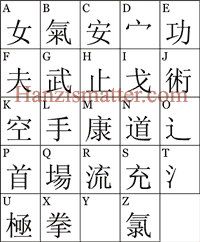
images of Chinese characters and 'radicals' produced when typing various letters in a fontTian at Hanzismatter always manages to find good stuff. But this time, with the help of Alan Siegrist, he’s outdone himself. I’ve got tears streaming down my face because I’ve been laughing so hard at the font of random characters and so-called radicals that some people have apparently been mistaking for a phonetic guide to Chinese characters.

My title for this entry is in reference to the character given when the letter Z is typed: 氯. This is , which means “chlorine.”

Festschrift for John DeFrancis now available for free

Most readers of Pinyin News will already know of John DeFrancis, editor of the ABC Chinese-English Comprehensive Dictionary and author of The Chinese Language: Fact and Fantasy and many other important works. (If you haven’t read The Chinese Language: Fact and Fantasy yet, order it now.)

In recognition of the 95th(!) birthday today of Professor DeFrancis, Sino-Platonic Papers is rereleasing Schriftfestschrift: Essays in Honor of John DeFrancis on His Eightieth Birthday. Previously, this important compilation, which runs more than 250 pages, was available only in a printed edition priced at US$35. The fifteenth-anniversary edition, however, is being released for free as a PDF (15 MB — so have a fast Internet connection, or a lot of patience).

I’d like to draw special attention to an article written in Pinyin: “Hanzi Bu Tebie Biaoyi,” by Zhang Liqing. (Zhang’s work also appears here on Pinyin Info, in her translations of The Historical Evolution of Chinese Languages and Scripts and of the amazing Comparing Chinese Characters and a Chinese Spelling Script — an evening conversation on the reform of Chinese characters.)

Feel free to print out a copy of the Schriftfestschrift for your own use or for inclusion in a library. Just don’t sell it.

The original publication contained several color photos. I’ll add those later. Also, the English tex is searchable to some degree, as I used OCR after scanning these pages; but the results weren’t perfect.

Here are the contents:

  • Tabula Gratulatoria
  • Introduction, by Victor H. Mair
  • Publications of John DeFrancis
  • Hanzi Bu Tebie Biaoyi, by Zhang Liqing
  • Typology of Writing Systems, by Zhou Youguang
  • Dui Hanzi de Jizhong Wujie, by Yin Binyong
  • The Information Society and Terminology, by Liu Yongquan
  • A Bilingual Mosaic, by Einar Haugen
  • The Polysemy of the Term Kokugo, by S. Robert Ramsey
  • Memorizing Kanji: Lessons from a Pro, by J. Marshall Unger
  • Why Chinese Is So Damn Hard, by David Moser
  • Ethnolinguistic Notes on the Dungan, by Lisa E. Husmann and William S-Y. Wang
  • Korean Views on Writing Reform, by Wm. C. Hannas
  • Language Policies and Linguistic Divergence in the Two Koreas, by Ho-min Sohn
  • Okinawan Writing Systems, Past, Present, and Future, by Leon A. Serafim
  • Proposal of a Comparative Study of Language Policies and Their Implementation in Singapore, Taiwan, and China (PRC), by Robert L. Cheng
  • The Topical Function of Preverbal Locatives and Temporals in Chinese, by Feng-fu Tsao
  • Yes-No Questions in Taipei and Peking Mandarin, by Robert M. Sanders
  • Patronizing Uses of the Particle ma: Bureaucratic Chinese Bids for Dominance in Personal Interactions, by Beverly Hong Fincher
  • Gender and Sexism in Chinese Language and Literature, by Angela Jung-Palandri
  • A zhezi Anagram Poem of the Song Dynasty, by John Marney
  • Some Remarks on Differing Correspondences in Old Chinese Assumed to Represent Different Chinese Dialects, by Nicholas C. Bodman
  • Can Taiwanese Recognize Simplified Characters?, by John S. Rohsenow
  • Simplified Characters and Their (Un)relatedness, by Chauncey C. Chu
  • The Teaching of Culture and the Culture of Teaching: Problems, Challenges, and Opportunities in Language Instruction, by Eugene Eoyang
  • The Culture Component of Language Teaching, by Kyoko Hijirida
  • Thinking About Prof. John DeFrancis, by Apollo Wu
  • Wo suo Renshi de De Xiansheng, by Chih-yu Ho
  • Two Poems for Professor John DeFrancis, by Richard F. S. Yang
  • Announcement, by Stephen Fleming

Happy birthday, John! And many happy returns!

Don’t use rare characters in teaching Taiwanese: official

It looks like some standardization might slowly be coming to the teaching in Taiwan of Taiwanese and Hakka. Beginning with the 2007-2008 school year, material from publishing companies for teaching “local languages” (i.e., Taiwanese, Hakka, and, sometimes, the languages of Taiwan’s tribes) must first pass inspection by the Ministry of Education. The ministry should have its own teaching materials ready by the 2009-2010 school year. Schools will be free to choose among textbooks from publishers or from the ministry.

Specifically, publishers should by all means avoid dredging up obscure Chinese characters to use for Taiwanese morphemes, Pan Wen-zhong, a high-ranking official with the ministry, said on Monday. There are easier ways to read and write the language than with such characters, especially when teaching elementary school students, he noted.

As much as I agree with this, it is still probably a case of too little, too late.

國小鄉土語言教材怪字連篇、拼音混亂的情況,很多家長教起孩子既頭痛、又氣 憤。教育部國教司長潘文忠表示,96學年度起,民間編印的鄉土語言教材,一律要 先經過審查,才能選用,一些罕見的怪字可望從教材中消失。

教育部國語推行委員會也已經著手編印閩南語、客家語教材,預計98學年度開始, 學校教閩南語或客語,就可以選用部編本教材。

在審定本和部編本教材還沒有出來之前,潘文忠呼籲老師使用既有教材教鄉土語言 時,盡量不要教、不要用罕見漢字。尤其是小學生,他強調應該使用「老師教過、 學生學過」的字辭,像蟑螂就用蟑螂,不必刻意教閩南語發音的新辭,更不要用罕 見字。

國小民編本鄉土語言教材怪字連篇的情況,多年來在立法院和地方議會經常被批 評,連官員都被考倒,家長更是苦不堪言。光是蟑螂、蒼蠅這些日常生活中常用 辭,不同教材,蟑螂就有「虼」、「假裁縫」等不同寫法,蒼蠅也有「真司公」、 「呼神」、「胡蠅」、「互蠅」等用法。

source: xiāngtǔyǔ jiàocái yào xiàn shěn — bùnéng yòng qíguài Hànzì (鄉語教材要先審 不能用怪字), August 27, 2006

What Chinese characters can’t do-be-do-be-do

It don’t mean a thing if it ain’t got that “shuing”!

David Moser uses the question of how would someone scat sing in Mandarin Chinese to start off an exploration of what Chinese characters can’t do well (and what Pinyin can).

Here’s an excerpt:

English has numerous conventions for representing casual oral speech: “Are you kiddin’ me?” “Whaddya wanna do tonight, Marty?” “I’m gettin’ outta here!” “Gimme that.” And so on. Such spelling conventions have been employed in the literature of most alphabetic traditions for hundreds of years, and are often an invaluable link to the vernaculars of the past. English-language writers from Mark Twain to James Joyce have used the flexibility of the alphabet to vividly re-created various speech worlds in their works. It is, in fact, hard to imagine how much of the literature of the West could have been produced without recourse to such devices.

Chinese characters, by contrast, cannot reproduce the equivalent elisions and blends of colloquial Chinese, except in rare cases, and only at the level of the syllable…. The result is that China effectively has no tradition of realistically notating vernacular speech. Wenyanwen ???, classical Chinese, exerted a virtual stranglehold on written literature up until the early twentieth century, and even then, most writers did not attempt to accurately represent common speech, despite the appearance of an occasional Lao She or Ba Jin. But even if such writers had so desired, working within the Chinese system of writing, they could never have notated the sounds of the language around them with the same kind of vivid verisimilitude of the following examples in English….

Read the whole article, here on Pinyin Info: Some Things Chinese Characters Can’t Do-Be-Do-Be-Do.

And if you haven’t seen it already, be sure to check out another work by Moser: Why Chinese Is So Damn Hard, which is one of Pinyin Info’s most popular readings.

Zhuang ms found, resembles Naxi documents

An ethnic culture research worker in Funing County, Yunnan Province, China, has come across an old Zhuang book of songs. What makes this manuscript particularly interesting is that the songs are written down not in a regular script but rather in something similar to Naxi pictographs, i.e. pictures that serve as mnemonic references to the text rather than as real pictographs or real writing.

The article I read on this is a little vague, so I’m hoping someone can come up with some images of the manuscript or a more scholarly source.

source: Yúnnán fāxiàn Zhuàngzú gǔlǎo xíngtài túhuà wénzì — kān pìměi Dōngbā wénhuà (云南发现壮族古老形态图画文字 堪媲美东巴文化), CCTV.com, August 16, 2006

typing in Pinyin on a Windows 2000/XP system

Jason Frazier has used the free Microsoft keyboard layout creator to devise a keyboard method for entering Pinyin texts with tone marks. This will work on Windows 2000 and XP systems.

Basically, to type a vowel with a tone mark, first press the key corresponding to the tone you want and then the vowel (or “v” for ü). Many may find this method preferable to using an online tool that converts Pinyin tone numbers to tone marks (my own online converter being desperately in need of an update) or a separate program such as Wenlin (or its free but tremendously useful demo version).

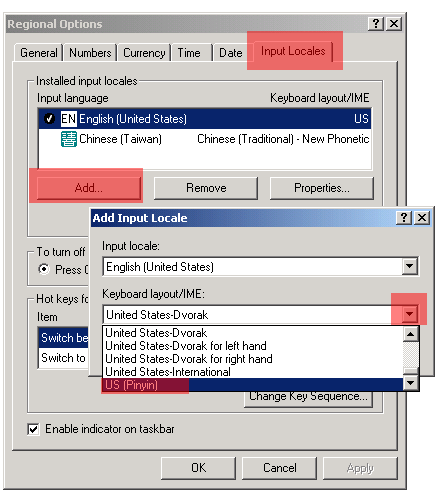
To download and install this Pinyin-entry tool, follow the directions on Jason’s Web page. I’ve added a screenshot below to help clarify part of the installation process.

screenshot of method to add pinyin keyboard layout