Book reviews, vol. 5

Sino-Platonic Papers has rereleased for free its fifth volume of reviews, mainly of books about China and its history and languages (11.6 MB PDF).

Even if you have no particular interest in the specific works reviewed, I recommend at least browsing through this and all of the other volumes of reviews from Sino-Platonic Papers, as they often feature Victor Mair at his most direct and entertaining about a wide range of subjects.

Table of Contents:

  • Review Article: The Present State and Future Prospects of Pre-Han Text Studies. A review of Michael Loewe, ed., Early Chinese Texts: A Bibliographical Guide. Reviewed by E. Bruce Brooks, University of Massachusetts at Amherst.

N.B.: The following 29 reviews are by the editor of Sino-Platonic Papers.

  • Roger T. Ames, Chan Sin-wai, and Mau-sang Ng, eds. Interpreting Culture through Translation: A Festschrift for D. C. Lau.
  • Sau Y. Chan. Improvisation in a Ritual Context: The Music of Cantonese Opera.
  • CHANG Xizhen. Beijing Tuhua [Pekingese Colloquial].
  • CHANG/AIXINJUELUO Yingsheng [AISINGIORO *Yingsheng]. Beijing Tuhua zhong de Manyu [Manchurian in Pekingese Colloquial].
  • BAI Gong and JIN Shan. Jing Wei’er: Toushi Beijingren de Yuyan [“Capital Flavor”: A Perspective on the Language of the Pekingese].
  • JIA Caizhu, comp. Beijinghua Erhua Cidian [Dictionary of Retroflex Final-r in Pekingese].
  • Julia Ching and R. W .L. Guisso, eds. Sages and Sons: Mythology and Archaeology in Ancient China.
  • FENG Zhiwei. Xiandai Hanzi he Jisuanji (Modern Chinese Characters and Electronic Computers).
  • FENG Zhiwei. Zhongwen Xinxi Chuli yu Hanyu Yanjiu [Chinese Information Processing and Research on Sinitic].
  • Andre Gunder Frank. The Centrality of Central Asia.
  • HUANG Jungui. Hanzi yu Hanzi Paijian Fangfa [Sinographs and Methods for Ordering and Looking up Sinographs].
  • W. J. F. Jenner. The Tyranny of History: The Roots of China’s Crisis.
  • Adam T. Kessler. Empires Beyond the Great Wall: The Heritage of Genghis Khan.
  • David R. McCraw. Du Fu’s Laments from the South.
  • Michael Nylan, tr. and comm. The Canon of Supreme Mystery, by Yang Hsiung.
  • R. P. Peerenboom. Law and Morality in Ancient China: The Silk Manuscripts of Huang-Lao.
  • Henry G. Schwarz. An Uyghur-English Dictionary.
  • Vitaly Shevoroshkin, ed. Dene-Sino-Caucasian Languages.
  • Vitaly Shevoroshkin, ed. Nostratic, Dene-Caucasian, Austric and Amerind.
  • Laurence G. Thompson, comp. Studies of Chinese Religion: A Comprehensive and Classified Bibliography of Publications in English, French, and German through 1970.
  • Laurence G. Thompson, comp. Chinese Religion in Western Languages: A Comprehensive and Classified Bibliography of Publications in English, French, and German through 1980.
  • Laurence G. Thompson, comp. Chinese Religion: Publications in Western Languages, 1981 through 1990.
  • Aat Vervoorn. Men of the Cliffs and Caves: The Development of the Chinese Eremitic Tradition to the End of the Han Dynasty.
  • WANG Jiting, ZHANG Shaoting, and WANG Suorong, comp. Changjian Wenyan Shumianyu [Frequently Encountered Literary Sinitic Expressions in Written Language].
  • John Timothy Wixted. Japanese Scholars of China: A Bibliographical Handbook.
  • YÜ Lung-yü, ed. Chung-Yin wen-hsüeh kuan-hsi yüan-liu [The Origin and Development of Sino-Indian Literary Relations].
  • ZHANG Guangda and RONG Xinjiang. Yutian Shi Congkao [Collected Inquiries on the History of Khotan].
  • ZHANG Yongyan, chief ed. Shishuo Xinxu Cidian [A Dictionary of A New Account of Tales of the World].
  • Peter H. Rushton. The Jin Ping Mei and the Non-Linear Dimensions of the Traditional Chinese Novel.

  • William H. Baxter, A Handbook of Old Chinese Phonology. Reviewed by Paul Rakita Goldin, Harvard University.
  • JI Xianlin (aka Hiän-lin Dschi). Dunhuang Tulufan Tuhuoluoyu Yanjiu Daolun [A Guide to Tocharian Language Materials from Dunhuang and Turfan]. Reviewed by XU Wenkan, Hanyu Da Cidian editorial offices in Shanghai.
  • GU Zhengmei. Guishuang Fojiao Zhengzhi Chuantong yu Dasheng Fojiao [The Political Tradition of Kushan Buddhism and Mahayana Buddhism]. Reviewed by XU Wenkan, Hanyu Da Cidian editorial offices in Shanghai.
  • W. South Coblin, University of Iowa. A Note on the Modern Readings of 土蕃.
  • Rejoinder by the Editor.
  • Announcement concerning the inauguration of a new series in Sino-Platonic Papers entitled “Bits and Pieces.”

This work also continues the discussion regarding the Chinese characters “土蕃” and Tibet.

This was first published in July 1994 as issue no. 46 of Sino-Platonic Papers.
Hanyu Pinyin backer to return to Taiwan’s Cabinet

Dr. Ovid Tzeng (Zēng Zhìlǎng / 曾志朗 ) will be returning to government as a minister without portfolio in the Cabinet of the incoming administration of Ma Ying-jeou.

Tzeng has done important work in psycholinguistics and is known to support Taiwan’s adoption of Hanyu Pinyin. Indeed, this support was one of the reasons he was pushed out of office the last time he was in government service, as minister of education at the beginning of President Chen Shui-bian’s first term.

Tasked with choosing a romanization system for Taiwan, Tzeng recommended Hanyu Pinyin. He was promptly replaced by someone who backed the adoption of the newly minted Tongyong Pinyin.

Tzeng’s name is often misspelled “”Ovid Tseng” in news reports.

President-elect Ma favors Hanzi-only writing of Taiwanese: report

If the Chen Shui-bian administration had bothered to do much of anything really useful to promote Taiwanese, especially as a written language, then we probably wouldn’t be faced with crap like this.

President-elect Ma Ying-jeou met last week with Chen Fang-ming (陳芳明), the chairman of the Graduate Institute of Taiwanese Literature at National Chengchi University (Zhèng-Dà). Although Professor Chen is a former DPP official and supported Frank Hsieh in the recent election, the two reportedly found much to agree on, such as that the idea that Chinese characters are all that are needed for literature in Taiwanese; romanization and other such phonetic spellings, they agreed, aren’t necessary.

Zǒngtǒng dāngxuǎnrén Mǎ Yīngjiǔ jīntiān bàihuì Zhèng-Dà Táiwān wénxué yánjiūsuǒ suǒzhǎng Chén Fāngmíng, tā biǎoshì liǎng rén jīntiān tándào běntǔhuà, zhuǎnxíng zhèngyì, běntǔ wénxué, dàxué píng jiàn děng yìtí, lìng tā yǒu “kōnggǔzúyīn” zhī gǎn, liǎng rén hěn duō kànfǎ dōu bùmóu’érhé, lìrú Chén Fāngmíng rènwéi zhǐyòng Zhōngwén xiě, Héluòhuà niàn, jiùshì Táiyǔ wénxué, bùyīdìng kèyì yào yòng Luómǎzì, yīn lái pīn.

This is certainly discouraging though not unexpected news for romanization supporters — and for those whose idea of Taiwanese lit isn’t stuck in the Qing dynasty or even earlier. But there’s always hope that this is another of those times in which Ma is simply persuaded by or agreeing with whatever is in front of him; and he may change his mind later. Regardless, though, it doesn’t augur well for a modern Taiwanese literature or for government work on — much less promotion of — romanization over the next four years.

source and further reading:

Find Chinese characters online by drawing them with your mouse

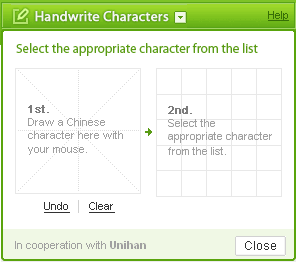
Nciku, a Web site that bills itself as “more than a dictionary,” has a nifty feature that allows users to find Chinese characters by drawing them with a mouse.

interface for the character-drawing tool

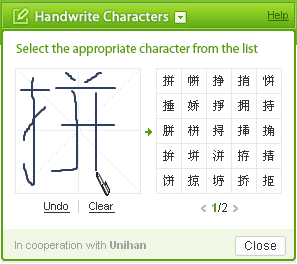
As you draw, possible character matches will appear in the box to the right of your drawing, with the results refined as your drawing progresses. You don’t need to know the canonical stroke order to get this to work, nor do your calligraphy skills need to be perfect, as this example shows.
, showing the results with a sloppily drawn ? (the 'pin' of 'Pinyin')

Once you see the correct character offered as a choice, click on it and it will be entered into the search box for the site’s online dictionary. This dictionary feature can handle multiple-character input and will even prompt you with likely choices to fill out your search.

via Keywords

Kyrgyzstan won’t switch to Roman alphabet yet: report

High-ranking Kyrgyz officials are now reportedly saying that having Kyrgyzstan switch from the Cyrillic to the Roman alphabet would cost more money than the country can afford for the project at present. A later switch has not been ruled out.

sources:

Ideography

This week’s rerelease from Sino-Platonic Papers is The Prestige of Writing: 文, Letter, Picture, Image, Ideography, by Haun Saussy, who is currently a professor of Chinese and comparative literature at Yale.

This work contains a memorable, wry disclaimer:

WARNING. The following section contains passages from the writings of Ernest Fenollosa which may be objectionable to some readers. The reproduction of these statements does not indicate endorsement or approval of their content by the author or editors, who decline all responsibility for any damages, direct or incidental, that may be attributed to the reading of them.

The author explains: “The need for such a disclaimer was brought home to me by the reactions of two sinological colleagues who refereed an earlier version of this paper.” Just in case anyone’s wondering why that might be the case, see Fennolosa, Pound and the Chinese Character, by George A. Kennedy, and The Ideographic Myth, by John DeFrancis.

Here is the introduction:

The disparagement of writing is a motif common, I suppose, to all traditions that have writing. Writing is often seen as inadequate to represent speech or thought. But another response to the inadequacy of writing has been to exalt some other kind of writing — occasionally a language reformer’s pet project, but more frequently the writing of the angels, the writing of the citizens of some utopia, of the scholars of some faraway kingdom, or of the forces of nature itself. Imagined writings of this sort telescope critique and critique’s wishful compensation. They attribute wonders — praestigia — to a medium most often noticed in its falterings.

Since Chinese writing became known in Europe, it has often been pressed into service as the model of this perfected writing. This enthusiasm must appear outlandish to those whose ‘native’ writing-system is Chinese. But it is not enough to show that the indigenous and foreign perceptions of Chinese writing are at variance, or even that the tales told of Chinese script do not stand up to linguistic scrutiny: there is an inventive element to all intercultural interpretation, a fit between its observations and the intellectual needs of its proponents, that expert testimony simply shoves aside. The proper way to analyze an intellectual tangle of this sort, it seems to me, is not to hold it to the standard of specialist univocity, but to situate it ethnographically among the conceptions it echoes or answers. Which aspects of which utopias still beckon, and which have definitely gone on to feed intellectual history, is another question deserving patient consideration.

This is issue no. 75 of Sino-Platonic Papers. It was originally published in February 1997.

Tibetan-English sample sentences

It seems like a good time for something related to Tibet.

The newest rerelease from Sino-Platonic Papers comprises 900 sample sentences in romanized Tibetan and English, the Tibetan being specifically Kham Tibetan.

From the introduction:

The reader is undoubtedly aware that written Tibetan radically differs from what is spoken and that there are also many differences in, for example, written Tibetan in Amdo regions and that of Lhasa. The value of this material is that it presents one of the most widely used Tibetan dialects as it is actually spoken.

Renchin-Jashe, a native of Yulshul (Yushu) Tibetan Autonomous Prefecture in Qinghai Province where Kham is spoken, wrote these sentences using a system that he devised. I then edited the sentences…. We have tried throughout to present sentences that reflect Tibetan culture.

This issue is Kham Tibetan Language Materials (2.7 MB PDF), by Renchin-Jashe and Kevin Stuart.

Here are the first 15 of the 900 sentences.

  1. Qa e tel.
    Hello.
  2. Chou ghale-jiele en?
    Is your life well?
  3. Nga Norbu Sangbho yin.
    I’m Norbu Sangbho.
  4. Chou Doje e rei?
    Are you Doje?
  5. Nga yin.
    Yes, I am.
  6. Chou dhemo yin nam?
    How are you?
  7. Nga dhemo yin, tujeche.
    Fine, thanks.
  8. Droma dhele ghale e ree?
    How is Droma?
  9. Mo ni dhele ghale ree tujeche.
    She is very well, thank you.
  10. Chou dhehi eyou, Avo Qalsang?
    How are you, Mr. Qalsang?
  11. Ghongmo zang, Ashe Yudron.
    Good evening, Ms. Yudron.
  12. Ghong mo chou dhemo en?
    How are you this evening?
  13. Da do nub dhe mo jie Tshering.
    Good night Tshering.
  14. Ghashou, Dondrub.
    Good-bye, Dondrub.
  15. Sang nyin tutree zei.
    See you tomorrow.

The work also contains a guide to pronunciation and sentences for learners at the intermediate level.

It was first published in November 1993 as issue no. 42 of Sino-Platonic Papers.

China’s earliest romanization system

The most recent rerelease from Sino-Platonic Papers is Dì-yī ge Lādīng zìmǔ de Hànyǔ Pīnyīn Fāng’àn shì zěnyàng chǎnshēng de? (How Was the First Romanized Spelling System for Sinitic Produced? / 第一个拉丁字母的汉语拼音方案是怎样产生的), by YIN Binyong (尹斌庸).

The author should be familiar to regular readers of this site, as he wrote the standard works on Hanyu Pinyin orthography — Chinese Romanization: Pronunciation and Orthography and the Xinhua Pinxie Cidian — as well as Pinyin-to-Chinese Character Computer Conversion Systems and the Realization of Digraphia in China.

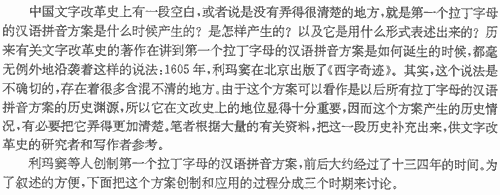
The text is in Mandarin in Chinese characters. Here is the introduction.
image of the Mandarin text (in Chinese characters) of the first two paragraphs of the article

This is issue no. 50 of Sino-Platonic Papers. It was first published in November 1994.