romanization in early communist propaganda

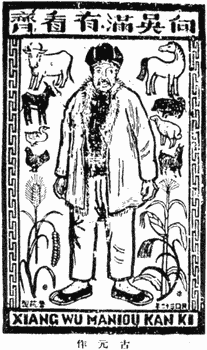
pre-1949 Chinese communist propaganda woodblock featuring Sin Wenz romanization; a peasant man is shown with crops and farm animalsI’ve been reading War and Popular Culture: Resistance in Modern China, 1937–1945, by Chang-tai Hung, which is one of the University of California Press books available for free online. It contains a reproduction of a woodcut with with the following text in romanization:

XIANG WU MANIOU KAN KI
(齊看有满吴向)

To my disappointment, the book does not discuss the romanization movement at all, though the presence of Sin Wenz (Xīn Wénzì / 新文字) in the woodcut is an indication of its relevence.

Note: DeFrancis’s Nationalism and Language Reform in China has some good material on Sin Wenz. The sample chapter I have here on Pinyin.info, however, doesn’t cover that. And the long-out-of-print book is not presently searchable through Google Books either. But at the time of this writing Bookfinder has two copies for under US$40, which is a good deal for this hard-to-find book. So if you have the money and this is the sort of book you like, you should buy this now, as you’re unlikely to come across one for less money.

Anyway, back to the romanization in the illustration. In Hanyu Pinyin, which would not exist until some 15 years later, XIANG WU MANIOU KAN KI would read “xiàng Wú Mǎnyǒu kànqí” (“emulate Wu Manyou”). This Wu Manyou was a “model peasant” who got his very own official emulate-this-guy campaign in the early 1940s.

Notice that the use of the letter x predates Hanyu Pinyin. (Actually, x in romanization for Sinitic languages long predates Hanyu Pinyin, appearing even in Trigault’s seventeenth-century work.) But even though the xiang of Sin Wenz and the xiang of Hanyu Pinyin are written the same, the two systems handle the letter differently in most cases. In Sin Wenz texts, most of the time the letter x represents what would be written h in Hanyu Pinyin. For example, the full name of Sin Wenz is Latinxua Sin Wenz, not Latinhua Xinwenz. Note, too, the use of the original “Latin” rather than “Ladin”, just as Gwoyeu Romatzyh uses Romatzyh rather than Luomaatzyh, indicating the link between romanization and the alphabet of Rome (Roma).

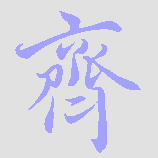
Also interesting is the form of the character that is second from the right. (These Chinese characters are read from right to left. Put left to right, they would appear as 向吴满有看齊.) Note how it is not in the traditional form:

Nor is it the standard “simplified” form (which would not have been officially adopted for more than decade after this woodblock was made):

Of variant characters there is no end.

meeting Zhou Youguang

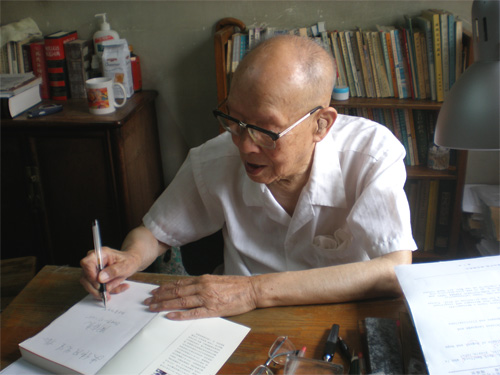
I’m back from a great trip Beijing. Among the people I was able meet there is Zhōu Yǒuguāng (周有光), who is often referred to as the father of Hanyu Pinyin.

I’m pleased to report that even though he is well beyond 100 years old, he remains sharp, in amazingly good health, and in good humor. I’ll be reporting later on what he had to say during our meeting. But since that lasted several hours, I won’t try to cover everything in one post; instead, I’ll break it up into lots of smaller posts over the next few weeks.

For now, here’s a photo I took of him on Sunday afternoon.

Hanyu Pinyin creator Zhou Youguang (???) at his desk, autographing a book

major updates to Chinese KEY

key_softwareIf you are using one or more programs from the Chinese Key family of software, you should definitely update if you haven’t in the past few months, as some significant improvements have been made.

One of the things I particularly like about Key is that it has the rare virtue of following proper Pinyin orthography. So if you’re not familiar with it, you might want to give it or one of its sibling programs a 30-day test drive.

No, I get no kickbacks from the company; I just admire the software.

Korea may make some spellings mandatory

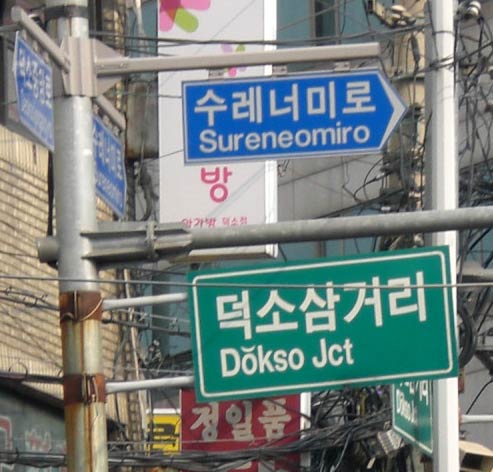
I’ve been doing so much on signage lately that I’ve been neglecting the issue of romanization. (Remember romanization?) Here’s something just in from South Korea, a country that rivals Taiwan in making a national pastime of screwing around with its romanization system.

The Ministry of Culture, Sports and Tourism and the Presidential Council on National Competitiveness on Wednesday discussed plans to make the Korean language more accessible worldwide, including working out a Romanization standard for family names, compiling a new Hangul dictionary with about 1 million entries, and building a Hangul cultural center.

The government will come up with standard Romanization for family names this year that will become mandatory for people when they apply for new passports and for government offices that use both Hangul and English on official documents such as birth records and residence registration cards.

In Taiwan, people can choose among romanization systems for the name on their passport. Employing romanization for Hoklo, Hakka, or a language of one of Taiwan’s official tribes is also permitted.

An earlier Romanization project for family names was suspended in 2000 due to controversy over exceptions. The new standard will cost a huge amount of money as the Romanized names of businesses, schools and individuals as well as road signs will have to be changed.

A new Hangul dictionary is to be compiled by 2012, adding a large number of words to the last official dictionary published in 1999, which has about 500,000 entries, and adding easy sample sentences.

Experts have said that the younger generation have trouble understanding the conventional dictionary, as there are too many difficult Chinese characters in explanations and definitions.

The government also plans to compile a multilingual web dictionary comprising about 20 different foreign language sections — such as Vietnamese-Hangul and Thai-Hangul — to help foreigners and Korean nationals overseas.

A Hangul cultural center, to be built at a cost of W35.2 billion [US$27.5 million] by 2012, is to give visitors hands-on experience of the Korean language.

source: Standard Romanization for Korean Names Planned, Chosun Ilbo, June 25, 2009

Photo of street signs in Namyangju, Gyeonggi-do (Namyangju, Ky?nggi-do) courtesy of Robert Badger.
korean_streetsigns

photos of and around Xindian City Hall MRT station

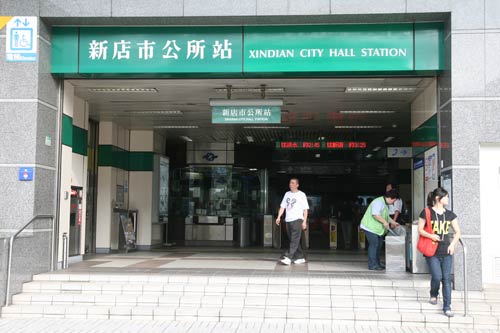
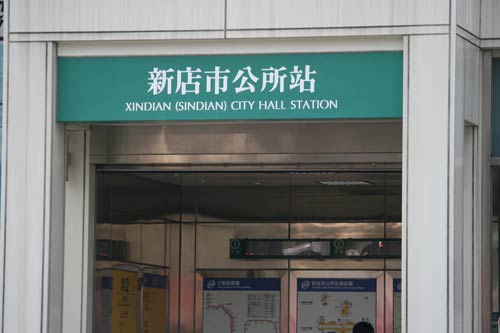
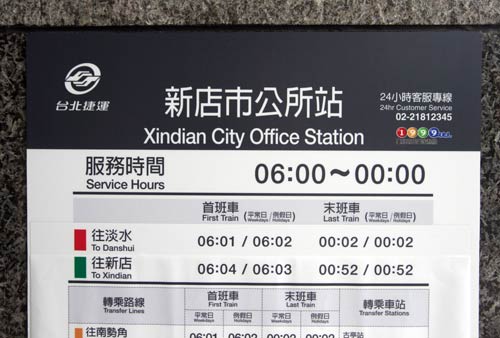
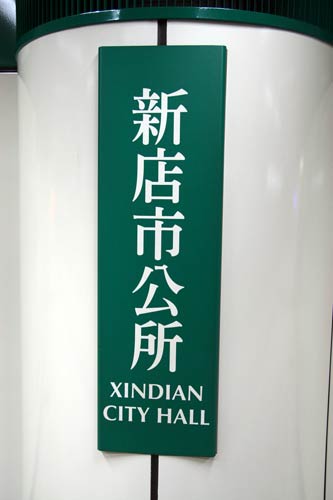
My friend David of David on Formosa kindly sent me lots of photos of the current signage at Xindian City Something-or-other Station. Here they are.

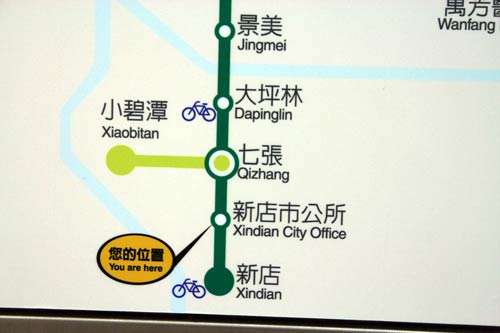
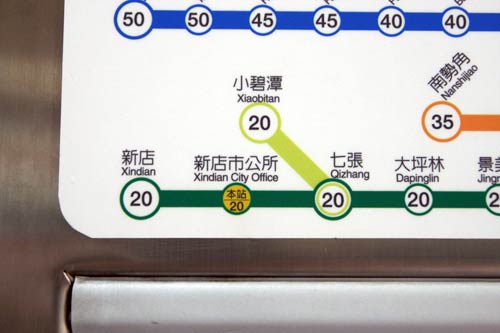
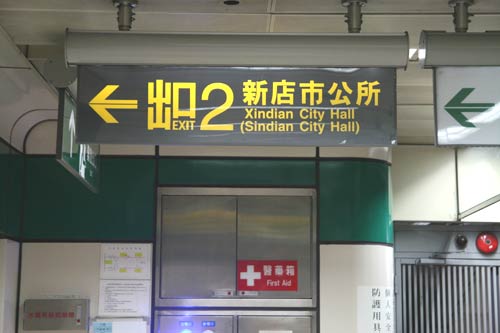
Note that some of the signage at the station itself gives the Tongyong Pinyin form (Sindian) as well as the Hanyu Pinyin form; but other signage does not. And the newest signs give Xindian City Office rather than Xindian City Hall.

MRT station main entrance, marked 'Xindian City Hall Station'

MRT station side entrance, marked 'Xindian (Sindian) City Hall Station'

Sign of things to come?
photo of station operation hours, with station name marked 'Xindian City Office Station'

sign on a pillar on the MRT platform reading 'Xindian City Hall'

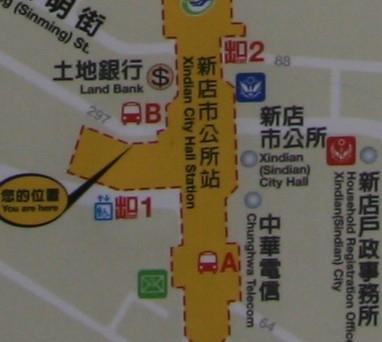
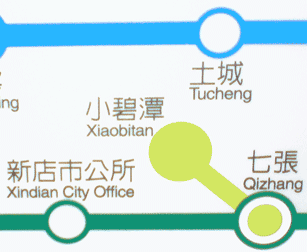
closeup of a new map on a station wall, with the station called 'Xindian City Office'

map_detail

exit2

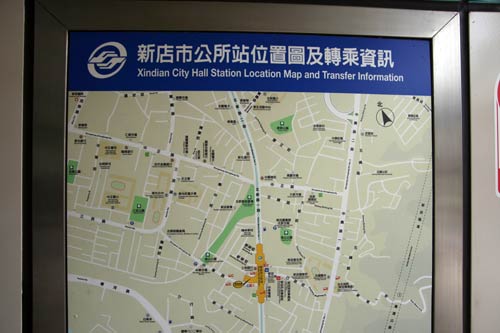
area_map

This closeup from the map above reveals that even city hall itself (not the MRT station) is labeled “City Hall.”

closeup from the photo above, as described

More than three years ago Taipei County Magistrate Zhōu Xīwěi (Chou Hsi-wei / 周錫瑋 / Zhou Xiwei) said that Taipei County should use the same romanization system as the city of Taipei (i.e., Hanyu Pinyin). But nothing has happened yet — not unlike his administration in general. So here we still see the Tongyong Pinyin form of “Sindian” rather than the Hanyu Pinyin form (now official at the national level) of “Xindian.”
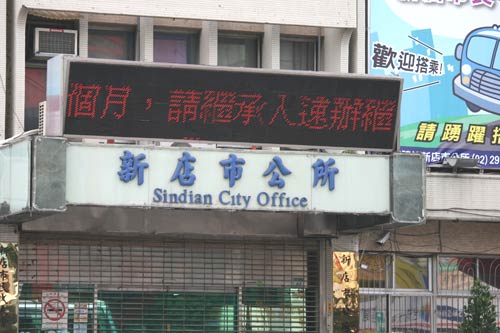
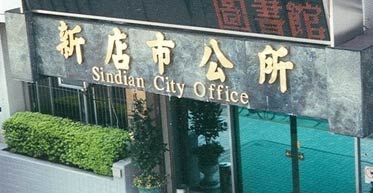
photo of Xindian City Hall (the actual building, not the MRT station). It's labeled 'Sindian City Office'

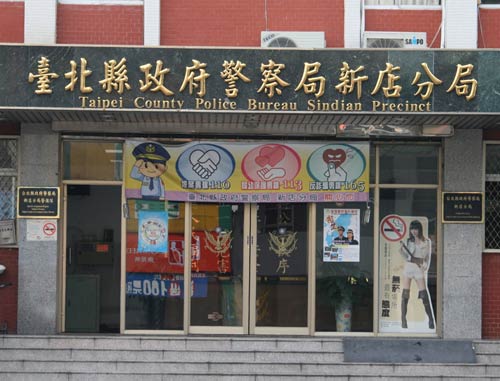
Taipei County Police Bureau Sindian Precinct

You can’t fight city hall, er, office

This follows up my previous post: new Taipei MRT stations and wordy names.

Although the MRT system resists fixing the mistakes in its station names — such as in wordy, unnatural English names or misuse of Hanyu Pinyin — that doesn’t mean it never changes a name. It does — and here I’m referring to things beyond the usual matter of romanization systems. In recent weeks a long-established MRT station name has been undergoing a quiet change. As this case reveals, however, it appears that the authorities have a rule that opposes change unless they want to take a perfectly good name and make it worse.

I recently complained about the needless and indeed counterproductive insertion of Taipei and Nangang into station names, such as in the case of adding “Taipei” to the English name of what in Mandarin is only “Nángǎng Zhǎnlǎnguǎn” (南港展覽館). But that’s not the only case of “Taipei” given in an English name that doesn’t have the city name included in Mandarin. Two more instances of this are “Taipei Zoo,” which in Mandarin is simply Dòngwùyuán (動物園), and “Taipei City Hall,” which in Mandarin is Shìzhèngfǔ (市政府).

First let’s examine the case of “Taipei Zoo.” The Mandarin name for this is simply the word for zoo: dòngwùyuán. So in English why not call this stop simply Zoo instead of Taipei Zoo? (There’s certainly no Xindian Zoo, Banqiao Zoo, Xinzhuang Zoo, Sanchong Zoo, etc., anywhere on the MRT system.)

There’s no clear answer. Although Hanziphiles love to proclaim “Just one Chinese character is enough,” the Mandarin language is most definitely not a monosyllabic one, especially when it comes to place names. (See, for example, Taipei street names and the monosyllabic myth.) So it’s possible that what’s happening here is the habits of Mandarin are being overwritten upon English.

Interestingly, in metropolitan Taipei most native Mandarin speakers, if they had to add a geographical distinction, would probably call this the Mùzhà Dòngwùyuán (木柵動物園) rather than the Táiběi Dòngwùyuán (台北動物園).

I’m more interested, however, in the case of “Taipei City Hall,” which in which in Mandarin is Shìzhèngfǔ (市政府) — again, no Táiběi. In this case adding “Taipei” makes sense because there really is another city hall stop on the MRT system: Xindian City Hall, which in Mandarin is Xīndiàn Shìgōngsuǒ (新店市公所).

Translated literally, shìzhèngfǔ is city government and shìgōngsuǒ is city administrative office. They have different names in Mandarin because of Taiwan’s somewhat convoluted governmental structure, a shìzhèngfǔ having somewhat greater autonomy than a shìgōngsuǒ. Nevertheless, in English both would usually be called simply city hall. Although New York City has hundreds of times more people than, say, Hays, Kansas (population 20,000), both places have a city hall … because usually that’s what cities have, regardless of their size or importance.

And for years the Taipei MRT has had a station named “Taipei City Hall” and another named “Xindian City Hall,” which is of course as it should be.

Unfortunately, however, Taiwan’s bureaucracy does not agree. The RDEC, keeper of the government’s bilingual stylebook for organizations, says that a shìgōngsuǒ is a city office, not a city hall, which is perhaps what has prompted the authorities with the MRT to change the perfectly good English name of “Xindian City Hall Station” to the distinctly worse “Xindian City Office Station.”

Basically, if there’s a discrepancy between how something is usually said in English and how some government official in Taiwan thinks it’s supposed to be said in English, real English loses. The same applies to Pinyin, whose clear and simple rules continue to be ignored here.

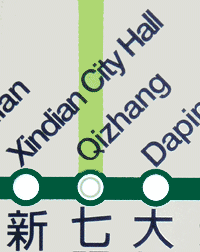
Both names — Xindian City Hall and Xindian City Office — can currently be seen on signage in the MRT system. The system maps next to MRT car doors have Xindian City Hall (see image at the left below). But the new long strips above the MRT doors (right) have Xindian City Office.

I expect Xindian City Hall to disappear soon.

Can anyone tell me what’s currently on that station itself?

xindian_city_hall xindian_city_office

photo of the front of Xindian City Hall, across the street from the MRT station. The sign reads 'Sindian City Office'

new Taipei MRT stations and wordy names

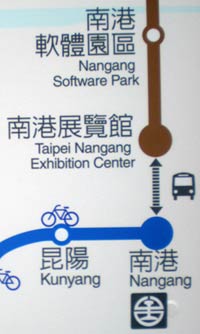
detail of a map of the Taipei MRT system, showing 'Nangang Software Park' and 'Taipei Nangang Exhibition Center' on the brown line, connected by bus to 'Nangang' on the blue lineTaipei will soon open a dozen new stations on its mass-transit system, the MRT. Most of the stations will be in the relatively newly developed district of Neihu, with a couple in the Nangang district. It’s the latter two stations I want to focus on:

  • Nangang Software Park
  • Taipei Nangang Exhibition Center

Basically, these names suck.

The most obvious problem is that they both are unnecessarily long, which is not a negligible consideration for not only signage but also the MRT’s announcement system, which is in four languages: Mandarin, Hoklo, Hakka, and English. (It takes a while to get through all of those.)

Also, “Nangang Software Park” (Nángǎng Ruǎntǐ Yuánqū 南港軟體園區)? There is no other software park around the MRT system. Just “Software Park” would work better as a name for the station. Accurate, but also short, simple, and distinctive — just what such a name should be.

BTW, this software park is the source of the name for Taipei’s still-not-corrected Park Street signs.

Worse still is “Taipei Nangang Exhibition Center”. First, calling it even “Nangang Exhibition Center” would be bad enough for the same reason that “Nangang Software Park” is unnecessarily wordy: there’s no “exhibition center” anywhere else on the system.

But “Taipei Nangang”? Ugh. That may work in Mandarin, but it’s lousy English. It follows the same unnaturally inverted pattern and redundancy that gave us “Taiwan Taoyuan International Airport,” or, as I like to call it, Chinglish International Airport. (But I do like it better than “Revere the Dictator Chiang Kai-shek International Airport.”)

Here’s a photo of the exhibition building itself (not the MRT station — though those are the MRT tracks behind the barrier in the foreground).

taipei_nangang_exhibition_center

So “Taipei Nangang Exhibition Center” probably is the official name of the complex. But that really doesn’t matter because (1) the MRT station certainly does not have to have the exact same name and (2) the name is just plain stupid.

Above, I mentioned that names for MRT stations should be “accurate, but also short, simple, and distinctive.” Sticking “Taipei Nangang” in front of “Exhibition Center” makes the name clumsy and less distinctive, especially since the two MRT stations closest to “Taipei Nangang Exhibition Center” are called “Nangang” and “Nangang Software Park”.

Nangang, Nangang, Nangang — yeah, we get it: They’re in Nangang.

Perhaps the MRT would like to change other names to be similarly useful. For example, instead of “Chiang Kai-shek Memorial Hall” we could have “Taipei Zhongzheng Chiang Kai-shek Memorial Hall;” and in place of, say, “Xindian City Hall” we could have “Taipei County Xindian Xindian City Hall.” (More about the Xindian City Hall station in another post.)

But perhaps those names aren’t nearly informative enough. According to the MRT’s way of thinking, people might still be confused about the location. How about, say, “Planet Earth Northern Hemisphere Asia East Asia Taiwan Taipei Zhongzheng Chiang Kai-shek Memorial Hall” and “Planet Earth Northern Hemisphere Asia East Asia Taiwan Taipei County Xindian Xindian City Hall,” etc.?

I’m happy to report that even the MRT seems to have some reservations about ridiculously long names — at least when those names are in Mandarin. Note the photo of part of the route map (top right of this post). The Mandarin name for “Taipei Nangang Exhibition Center” is Nángǎng Zhǎnlǎnguǎn (南港展覽館), not Táiběi Nángǎng Zhǎnlǎnguǎn (台北南港展覽館). (I didn’t crop any characters from the left of the station name.) So why is “Taipei” in the English version but not in the Mandarin one? Does the city government believe that foreigners are so stupid that they fail to comprehend that the Taipei MRT system is indeed in the Taipei metropolitan area? If so, then maybe they should be giving consideration to my idea of putting at least “Planet Earth Northern Hemisphere Asia East Asia Taiwan Taipei” in front of all the names in the city of Taipei. This could come in in several versions:

  • “Planet Earth Northern Hemisphere Asia East Asia Taiwan, Republic of China, Taipei” — for pan-blue traditionalists
  • “Planet Earth Northern Hemisphere Asia East Asia Taiwan, which is really a country and not a part of China, Taipei” — for the pan-green crowd, and
  • “Planet Earth Northern Hemisphere Asia East Asia China Chinese Taipei Taipei” — for the unificationists and those who like to “q?n Zh?ngguó

Then administrations could have fun changing from one system to another, depending on who was in power.

There’s more to say about this topic (e.g., how the names of stations such as Taipei Zoo, Taipei City Hall, and Xindian City Hall Office do or don’t fit into this pattern). But I’ve already written enough for one post.

And in case anyone is wondering: Yes, I have brought my concerns to the attention of the officials of the MRT. They don’t care. Does anyone have contacts in the media or with politicians?
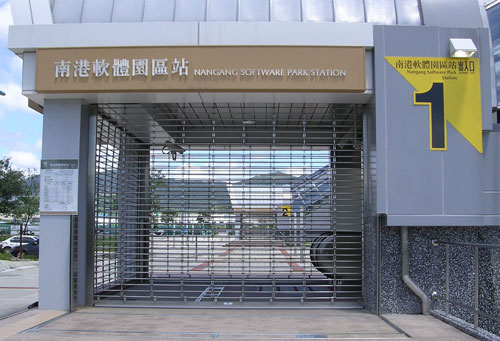

photo of an entrance to the 'Nangang Software Park Station'

common newbie errors in Pinyin: YAN

Today’s post is something for those who are relatively new to Pinyin and Mandarin. It covers something I’ve received more than one query about.

Hanyu Pinyin is quite simple. But it still has a few points — beyond the usual caveats about x, q, c, and zh — that sometimes trip up introductory students of Mandarin. One of the most common of these is the syllable yan.

Lots of Mandarin learners tend to pronounce this as if it were yang — but with an n on the end instead of an ng. But it’s properly pronounced much like the English pronunciation of the name of the Japanese currency: yen. Thus, yen for yan is a common misspelling.

Yet yan is a perfectly regular spelling within the Pinyin system. What’s more: Pinyin doesn’t have anything spelled yen.

Remember that when an i comes at the beginning of a syllable, it is written y (or yi, if there is no vowel immediately following). Thus,

yan = ian

I stress this because relatively few people get any of the following related syllables wrong:

  • bian (as in former Taiwan president Chen Shui-bian)
  • pian (as in pianyi / cheap)
  • mian (as in chaomian / fried noodles)
  • dian (as in dianhua / telephone)
  • tian (as in tianqi / weather)
  • nian (as in nian / year)
  • lian (as in buyao lian / shameless)
  • jian (as in zaijian / good-bye)
  • qian (as in qian / money)
  • xian (as in xiansheng / mister)

Now try reading these:

  • yanjing / eye
  • yanjing / glasses
  • chouyan / smoke (verb)
  • yuyan / language
  • yanse / color
  • keyan / scientific research
  • It’s easy!

    further reading:
    combinations of initials and finals in Hanyu Pinyin/span