
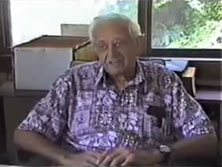
John DeFrancis video

John DeFrancisTen years ago John DeFrancis was awarded the Chinese Language Teachers Association’s first lifetime achievement award. Since he could not be present at the association’s annual conference to receive the award, he sent a videotape of a 12-minute acceptance speech. The video was recently edited down to 6:27 and uploaded to YouTube: John DeFrancis remarks.

Here’s my summary of the main points:

0:00 — While working on what he intended to be a largely political study of Chinese nationalism, DeFrancis encountered references to people who wanted China to adopt an alphabetic writing system, an idea which he initially dismissed. But discovering Lu Xun’s interest in romanization led him to investigate the matter further. [I’m frustrated by the cut away from this discussion. Perhaps a fuller version of the video will be posted later.]
1:30 — Emphasizes he’s not in favor of completely abandoning Chinese characters. Rather, he favors digraphia.
2:30 — “I’d like to mention three aspects of the Chinese field which have interested me.”

  1. pedagogy (2:50) — lots of advancements
  2. linguistic aspect (3:20) — that’s also progressing well
  3. socio-linguistics (3:52) — the field isn’t doing as well as it should be

5:00 — computers and Chinese characters. DeFrancis tears into the Chinese government for its emphasis on shape-based character-input methods rather than Pinyin.

letters with diacritics: a roughly alphabetical chart

þ

For those who don’t know an ogonek from a retroflex hook — and sometimes for those who do — finding a needed letter with a diacritical mark can be a time-consuming process. (I look forward to the days when combining marks are much better supported.)

So I made a chart with lots of — but certainly not all — diacritics, sorted alphabetically by appearance as well as name and sound. That means, for example, that a thorn (þ) can be found under p as well as under t (as in th), even though — I know, I know — p and þ are unrelated.

Perhaps some people will find it quicker to use than going through the various Unicode charts or searching through various other charts in which the letters are grouped by sound rather than appearance. Someone has probably already made one of these, and done a better job. But I didn’t have any luck finding it before hacking out my own.

Here it is, for what it’s worth: letters with diacritical marks, grouped alphabetically.

I hope some people find it useful.

Ma administration still undecided on how to teach Taiwanese

Under the new administration of President Ma Ying-jeou, Taiwan’s Ministry of Education has worked out its plan for teaching pretty much everything … except for Hoklo (the language better known in these parts as “Taiwanese”). There have been a lot of arguments. How early to start teaching the language? How much should be taught? Use romanization? Use zhuyin? May teachers use any kind of soap or only special kinds when washing out the mouths of students speaking the language? (OK, they don’t do that last one anymore.)

So the ministry has decided to appoint a new committee to review such questions. Decisions on these issues are expected in six months or so.

My guess would be that the ministry is going to pack the new committee with conservatives who will see to it that romanization is avoided or at least belittled, that little of the language will actually be taught, and that students will not be tested seriously on the subject. But I’ll be happy if I’m wrong.

sources:

Kyrgyzstan won’t switch to Roman alphabet yet: report

High-ranking Kyrgyz officials are now reportedly saying that having Kyrgyzstan switch from the Cyrillic to the Roman alphabet would cost more money than the country can afford for the project at present. A later switch has not been ruled out.

sources:

Kyrgyzstan may join trend, adopt the Roman alphabet

Asel translates and summarizes remarks by Tashboo Jumagulov (Ташбоо Жумагулов), chairman of Kyrgyzstan’s state language commission, and Kyrgyz legislator Zainidin Kurmanov (Зайнидин Курманов) on the possibility of Kyrgyzstan switching from the Cyrillic to the Roman alphabet, which was recently discussed in the Kyrgyz parliament.

Both Jumagulov and Kurmanov seem to regard the switch as inevitable, though the latter voiced concern that the switch is done carefully and not rushed.

Kyrgyzstan is not to be confused with its neighbor, Kazakhstan, which has been seesawing on its own proposed switch to the Roman alphabet.

sources:

On Kazakhstan’s proposed switch:

more Dungan

Since earlier this month when I wrote a post on Dungan-language radio, I’ve discovered that Olli Salmi has some great Dungan material on his website, including a paper he wrote and a couple of stories in Dungan, including one he has translated into English.

And for lagniappe he offers “An Unofficial Practical Orthography for the Kiowa Language.”

Mandarin borrow-ing English grammatical forms

click for image of complete campaign poster; the slogan, shown in this image, reads '台灣維新ing'Putting English words in Mandarin sentences is of course extremely common in Taiwan and elsewhere in Asia, generally because this is thought to look cool and modern. But last month I was surprised to see Mandarin sentences with just English’s -ing added — and not one but two examples of this.

The image here is from a poster for the DPP’s presidential candidate, Frank Hsieh, that came out in March but which I didn’t see until a few days ago. It reads 台灣維新ing (“Táiwān wéixīn-ing“): “Taiwan is modernizing.” (Click the image to see the whole poster.)

The other example I noticed was in a newspaper headline about the Hong Kong pop diva Faye Wong: 明年拚老三 天后暫不復出 李亞鵬王菲 積極做人ING (Míngnián pīn lǎosān — tiān hòu zàn bù fùchū — Lǐ Yàpéng, Wáng Fěi jījí zuòrén-ing. “Next year work hard to produce third child — superstar temporarily not appearing — Li Yapeng and Faye Wong are energetically working on making a baby.”)

There are several other interesting things about the Faye Wong headline, such as the way in most other contexts zuòrén (lit. “be/make a person”) means something like “be a mensch.” But I don’t want to digress too much lest I never finish this post.

In both of these examples, -ing is used to emphasize the currentness of the actions. But it is of course possible in Mandarin to stress that something is going on now — and to do so without borrowing forms from English. For example, with zài:

  • Lǐ Yàpéng, Wáng Fěi jījí zài zuòrén
  • Táiwān zài wéixīn

Has anyone seen or heard other examples of this -ing grafting?

sources:

For lagniappe: lyrics to the Faye Wong song “Bù liú” in Pinyin, which has lots of examples of Mandarin’s .

Dungan-language radio

The state radio station of Kyrgyzstan offers a weekly broadcast in Dungan, which is basically a spin-off of northwestern Mandarin with lots of loan words from Persian, Arabic, and Russian. Of particular interest is that the language — which, permit me to note again, is basically Mandarin — is written with an alphabet (at present, one based on the Cyrillic alphabet). Chinese characters are of course not necessary and are not used. For details of the language, script, and people, see Implications of the Soviet Dungan Script for Chinese Language Reform, by Victor H. Mair, and Ethnolinguistic Notes on the Dungan, by Lisa E. Husmann and William S-Y. Wang (available online in Schriftfestschrift: Essays in Honor of John DeFrancis on His Eightieth Birthday, pp. 71-84).

The Dungan radio show is broadcast on Mondays between 6:35 and 7:05 p.m., Taipei time (4:35-5:05 a.m. U.S. central standard time). The show usually starts closer to 6:40 and ends about 7:03.

I made a recording of the latest broadcast (Dec. 31, 2007): Dungan radio broadcast (23 MB mp3).

[Here’s another: Dungan radio broadcast, January 14, 2008 (23 MB mp3).]

I mainly understand words, not entire sentences, though my comprehension improves a little with repeated listenings.

This Kyrgyz radio station (Кыргызское радио) is available through at least three different Internet links:

  1. www.radio.kg/RadioKTR.asx
  2. www.radio.kg/RadioKTR.ram
  3. mms://212.42.102.212:8554/RadioKTR, which is what you get by using the “Kyrgyz radio” link on the Web site for the State Broadcast Company of the Kyrgyz Republic

I have had the best luck with link no. 1.

I made the recording with Total Recorder for Windows and edited it in Audacity.

I’ve heard that Mac users can get good results with Audio Hijack.